Announcing our next conference: The Power and Promise of Biodiversity: Visions of Restoring Land, Sea and Climate, April 30, 2016, Harvard University

Videos and slideshows:Restoring Water Cycles to Reverse Global Warming!
We now have five highly successful conferences behind us on the road to restoring ecosystems to reverse global warming. Check them out!
Our Work: Restoring Ecosystems to Reverse Global Warming

Biodiversity for a Livable Climate brings you information about decades of scientific research and the practical experience of land managers around the world. We work to remedy the information gap in mainstream climate advocacy which tells us that virtually the only practical effective action we can take is to reduce fossil fuel emissions. There is another way. One foundational approach is Holistic Management as applied to billions of acres of grasslands worldwide, where soils have the potential to store enough carbon to reduce atmospheric carbon concentrations significantly. In addition, we are fully supportive of reforestation, ocean regeneration and other restorative endeavors, all of which return essential health, climate stability and diversity to the biosphere.
Primarily based in the physical sciences, climate scientists generally do not yet recognize what life scientists and ecologists have long known: the power of life has molded almost every aspect of the physical earth, including the climate. Wise human management of the biosphere can undo the eco-mess we have created, and regenerate a planet that we can live on.
While reducing emissions is of critical importance, there is far more that we can and must do, especially considering that emissions reductions efforts have to date been insufficient and even if emissions were to go to zero today, we would still be faced with catastrophic effects of climate change.
According to the 2013 Intergovernmental Panel on Climate Change (IPCC) report:
A large fraction of anthropogenic climate change resulting from CO2 emissions is irreversible on a multi-century to millennial time scale, except in the case of a large net removal of CO2 from the atmosphere over a sustained period . . . (p. 26, emphasis added)
We have lost far more carbon to the atmosphere from soil disruption since the beginning of agriculture than we have added by burning gas, coal and oil. We must do something else: Through eco-restoration and regenerative agriculture, we can take gigatons of carbon out of the atmosphere and put it back into the ground.
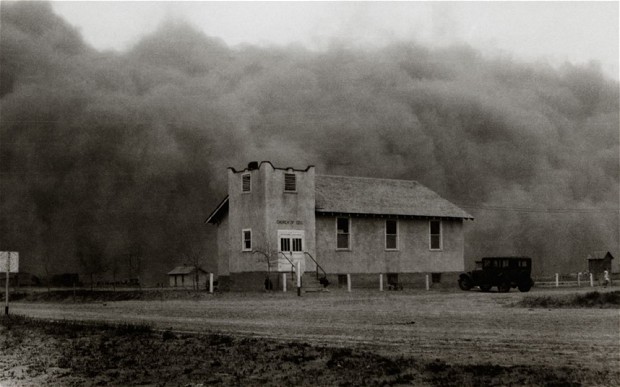
The American Dust Bowl, 1930s. Tons of carbon are moving from formerly healthy soils to the atmosphere. Since the beginning of agriculture, worldwide soil degradation from farming, deforestation and other human activities has caused greenhouse gas pollution that rivals that currently in the atmosphere.
We know now that the safest and most effective approach to reducing atmospheric carbon is to capture it with millions of species of green plants, animals, insects, fungi and micro-organisms, which bury it deep in soils in carbon-rich molecules that are stable for centuries or longer. In the process, because complex organic carbon molecules retain many times their weight in water, we restore vibrant life to billions of acres of parched, desertified areas that were once healthy forests or grasslands.
There’s more good news: with biodiversity and eco-restoration we can unite people, organizations and governments, even those who have been fighting and maneuvering for advantage for decades. Everyone will agree that a magnificent stretch of wooded hills or green fields of grasses full of life are preferable to those rendered parched, cracked, barren and lifeless due to human misuse. Therefore, the mission of Biodiversity for a Livable Climate is to promote seeing the world in wholes to re-establish biodiversity and the water cycle, store carbon in the soils, maximize photosynthetic solar energy capture, eliminate bare soils and reverse global warming by applying regenerative approaches to the land worldwide. 

Site in the Chihuahan Desert in Mexico before and after restoration with Holistic Planned Grazing. There is roughly six times more water captured in the ground by plants (bottom photo) than there was in the artificial pond (top photo).
==========

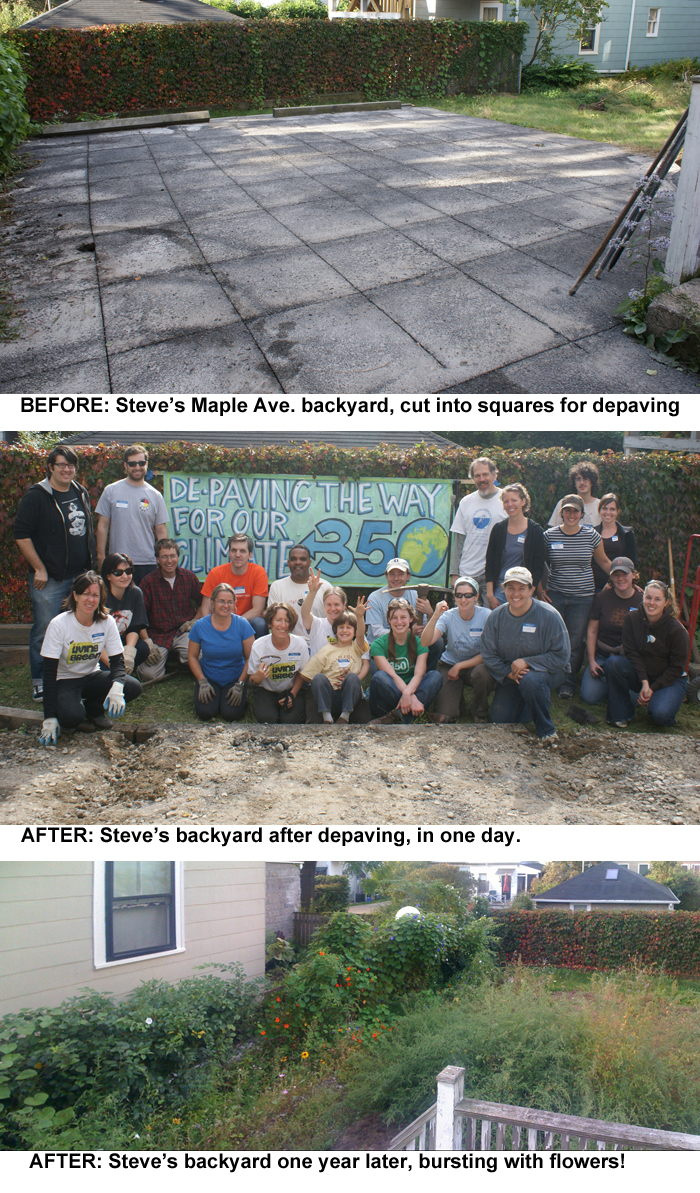
Above: Depaving in an urban environment (Somerville, Massachusetts) to recreate healthy soils. Carbon dioxide, along with water, is the basic and primary building block of plants. Now that the asphalt is gone, all the carbon you see as leaves and flowers is carbon that’s no longer polluting the atmosphere and causing a greenhouse effect.
Contact: info (at) bio4climate.org

 To pull carbon out of the atmosphere and sequester it in soils, we need to restore biodiversity: that’s the foundation of the whole show. One of the most important visible elements from the perspective of ecosystems is to cover bare ground. Bare ground doesn’t absorb water, it breaks the water cycle, it interferes with the moderating effects of moisture on planetary temperature, it kills soil life, it fails to create carbon storing molecules created by green plants, fungi and microbes. This is less obvious in the relatively wet northeast than in the dry west, but still a real problem here.