
By Judith Schwartz, Advisory Board Member and author of Cows Save the Planet
With a record drought in California, floods in the UK and snow paralyzing areas of the South that have hardly met a plow, people are starting to make the connection between climate change and water. But generally the cause-and-effect link only goes one way, noting how climate change will affect water by putting stress on global water sources while parts of the world get soaked. This is a real concern. But we’re not seeing the other part of the picture: the effect that water can have on climate. You see, water in its various forms is an important thermoregulator of climate. By working with the water cycle—most basically by keeping water on the land in soil and vegetation—we can address climate changes locally, regionally and even beyond.
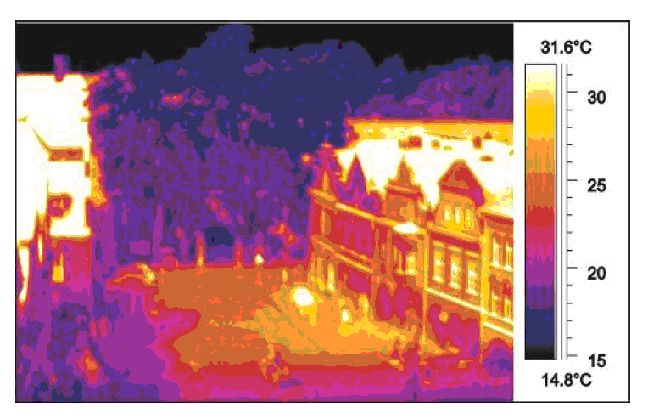 Photograph of the square and adjacent park in Trebon, Czech Republic, taken with a thermal camera. The differences in temperatures between the vegetation, facades and roofs of the houses – from 15°C (59°F) to 30°C (86°F) – are visible.
[From New Water Paradigm, p. 33]
