
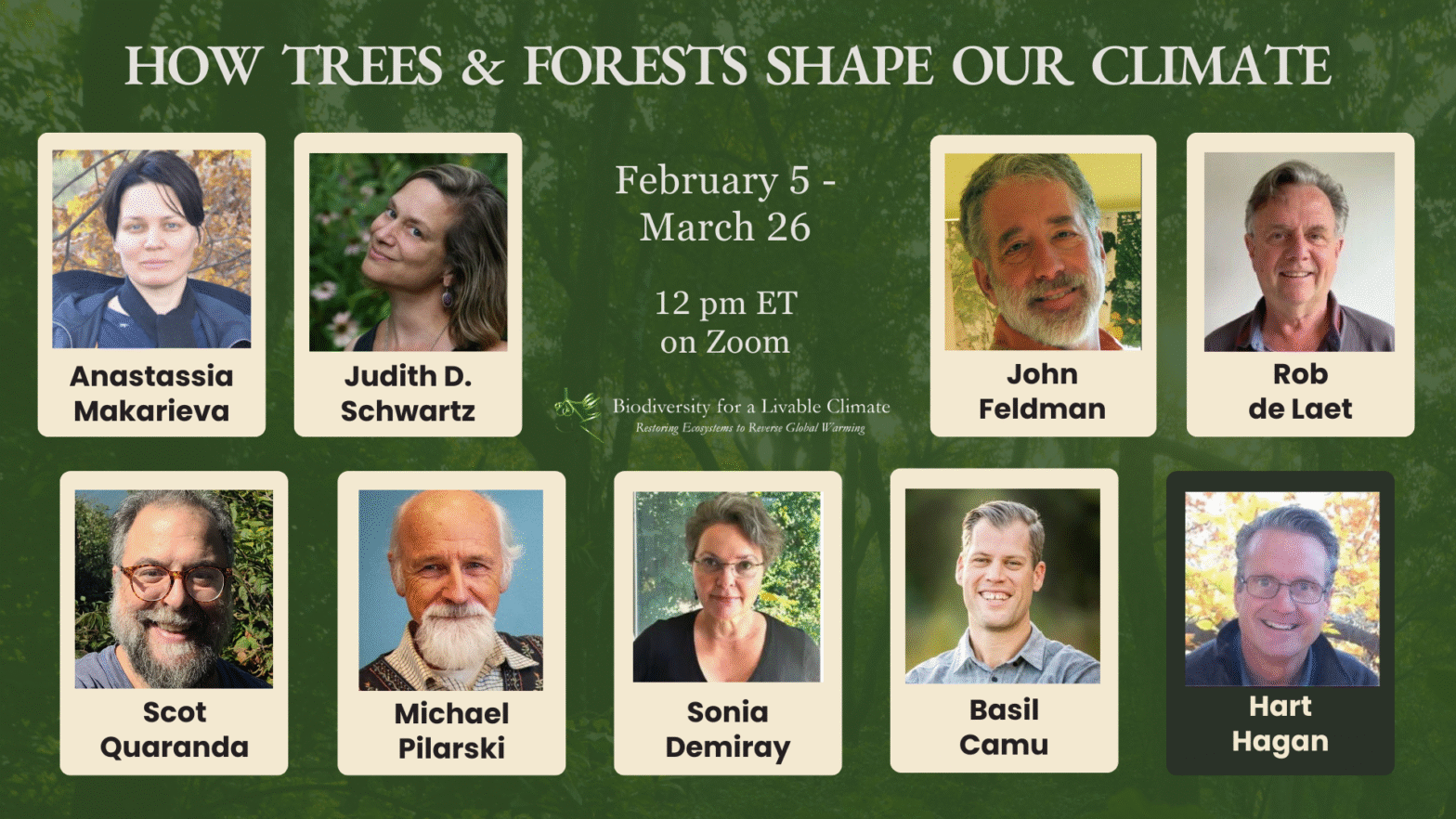
How Trees & Forests Shape Our Climate
How trees and forests interact with wind, water, wildlife and carbon to cool our climate and bring rain
February 5 – March 26, 2026
Thursdays — 12:00 Noon ET
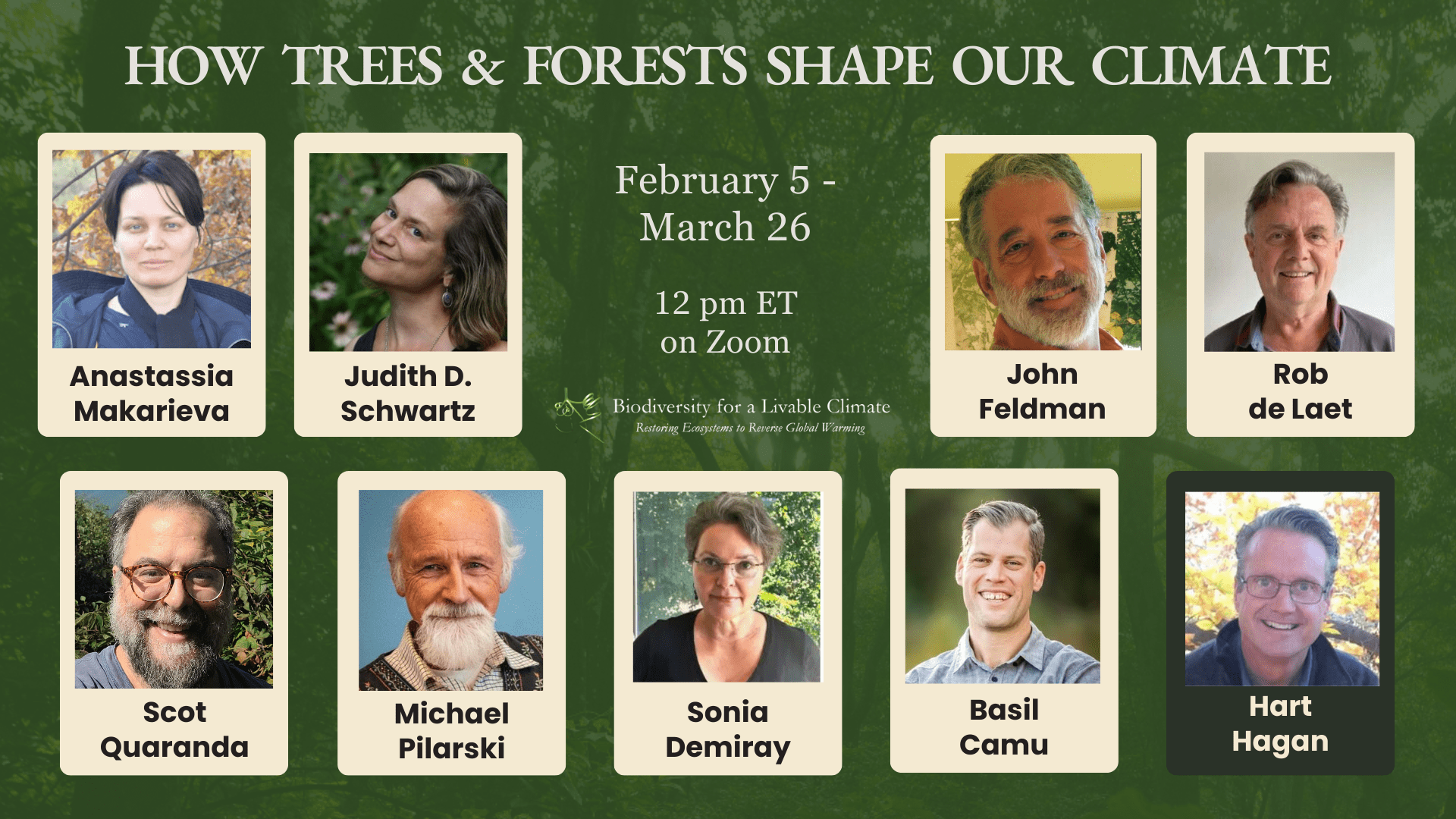
Featured Guest Speakers
Anastassia Makarieva, PhD – February 5
Judith D. Schwartz – February 12
John Feldman – February 19
Rob de Laet – February 26
Scot Quaranda – March 5
Michael Pilarski – March 12
Sonia Demiray – March 19
Basil Camu – March 26
Registration is now closed.
Sign up here to receive invitations to
our upcoming courses.
Recently, Brazilian forest advocate Antonio Nobre wrote: “Deforestation is climate action’s blind spot.”
He continues: “Since 2023, extreme weather events have shattered most model projections of the Intergovernmental Panel on Climate Change. Meteorologists are grappling with this new reality. Standard climate models were designed for a stable world that we have irrevocably left behind. But wait, there was a crucial omission. The dynamic land-atmosphere water cycle — powerfully mediated by living forests — has inexplicably been relegated to a mere footnote in the carbon story.”
This “dynamic land-atmosphere water cycle” is only one of many ways in which forests provide benefits to our climate, our fellow species and our society. And yet, deforestation in the United States continues at record levels.
In this course, instructor Hart Hagan will examine the ways in which trees and forests benefit our climate, while preventing flooding and drought and also providing habitat for a myriad of wildlife species. Hart brings his unique perspective and values to an exploration of the false notions, narratives and mythologies that are used to justify cutting down trees.
Participants will engage with a range of highly qualified experts, and we will ask and answer questions like these:
- What are the mechanisms within forests that cool our climate—through shade, water evaporation, water cycling, and sponge-like absorption that prevents floods, droughts, wildfires and extreme heat?
- What role do microbes, fungi and wild species play in the climate-regulating mechanisms of a forest?
- What is the difference between a forest and a tree plantation?
- What is the extent of logging in North America?
- How do we choose between a forest and a solar array?
- When is logging justified for solar installation?
- What’s the deal with biomass logging, and who benefits?
- What is forest thinning, and when is it recommended?
- Should we promote post-fire logging? Why or why not?
- How to identify timber industry propaganda
- How to protect wild species such as owls and woodpeckers
- What is the catastrophic wildfire narrative? How is it harmful and misleading?
- Under what circumstances do fires burn at higher intensity? What are the factors, and what can we do?
- When is wood the best building material, and when should we search for substitutes?
- Who are some of the leading experts whom we can trust for guidance?
- What can we do as a community to safeguard and restore our forests?
This will be a nuanced exploration of how to respect our forests while pushing back against false narratives that call for clearcutting, thinning, logging, burning and spraying.
Major issues to be addressed:
Learning how our forests work as ecosystems
In this course, you will learn what constitutes a healthy, high functioning forest ecosystem, which is biologically diverse, with many bees, butterflies, birds and small mammals, all of which require insects and their larvae, which in turn require a variety of native trees and dead wood.
Dead wood
We will explore the untold story of dead wood. Did you know that a dead tree is home to more species than a living tree? We will explore the value of dead wood—and why it’s important not to remove it from a forest— since it’s a source of food, water and shelter for myriad insects, birds, mammals and amphibians.
How caterpillars infuse energy into the forest ecosystem
We will learn the surprising importance of caterpillars, and the trees that support them. Did you know that just one pair of Carolina chickadees, each weighing ⅓ oz., require 6,000 caterpillars to raise their young in the spring? If you need 6,000 for one nest of baby chickadees, how much more do you need to support North America’s 2,000 bird species?
Wildfires
We will explore the causes, solutions and mythology around wildfires. We will discuss how homeowners can keep themselves and their homes safe and protected. We will look at the benefits of natural wildfires and the limitations of “prescribed burns.” Did you know that the black-backed woodpecker and the spotted owl are specifically adapted to thrive in a forest after a wildfire? The same is true of Melanophila beetles.
Timber industry talking points
We will study timber industry “talking points” so that we can identify them in the media. The timber industry uses terms like “fuel reduction” and “forest thinning” to extract the least flammable trees under the guise of wildfire prevention.
Biomass energy
The “biomass energy” industry cuts down our forests and burns them in place of coal. This is neither clean nor energy efficient. Nor is it smart from a carbon standpoint. Quite the opposite.
Registration is now closed.
Sign up here to receive invitations to
our upcoming courses.
What’s Included in the Course
- Live classes every week! A 90-minute class is hosted live each week on Zoom over 8 weeks
- Recordings of each class are made available weekly
- Expert guest speakers share their research and experience in select classes
- Talk directly with our expert speakers live on Zoom
- Membership in a private email group to ask questions, share resources and stories, and build connections within our like-minded community
- Advocacy coaching for you to be effective in your community
- Resources you can use to help decision makers create truly effective climate action plans
Reserve your spot today!
Guest Speakers
Anastassia Makarieva graduated from Leningrad Polytechnic Institute, Faculty of Physics and Mechanics, in 1996 and obtained her PhD in atmospheric physics from St. Petersburg State University in 2000. Since 1996, she has been working in the Theoretical Physics Division of Petersburg Nuclear Physics Institute investigating the life-environment interactions in the framework of the biotic regulation concept founded by Prof. Victor Gorshkov. In co-authorship with V.G. Gorshkov, Anastassia formulated the concept of the biotic pump of atmospheric moisture highlighting key ecological feedbacks on atmospheric moisture transport (2007) and, in cooperation with an international team of colleagues, demonstrated the existence of life’s metabolic optimum (broadly universal rate of energy consumption across life’s kingdoms) (2008). Combining theoretical work with field observations, Anastassia spent over sixty months doing forest research in the Russian wilderness. Her current research interests focus on deepening the physical understanding of ecosystem feedbacks on the water cycle and moisture transport.
To review her important work, visit Biotic Regulation.
February 5 — 12:00 noon ET
Judith D. Schwartz is an author and journalist known for illuminating scientific ideas through compelling stories that reveal the cultural, ecological, and economic dimensions of global challenges. Her work focuses on nature-based solutions, drawing insight from how living systems heal land, restore water cycles, and rebuild resilience. Judith writes for publications such as The American Prospect, The Guardian, Scientific American, Discover, and Yale E360, and speaks internationally on restoration ecology and regenerative approaches to climate and landscape repair.
She is the author of several influential books, including Cows Save the Planet, Water in Plain Sight, and The Reindeer Chronicles, a global journey through successful ecosystem restoration efforts from Norway to Hawai‘i to New Mexico.
Judith holds degrees from Brown University (B.A.), the Columbia Graduate School of Journalism (M.S.J.), and Northwestern University (M.A. in Counseling Psychology). She lives in southern Vermont on the side of a mountain with her husband, author Tony Eprile, and enjoys cross-country skiing, gardening, and training in Uechi-Ryu karate, in which she holds the rank of Sandan.
Learn more at: JudithDSchwartz.com
February 12 — 12:00 noon ET
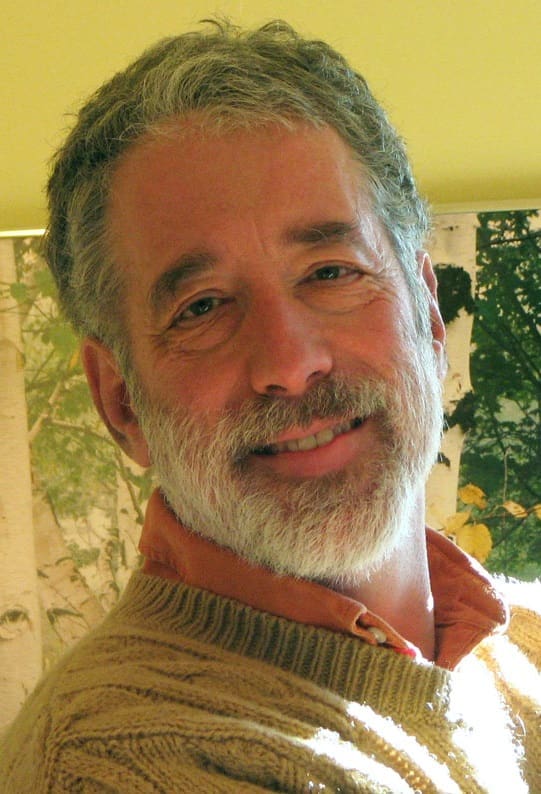
John Feldman is a highly original and critically acclaimed filmmaker who works as a writer, director, cinematographer, and editor. His career spans over 40 years and covers a wide range of genres, including independent dramatic feature films, documentaries, experimental shorts, and educational films.
Feldman’s recent film Regenerating Life, How to cool the planet, feed the world, and live happily ever after (2023) looks at the climate crisis from an ecological perspective. Screening globally, it is translated into 11 languages. “John Feldman’s film is a masterpiece in which he puts life, in terms of healthy ecosystems, centre-stage as the Earth’s extraordinary global-temperature regulator. (Peter Bunyard, The Ecologist Magazine, UK).
Symbiotic Earth: How Lynn Margulis Rocked the Boat and Started a Scientific Revoultion (2018), “is a vivid portrait of a bold scientist who took us to an understanding of evolution very different than any previous one. This film represents an effervescent intelligence leading the way to a revolution in understanding life on Earth.” (Thomas Lovejoy, Professor, George Mason University, known as “The Godfather of Biodiversity”)
Learn more about John and his work at: Humming Bird Films.
February 19 — 12:00 noon ET

Rob de Laet is the founder of Cooling the Climate and a climate strategist and co-author of Cooling the Climate – How to Revive the Biosphere and Cool the Earth Within 20 Years. He is the project lead for the Cooling the Climate Amazon Rainforest Project and works in collaboration with organizations including the Global Evergreening Alliance and the EcoRestoration Alliance.
Born in the Netherlands in 1956, Rob is a world traveler, serial entrepreneur, philosopher, and climate activist. He has built an international ecotourism company with partnerships in seventeen countries and is actively involved in rewilding degraded areas of the Brazilian Amazon. His work focuses on preventing the dieback of the Amazon Rainforest by strengthening the biotic pump and restoring natural water cycles.
As a principal member of the EcoRestoration Alliance and a fellow of the Global Evergreening Alliance, Rob is developing the Cooling Climate Chaos project alongside Peter Bunyard and others. Working from a Lovelockian Gaia perspective, he advocates for rapid action to restore Earth’s metabolisms through biosphere regeneration and water cycle restoration, emphasizing the urgent need to avert critical tipping points affecting the Amazon Rainforest, ocean biology, and Arctic sea ice.
You can read more about Rob and his work at: Cooling the Climate.
February 26 — 12:00 noon ET
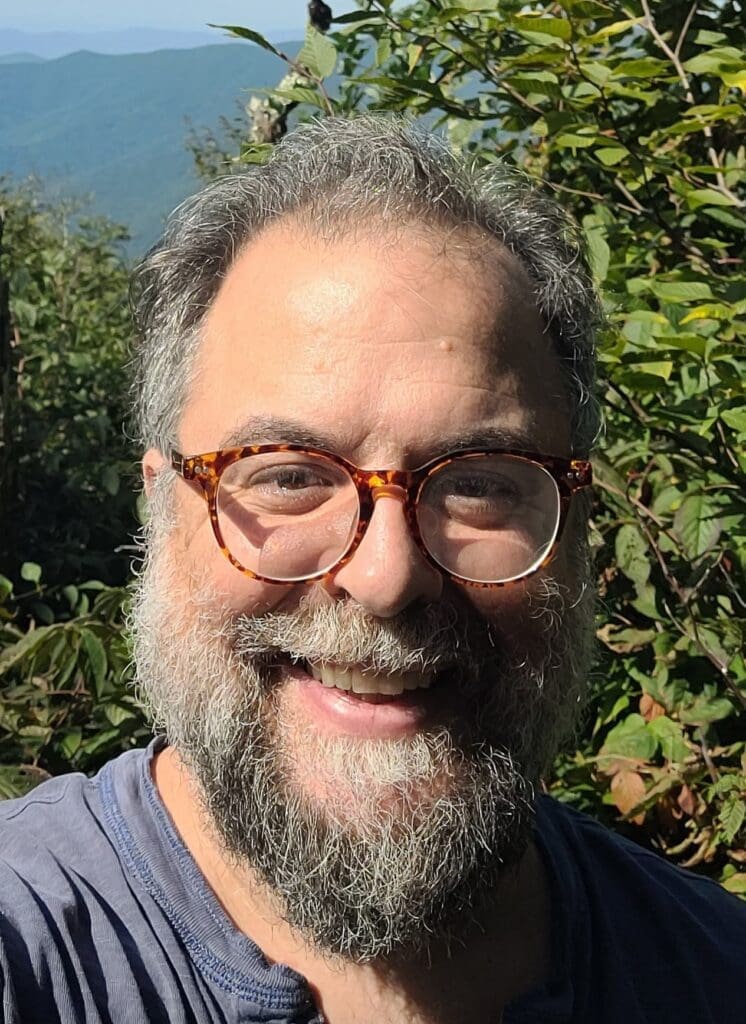
Scot Quaranda has been a driving force at Dogwood Alliance since 2000, serving in roles ranging from campaign organizer to field director to campaign director, and now Communications Director. For nearly 25 years, he has shaped the organization’s storytelling, creative strategy, media relations, and public communications—helping bring national attention to the urgent need to protect Southern U.S. forests and the communities who depend on them.
Dogwood Alliance is a leading environmental organization working across the Southern United States to end destructive industrial logging practices, advance climate-smart forest protection, and support frontline communities disproportionately affected by deforestation and biomass expansion. Through policy advocacy, grassroots organizing, and powerful communication campaigns, Dogwood Alliance challenges corporate forestry interests and champions ecological integrity, environmental justice, and community resilience.
Scot’s professional background blends advocacy and creative communication. Prior to joining Dogwood Alliance, he worked with the Fund for Public Interest and in music public relations, representing artists such as Buddy Guy and Ani DiFranco. He holds dual bachelor’s degrees in Psychology and Philosophy from Drew University.
With decades of experience at the intersection of environmental policy, storytelling, and movement-building, Scot brings a seasoned perspective on how communication can shift public narratives and drive meaningful forest protection.
Listen to Scot’s 2021 Interview on Audible Cafe and Radio Show Podcast – Episode 21: Dogwood Alliance with Scot Quaranda
March 5 — 12:00 noon ET
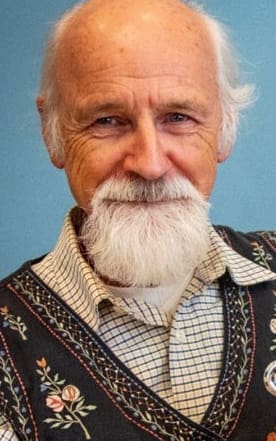
Michael Pilarski is the founder and director of Friends of the Trees Society and the Global Earth Repair Foundation. He is a permaculturist, educator, and expert in earth repair with decades of experience in grassroots ecosystem restoration and regenerative agriculture. He began farming organically in the early 1970s and has focused his work on permaculture, forestry, agroforestry, wildcrafting, ethnobotany, and sustainable land stewardship, working hands-on with over 1,000 plant species.
Michael founded Friends of the Trees Society in 1978 as a hub for community-based ecological education and restoration, and he has taught more than 36 permaculture design courses in the United States and abroad since the late 1980s
In 2019, he established the Global Earth Repair Foundation to expand global collaboration around ecosystem restoration and regenerative practices and to convene practitioners and leaders through events such as the Global Earth Repair Convergence.
Michael’s work emphasizes practical, site-based earth repair and regenerative design, integrating learning with action to strengthen landscapes and communities for climate resilience.
You can learn more about Michael’s initiatives at the Friends of the Trees Society and Global Earth Repair Convergence.
March 12 — 12:00 noon ET
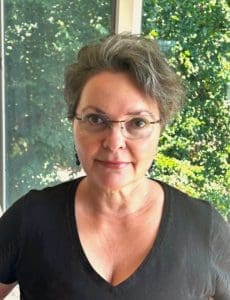
Sonia Demiray is the Director of the Climate Communications Coalition and a strong advocate for the permanent protection of lands and waters, with a focus on forest ecosystems, for the recovery of biodiversity and rebalancing of Earth systems processes. Sonia builds regional and national coalitions to advance environmental health and climate justice, works on public education, and on the development of grassroots movements such as Keep It In the Forest and Down to Earth. In addition to leading the Climate Communications Coalition, she is a member of the Environmental Paper Network’s Steering Committee, which coordinates International Biomass Action Network for the Americas, and a member of the Sierra Club Maryland Chapter’s Executive Committee, of Eastern Forests, Heartwood, and the Climate Forest Campaign -among others.
Sonia is enrolled in a Graduate Program on Forests and Climate Change at Oregon State University to ensure that she works with the latest science in these fast-developing fields. Her studies and ample experience from an earlier career as a communications strategist serving international, federal, and regional clients across the Americas and Europe, strengthen and support her advocacy and outreach.
Learn more at: climatecc.org
March 19 — 12:00 noon ET
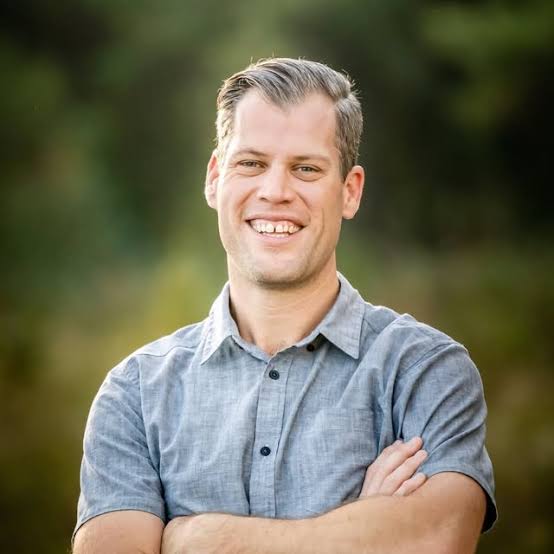
Basil Camu is the co-founder of Leaf & Limb, a tree care company in Raleigh, NC, and Project Pando, a non-profit that aims to connect people to trees. He is also the author of From Wasteland to Wonder: Easy Ways We Can Help Heal Earth in the Sub/Urban Landscape.
When asked what he thinks about himself, Basil will tell you he is incredibly lucky. He has a family he loves dearly, friends and colleagues who inspire him, and every day he gets to care for trees, soil, and flowers. He pursues his purpose and passions through his work as a Treecologist, ISA Board Certified Master Arborist, Duke graduate, Wizard of Things, and author.
His work has been featured in the New York Times, Seattle Times, Forbes, Gardenista, The Joe Gardener Show, and a number of other publications and podcasts. When he’s not having fun at work, he enjoys pulling invasive plants from his pocket forests, contemplating on his front porch, and hiking with his family.
Learn more at: Leaf & Limb
March 26 — 12:00 noon ET
Your Course Instructor
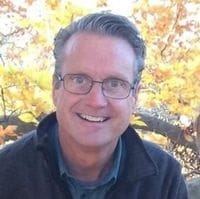
Hart Hagan is an environmental reporter who has produced nearly 400 radio shows and close to 300 videos since 2018. He is the founder of Water & Climate, a Facebook group with over 4,600 members. Six years as a climate reporter has led him to focus on the value of ecosystems and water cycles as a key driver of climate, and the primary means of curbing extinction and providing habitat for our fellow species.
Hart is passionate about educating people that in order to understand flooding, drought, heatwaves and wildfires, we must look beyond CO2 and examine how we treat our land. He is an avid gardener with a focus on native wildflowers and creating landscapes that capture all the rainfall.
Hart is also an educator, a native plant expert, an Accredited Organic Land Care Professional certified through the Northeast Organic Farming Association, and he has been trained by the Savory Institute in the ecological evaluation of pastures through a process known as Ecological Outcome Verification.
To review and subscribe to Hart’s important work, visit his:
YouTube Channel: @harthagan23
Blog on Substack: harthagan.substack.com
Facebook Group: Water & Climate
Whether this is your first course or your tenth course, please join us if you are curious about Trees & Forests, as they relate to our Water, our Wildlife, Wildfires and our Climate. Everyone has much to learn and share, and there is much to be done. We are all on a journey of expanding our knowledge on nature’s climate solutions, and we each bring something valuable to the conversation.
If you have any registration or general course questions, email us at courses@bio4climate.org. If you have specific questions about the course for Hart Hagan, you can contact him at nhhagan@gmail.com.