Featured Creature: Whooping Crane

A whooping crane in flight in Arkansas. Skye Haas via Macaulay Library

What bird is the tallest in North America, is named for the calls it emits, and has small white airplanes to thank for its comeback from near extinction?

The whooping crane (Grus americana)

Adult whooping crane standing among green pine trees, showing its white plumage, red crown, long neck, and black legs.
Image copyright Sienna Weinstein.

My formal introduction to the whooping crane came in 2016, when I interned at the Stone Zoo in Stoneham MA. My project was to behaviorally condition the zoo’s whooping crane to step onto a scaled platform so I could record his weight. It was a multi-week process of getting him used to my presence and then to the scale itself during feeding time. It involved plenty of trial and error, waiting, hisses, and a few bloody bites from the weary crane. In the end, he grew comfortable feeding near the platform but never stood on it long enough for me to get a reading.

As a consolation prize, I nicknamed him “Alec,” since he was a real smart aleck. The name stuck, apparently; years later, the zoo posted a video of a newly acquired female crane named Sunflower sharing the enclosure with the resident male, still known as Alec.

Tall, Smart, and Mighty!

One of only two crane species native to North America, the whooping crane is named for the loud “whooping” call it emits. It’s the tallest bird in North America standing anywhere from 49–62 inches (1.24 to 1.6 m) in height. Its typical wingspan ranges from 79–91 inches (2 to 2.3 m). It’s the fifth largest crane species on Earth and among the heaviest as well. In the wild, these big birds can live between 22 and 30 years. Conservationists consider whooping cranes an indicator species based on their need for large, undisturbed, high-quality wetlands. If whooping cranes are thriving, the wetland itself is generally thriving too, along with the many other species that share it.

Adult whooping cranes are white with a red crown and a long, dark, pointed bill that measures, at most, close to 6.5 inches (17 cm). Immature whooping cranes are cinnamon brown, becoming whiter as they age and mature. In flight, the crane’s long neck stays straight and its long dark legs trail behind rather than tucking in. The black wing tips of adults are also visible during flight.

Whooping cranes are intelligent, consistently alert and definitely not shy. They defend their territories strongly, especially during breeding season, and use a range of displays that include hissing, wing-thrashing, biting, and jumping in order to rake the perceived enemy with their sharp talons. This behavior from the tallest bird in North America makes an angry whooping crane quite an intimidating opponent. I can confirm all of this first-hand, as I had to defend myself with a rake from any potential hits after being attacked the first time.

Juvenile whooping crane with cinnamon-brown and white feathers walking through wetland vegetation beside shallow water in Arkansas.
A juvenile whooping crane photographed in Arkansas. Bill Morris via Macaulay Library

Of Marshes, Mates, and Migrations

Today, there are two migratory and one nonmigratory populations of whooping cranes, but it wasn’t always this way. By 1941, hunting and habitat loss had reduced the species to a single flock of just 15 birds, migrating between Wood Buffalo National Park and Aransas National Wildlife Refuge. That original flock is still the largest today, and is the only naturally occurring migratory population. It winters in Aransas National Wildlife Refuge in Texas and breeds in Wood Buffalo National Park, the largest National Park in Canada, bordering northeastern Alberta and the Northwest Territories. The other two populations exist because of decades of reintroduction work. One of these migratory flocks was established using small planes to teach young cranes a new route from Wisconsin to Florida. It now winters at the Chassahowitzka National Wildlife Refuge in Florida and breeds at the Necedah National Wildlife Refuge in Wisconsin. A nonmigratory flock, also formed through reintroduction, lives year-round near Kissimmee, Florida.

Whooping cranes depend on wetlands, marshes, mudflats, wet prairies and fields for food, shelter, and safe breeding grounds. Breeding happens in prairie wetlands alongside the shallow lakes, ponds, and marshes that offer plenty of vegetation. Cranes choose their breeding habitats based on safety from predators. The wetlands give them the ability to visually scan their surroundings and detect potential threats, and food availability. During their 2,500-mile (4,000 km) migration, whooping cranes seek out wetlands and agricultural fields. They prefer brackish bays and coastal marshes for wintering.

Whooping cranes are diurnal and roost on the ground at night. They are also omnivores, with a diet that depends upon available food in the region. As one of the largest predators hunting in wetland habitats, their feeding helps keep prey populations like crabs, insects, and small vertebrates in check while cycling nutrients back through the ecosystem. Staples of their diet include blue crabs and wolfberries, also known as goji berries. In their Texas wintering grounds, cranes feed on crustaceans, mollusks, grasshoppers, fish, small reptiles, mice, voles, aquatic plants, acorns, and berries. In the summer, they feed on frogs, snakes, small rodents and birds, fish, aquatic insects, crayfish, clams, snails, aquatic tubers, and berries. During their seasonal migration, they feed on waste grain, including barley, corn, and wheat. Unlike the sandhill crane (the other crane species native to North America), whooping cranes digest grains less efficiently, and don’t use gizzard stones, stones swallowed to help grind down foodstuffs to aid in digestion.

Partners, Parents, and Predators

Whooping cranes live primarily in breeding pairs or small family groups, and walk or fly to cover territory. Newly paired cranes often locate their first territory near that of their parents, and learn migration routes and behaviors from their parents as well.

Whooping cranes form monogamous pair bonds around age two or three, typically while still in their winter feeding grounds. Courtship involves elaborate displays, dancing, wing flapping, bowing, tossing tufts of grass into the air, and trumpeting “whooping” calls. Pairs begin nesting around age four, building a mound of vegetation surrounded by water. The female typically lays two eggs in April or May, which hatch after about a month, though usually only one chick survives. Both parents raise the offspring, who becomes independent at around nine months and reaches adulthood at age four.

Whooping cranes defend against predators like the black bear, lynx, raven, coyote, eagle, fox, wolverine, and wolf using their keen eyesight across their open, water-filled habitat, calls to intimidate threatening species and, when needed, fight back. Their water habitat works as a defense system, but warming conditions risk drying out the nesting marshes as soon as 2050. This would make it easier for predators to access crane eggs and chicks, threatening the survival of the species.

Featured Creature: Whooping Crane
A whooping crane in flight in Arkansas. Skye Haas via Macaulay Library

A Comeback Story on the Wing

The whooping crane is currently listed as Endangered on the International Union for the Conservation of Nature (IUCN) Red List. Its recovery from near-extinction has been slow but steady. Conservationists worked with local, federal, and international governments to protect the surviving flock, restore and manage wetland habitats, and encourage captive breeding. In 1970, there were 57 cranes, and that increased to 214 by 2005.

Much of the crane habitat at Aransas National Wildlife Refuge is unoccupied, waiting for the population to grow and expand in that area. Unfortunately, developers are trying to obtain the land to build housing. Oil spills and river inflows to Aransas are also a risk, as is reduced water flows in the central Platte River Valley, Nebraska, a key stopover site for migrating cranes. Illegal shooting is also an increasing threat, with 27 confirmed shooting mortalities between 1967 and 2016.

Conservationists are working to protect and enhance the cranes’ wetland stopover sites, reduce powerline collisions, factor stopover sites into development planning for projects like wind farms, especially in Texas, continue raising cranes for reintroduction, and build further self-sustaining populations. With help from innovative scientists, such as those from the International Crane Foundation, the slow recovery of the whooping crane seems poised to continue.

Sienna Weinstein is a wildlife photographer, zoologist, and lifelong advocate for the conservation of wildlife across the globe. She earned her B.S. in Zoology from the University of Vermont, followed by a M.S. degree in Environmental Studies with a concentration in Conservation Biology from Antioch University New England. While earning her Bachelor’s degree, Sienna participated in a study abroad program in South Africa and Eswatini (formerly Swaziland), taking part in fieldwork involving species abundance and diversity in the southern African ecosystem. She is also an official member of the Upsilon Tau chapter of the Beta Beta Beta National Biological Honor Society.

Deciding at the end of her academic career that she wanted to grow her natural creativity and hobby of photography into something more, Sienna dedicated herself to the field of wildlife conservation communication as a means to promote the conservation of wildlife. Her photography has been credited by organizations including The Nature Conservancy, Zoo New England, and the Smithsonian’s National Zoo and Conservation Biology Institute. She was also an invited reviewer of an elephant ethology lesson plan for Picture Perfect STEM Lessons (May 2017) by NSTA Press. Along with writing for Bio4Climate, she is also a volunteer writer for the New England Primate Conservancy. In her free time, she enjoys playing video games, watching wildlife documentaries, photographing nature and wildlife, and posting her work on her LinkedIn profile. She hopes to create a more professional portfolio in the near future.

Sources

Featured Creature: Palm Tree

Coconut palms in Key West, FL. Image open source.

What tree isn’t really a tree at all, has no annual growth rings, no taproot, and no branches — yet can outlast almost everything around it in hurricane-force winds?

The Palm Tree!

Featured Creature: Palm Tree
Coconut palms in Key West, FL. Image open source.

This week’s Featured Creature is written by Lori Pierelli, Bio4Climate’s Director of Communications and Strategic Engagement. A transplant from Maryland to Florida, Lori now lives in the land of palm trees . . . and hurricanes. After removing the stump of a palm tree that did not survive Hurricane Helene floodwaters, Lori discovered an extraordinary network of roots that needed to be removed. It was then she realized how these trees nearly always survive storms that take down almost everything else around them. . .

When you imagine a palm tree, you almost always picture them in a setting of sunny weather, tropical breezes, and turquoise waters. And you’re not wrong. But palm trees are much more than scenery for beachy dreams or a background for vacation memories. Their resiliency and ecological engineering help stabilize and restore storm-damaged areas like those along the Florida Gulf Coast.

Globally, there are more than 2,500 species of palms spread across tropical and subtropical regions. Part of the Arecaceae family, palm trees are monocots (a type of flowering plant characterized by seeds that contain only one embryonic leaf) and are more closely related to grasses than what we typically picture as a “tree.” Palms don’t have annual growth rings, they don’t branch out in the same way, and their root systems are completely different.

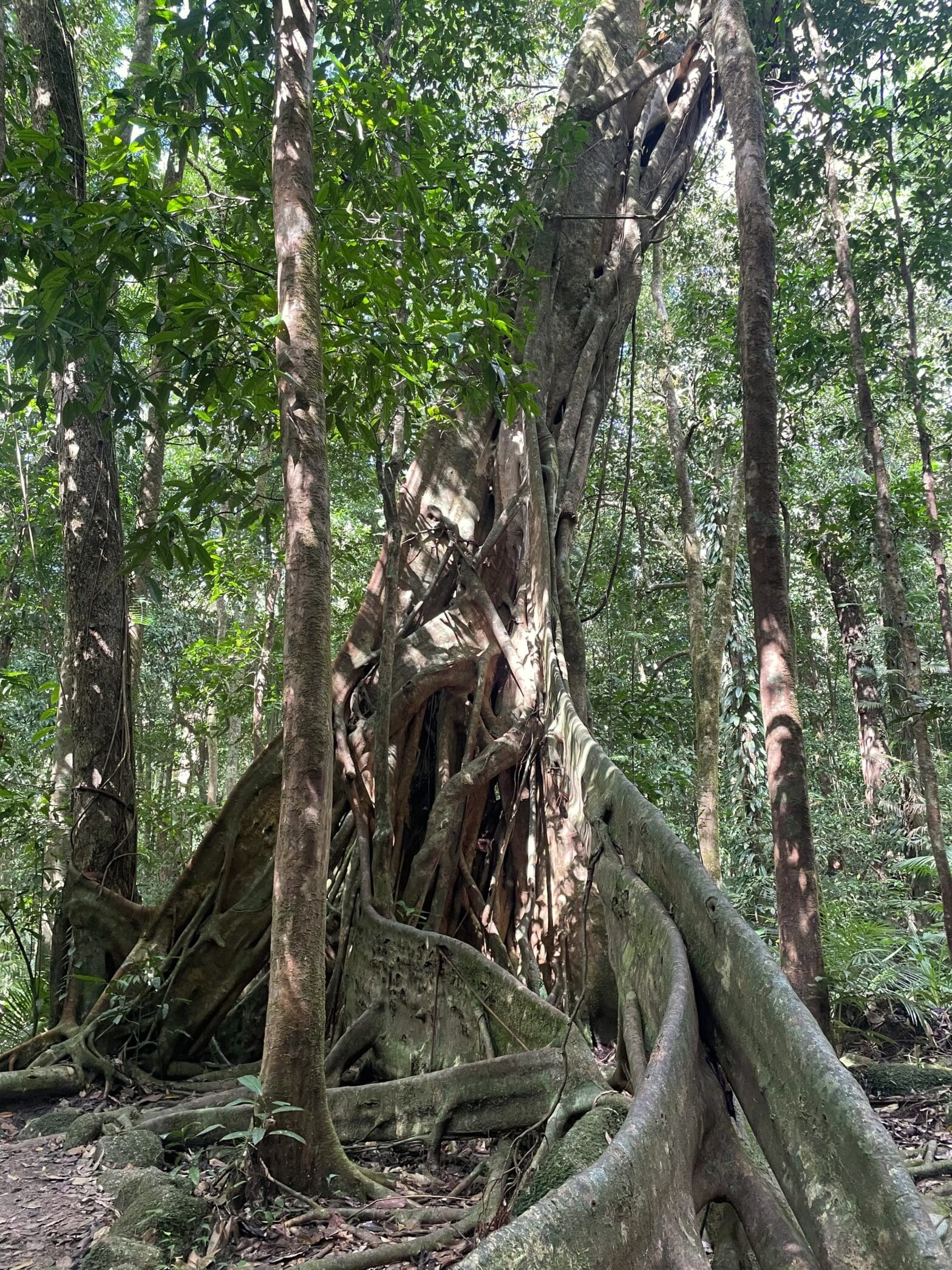
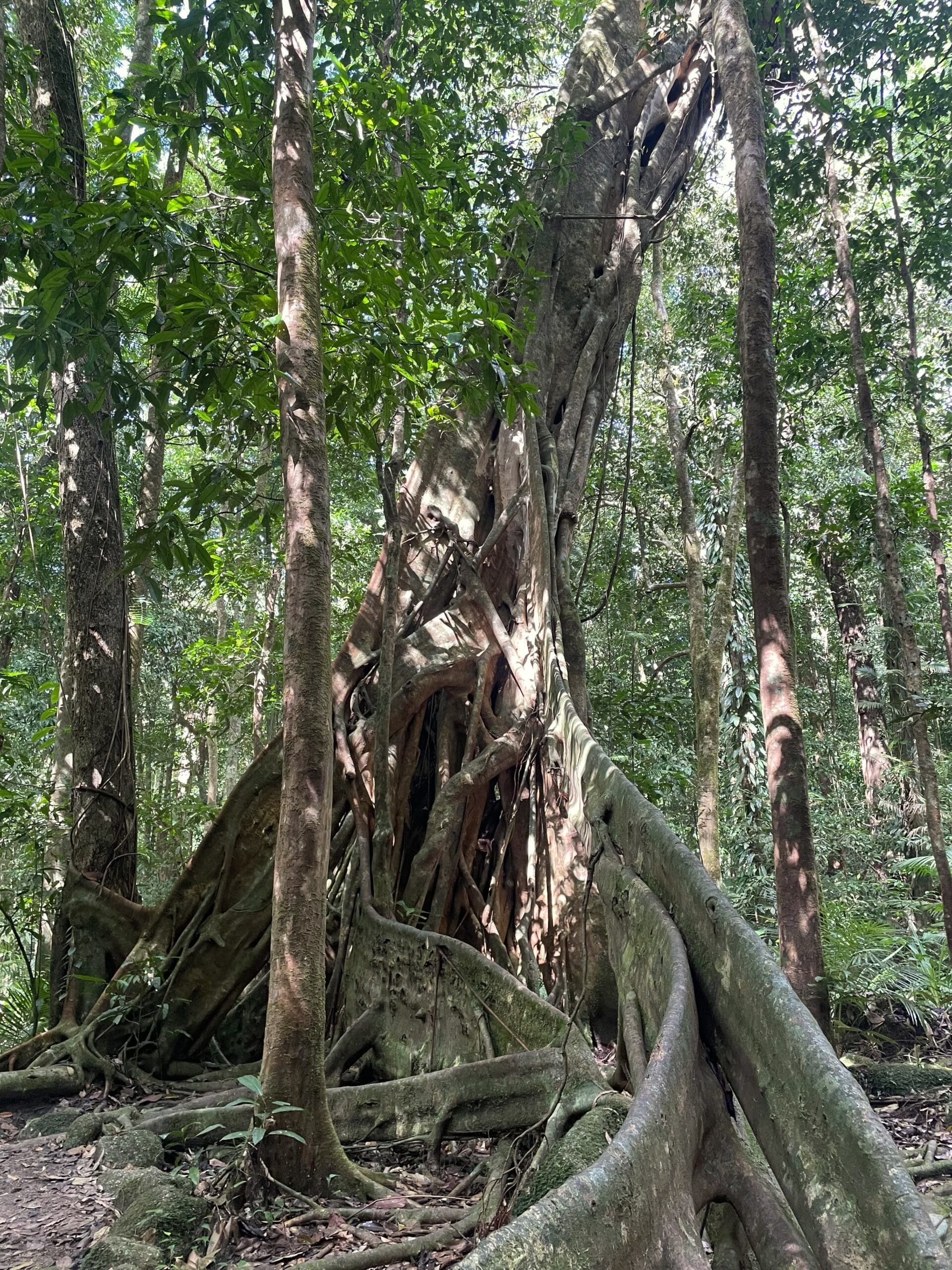
While most trees have a single taproot from which their roots spread, palm trees have a dense, fairly shallow network of fibrous roots that emerge from a small area around the base of the trunk. The roots maintain a generally uniform thickness as they grow outward, forming a flexible network that grips into sandy or saturated soil.

The flexible network of roots is how the trees stay standing in hurricane winds. As the winds push against the palm, the trunk bends and sways. The root system shifts but holds. In loose coastal sands or flood-soaked ground, the root system distributes the force instead of concentrating it in a single, rigid point. Even after a palm dies, those roots continue to matter. As they decay, they leave channels in the soil that allow water to infiltrate more easily, air to move downward, and microbes and invertebrates to travel. Even after the tree is gone, the root structure doesn’t simply disappear.

Spotlighting Florida Natives

Palm trees are ancient “grasses” that build living architecture above and below ground. In Florida, two types of palm tree showcase the resiliency of these monocots: the cabbage palm (Sabal palmetto; the Florida state tree), and the low-growing saw palmetto (Serenoa repens). These cousins thrive in hurricane country, from coastal dunes to inland hammocks, stitching together sandy soils and storm-battered landscapes.

Cabbage palms grow anywhere from 30 to 80 feet, their fan-like fronds fanning out from a fibrous trunk that sways without snapping. They anchor marshes, barrier islands, and urban edges, tolerating salt spray, poor drainage, and fire. Their fruits — sweet, black drupes — are a feast for northern cardinals, mockingbirds, raccoons, black bears, and Keys deer, while nectar-rich flowers draw bees, butterflies, and wasps. Epiphytes like Spanish moss and resurrection ferns drape the trunks, sheltering treefrogs, anoles, and nesting cavity birds such as screech owls and pileated woodpeckers.

Cabbage palms; Open Source.

Saw palmettos hug the ground in dense thickets, their fan leaves edged with tiny saw-teeth. They bind dunes against erosion, shelter quail, gopher tortoises, rabbits, and marsh rabbits from predators and storms, and resprout after fires or floods. 
(Note: the saw palmetto shown in the author’s image below sprouted after Hurricane Helene. There was no indication of any sort of palm in that spot prior to the flood, and the author did not plant it.) 
 

Saw palmetto berries nourish black bears, Florida panthers, scrub jays, and white-tailed deer, while small white flowers lure sweat bees, native solitary bees, and hoverflies. The shaded understory becomes a safe haven for cotton rats, skinks, grasshoppers, and even bobwhite quail chicks hiding from hawks. (So far, the author hasn’t seen any bears, deer, or panthers in her yard.)

Saw palmetto. Courtesy Lori Pierelli, from her side yard.

Cold Limits

Palm trees are synonymous with tropical weather for a simple reason. They’re adapted to warm climates but not cold. Most species struggle when the temperature drops below freezing because their cells lack “antifreeze” proteins (thickened cell walls) that prevent ice crystal damage. Freezes cause fronds to yellow and drop, meristems (the growing tips) to blacken and die, and vascular tissues to rupture as water expands into ice.

Sabal palmettos tend to be hardier and can survive brief temperature drops to as low as 15°F (-9°C), but prolonged cold or wet freezes can still kill young palms or stress mature ones.

Saw palmettos handle the cold similarly. While their lower profile offers some ground-level protection, sharp frosts can brown their fans and slow berry production.

Temperature vulnerabilities are what define the range of palm trees, and prove that even resilient creatures have limits built on millennia of equatorial evolution.

Spikes. Spikes? Spikes!

Palm Spikes; Image from Wikimedia Commons.

Many palms, including varieties common in Florida yards, sport sharp spines along their stalks.
(And yes, they hurt when you try to trim the fronds, even if you’re wearing thick gardening gloves.)

The spikes do serve a purpose, however. They are a defense mechanism against hungry herbivores, making tender leaves and growing tips harder to reach. In wilder settings, they thwart feral pigs and overbrowsing from invasive species. They also create safe nooks for smaller creatures like fence lizards, Carolina wrens, and juvenile snakes. They are a perfect example of the dichotomy of nature: repelling some species while welcoming others.

Ecosystem Engineers

Palm trees aren’t just survivors. They are active “ecosystem engineers,” creating conditions that support a range of life systems. Below ground, their fibrous roots form a living net that traps nutrients washed from sandy soils, slows floodwater runoff to recharge aquifers, and feeds mycorrhizal fungi, nematodes, springtails, and earthworms that churn and enrich the earth. Even as roots turn over, they support carbon and nitrogen cycles by maintaining pore spaces that boost infiltration, cut erosion, and let oxygen reach deeper microbes.

Above ground, the support systems multiply. Fallen palm fronds create a thick layer of mulch that suppresses weeds, retains moisture through dry spells, and decomposes into humus that feeds ground-nesters like ants and beetles. The rough bark of palm trunks hosts orchids, tillandsias, and bromeliads whose tiny tanks shelter frogs, springtails, and fairy shrimp, while older frond “skirts” offer roost sites for bats, owls, and insects. Flowers provide pulsed nectar for bees and butterflies, and fruits sustain hungry animals, such as  cardinals who strip seeds, or bears who raid fallen drupes.

Palms are also carbon sinks, locking CO₂ into persistent fibers and fruits, bolstering coastal “blue carbon” in marshes and mangroves against sea rise and waves. They moderate microclimates by shading and cooling burrows for tortoises and rabbits, creating windbreaks that protect seedlings, and humdifying dry air for understory herbs as their fronds evaporate.

After significant events such as floods or gale force wind storms, palms jump-start habitat recovery because they resprout quickly and rapidly provide structures where animals can hide and forage while full habitats rebuild.

Palm tree survivors among Hurricane Melissa (2025) devastation in Black River, Jamaica. Copyright @Traceyathorne, Instagram.

Enjoying the Beach Vibes with a New Level of Understanding

Next time you’re dreaming of lounging by the sea with a cold drink in your hand, remember that the warm tropical breeze blowing through your hair is being created by much more than just another type of tree. The quintessential vacation backdrop has been adapted over millenia into one of nature’s most sophisticated living infrastructures, sheltering native species, pulling carbon from the air, recharging aquifers, and anchoring shorelines against storms. Experiencing these wonders of nature are one more reason to book that tropical vacation!

Sources

Featured Creature: Atlantic Puffin

What striking seabird is a master of adaptability in the ocean and the air? 

The Atlantic Puffin!

Featured Creature: Atlantic Puffin
Image by Anne-Ed C. from Pixabay

Nestled around the edges of the North Atlantic, the Atlantic Puffin, or Fratercula arctica, is a seabird of great charm and adaptability. Resembling a penguin in its coloration, yet distinguished by its multicolored and uniquely shaped bill, this captivating creature is often affectionately dubbed the “sea parrot.” 

Atlantic puffins have also been known as “sea clowns” because of that funky flattened bill, but make no mistake – these are some seriously impressive seabirds. With sophisticated burrows, skillful hunting, and dedication to raising families with determined care, these bright birds are marvels of the ocean.

Image by Mario from Pixabay

Aquatic Aviators

Atlantic puffins spend the majority of their lives navigating the vast expanse of the North Atlantic, where they are found on islands and coastal shores from North America to Scandinavia. With wings that double as paddles, they can “fly” through the water, propelled by powerful flippers and webbed feet.

These adept swimmers dive to impressive depths of up to 200 feet, hunting small fish like sand eels and herring with remarkable precision. In addition to their aquatic prowess, puffins can also fly, though they are unable to soar like other broad winged seabirds. Instead, using wings that can flap up to 400 times per minute, Atlantic puffins are able to reach speeds of up to 55 miles per hour (88.5 km/h).

Image by Decokon from Pixabay

Family Life

During the breeding season, thousands of puffins gather in colonies along the coasts and islands of the North Atlantic. These colonies provide safety in numbers, shielding the birds from larger predators like skuas and gulls that patrol the skies above. The breeding season sees puffins at their most colorful, with those distinctive bills featuring their blue-gray triangles accented in bright yellow. When the season is over, the bills’ outermost layers actually molt, and revert to a partly gray and partly orange color combination. 

Puffins exhibit strong pair bonds, often forming lifelong partnerships with their mates. They engage in affectionate behaviors such as rubbing and tapping beaks, reinforcing their bond year after year. Remarkably, these avian couples frequently return to the same burrow to raise their young each season.

Using their beaks and claws, they construct deep burrows that nestle between rocky crags and crevices. These generally feature separate tunnels that are used as a bathroom area, and a main nesting chamber that serves as a safe haven for incubating eggs, which hatch after a period of 42 days. 

Pufflings, as these chicks are called, are adorned with fluffy feathers that will eventually facilitate their ability to swim and fly. Both parents play an active role in incubating the egg and caring for their offspring once it has hatched, fetching food for the young puffling with skill and dedication. They make use of a unique adaptation of small spines along their bills, tongues, and the roofs of their mouths that allow them to hold bunches of fish in place as they fly from their hunts on open waters back to the nests where their young ones wait. It is estimated that during the time a puffling stays in its burrow dependent on this care, its parents will make close to 12,400 dives total to keep up the steady supply of food.

Image by Simon Marlow from Pixabay

Persevering Under Threat

Despite their remarkable adaptability, Atlantic puffins face a number of challenges in the modern world. From habitat loss and predation to climate change and human disturbances, these beloved seabirds are confronted with an uncertain future, and they are currently classified as Vulnerable by the IUCN (International Union for Conservation of Nature). In particular, as ocean temperatures rise and fish populations decline or shift their habitat, puffins struggle to find food with enough frequency and reliability to get by. Conservation and restoration measures can help ease these pressures by preventing overfishing, ensuring abundant marine ecosystems, and allowing all forms of ocean life, from underwater critters to seabirds, to survive and adapt. While the intersecting challenges of a warming and increasingly chaotic planet may be complex, modifying human behaviors has made a tremendous difference for these colorful creatures before. 

Take a look at the story of their bounce back from near extinction in the 20th century:

May we take hope in our power to shape our planet’s future for the better, and show the same love and dedication to these sweet seabirds as they do to their young pufflings. 

Flapping away now,

Maya


Maya Dutta is an environmental advocate and ecosystem restorer working to spread understanding on the key role of biodiversity in shaping the climate and the water, carbon, nutrient and energy cycles we rely on. She is passionate about climate change adaptation and mitigation and the ways that community-led ecosystem restoration can fight global climate change while improving the livelihood and equity of human communities. Having grown up in New York City and lived in cities all her life, Maya is interested in creating more natural infrastructure, biodiversity, and access to nature and ecological connection in urban areas.


Sources and Further Reading:
https://www.allaboutbirds.org/guide/Atlantic_Puffin/overview#
https://www.nationalgeographic.com/animals/birds/facts/atlantic-puffin
https://kids.nationalgeographic.com/animals/birds/facts/atlantic-puffin
https://www.audubon.org/field-guide/bird/atlantic-puffin
https://abcbirds.org/bird/atlantic-puffin/
https://www.science.org/content/article/watch-puffin-use-tool-scratch-itch
Recent changes in the diet and survival of Atlantic puffin chicks in the face of climate change and commercial fishing in midcoast Maine, USA. Stephen W. Kress, Paula Shannon, Christopher O’Neal. FACETS 21 April 2016. https://doi.org/10.1139/facets-2015-0009