Featured Creature: Staghorn sumac

What berries grow in crimson towers,
With tangy taste that puckers and sours?

Staghorn sumac! (Rhus typhina)

Staghorn Sumac (By Alicja via Pexels) 

Growing up, the slim outline of the staghorn sumac lined the perimeter of my backyard, reaching out its limbs, dotted with dark red berries. In the bored heat of summer, my brothers and I would grab the plant’s thin trunk and shake, raining berries down on us and gathering as many in our hands and pockets as we could. 

These wide and angular branches give the staghorn sumac its name, resembling the sharp antlers of a deer. And much like the thin, soft velvet that covers young antlers, the staghorn sumac’s stem is lined with a fine velvety layer of hair (or trichomes). In addition to serving as a protective layer from insects and the elements, this fuzz distinguishes the staghorn sumac from its common relative, the smooth sumac. These two plants share quite a few traits, both having pinnate (feather-like leaves) and producing red fruit. However, the smooth sumac, as the name suggests, lacks the fine velvety texture on its stems that characterizes the staghorn.

Budding branch of staghorn sumac (WikiMedia Commons by Krzysztof Ziarnek)

Planting roots

Beyond its striking leaves and vibrant berries, the staghorn sumac has a unique way of multiplying and thriving in the wild.

Growing from a large shrub to a small tree, the staghorn sumac ranges in size from about 3 to 30 feet in height. It is native to the eastern half of the United States and flourishes on the edges of forests, clearings, and dry, rocky, or gravelly soils. 

The staghorn is a colony forming plant, meaning that they cluster in groups of genetically identical clones, connected through an underground network of roots. The plant reproduces new clones via a process known as root suckering, where vertical growths originate from its root system. In addition to producing colonies, the staghorn sumac also naturalizes through self seeding, the dispersal of its own seeds. 

The flowers of a staghorn sumac are crimson, hairy, and bloom through May to July. Berries form tightly pyramidal clusters and are usually ripe by September, persisting into the winter, even after the staghorn sumac has lost its leaves, though this timeline can vary by geography. 

Staghorn sumac in the winter (photo by author)

The staghorn sumac is dioecious, male staghorn sumac and female staghorn sumac flower separately. The female staghorn sumac produces flowers and seed, while the male staghorn sumac only produces flowers. Due to the staghorn sumac’s colony forming habits we just learned about, and while not always the case, groves of predominantly female-only or male-only trees can be found. The colony of staghorn sumacs that grew around my childhood backyard were all seed bearing, and therefore a colony of female-only sumacs. 

Berries and Beyond

The berries produced by the female staghorn sumac hold the same shade of deep red as the flowers, but also have finer hairs and a denser, round body. As children, my brothers and I were convinced that these velvety, red berries were poisonous, and we handled them with a slight air of suspicion. However, despite their vibrant color, the berries lining our pockets were not poisonous.  While brightly colored fruits may have a reputation for being dangerous, many use bright colors to attract different pollinators. In this case, the bright Staghorn sumac berries are an edible fruit that has been used by humans for centuries. They are high in vitamin c and have a strong, tart taste. Upland game birds, songbirds, white-tailed deer, and moose also eat the tree’s leaves and twigs, while rabbits eat even the plant’s bark. 

The staghorn sumac has been utilized by Indigenous peoples in North America for a variety of different purposes—including traditional medicine—over hundreds of years. The fresh twigs of the staghorn sumac, once peeled, can be eaten, and have been used in dishes such as salads. These same twigs, along with the leaves, can be brewed into medicinal tea, traditionally used to relieve post pregnancy bleeding, alleviate respiratory conditions such as asthma, and assist in digestion. In addition, the roots of the staghorn sumac have historically been used for their supposed antiseptic and anti-inflammatory properties.

A common use for sumac berries is to make sumac-aide, a lemonade-like beverage with a strong, tart taste. Sumac-aide has been used for its believed medicinal properties, or simply as a refreshing summer drink. Sumac berries are ready to be harvested and used for culinary purposes during late summer, once they turn dark red in color.

Staghorn sumac (Josveo5a via WikiMedia Commons

The staghorn sumac trees that once grew lush in my childhood backyard are all gone now, leaving an empty patch of dirt in their wake. Although my family does not understand the events that lead to their demise completely, potential disease could be one contributing factor. The staghorn sumac is a resilient tree that is able to flourish under a variety of conditions. However, like all plants, the staghorn sumac is still susceptible to disease. Fungal diseases such as anthracnose, powdery mildew, and root rot, and bacterial diseases such as leaf spot can infect and kill groves of the staghorn sumac. In addition, invasive pests such as Japanese beetles can strip the staghorn sumac by skeletonizing its leaves and damaging flowers. 

Recently, I was walking along an icy boardwalk near my childhood home and noticed little fuzzy flowers, bright red against the white snow. It took me a closer inspection of these cute crimson flowers to notice the large group of staghorn sumac arching above the boardwalk and over my head. The trees bore their rich red flowers despite the other snow encrusted barren trees of the landscape. 

If you know where to look, the staghorn sumac is everywhere, dotting the sides of highways, bike paths, playgrounds, and perhaps even your own backyard.


Helena Venzke-Kondo is a student at Smith College pursuing psychology, education, and environmental studies. She is particularly interested in conversation psychology and the reciprocal relationship between people and nature. Helena is passionate about understanding how communities are impacted by climate change and what motivates people towards environmental action. In her free time, she loves to crochet, garden, drink tea, and tend to her houseplants. 


Sources and Further Reading:

Featured Creature: ‘Ōhi’a Lehua

What tree has adapted to grow directly in lava rock and is a keystone species of the Hawaiian watershed?

‘Ōhi’a Lehua (Metrosideros polymorpha)!

Image Credit: Kevin Faccenda via iNaturalist 

The first time I saw the vibrant blossoms of the ‘ōhi’a lehua tree, I was walking on a dirt path in Kauai’s Waimea Canyon State Park, gaping down at the most colorful red and green gorges I had ever seen. Needing a breather from the steep visual plunge, I looked up from the canyon and noticed bright red flowers on the side of the path. As I got closer and could see the plant more clearly, the first thought that popped into my head was how similar the flowers looked to those fiber optic light toys I had played with as a kid. (If you don’t know what fiber optic light toys look like, look them up. You’ll see exactly what I mean.) 

After my trip to Waimea Canyon, I saw ‘ōhi’a lehua everywhere. When I drove along the coast between the beach and the sloping mountains, when I hiked the volcanic craters of Haleakala, and when I visited parks and gardens across the islands that protect native plants and animals. ‘Ōhi’a lehua is the most common native tree in Hawaii, so seeing its fiery red, orange, or yellow blossoms every day felt so very ordinary. But ‘ōhi’a lehua is far from ordinary.

Let Me Introduce You to My New Friend, ‘Ōhia Lehua

Endemic to the six largest islands of Hawaii, ‘ōhi’a lehua is the dominant tree species in native forests, present in approximately 80% of the total area of these ecosystems and covering close to one million acres of land across the state. Depending on where exactly it grows, its size can vary widely, from a small shrub to a large tree. Found only in the Hawaiian archipelago, ‘ōhi’a lehua grows at elevations from sea level to higher than 9000 feet, and in a variety of habitats like shrublands, mesic forests (forests that receive a moderate amount of moisture throughout the year), and more wet, or hydric, forests.

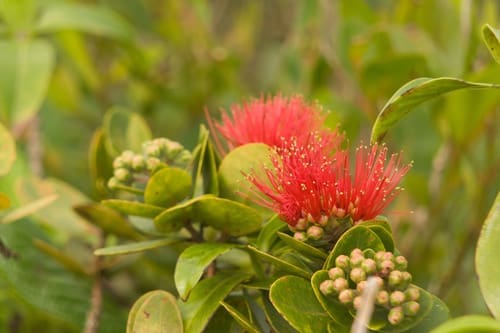
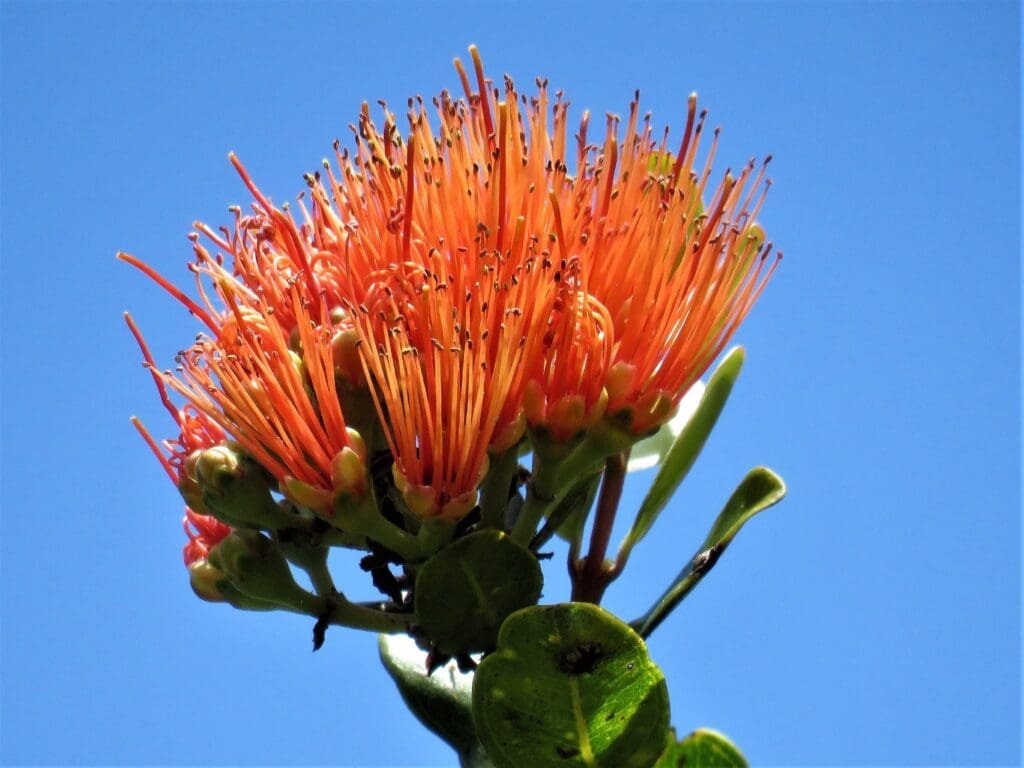
You can easily identify the ‘ōhi’a lehua blossoms by their mass of stamens – the part of the flower that produces pollen – which are slender stalks with pollen-bearing anthers on the end. It’s what made me think the ‘ōhi’a lehua looked exactly like those fiber optic light toys. These powder puff-like flowers are most often brilliant shades of red and orange, but yellow, pink, and sometimes even white ones can be found.

‘Ōhi’a lehua grows slowly, reaching up to 20-25 meters (66-82 feet) in certain conditions.

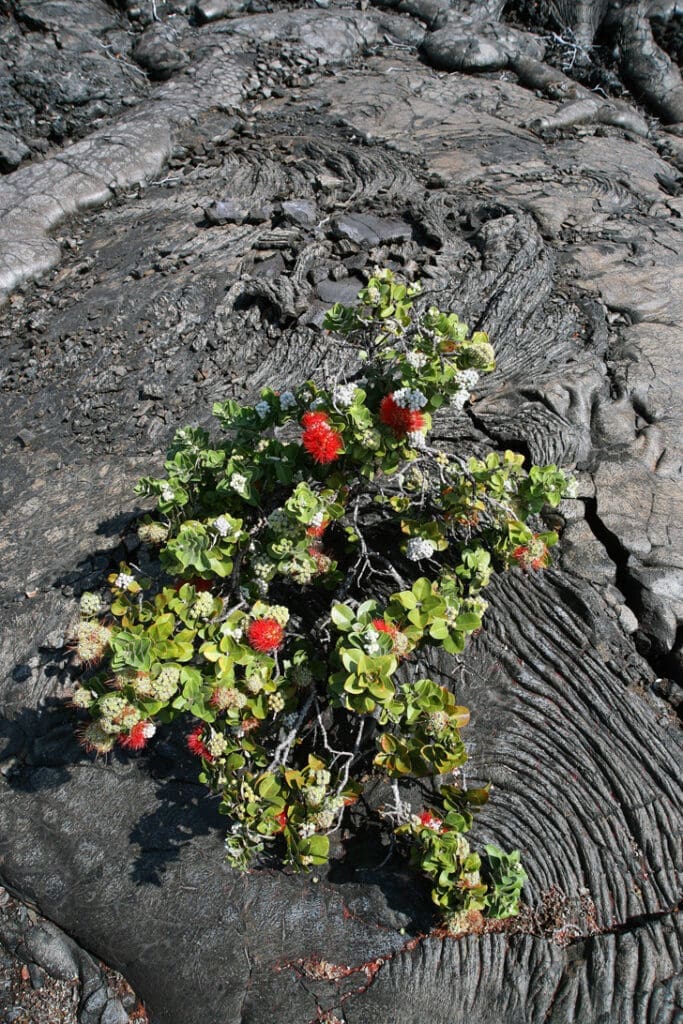
With a little help from the wind, the seeds of ‘ōhi’a lehua travel from the tree and settle in cracks in the ground of young lava rock. It is, in every sense, a true pioneer plant. As one of the earliest plants to colonize and grow in fresh lava fields, ‘ōhi’a lehua stabilizes the soil and makes it more habitable for other species.

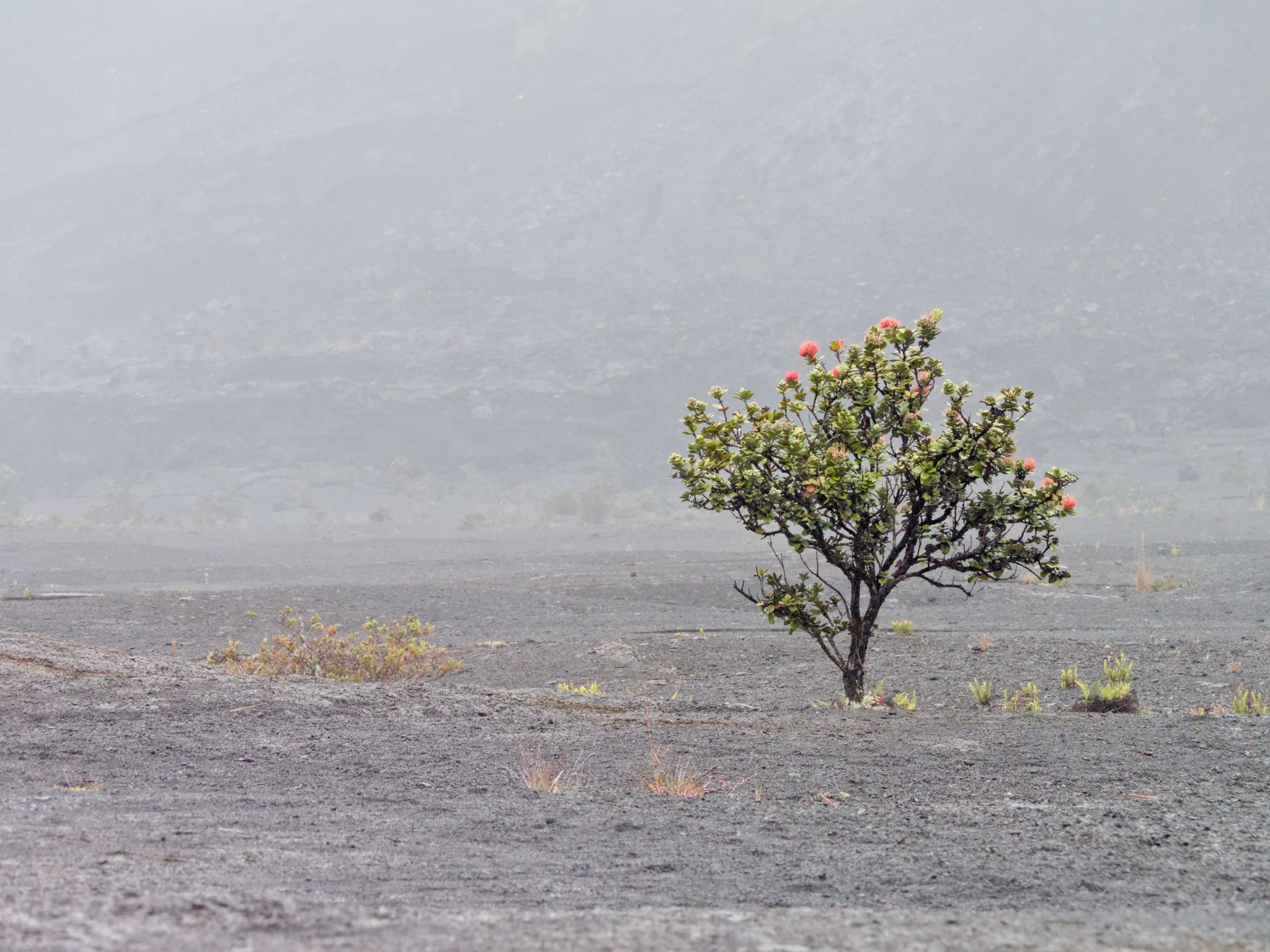
Even though ‘ōhi’a lehua can blanket Hawaii’s native forests, this flowering tree also grows alone, as you can see in the photograph below. Plants like ‘ōhi’a lehua fill me with happiness because they are able to grow in the most harsh, barren, and disrupted places, and they make it possible for other species to do the same. Plants like ‘ōhi’a lehua fill me with surety that even though sometimes poorly treated, the natural world will continue to be strong. Plants like ‘ōhi’a lehua make me believe in the resilience of nature.

Arid, rocky, Mediterranean coast. (Via Pexels)

How ‘Ōhi’a Lehua Cares for the Hawaiian People

Biodiversity forms the web of life we depend on for so many things – food, water, medicine, a stable climate, and more. But this connection between human beings and natural life is not always clear, understood, or appreciated. But there is a concept in Hawaiian culture called aloha ‘āina, or love of the land, which teaches that if you take care of the land, it will take care of you. The ‘ōhi’a lehua in particular takes care of the Hawaiian people in a pretty special way. 

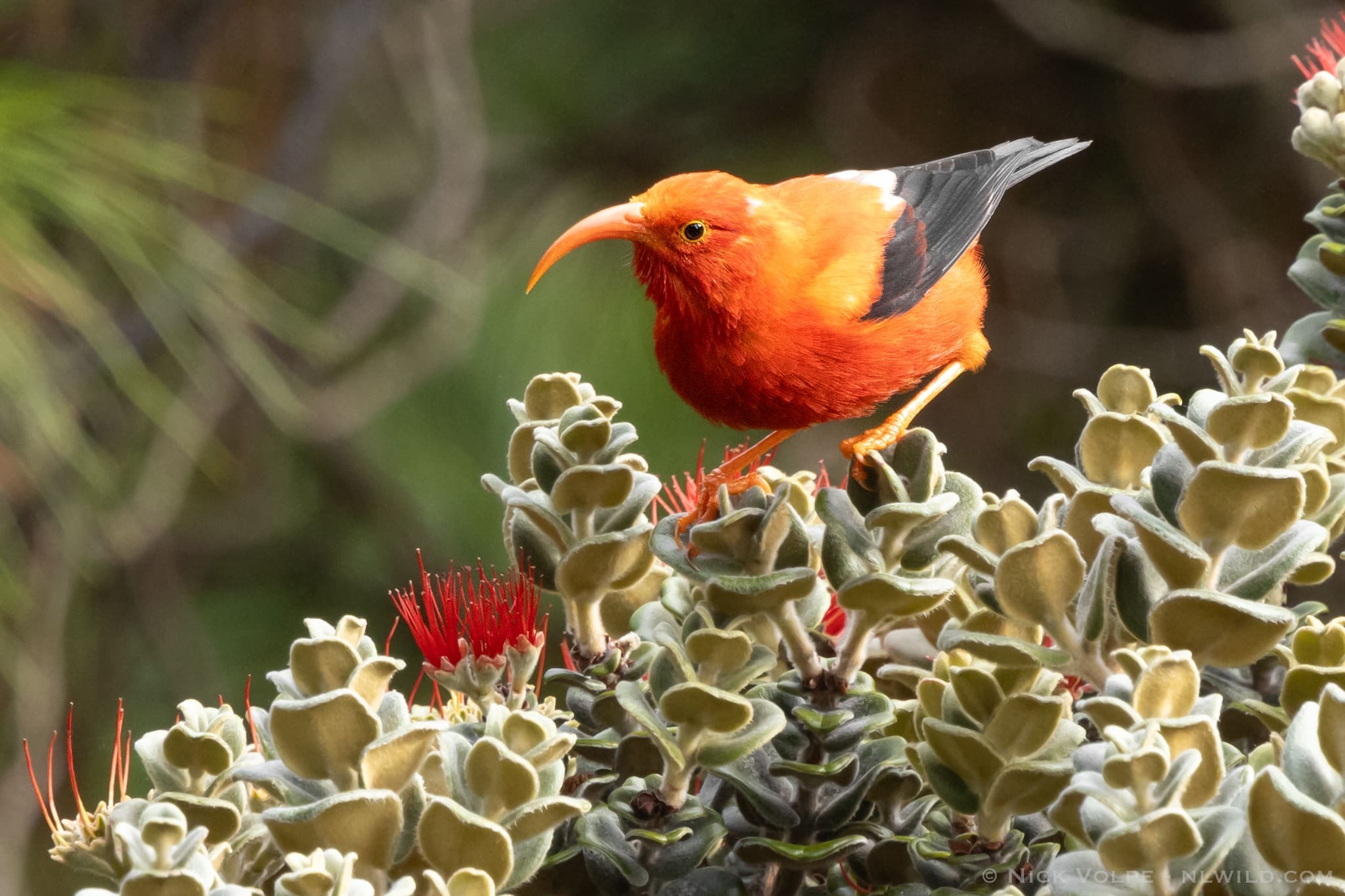
One of the most important characteristics of this flowering evergreen tree is that it’s a keystone species, protecting the Hawaiian watershed and conserving a great amount of water. The way I see it, ‘Ōhi’a lehua is an essential glue that holds Hawaii’s native ecosystems together. The leaves of ‘ōhi’a lehua are excellent at catching fog, mist, and rain, replenishing the islands’ aquifers and providing drinking and irrigation water for Hawaiian communities. ‘Ōhi’a lehua’s ability to retain water, particularly after storms, not only makes that water accessible for other plants, but it helps mitigate erosion and flooding. The tree provides food and shelter for native insects, rare native tree snails (kāhuli), and native and endangered birds like the Hawaiian honeycreepers (‘i’iwi, ‘apapane, and ‘ākepa). ‘Ōhi’a lehua trunks protect native seedlings and act as nurse logs, providing new plants with nutrients and a growing environment.

‘I’iwi, the Scarlet Hawaiian Honeycreeper, perched on an ‘ohi’a tree (Image Credit: Nick Volpe)

The Myth of ‘Ōhi’a Lehua

‘Ōhi’a lehua may have a disproportionately large effect on Hawaii’s ecosystems as a keystone species, but its presence as a meaningful part of Hawaiian culture could be even larger. There are many versions of mo’olelo (story) about the origin of the ‘ōhi’a lehua tree, but the most common one is about young lovers named Ōhi’a and Lehua. Pele, the goddess of the volcano, changed herself into a human woman and tried to entice ‘Ōhi’a. When he denied her, Pele became enraged and transformed ‘Ōhi’a into a tree. When Lehua found out, she was so heartbroken that she prayed to the gods to somehow help her reunite with him. Answering her prayers, the gods transformed Lehua into a flower and placed her on the ‘ōhi’a tree’s limbs. To this day, it’s believed that whenever a lehua flower is picked, the skies will open up and rain will fall, because the lovers have been separated.

‘Ōhi’a Lehua as a Cultural Symbol

In Hawaiian culture, the ‘ōhi’a lehua is a symbol of love, resilience, and ecological harmony. The transformation of Ohia and Lehua into tree and flower represents the inseparable bond between two people who love each other, and between the tree and its flowers. The term pua lehua, or lehua flowers, is often used to describe people who express the same grace, strength, and resilience of the ‘ōhi’a lehua. Pilina, a Hawaiian word that means “connection” or “relationship,” is an important value in Hawaiian culture because it is a critical way for people to connect with and understand the world around them. The ‘ōhi’a lehua tree is a symbol of pilina, and embodies this relationship between the Hawaiian landscape and its people.

The ‘ōhi’a lehua is also incredibly important to hula. Hula is the narrative dance of the Hawaiian Islands, and it is an embodiment of one’s surroundings. Dancers use fluid and graceful movements to manifest what they see around them and tell stories about the plants, animals, elements, and stars. ‘Ōhi’a lehua trees and forests are considered sacred to both Pele, the goddess of the volcano as you may recall, and Laka, goddess of hula. To enhance their storytelling and evoke the gods, dancers traditionally wear lehua blossoms or buds in lei, headbands, and around their wrists and ankles.

The Dependability of ‘Ōhi’a Lehua 

‘Ōhi’a lehua has long been a part of daily life. Historically, the hardwood of the tree was used for kapa (cloth) beaters, papa ku’i ‘ai (poi pounding boards), dancing sticks and ki’i (statues), weapons, canoes, and in the construction of houses and temples. Today, the tree’s wood is used for flooring, furniture, fencing, decoration, carving, and firewood. ‘Ōhi’a lehua blossoms decorate altars for cultural ceremonies and practices. Flowers, buds, seeds, and leaves form the base of medicinal teas that can stimulate appetite and treat childbirth pain.

Threats to ‘Ōhi’a Lehua

As a native tree, ‘ōhi’a lehua competes with invasive species for moisture, nutrients, light, and space. Plants like the strawberry guava plant (Psidium cattleyanum) grow in dense thickets and block the growth of ‘ōhi’a seedlings. The invasive fountain grass (Pennisetum setaceum) can dominate barren lava flows, making it difficult for ‘ōhi’a to compete. ‘Ōhi’a lehua is also threatened by non-native animals. Hooved animals like pigs, cattle, goats, and deer disturb the soil, eat sensitive native plants, and trample the roots of ‘ōhi’a lehua trees.

The most dangerous threat to ‘ōhi’a lehua is a virulent fungus called Ceratocystis fimbriate, which attacks the tree’s sapwood, preventing it from uptaking water and nutrients, and killing the tree within weeks. It’s been given the name Rapid Ohia Death (ROD) because of how quickly it suffocates the tree, turning the leaves yellow and brown and the sapwood black with fungus. Infections spread through a wound in the bark, which can be caused by animals trampling roots, lawn mowing, or even pruning, and can be present in the tree for up to a year before showing symptoms. ROD is spread by an invasive species of wood boring Ambrosia beetle that infests the tree and feeds off the fungus. When colonizing trees, the beetle produces a sawdust-like substance made of excrement and wood particles called frass, which can contain living fungal spores that get carried in wind currents and spread by sticking to animals and human clothes, tools, and vehicles. 

Since its discovery in 2014, ROD has killed more than one million ‘ōhi’a lehua trees across 270,000 acres of land, making it a significant threat to biodiversity and cultural heritage. The International Union for Conservation of Nature (IUCN) classifies ‘ōhi’a lehua’s conservation status as vulnerable, and has recorded a decline in mature trees since 2020. Because ROD can spread long distances, it has the potential to wipe out ‘ōhi’a lehua across the entire state. If ‘ōhi’a lehua disappears, it will lead to a collapse of the Hawaiian watershed and radically change the ecosystem.

How the Hawaiian People Care for ‘Ōhi’a Lehua

Scientists, researchers, and native Hawaiians are working together to ensure the long-term health and resilience of ‘ōhi’a and Hawaii’s native forests by mitigating the spread of Rapid Ohia Death. Hawaii’s Forest Service monitors the land to track the spread of ROD and mortality of trees, has developed sanitation and wound-sealing treatments, and collaborates with hunters and game managers to reduce disease transmission. Scientists rigorously test ‘ōhi’a trees to understand the disease cycle, find out how it can be broken, and to identify trees resistant to the infection that could be used in potential reforestation efforts. 

To prevent the spread, Hawaii has announced quarantine restrictions, travel alerts, and sanitation rules. If you are shipping vehicles between islands, you should clean the entire understory with strong soap to remove all mud and dirt from the tires and wheel wells. People who go into ‘ōhi’a forests are advised to avoid breaking branches or moving wood around, to clean their shoes and clothes, and to decontaminate any tools used with alcohol or bleach to kill the fungus. Even hula practitioners are forgoing the use of ‘ōhi’a lehua.

Orange ‘ōhi’a lehua blossom (Image Credit: Joan Wasser via National Park Service)

Mālama the ‘āina

Mālama the ‘āina is a phrase that means to care for and honor the land. ‘Ōhi’a lehua is a wonderful representation of the interconnection between people and nature and I hope learning about this beautiful tree has encouraged you to appreciate the relationship we have with the Earth and what the natural world does for us. 

Remember, if you take care of the land, it will take care of you.

Abigail


Abigail Gipson is an environmental advocate with a bachelor’s degree in humanitarian studies from Fordham University. Working to protect the natural world and its inhabitants, Abigail is specifically interested in environmental protection, ecosystem-based adaptation, and the intersection of climate change with human rights and animal welfare. She loves autumn, reading, and gardening.


Sources and Further Reading:

Featured Creature: Lichen

Which creature is a combination of two other organisms, comes in bright colors, and helps us measure air quality?

Lichen!

Image by Jerzy Górecki from Pixabay

Master of Symbiosis

Though we know lichens as creatures in and of themselves, lichens are actually a result of symbiosis, a mutually beneficial relationship between two or more species. In the lichen’s case, algae and fungi come together to form a new creature. No two lichens are alike. They vary in form, color, and which type of algae they have – either green, blue-green, or both.

The fungus gives the lichen a majority of its traits, including shape and anatomy. The algae determines the color, from orange to yellow to neon green. The fungus partners with the algae out of necessity for food. Since the algae, or cyanobacteria, can photosynthesize, they provide food for the fungus in exchange for shelter. Therefore, each party relies on the other for survival.

Image by Emmi Nummela from Pixabay

Abundant yet Unique

From hot deserts and windy coastlines to the arctic tundra, lichen are found around the world. In North America alone, there are thought to be 3600 different species! They grow on trees, rocks, and soil. They can even grow on things made out of one of the above, such as a house made out of wood. If a sand dune remains stable for long enough, soil crusts will form and lichens will begin to appear along the crusts. Essentially, all lichens need is something solid to hang onto. 

Lichens require a stable habitat because they take a long time to grow. Every year, they only grow 1-2 mm. To promote their growth cycle, lichens will often partner with moss, adding yet another organism to the party. Mosses are simple plants (meaning they lack roots, stems, and leaves) that retain water, and since lichens have two creatures to sustain (the algae and fungi), this water source is a welcomed one. This partnership is so common that if you look up ‘lichen’ on the internet, a majority of pictures will contain both lichen and moss. They are truly geniuses of cooperation!

The lichen Letharia vulpina at Mt. Gleason, CA (Photo by Jason Hollinger from Wikipedia, CC BY-SA 3.0)

Welcomed by All

At first glance, it may look like lichens harm trees. (After all, if you or I had something bright green or orange growing on our limbs, we should call the doctor). But fear not – lichens don’t harm any plants they attach themselves to. On the contrary, they benefit many other species, such as birds that use lichen as nesting material. Numerous invertebrates see lichen as a source for food and shelter and, as a result, the more lichen in a forest, the more organisms the ecosystem can sustain. 

Humans have reaped the benefits of lichen, too. We have used them for clothing, decorations, and food. They are also highly valued for their antibiotic properties. Today, we use them in toothpastes, salves, deodorants, and other products. So you can thank lichens for helping us stay clean and healthy!

Cup Lichen (Image by Jürgen from Pixabay)

A Climate Helper

Since the algae in lichen photosynthesize, lichens contribute to the important function of converting carbon dioxide in the atmosphere to oxygen. The fungus in lichen contribute to this function, too, by allowing algae to live in places they wouldn’t be able to on their own. By providing a form of shelter, the fungus gives an opportunity for more algae to exist and thrive, and that means we have more creatures sequestering carbon and stabilizing the climate.

Lichens also play a vital role in soil formation and development by helping to break down solid minerals like rock. This process creates pockets in the soil – perfect for larger organisms to thrive in. It also creates pathways for nutrients to sink deep into the Earth, where they will later benefit plants and other creatures. As we like to say at Bio4Climate, healthy soil makes for a healthy planet.

Last but not least, lichens give us an insight on the amount of pollution in their respective area. Lichens absorb everything around them – including air, nutrients, water, and pollutants. Scientists study lichens in order to understand the type of toxins present in the environment and their levels. This information gives us insights on the root causes of disease and environmental degradation. With that knowledge, we can address issues affecting human and wildlife communities – creating a cleaner environment for us all. 

That’s all for now, but I hope you’re lichen this series!
Tania


Tania graduated from Tufts University with a Master of Science in Animals and Public Policy. Her academic research projects focused on wildlife conservation efforts, and the impacts that human activities have on wild habitats. As a writer and activist, Tania emphasizes the connections between planet, human, and animal health. She is a co-founder of the podcast Closing the Gap, and works on outreach and communications for Sustainable Harvest International. She loves hiking, snorkeling, and advocating for social justice.


Sources:
https://www.deschuteslandtrust.org/news/blog/2016-blog-posts/five-fun-facts-about-lichen
https://www.fs.fed.us/wildflowers/beauty/lichens/about.shtml
https://www.woodlandtrust.org.uk/blog/2019/04/what-is-lichen-seven-types-of-lichen-found-on-trees/
https://digitalcommons.humboldt.edu/cgi/viewcontent.cgi?article=1078&context=ideafest