What creature can knock a human off their feet, soars at heights beyond the naked eye, and is known as the “leopard of the air?”
Meet the Martial Eagle!
My first introduction to the Martial Eagle (Polemaetus bellicosus) came when I was studying abroad in southern Africa. It was nearing sunset after a full day of working in the bush of South Africa’s Kruger National Park. Our vehicle was making its way back to camp when we stopped to observe a simple, yet powerful scene: an adult Martial Eagle perched atop a foliage-free tree with a snake in its talons.
A Big Bird With Big Differences in Appearance
The Martial Eagle is the largest bird of Africa, with a length ranging between 31 to 38 inches (78-96 cm), weighing between 6.6-13.2 pounds (3-6 kg), and with a wingspan ranging between 72 inches to 102.4 inches (188-240 cm). Martial Eagles are highly sexually dimorphic, with females being larger and heavier than males.
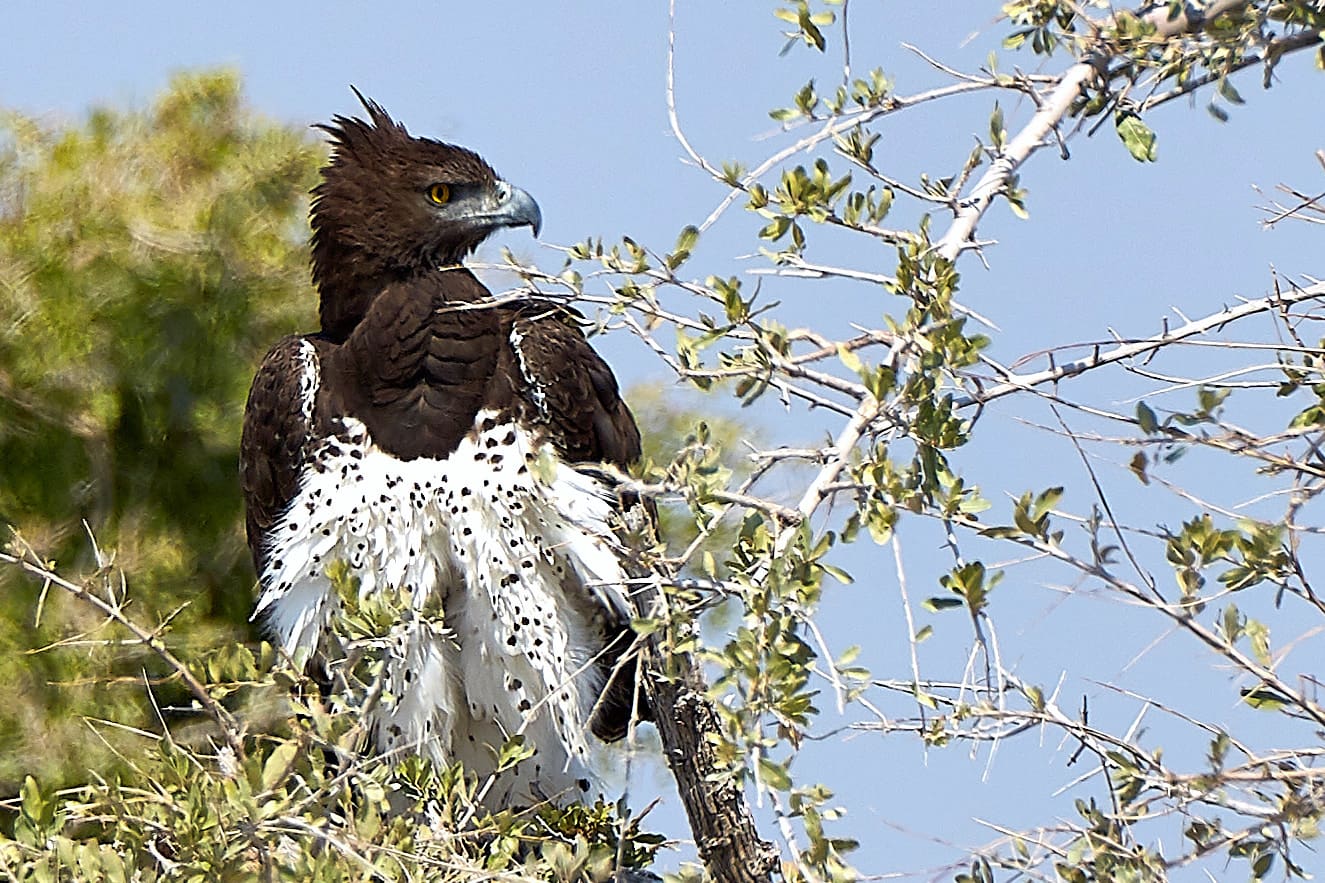
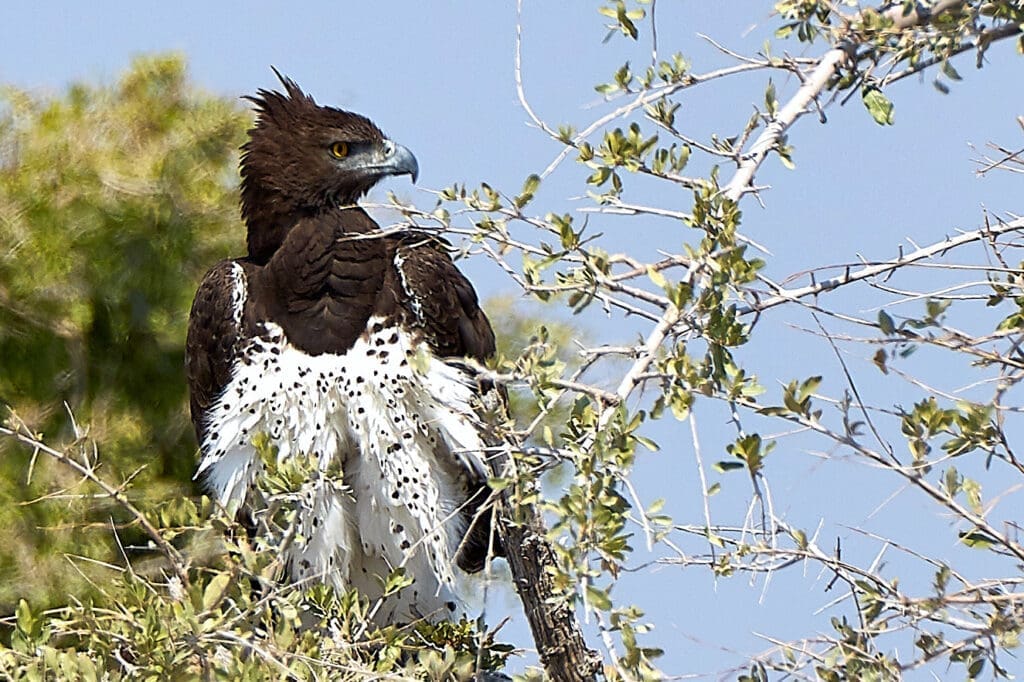
Adult Martial Eagles are dark brown to almost blackish brown on the crown, nape, back, and upperwings, forming a solid, uniform mantle. The white chest, belly, and legs are marked with distinct dark brown to black spots or tear-shaped blotches. The spotting is heaviest on the chest, and becomes sparser towards the belly. The underside of the wings have a whitish base with darker flight feathers, giving quite a contrasting look while in flight, and the tail is dark brown with faint, broad grayish bands. Finally, the eyes sport striking yellow irises.
Juveniles, by comparison, are much paler with less contrast and with coloration often described as “washed out.” The head and upperparts are chocolate to sandy brown, while the underparts are almost entirely white with little to no spotting. The underside of the wings is pale overall, lacking the sharp contrast between the body and flight feathers seen in adults. The tail is paler brown with more visible banding than the adults, and the eyes are dark brown or grayish in coloration.
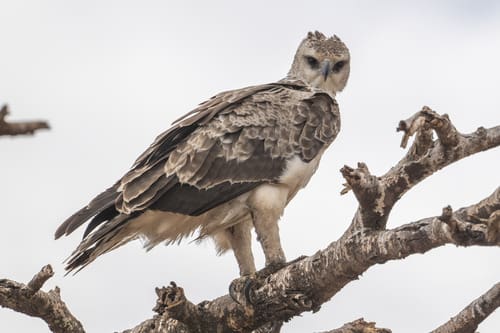
Image credit: nancylightfoot via iNaturalist (CC-BY-NC)
A High-Flying Powerhouse
The Martial Eagle is diurnal, and spends most of the day on the wing, soaring at heights at around 3.5 miles (5,500 m) above seal level. At these heights, the Martial Eagle can often not be seen by the naked eye. Speaking of eyes, in part due to theirs being roughly the size of a human’s, the Martial Eagle has incredibly keen eyesight, eight times as powerful as a human’s, and is able to spot prey from 3.1-3.7 miles (five to six km) away.
From its position high in the air, and with its muscular legs, powerful talons, and sharp beak, the Martial Eagle swoops down and delivers a swift and deadly strike, immediately incapacitating its prey. Coupled with the Martial Eagle’s immense size, the force is able to knock an adult human off their feet! Due to its spotted underbelly and ferocious efficiency as a predator, the Martial Eagle has sometimes been nicknamed “the leopard of the air.” A worthy moniker, indeed!
More Power Needed: Conservation
Despite their power as an apex predator, the Martial Eagle’s strength in numbers has been on a downward spiral in the wild. The most critical cause for the decline across their vast range in sub-Saharan Africa is direct persecution by farmers via hunting, trapping, and in very rare cases, poisoning, as they are mistakenly perceived as threats to livestock. In actuality, due to their shyness around humans, livestock makes up a very small percentage of a Martial Eagle’s diet.
Other threats facing the Martial Eagle include indirect poisoning, drowning in sheer-walled reservoirs, electrocution on power lines and pylons, habitat alteration and degradation, and nest disturbance. In West Africa, the Martial Eagle is also threatened by a decline in suitable prey through human over-hunting. Large mammal populations in West Africa, an important food resource for the eagle, are highly threatened, and as human populations continue to rise, the threats are likely to increase in the future. The reduction in natural prey may lead to an increase in predation on domestic animals, which may in turn lead to further increased persecution by farmers.
In some areas, birds including the Martial Eagle may be taken for use in traditional medicine, and bird parts have been found in muthi markets (i.e., traditional Southern African medicine markets) in Johannesburg, South Africa. Finally, Martial Eagles can use power pylons as nesting sites, which can lead to power outages, and thus create another form of human-wildlife conflict.
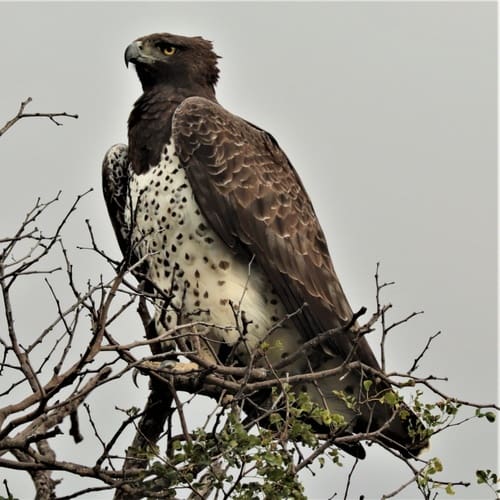
Photo credit: iprabhu via iNaturalist (CC-BY-NC-ND)
Currently, the Martial Eagle is listed as Endangered on the IUCN’s Red List. Conservation efforts are underway to aid the Martial Eagle, including a system initiated in South Africa to compensate farmers for stock losses. Additional proposed conservation actions include introducing programs that combine awareness campaigns and compensation to farmers for stock losses across the eagle’s range, installing anti-electrocution devices on power pylons, implementing education and awareness campaigns across the eagle’s range to reduce the use of poisoned baits, and carrying out regular population monitoring across the eagle’s range.
Hopefully, with these actions implemented, the Martial Eagle’s numbers can recover, and this incredible bird of prey can continue to soar across the southern African skies for decades to come.

Sienna Weinstein is a wildlife photographer, zoologist, and lifelong advocate for the conservation of wildlife across the globe. She earned her B.S. in Zoology from the University of Vermont, followed by a M.S. degree in Environmental Studies with a concentration in Conservation Biology from Antioch University New England. While earning her Bachelor’s degree, Sienna participated in a study abroad program in South Africa and Eswatini (formerly Swaziland), taking part in fieldwork involving species abundance and diversity in the southern African ecosystem. She is also an official member of the Upsilon Tau chapter of the Beta Beta Beta National Biological Honor Society.
Deciding at the end of her academic career that she wanted to grow her natural creativity and hobby of photography into something more, Sienna dedicated herself to the field of wildlife conservation communication as a means to promote the conservation of wildlife. Her photography has been credited by organizations including The Nature Conservancy, Zoo New England, and the Smithsonian’s National Zoo and Conservation Biology Institute. She was also an invited reviewer of an elephant ethology lesson plan for Picture Perfect STEM Lessons (May 2017) by NSTA Press. Along with writing for Bio4Climate, she is also a volunteer writer for the New England Primate Conservancy. In her free time, she enjoys playing video games, watching wildlife documentaries, photographing nature and wildlife, and posting her work on her LinkedIn profile. She hopes to create a more professional portfolio in the near future.
Dig Deeper
- https://academic.oup.com/beheco/article-abstract/28/3/657/3058530
- https://www.cbsnews.com/news/giant-pandas-off-endangered-species-list-china/
- https://en.wikipedia.org/wiki/Giant_panda
- https://www.ifaw.org/journal/15-fascinating-facts-giant-pandas
- https://www.iucnredlist.org/species/712/121745669
- https://nationalzoo.si.edu/animals/giant-panda
- https://www.nature.org/en-us/get-involved/how-to-help/animals-we-protect/giant-panda/
- https://www.pandasinternational.org/education-2/panda-facts/
- https://pmc.ncbi.nlm.nih.gov/articles/PMC4442137/
- https://www.theguardian.com/world/2021/jul/09/giant-pandas-no-longer-endangered-in-the-wild-china-announces
- https://www.universityofcalifornia.edu/news/why-are-pandas-black-and-white-uc-davis-scientists-have-answer
- https://www.washingtonpost.com/news/speaking-of-science/wp/2015/05/20/giant-pandas-somehow-exist-despite-having-guts-that-can-barely-process-the-only-food-they-eat/
- https://www.worldwildlife.org/stories/what-do-pandas-eat-and-other-giant-panda-facts