
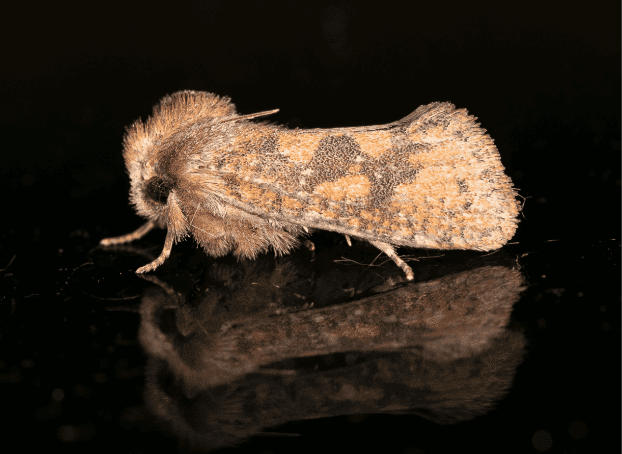
What animal evolved ears on its ribcage, can detect sounds far beyond the range of human hearing, and performs dazzling aerial evasive maneuvers in total darkness—all to avoid being eaten mid-flight?
The Night-flying Moth!
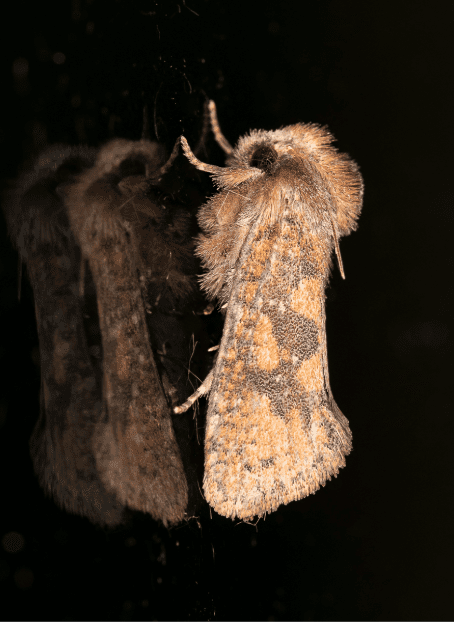
This week’s Featured Creature is written by Allison Eckard. Allison is a student at Lesley University studying Animal Behavior. She is interning with Bio4Climate this spring.
The Moth That Learned to Hear Death
The first time I learned that some moths have ears on the sides of their thorax, I assumed it was a delightful biological oddity. They certainly didn’t evolve ears to hear music! Instead, they evolved them to hear bats.
In one of my animal behavior classes, I remember seeing the neural pathway drawn on the board: sensory receptor → interneuron → motor neuron → muscle. Clean. Elegant. Survival encoded in milliseconds. That was the moment it clicked for me. Biodiversity isn’t just about species existing. It’s about systems in motion. It’s about evolutionary arms races unfolding in the dark. And the night sky is full of them.
Life in the Ultrasonic Battlefield
Bats hunt using echolocation. They emit high-frequency ultrasonic pulses, typically between 20 and 100 kHz, and listen for the returning echoes to detect and track prey. To human ears, this world is completely silent. To a moth, it is full of alarms.
Many nocturnal moth species have evolved tympanal organs—simple “ears” located on the thorax—that are exquisitely tuned to ultrasonic frequencies. For moths, a split-second neural decision can mean the difference between life and death. Some species can detect bat calls specifically in the 20 to 50 kHz range. Inside those ears are two primary receptor neurons, typically called the A1 and A2 cells, and their division of labor is a marvel of minimalist engineering.
A1 receptors are highly sensitive and respond to distant bat calls—the first whisper of danger from across the night sky. When A1 fires, the moth subtly alters its flight path, steering away from the threat before it even registers as a genuine emergency.
A2 receptors only fire when a bat is very close—when the sound intensity spikes into the danger zone. When A2 fires, the moth throws all caution aside and performs drastic evasive maneuvers: dives, loops, and sudden power-off drops toward the ground.
This is stimulus filtering at its finest. Ignore irrelevant background noise; respond only to biologically meaningful signals. Evolution has shaped moth nervous systems to prioritize exactly the frequencies associated with their primary predators. In a very real sense, the moth’s brain has been sculpted by bats.
An Arms Race in the Dark
The relationship between bats and moths is a textbook example of coevolution—an ongoing, reciprocal evolutionary arms race. Bats evolve more precise echolocation; moths evolve better detection and faster evasive flight. Some bats shift to quieter or higher frequencies to “fly under the radar” of moth hearing; some moths respond by widening their auditory range. The battlefield reshapes both combatants, generation by generation.
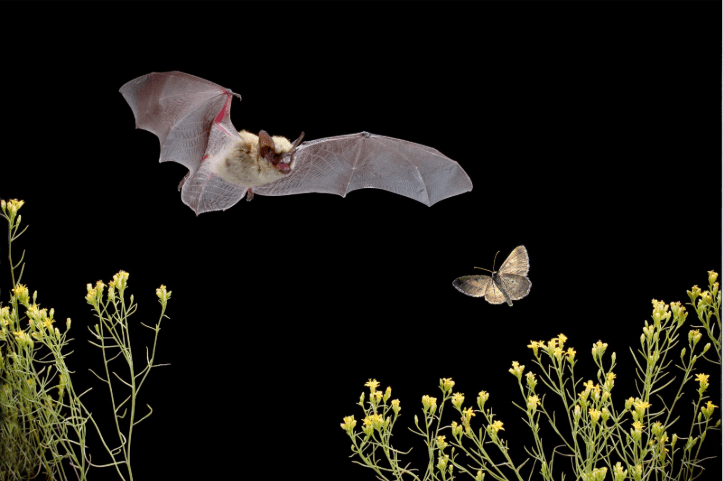
Some moth lineages have taken defense a step further. Certain tiger moths (family Erebidae) produce rapid ultrasonic clicks that may actually jam bat sonar or advertise to the bat that the moth is chemically unpalatable—a kind of acoustic warning label. The night sky, far from being the quiet backdrop we perceive, is an adaptive battlefield alive with ultrasonic signals, countermeasures, and counter-countermeasures.
More than Just Predator and Prey: Moths as Ecological Connectors
It would be easy to focus on the drama of the bat-moth chase and miss a larger story. Moths are not merely prey. They are pollinators, nutrient cyclers, and food web anchors that connect plant and animal communities across entire ecosystems (Macgregor et al., 2015). Many night-blooming plants depend almost entirely on moths for pollination—relationships that have co-evolved over millions of years, as intricate as any bat-moth interaction.
Yet nocturnal insect populations are declining globally. Long-term studies have documented dramatic losses in flying insect biomass across multiple regions, driven by habitat loss, pesticide use, and climate change. Among the most overlooked and underappreciated threats is artificial light at night (ALAN).
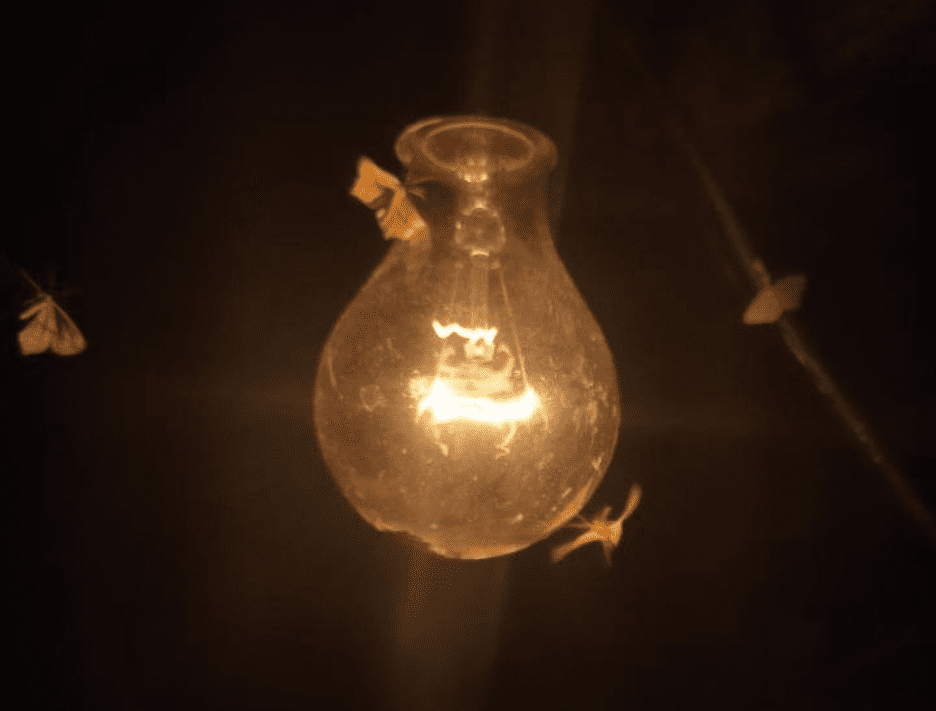
Light pollution disrupts moth navigation, mating behavior, and the very predator-detection systems we have been admiring—drawing moths toward lights where they are exposed, exhausted, and vulnerable (Owens et al., 2020).
The consequences cascade. Fewer moths mean less food for bats, whose own populations are already stressed by disease and habitat loss. It means fewer pollinators for night-blooming wildflowers. It means weakened food webs from the ground up. The bat-moth arms race, so finely tuned over millions of years, cannot simply be paused and resumed. Once the players are gone, the relationship dissolves.
What Moths Teach us about Engineering and Intelligence
From a biomimicry perspective, the moth auditory system offers a humbling lesson. With only two primary receptor cells, a moth executes rapid, context-sensitive, life-saving decisions in real time—distinguishing a distant threat from an immediate one and responding proportionately to each. In an era where we design elaborate sensor networks and AI systems to perform exactly this kind of layered threat detection, there is something worth pausing over: evolution already solved this problem, elegantly and cheaply, hundreds of millions of years ago.
Open questions remain. How flexible are moth neural responses under rapid environmental change? Can populations adapt quickly enough to shifting bat echolocation frequencies, increasing anthropogenic noise, or the novel sensory landscape created by artificial light? These are not merely academic curiosities—they are questions about whether a coevolutionary relationship refined over geological time can survive the pace of human-caused change.
What We Can Do
Protecting biodiversity means protecting relationships, not just species. The bat-moth arms race is one conversation in a vast, interconnected web of such dialogues. When we protect the conditions that allow it to continue—intact habitats, dark skies, pesticide-free landscapes, and the native plant communities that support insect diversity—we protect the whole fabric.
Practical steps include:
- Reducing or eliminating pesticide use, which directly depletes moth populations and the prey base for bats
- Supporting dark-sky initiatives and switching to wildlife-friendly outdoor lighting to limit the disorienting effects of ALAN
- Protecting and restoring bat habitats, including old trees, caves, and undisturbed buildings that serve as roosts
- Planting native species, especially night-blooming flowers that support moth populations and the broader pollination networks they anchor
When a moth detects the ultrasonic pulse of an approaching bat and drops into a power dive—a maneuver honed across millions of years of reciprocal evolution—we are witnessing one of the most ancient and intricate dialogues in the natural world. That dialogue is part of the climate story. And it is worth listening to.

Allison Eckard is a senior Biology major with minors in Health and Environmental Science at Lesley University with a passion for ecological literacy and science communication. Through her internship with Bio4Climate, she explores the hidden relationships between neural systems, biodiversity, and climate resilience. She especially enjoys helping readers discover the surprising ways evolution shapes life in the smallest—and most unexpected—places.
References
Corcoran, A. J., Barber, J. R., & Conner, W. E. (2009). Tiger moth jams bat sonar. Science, 325(5938), 325–327.
Fullard, J. H. (1998). The sensory coevolution of moths and bats. In R. R. Hoy, A. N. Popper, & R. R. Fay (Eds.), Comparative Hearing: Insects (pp. 279–326). Springer.
Hallmann, C. A., Sorg, M., Jongejans, E., et al. (2017). More than 75 percent decline over 27 years in total flying insect biomass in protected areas. PLOS ONE, 12(10), e0185809.
Macgregor, C. J., Pocock, M. J. O., Fox, R., & Evans, D. M. (2015). Pollination by nocturnal Lepidoptera, and the effects of light pollution: a review. Ecological Entomology, 40(3), 187–198.
Owens, A. C. S., Cochard, P., Durrant, J., Farnworth, B., Perkin, E. K., & Sondergaard, B. (2020). Light pollution is a driver of insect declines. Biological Conservation, 241, 108259.
Roeder, K. D. (1962). The behaviour of free flying moths in the presence of artificial ultrasonic pulses. Animal Behaviour, 10(3–4), 300–304.
Schnitzler, H.-U., & Kalko, E. K. V. (2001). Echolocation by insect-eating bats. BioScience, 51(7), 557–569.
Ter Hofstede, H. M., & Ratcliffe, J. M. (2016). Evolutionary escalation: the bat–moth arms race. Journal of Experimental Biology, 219(11), 1589–1602.