
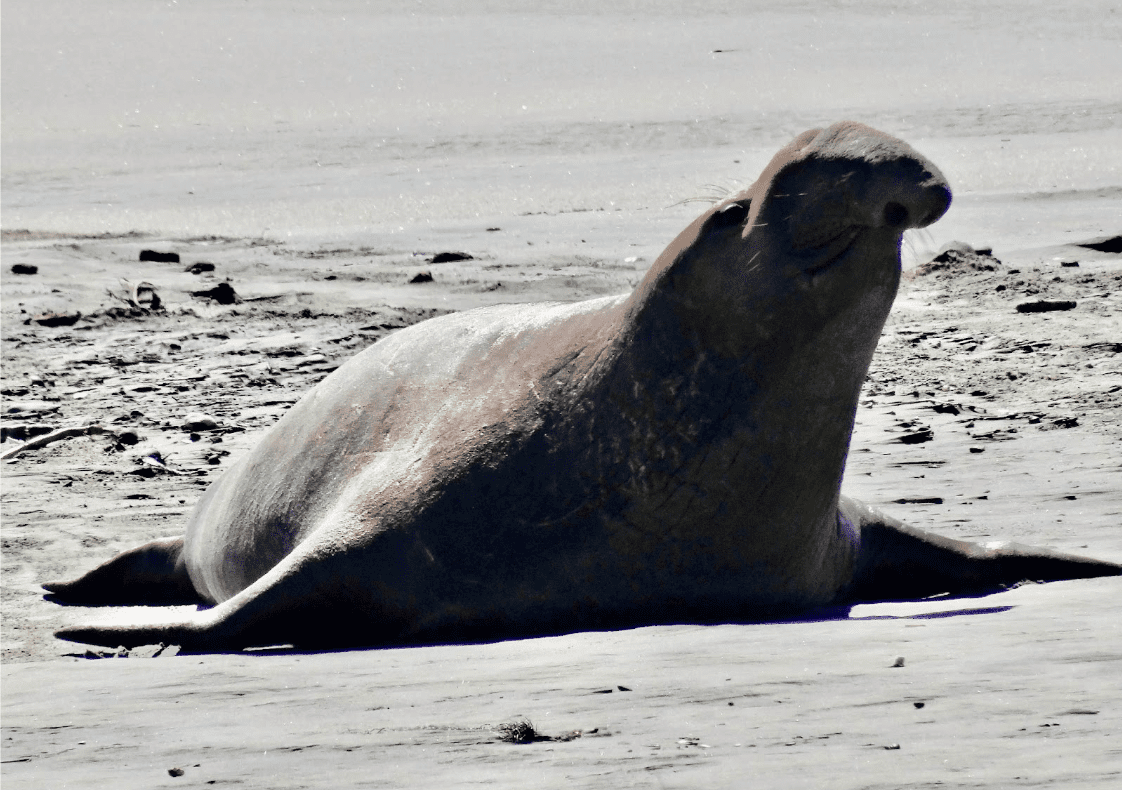
What animal’s nose doubles as a megaphone and a built-in water recycler?
The Elephant Seal! (Mirounga)
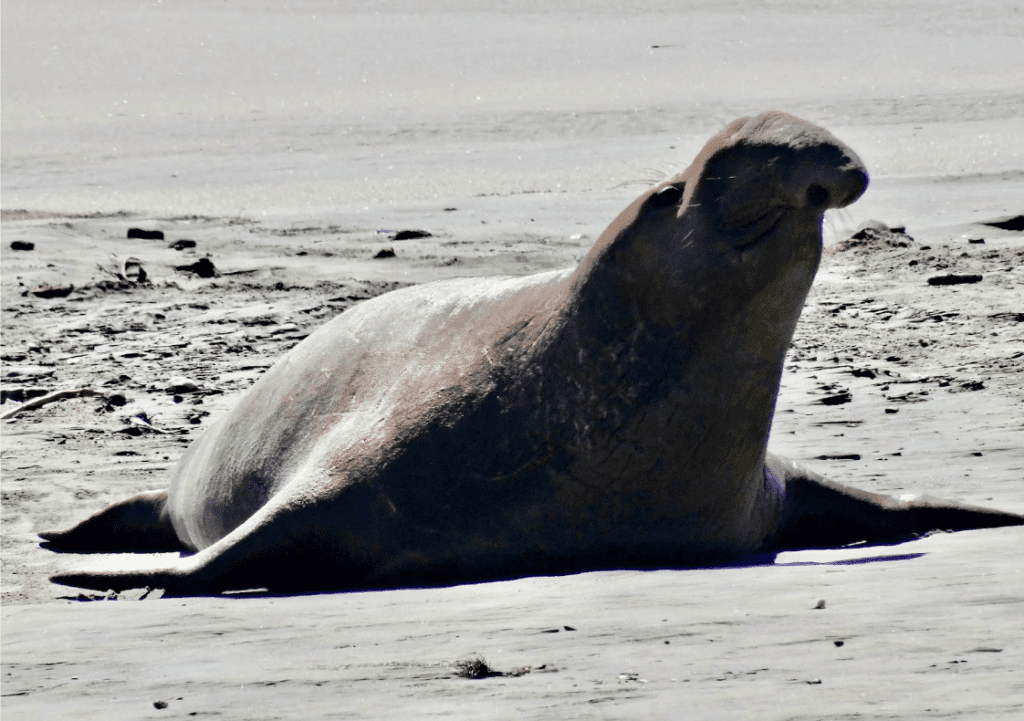
Image copyright, Sienna Weinstein, 2026.
This week, we visit coastal California with Sienna Weinstein.
Blubbery monarch
Crowned with scars and briny roar,
Tide bows at his chest.
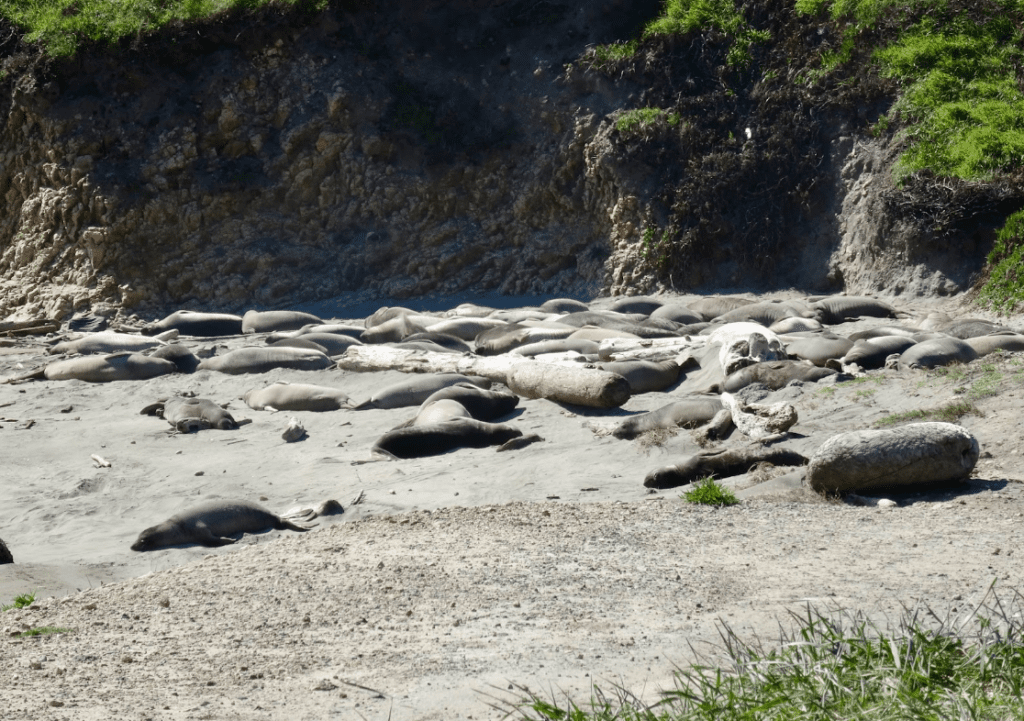
As I finalize today’s Featured Creature, I am vacationing in the Silicon Valley of California. I recently explored Point Reyes National Seashore to take in the natural beauty of the area, and, more importantly, visit the iconic residents of this nature preserve: the northern elephant seals. By the time I arrived, breeding had concluded and the adult females had left the beach to feed. All that remained were groups of weaned pups and a few adult males.
Two Species, One Recognizable Appearance
There are two species of elephant seal: the northern and southern elephant seal. When not foraging for food in the open ocean, northern elephant seals, which are smaller than their southern cousins, are native to the Pacific coast of Canada, the United States, and Mexico’s Baja California. Southern elephant seals forage in the southern Pacific, Atlantic, and Indian Oceans. They form breeding colonies across the Valdés Peninsula of Argentina, various sub-Antarctic islands—primarily South Georgia, Macquarie, Heard, and Kerguelen, and even extend to the Antarctic pack ice. The southern species has also been spotted visiting the coasts of mainland Australia and New Zealand.
Sexual dimorphism is extreme among elephant seals: males (bulls) weigh up to 10 times more than females (cows), and have a prominent proboscis reminiscent of an elephant’s trunk, hence their name. This nose is used in producing extremely loud roaring sounds, especially during the breeding season. More importantly, however, the nose acts as a kind of rebreather, as it is filled with cavities that reabsorb moisture from their exhalations. This is critical during breeding season when the seals do not leave the beach to feed, and must conserve body moisture, as there is no incoming water source.
Elephant seals are much larger than other seals. Southern elephant seal bulls typically reach a length of 16 feet (5 m), and a weight of 7,000 pounds (3,000 kg); some exceptionally large males may reach up to 20 feet (6 m) in length, and weigh 9,000 pounds (4,000 kg); cows typically measure about 10 feet (3 m) and weigh 2,000 pounds (900 kg). Northern elephant seal bulls reach a length of 14 to 16 feet (4.3 to 4.8 m), and the heaviest of them weigh about 5,500 pounds (2,500 kg). Newborns can weigh 79 pounds (36 kg), and reach lengths up to 4 feet (122 cm).
Despite their massive size, elephant seals move easily in the water. Their bodies are covered in blubber, which helps keep them warm and reduces drag when swimming. Their limbs are small, making them more streamlined in the water, and their hind flippers have a large surface area, which helps propel them through the water. Unfortunately, their reduced limb size makes movement difficult while on land. This marks a difference with eared seals (Family Otariidae, those who have an outer ear, unlike true seals like the elephant seal, Family Phocidae), who are able to turn their hind flippers forward to assist with walking.
Land Ho!: Battling and Breeding
In addition to an annual visit to land in order to molt their fur, the only other time elephant seals come ashore is to breed and birth the next generation. The breeding season for the northern elephant seal runs from December through March, while the breeding season for the southern elephant seal runs from September through November. Males haul out to the rookery first, and females arrive later, heavily pregnant with pups which had been conceived nearly a year prior. Females give birth to a single pup a few days after arriving at the rookery, and pups feed on their mother’s milk for a month, while she doesn’t eat—living off of reserves in her blubber. During the last week of lactating, females go into estrus and the adults work on creating the next generation. Once weaned, the pups spend the next ten weeks learning how to swim and dive.
Males use a dominance hierarchy primarily based upon size, secondarily based upon age, and to some extent, upon previous experience. The alpha males establish harems of 40 to 50 females per individual. Outside of these groups, two to three beta bulls will roam around sections of the alpha’s territory, helping the alpha by preventing other males from accessing the females. Males will use their large proboscisses to vocally threaten others, and typically, this is enough to deter rivals. Should a confrontation occur, males will engage in shoving and battering fights. These fights can be bloody, but usually don’t result in fatalities. During this time of constant breeding and fending off of rivals, males, like females, can lose up to a third of their body weight! After breeding, females retreat back into the water, with the adult males following them. The numbers of adults on the beach continues to dwindle, leaving the weaned pups to practice the skills they need for survival.
Bouncing Back from a Historic Hunting Past
Historically, both subspecies of elephant seal were hunted by humans, who used their blubber to make oil until protections were enacted in the twentieth century. Today, both subspecies are listed as Least Concern on the IUCN Red List.
Compared with the northern elephant seal, southern elephant seals currently face few threats and conflicts, as they live far from human population centers, and have minimal interactions with commercial fisheries. Northern elephant seals, meanwhile, face greater potential for entanglement in fishing gear and collisions with boats. Both species, however, face non-direct human-caused threats, such as pollution, habitat degradation, and climate change. Intensive fishing could deplete prey stocks, and climate change may negatively impact prey populations as well as change marine habitats, especially for the southern subspecies. In addition, southern elephant seals which haul out at mainland sites could come into contact with domestic and wild animals, and potentially be exposed to a variety of diseases, such as morbilliviruses.
Ultimately, while both subspecies continue to bounce back after historic population declines, further monitoring of and actions to mitigate long term threats, including climate change and habitat degradation should continue in order that this enormous seal species survives in an ever-changing world.

Sienna Weinstein is a wildlife photographer, zoologist, and lifelong advocate for the conservation of wildlife across the globe. She earned her B.S. in Zoology from the University of Vermont, followed by a M.S. degree in Environmental Studies with a concentration in Conservation Biology from Antioch University New England. While earning her Bachelor’s degree, Sienna participated in a study abroad program in South Africa and Eswatini (formerly Swaziland), taking part in fieldwork involving species abundance and diversity in the southern African ecosystem. She is also an official member of the Upsilon Tau chapter of the Beta Beta Beta National Biological Honor Society.
Deciding at the end of her academic career that she wanted to grow her natural creativity and hobby of photography into something more, Sienna dedicated herself to the field of wildlife conservation communication as a means to promote the conservation of wildlife. Her photography has been credited by organizations including The Nature Conservancy, Zoo New England, and the Smithsonian’s National Zoo and Conservation Biology Institute. She was also an invited reviewer of an elephant ethology lesson plan for Picture Perfect STEM Lessons (May 2017) by NSTA Press. Along with writing for Bio4Climate, she is also a volunteer writer for the New England Primate Conservancy. In her free time, she enjoys playing video games, watching wildlife documentaries, photographing nature and wildlife, and posting her work on her LinkedIn profile. She hopes to create a more professional portfolio in the near future.
References:
• https://www.bigsurcalifornia.org/elephant-seals/
• https://www.doc.govt.nz/nature/native-animals/marine-mammals/seals/elephant-seal/
• https://elephantseal.org/about-the-seals/
• https://en.wikipedia.org/wiki/Elephant_seal
• https://www.fisheries.noaa.gov/species/northern-elephant-seal
• https://www.iucnredlist.org/species/13581/45227116
• https://www.iucnredlist.org/species/13583/45227247
• https://polar-latitudes.com/discover/wildlife/elephant-seal/
• https://www.pbs.org/wnet/nature/blog/elephant-seal-fact-sheet/
• https://thewhaletrail.org/wt-species/northern-elephant-seal/