Featured Creature: Thylacine

What stands like a kangaroo, has stripes like a tiger, and is found everywhere in art but nowhere in nature?

Meet the Thylacine!
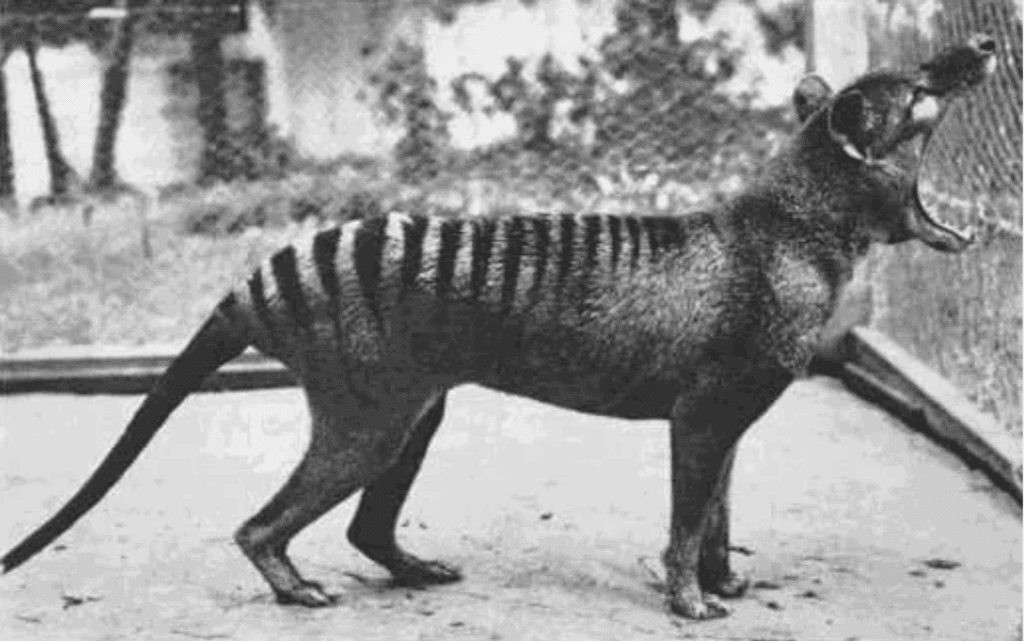
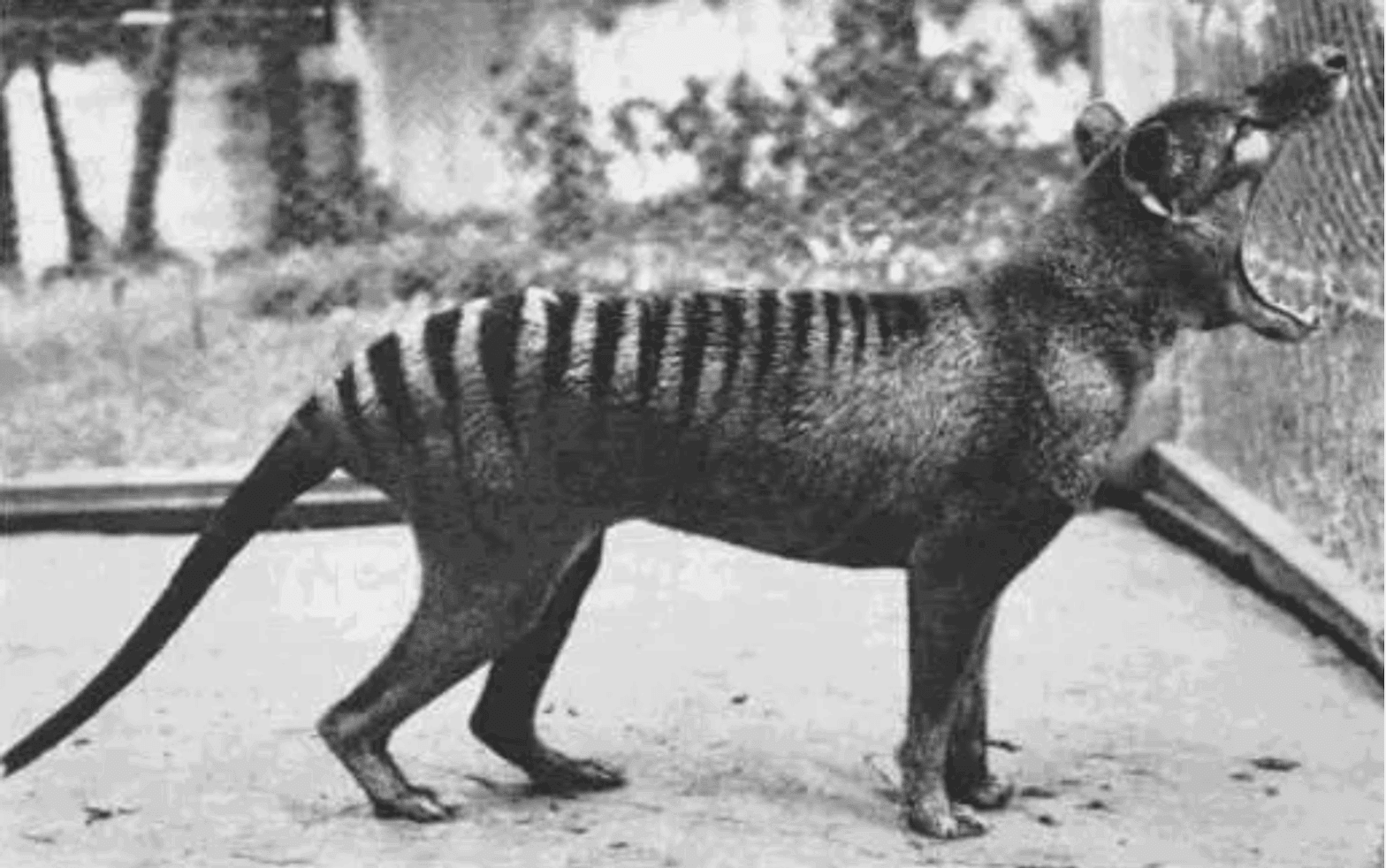
Benjamin, the last living thylacine, showing off his amazing yawn gape at the Hobart Zoo, 1933
(Image credit: Unknown original photographer; Public Domain)

A Unique Creature with a Truly Unique Biology

I was first introduced to the thylacine at a young age while watching a wildlife documentary. This one, focused on the wildlife of Australia, featured a few seconds of black-and-white footage of a wolf-like creature with distinctive tiger-like stripes, pacing around its enclosure at the now-closed Hobart Zoo (also known as the Beaumaris Zoo) in Tasmania’s capital of Hobart. I was captivated by this animal’s unique appearance, and was shocked beyond belief when at one moment, the animal opened its jaws at an alarmingly wide gape. Instantly, it became my favorite extinct animal of modern times, and remains so to this day.

Though it is also known as the Tasmanian tiger and Tasmanian wolf, the thylacine was neither. Rather, it was a marsupial, a group of mammals in which the female carries her young in a pouch. Much like those of tigers, the stripes across the back and down to the base of the tail were used for camouflage. The thylacine was the apex predator in its woodland ecosystem, and relied on ambush to attack its prey. It was also the largest carnivorous marsupial of its time, with a size comparable to that of a medium or large dog.

Despite having raised heels like canids, and typically walking with a stiff, shuffling gait on all fours, the thylacine was able to rest its heels on the ground and use its rigid tail for balance, adopting a kangaroo-like stance. This stance was primarily used to gain better observation of the surroundings. Thylacines were one of only two marsupials in which the male had a pouch (the other was the water opossum). 

The most noteworthy (and intimidating) feature of the thylacine was its ability to open its jaw to a near 80º angle—the widest of any mammal! This may have been beneficial in taking down fast-moving prey, like wallabies. In theory, the greater the gape, the greater the clench onto the prey, which in turn, heightened the chance of a hunt well done. The gape yawn was also documented as a threat warning. It has been theorized that the gape may have been used by males as a display to win the attention of females and intimidate rival males.

Out-Competed, Wrongly Persecuted, and Hunted Until the End

Native to the islands of Tasmania, New Guinea, and mainland Australia, the thylacine died out in the latter two locations over 3,000 years before the arrival of Europeans. This has been theorized to be the result of the introduction of another Australian icon: the dingo, who won the competitive war for prey in those areas, but never reached our striped hero’s last stronghold in Tasmania.

Once Europeans formally established settlements on Tasmania in the nineteenth century, the thylacine was perceived as a sheep thief and a bounty placed on their innocent heads. A series of photos taken by Harry Burrell depicted a thylacine with a chicken in its mouth. Over recent years, these photos have been the subject of heavy debate and discussion among researchers as to whether the individual shown is captive, or even a living specimen. Speculation exists that editing was performed prior to the a photo’s publication in The Australian Museum Magazine (shown below).[1] [2] [3] 

Based on observations, the thylacine was in fact  a shy and reclusive animal. Their depiction as a sheep-killer was greatly exaggerated, yet persisted. A 2011 study exploring thylacine skull biomechanics conducted by Marie Attard, PhD of the University of New South Wales advanced our understanding of their hunting behavior. Her research suggested that the thylacine’s bite force and jaw mechanics restricted it to smaller prey. As stated by Attard, “… our findings suggest that [the thylacine’s] reputation was, at best, overblown.”
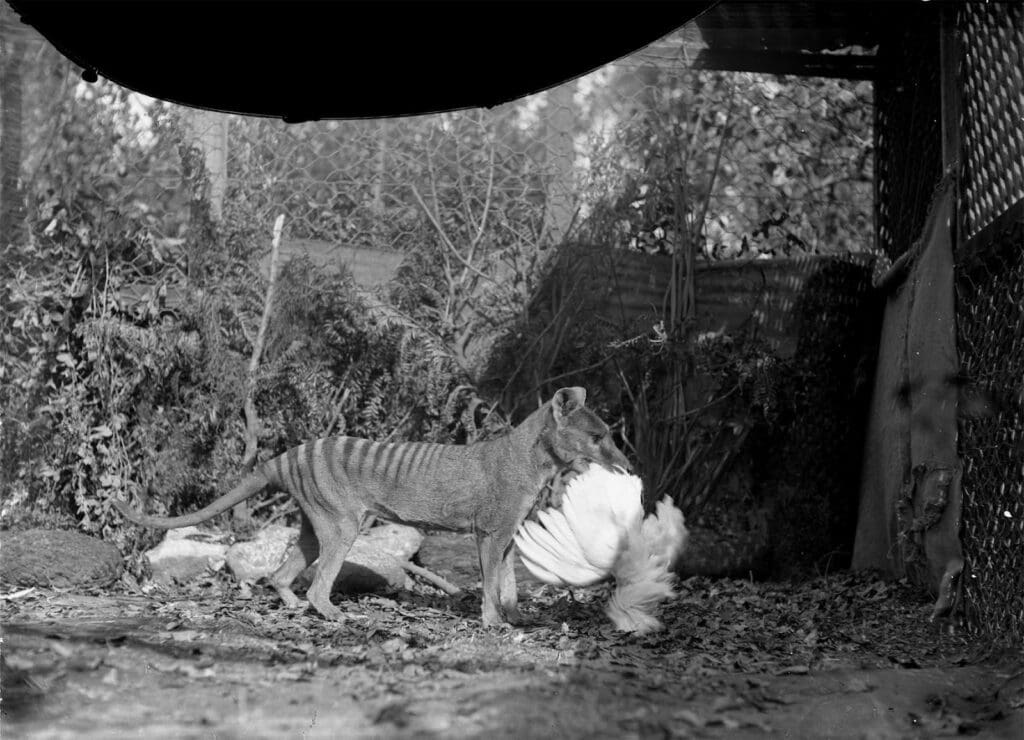
The (potentially-staged) image that sealed the thylacine’s fate: A thylacine specimen with a chicken in its jaws, 1921. The image presented to the Tasmanian public was zoomed in, omitting the fenced background. (Image credit: Harry Burrell; Public Domain)

Cultural Icon

The last wild thylacine was shot and killed by farmer Wilf Batty on his property in Mawbanna, Tasmania, in 1930. In 1936, the last captive thylacine, named Benjamin, died at the Hobart Zoo on September 7. The day is now known as National Threatened Species Day in Australia, and not only serves to remember Benjamin, but to raise awareness for all threatened native plant and animal species throughout the continent. 

Today, the thylacine is a cultural icon of Australia, and imagery of this unique marsupial is found all over Tasmania, including in artwork, the Tasmanian cricket team mascot, license plates, and even the state’s coat of arms.
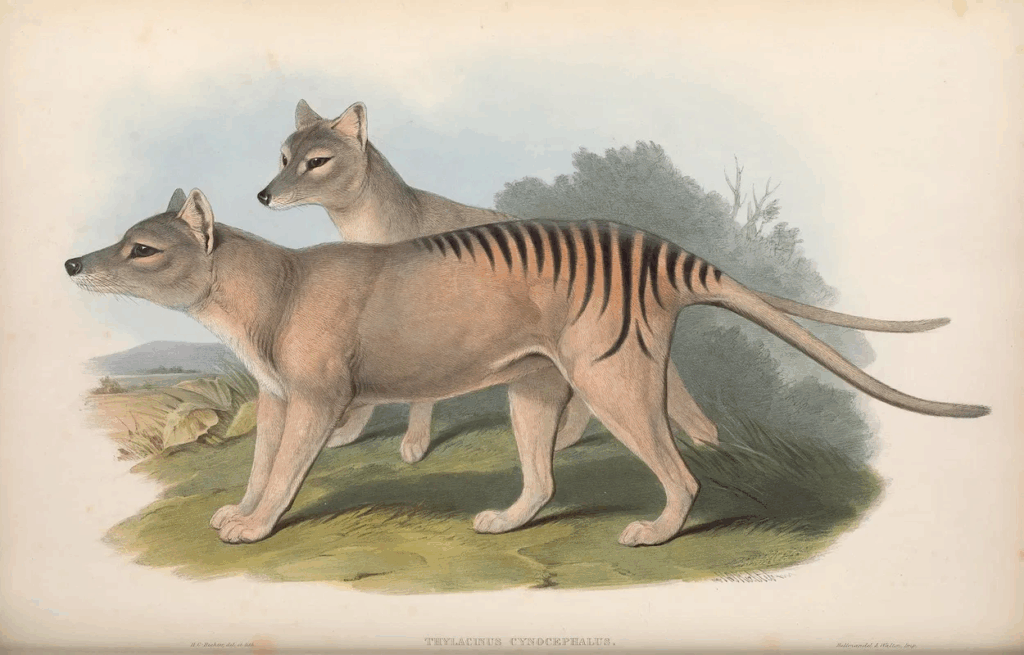
Photograph: HC Richter/National Library of Australia

A Candidate for a Real Life Jurassic Park

The thylacine is just one of several subjects currently undergoing intensive research and experimentation by the American biotechnology and genetic engineering company Colossal Laboratories & Biosciences De-extinction Project. The company has already made headlines for planning to bring back the wooly mammoth; the thylacine is another animal they hope to bring back from extinction. 

As the apex predator of Tasmania, the thylacine controlled populations of various native and invasive herbivore species, ensuring they did not cause chaos in their native ecosystem. This included preventing overgrazing, culling weaker and sick animals, suppressing disease among other species, and promoting biodiversity. Since the loss of the thylacine, trophic downgrading has occurred, which is a significant ecological disruption that cascades throughout the food chain. 

Think about the classic example of Yellowstone’s wolves: when they were hunted to near extinction, herds of elk began overgrazing across the landscape, damaging the health of the ecosystem. With the return of wolves to Yellowstone, elk numbers are kept in check, and the number of plant and animal species have since diversified and thrived. 

While genetic engineering may create hope of restoring thylacines as the wolf of Tasmania, it is more important to address threats to living species and their habitats. As we restore the water cycles and vegetation of degraded land, biodiversity begins to recover, creating a positive feedback loop of regeneration. 


Sienna Weinstein is a wildlife photographer, zoologist, and lifelong advocate for the conservation of wildlife across the globe. She earned her B.S. in Zoology from the University of Vermont, followed by a M.S. degree in Environmental Studies with a concentration in Conservation Biology from Antioch University New England. While earning her Bachelor’s degree, Sienna participated in a study abroad program in South Africa and Eswatini (formerly Swaziland), taking part in fieldwork involving species abundance and diversity in the southern African ecosystem. She is also an official member of the Upsilon Tau chapter of the Beta Beta Beta National Biological Honor Society.

Deciding at the end of her academic career that she wanted to grow her natural creativity and hobby of photography into something more, Sienna dedicated herself to the field of wildlife conservation communication as a means to promote the conservation of wildlife. Her photography has been credited by organizations including The Nature Conservancy, Zoo New England, and the Smithsonian’s National Zoo and Conservation Biology Institute. She was also an invited reviewer of an elephant ethology lesson plan for Picture Perfect STEM Lessons (May 2017) by NSTA Press. Along with writing for Bio4Climate, she is also a volunteer writer for the New England Primate Conservancy. In her free time, she enjoys playing video games, watching wildlife documentaries, photographing nature and wildlife, and posting her work on her LinkedIn profile. She hopes to create a more professional portfolio in the near future.


Dig Deeper

https://www.australiangeographic.com.au/photography/2018/01/fake-or-real-this-photo-of-the-thylacine-has-caused-a-lot-of-controversy/

https://www.biospace.com/press-releases/colossal-achieves-multiple-scientific-firsts-in-progress-towards-thylacine-de-extinction 

https://www.cbsnews.com/news/tasmanian-tiger-scientists-breakthrough-bringing-back-extinct-thylacine/

https://colossal.com/de-extincting-tassie/

https://colossal.com/thylacine/

https://en.wikipedia.org/wiki/Thylacine

https://en.wikipedia.org/wiki/Water_opossum

https://www.instagram.com/p/DICL8ALsbGA/

https://www.livescience.com/15862-tasmanian-tiger-jaw-sheep.html

https://meridian.allenpress.com/australian-zoologist/article/33/1/1/134595/Is-this-picture-worth-a-thousand-words-An-analysis

http://www.naturalworlds.org/thylacine/index.htm

https://www.nma.gov.au/defining-moments/resources/extinction-of-thylacine

https://zslpublications.onlinelibrary.wiley.com/doi/abs/10.1111/j.1469-7998.2011.00844.x

Images:
https://trowbridgegallery.com.au/shop/john-gould/john-gould-mammals/thylacine-2/?srsltid=AfmBOoq-wfbhLQJK0LoefDYytlcCOD3Gjb1KjvlaQZn_6k_tMx1F2UYZ 

https://www.australiangeographic.com.au/photography/2018/01/fake-or-real-this-photo-of-the-thylacine-has-caused-a-lot-of-controversy/

https://www.dailymail.co.uk/sciencetech/article-13958755/Deextinction-Tasmanian-Tiger-Colossal-Biosciences.html

https://www.smithsonianmag.com/smart-news/remembering-tasmanian-tiger-80-years-after-it-became-extinct-180960358/

Featured Creature: Cheatgrass

What plant plays an important role in the grasslands of its native hemisphere, but alters soil moisture and fire regimes when introduced in North America?

Cheatgrass (Bromus tectorum)!

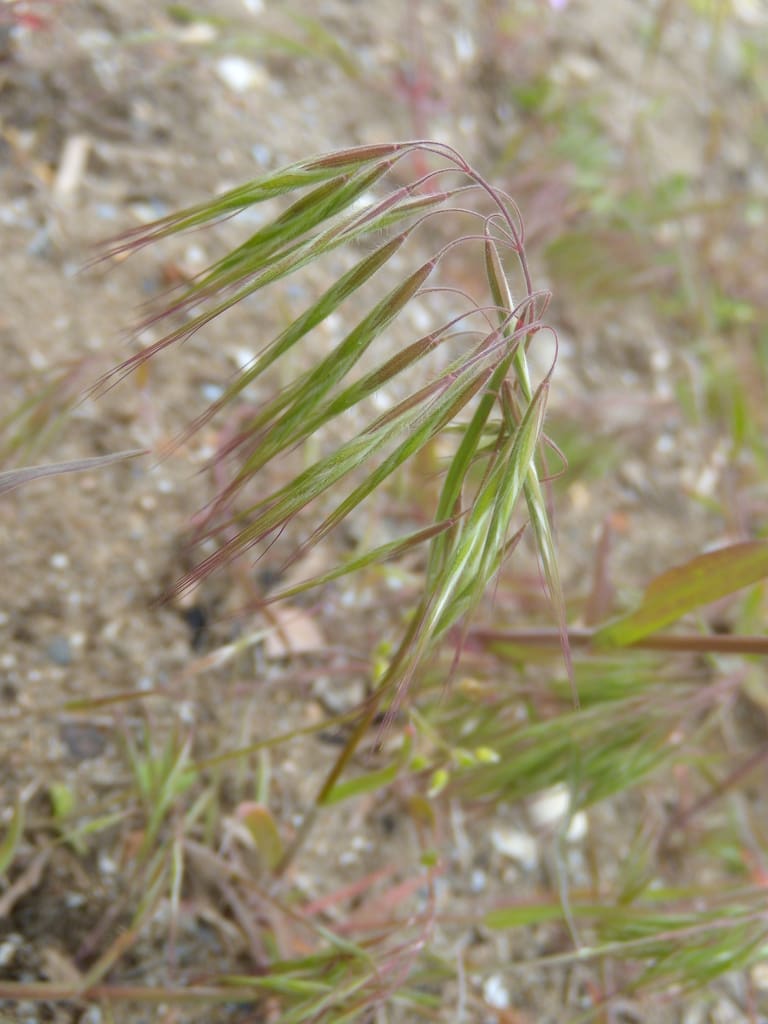
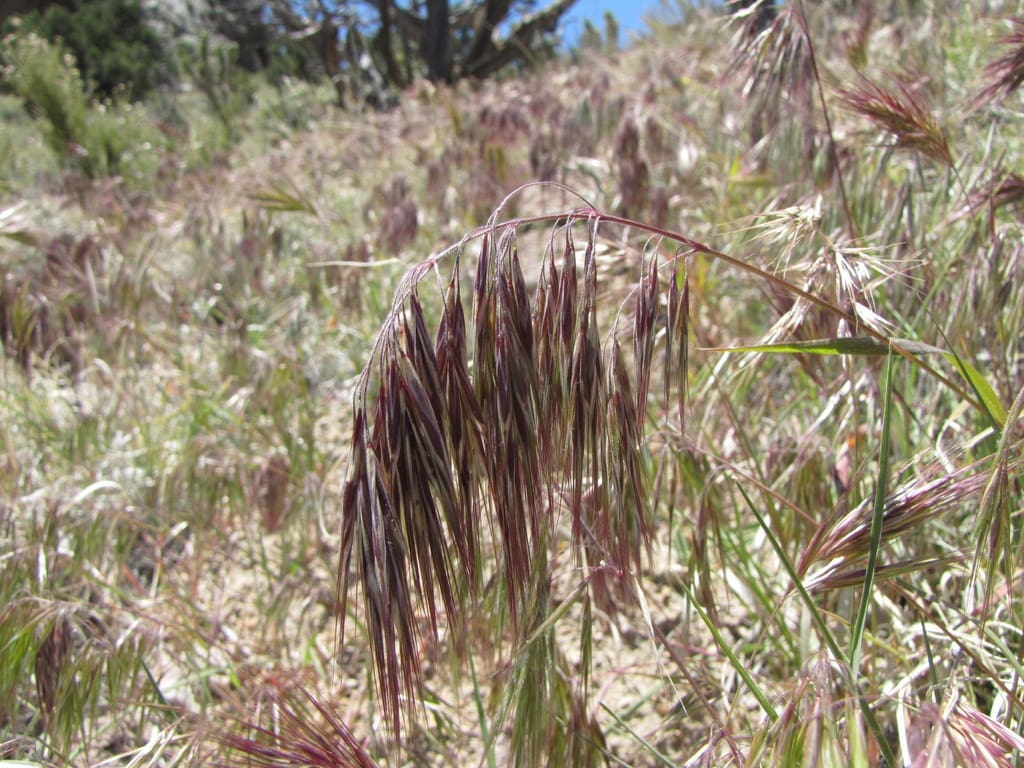
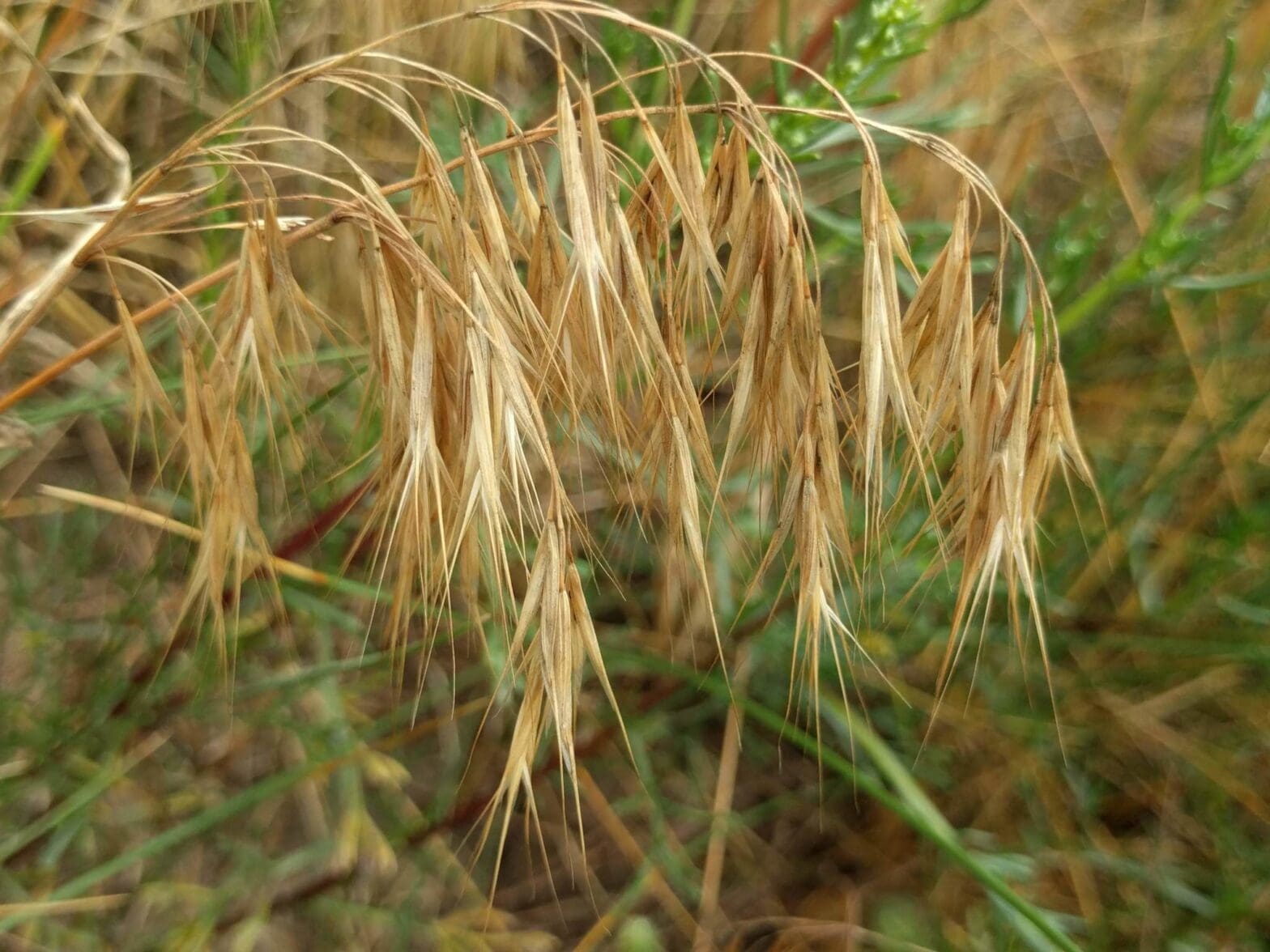
Mature cheatgrass, Bromus tectorum
Michel Langeveld (CC via Wikimedia Commons)

A cheatgrass seed had needled its way into my skin again. I thought that I had freed myself of the cheatgrass when I came back east, to the land of ample water and broad leaves, and threw all of my camping gear into a dark corner of my bedroom. This was not so – it was hiding out in my sock drawer. When I pulled up my socks, I dragged the pointed tips of the cheatgrass seeds up my ankles, and I was once again somewhere out west, nursing the delicate white surface wounds that they left. I was, for the first time, not grateful for the tight warmth-trapping weave of my wool hiking socks – it is highly adept at locking the lance-like grass seed into a comfortable chamber from which it can prod at my ankles. The cheatgrass survived the washer and the dryer and my prying fingernails, survived my desperate attempts to wrench it out of my socks and into the campfire. Cheatgrass burns fantastically well– it’ll ignite from marshmallow-toasting-distance and beyond. 

My cheatgrass came with me from Wyoming months ago. Out there, it rolled for miles across the sagebrush steppe, slowly but surely creeping into every space between every shrub. The site where I gathered the seeds into my socks smelled more of earth than sagebrush, which was unusual for the basins where I’d been working. My boss Rachel and I hopped down out of our work truck and took in our site: some sagebrush, sure, but only a few dashes of it scattered between rolling hills of crisp, flame-red cheatgrass. The site was nearly silent; I found myself missing the usual distant whirrr of farm machinery and the cacophonous cry of a startled sage grouse. We were instead accompanied by the whistling of wind and the knowledge that we would be blowing dust into our handkerchiefs for a few days.

“Downy Brome”

Some call cheatgrass “downy brome”, which is a perfect term for it in the early spring when it hasn’t grown into its wretchedness. In early spring, when its long awns have not yet grown stiff and sharp, it is a soft and elegant plant. Its leaves fall in a gentle cascade from the long stem. The downy brome rolls over hillsides and whispers to its sisters in the breeze; as they dry in late summer, the wind knocks the heads of their seeds against one another, and they are scattered to the ground to start their cycle anew. When the cool season rains end and they’ve sucked up all the water they can from the parched earth, their chloroplasts finally falter, and the grass turns a faint purple-red from the awn-tip up. In spring, the dusty green tones of the sagebrush and the brightly-colored grass dapple the landscape. By summer, the sagebrush is nearly overtaken by an orange-brown, foreshadowing the fire which cheatgrass so often fuels. The grass sticks its seeds through your shoes and between your toes and into your socks and the hems of your pants. It doesn’t matter if you stop to pull them out– you will have just as many jabbing and nudging away at you after you walk another ten feet through their swaying abundance. It is useless to shake them out, too. You must pull them, piece by piece, out of your hair and your tent and your boots, and cast them to the ground. This is just what they wish for– you are seeding them for next year.

A rugged invader

Humans introduced cheatgrass to the Northeastern United States by accident sometime around 1860. You can find it in many places around New England, but in the presence of such an overwhelming amount of water, it often fails to compete with its fellow grasses and is relegated to cracks in sidewalks and highway islands full of compacted, inhospitable soil. Cheatgrass seems lost on this coast; few in the East know what it is or why it’s here. It is a plant surviving as plants do, regardless of the “invasive” status we’ve thrust upon it. In the West, however, its success is something wicked and wonderful.

Any water from the winter’s snowmelt or early spring rains gets sucked up by the eager roots of the cheatgrass, leaving little for the still-sprouting native grasses, forbes, and shrubs, even as their taproots probe deep into the earth. Ecologists curse the plant for its brutal efficiency in driving out those native to the arid steppe; birders lament the loss of woody habitat for their feathered favorites; ranchers sigh at the sight of yet another dry, nutritionally-deficient plant that even their toughest cow is loath to graze. And there is, of course, the fire. Cheatgrass dies and dries in the early summer, long before native grasses do, providing an early fuel source for the ever-lengthening fire season. 

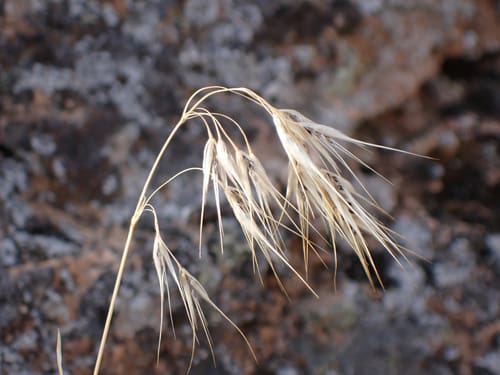
Cheatgrass seeds
Jose Hernandez, USDA (Public Domain via Wikicommons)

The seeds lie in wait in the earth, and in the spring, they unfurl their new leafy heads and emerge from between blackened sagebrush branches. In the grass’s native range in Europe and Southwestern Asia, the plant is no worse or better than any other; it just is. Moths and butterflies lay their eggs along its edges. Ungulates nibble it slowly as their eyes each search opposite directions for the next snack.

Nearly all of the existing research on the plant explores its role far from home, in the United States. It is grass, and it would be hard to imagine that here on the other side of the world, some field tech is cursing its very existence. You’d never know from looking at the cheatgrass that ranchers and federal scientists alike have spent years dousing their own lands in herbicides with the hope of its extirpation. We humans have of course played our role in keeping the cheatgrass strong even as we try to drive it out, since cheatgrass, like many invasives, is far better at taking over already-disturbed soils where the native plant communities and biological soil crusts have been weakened. As extreme wildfires, agricultural use, overgrazing, and the general ravages of climate change continue to impact larger and larger regions, so too does the invasive capacity of the cheatgrass.

 I wore a different pair of socks hiking that day for fear of bringing more cheatgrass to Connecticut. It was silly, though; the cheatgrass already knows this land well. 

Jasmine


Jasmine Gormley is an environmental scientist, writer, and advocate from New Hampshire.  She holds a BS in Environmental Studies from Yale, where she conducted research in plant community ecology and land management. She aims to obtain a degree in environmental law. As a first-generation college student, she is passionate about equity in educational and environmental access, and believes that environmental justice and biodiversity conservation are often one and the same. In her spare time, you can find her rock climbing, foraging, and going for cold water swims.


Sources and Further Reading: