
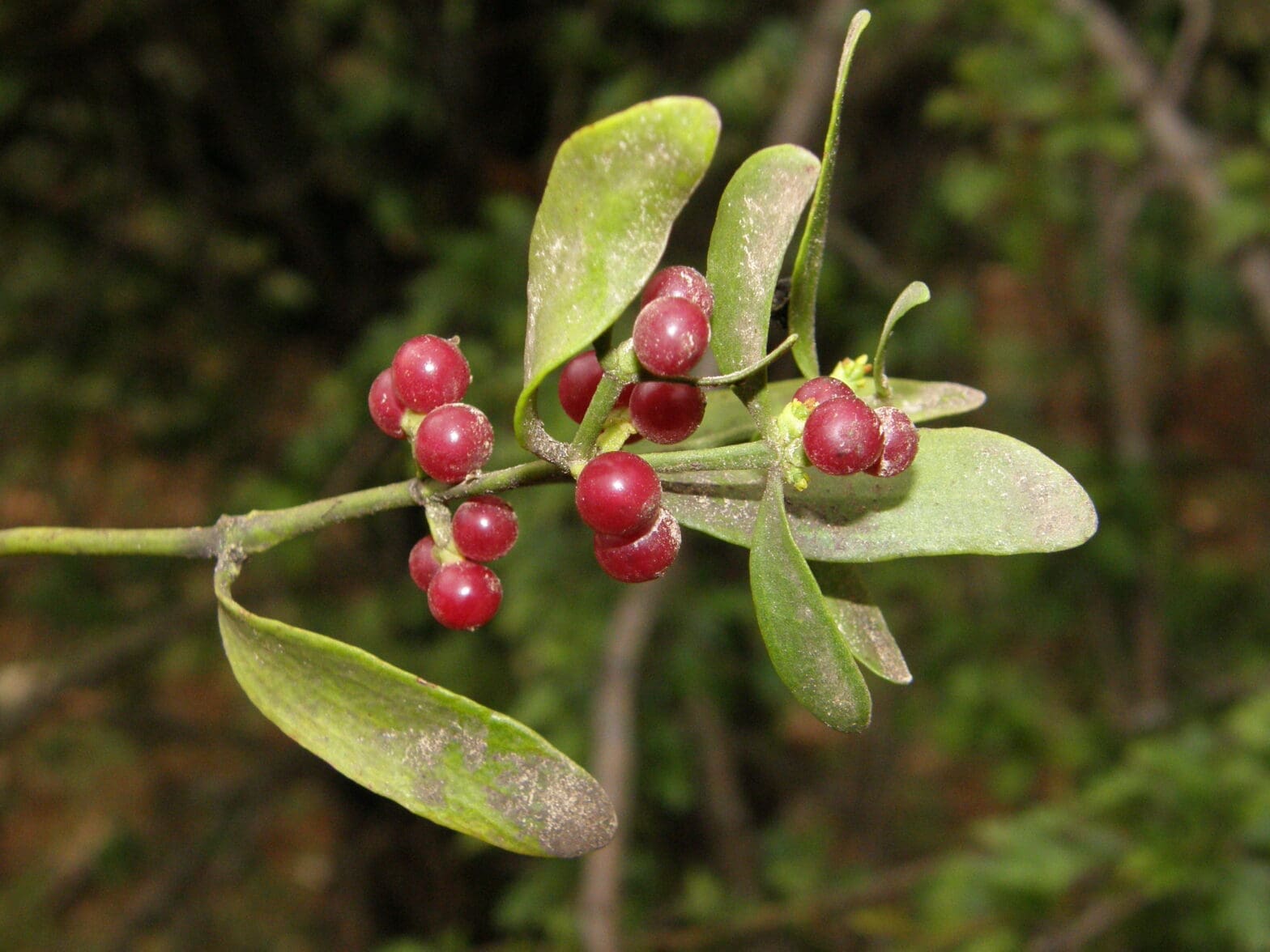
What creature feeds on trees, spits its seeds out, and is known as a symbol of love despite being poisonous to humans?
Mistletoe!
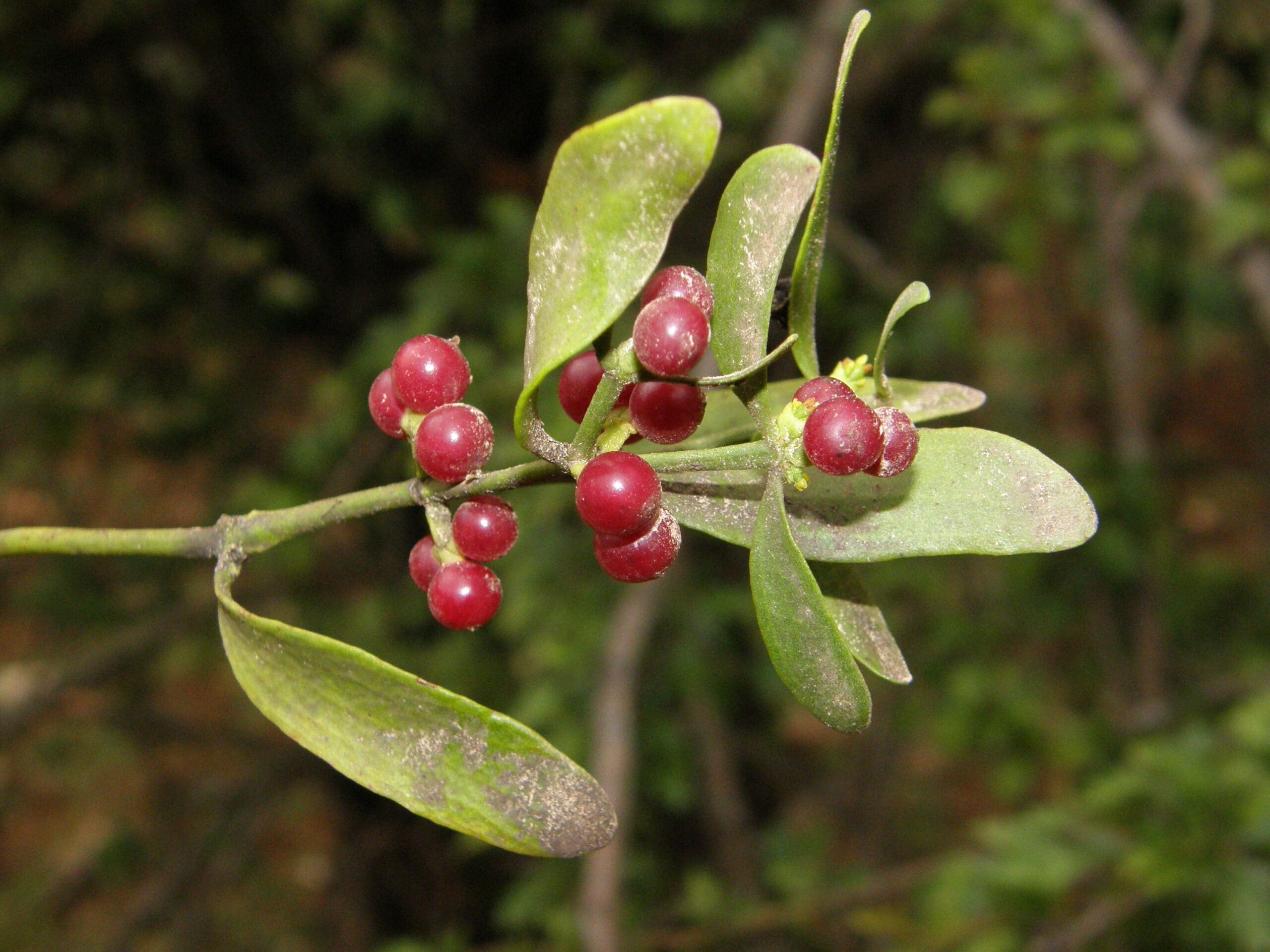
You may be familiar with mistletoe, the Christmas-coded plant known for decorating homes and inciting kisses in the spirit of the season. But how much do you know about the plant’s ecology and history?
This resilient plant, a member of the sandalwood family, evolved to thrive on tree branches, leveraging sticky seeds for self-propagation. Mistletoe is tremendously hardy, with many varieties across the globe, and forms parasitic relationships with trees and shrubs.
Despite its sweet associations, the term ‘mistletoe’ traces its origins back to the Anglo-Saxon words for ‘dung’ (mistel) and ‘twig’ (tan). This nomenclature emerged from a historical belief that mistletoe sprouted from bird droppings, as plants would often appear on branches where birds had left their mark.

A Pretty Parasite
Mistletoe seeds germinate on the branches of host trees or shrubs, initially independent of their hosts. These seeds mature into clumps of two to four embryos, penetrating the bark to rely on the host for sustenance.
Evolutionarily, mistletoes trace their roots to parasitic ancestors that originally relied on tree roots, and later transitioned to attaching to branches. This upward movement facilitated improved access to sunlight and water for photosynthesis, marking a pivotal evolutionary shift. Mistletoes showcase a diverse array of host relationships, attaching not only to trees but also to orchids, cacti, and at times, even to themselves, forming multi-layered associations.
Mistletoe species demonstrate a wide host range, affecting certain host trees by inducing reduced growth, stunted development, and loss of outer branches. However, the severity of infestation rarely results in the death of the trees they inhabit, except in cases of heavy infestations. When mistletoe has encroached intensively, it jeopardizes the crown of the host tree, blocking its functions and appropriating its supply of water and nutrients.
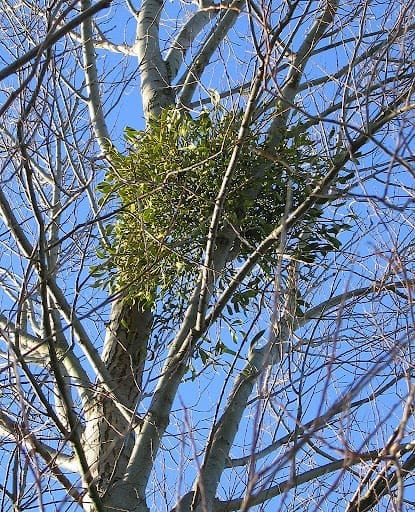
Certain species parasitize succulents, growing primarily within the host plant. Once established within the host’s circulatory system, mistletoes often diminish their own photosynthesis, while relying on the host for sustenance. Some species adapt to semi-arid conditions, conducting photosynthesis and transpiration within their stems, thereby lessening their demands on the host plant. Conversely, other species display vigorous green leaves and engage actively in photosynthesis.
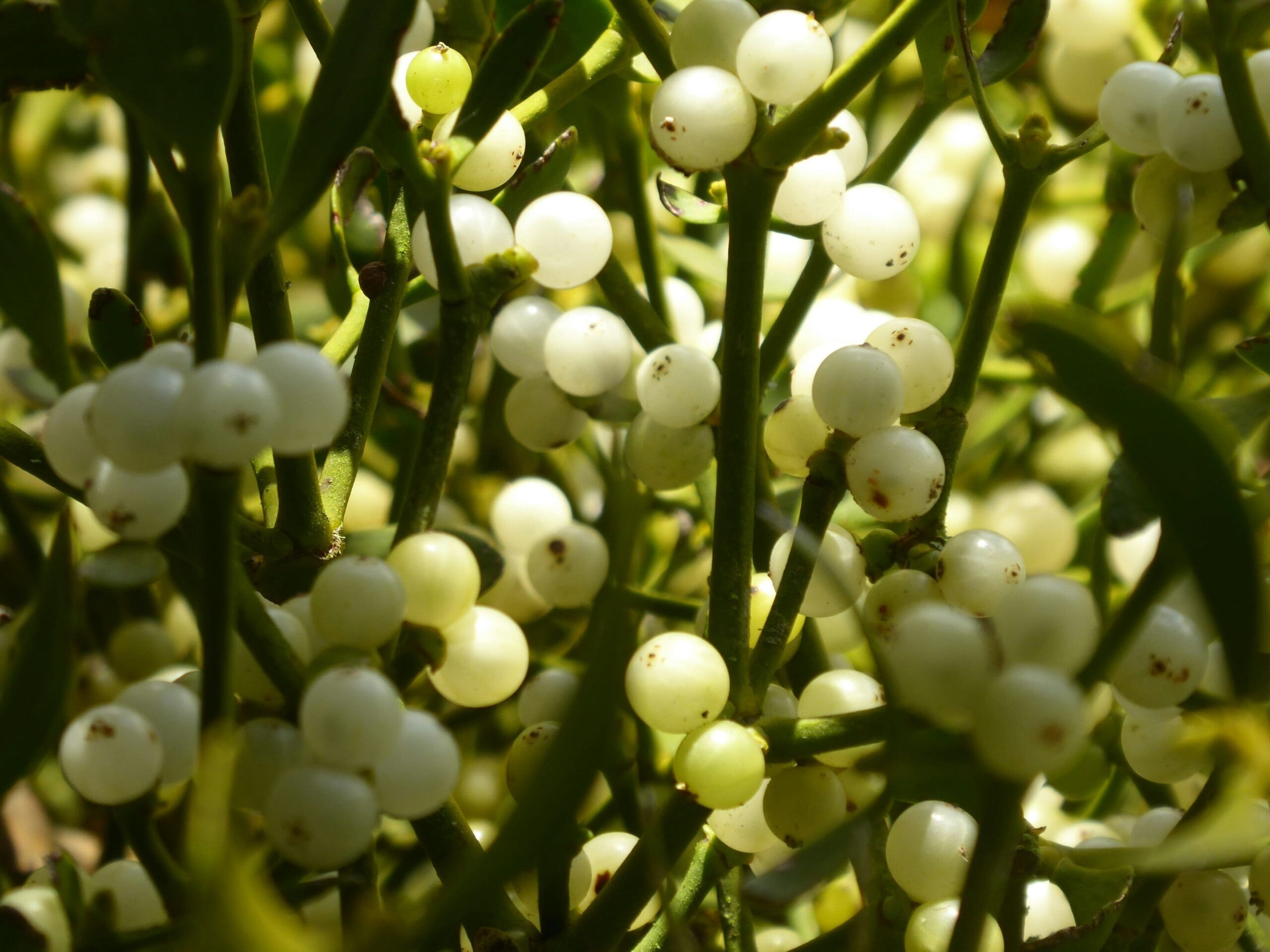
These plants exhibit dioecious characteristics, meaning that male and female flowers reside on separate plants. While some plants produce only pollen (male), others yield white berries (female). All mistletoe species perform some degree of photosynthesis during their life cycle, which makes them hemiparasites (a plant that has not lost all chlorophyll, and does not have to derive all its energy from a host).

Ecological Role
Despite often being considered pests, some mistletoe species hold significance as keystone species. These plants provide crucial food sources for various animals, with sticky seeds dispersed through consumption. Fallen mistletoe leaves enrich the forest floor with nutrients, benefiting multiple species across the food chain. Mistletoes support a rich ecosystem, serving as habitats for diverse wildlife, including birds, mammals, butterflies, and bees. Researchers have identified over 20 endangered mistletoe species out of approximately 1500 known variants.
Birds predominantly spread mistletoe seeds by consuming their berries, while mammals and, during heavy floods, fish also partake in mistletoe berry consumption. Dwarf mistletoes, primarily parasitic on coniferous trees, utilize water pressure within their berries to propel their sticky seeds at speeds approaching nearly 50 miles per hour (or 80 km/h), attaching firmly to new host sites. That is some hardcore propagation in action!
Mistletoe appeals to many different bird species, acting as both a dietary component and a potential pollinator due to many mistletoe flowers being rich in nectar. Numerous bird-pollinated mistletoe species feature vivid, lipstick-red flowers and have evolved intricate mechanisms, such as fused petals that explosively discharge pollen onto birds’ heads.
Poison or medicine?
The toxicity of mistletoe varies among its 1500 species, and some Asian variants of the plant are used in traditional medicine. Toxic exposure to mistletoe may cause blurred vision, diarrhea, nausea, vomiting, and even cardiac issues. The plant’s toxic elements concentrate in its leaves and berries, so don’t fancy yourself a pollinator and try them.
Like in many substances and natural compounds, the line between helpful and harmful is a thin one, and depends on context and combination. Historically different mistletoe variants have been used to treat various ailments like arthritis, high blood pressure, epilepsy, and infertility, and these days mistletoe extracts are being explored for their potential effectiveness against cancer.
Many European mistletoe extracts are sold as prescription drugs, but this treatment has not been approved by the US Food and Drug Administration (FDA). Clinical trials on mistletoe extracts have so far indicated certain benefits against cancer. However, because of major weaknesses in study design and sample size, their widespread application for cancer treatment beyond clinical trials is limited.
Symbolic significance
This ancient plant is just as important to several cultural traditions as it is to the ecosystems it supports. Because it stays evergreen and keeps its fruits through winter, mistletoe became a symbol of fertility and vitality in Celtic traditions.
One early association of mistletoe with kissing comes from Norse mythology. As the story goes, when the god Odin’s son Baldur was prophesied to die, his mother Frigg, the goddess of love, went to all the animals and plants of the natural world to secure an oath that they would not harm him. But Frigg neglected to consult with mistletoe, so the scheming god Loki made an arrow from the plant to kill the otherwise invincible Baldur. According to one sunnier version of the myth, the gods were able to resurrect Baldur from the dead. Delighted, Frigg then declared mistletoe a symbol of love and vowed to plant a kiss on all those who passed beneath it.
Greek and Roman cultures attributed medicinal properties to mistletoe, using it to address various health conditions. Romans associated mistletoe with peace and hung it over doorways for protection.
More recently, the tradition of kissing under mistletoe gained prominence in 18th-century England, first as a custom among the lower classes, and spreading through all ranks of society. Soon this became a universal holiday ritual, growing in popularity in the 1800s. The Victorians especially became big fans of puckering up under the plant – and it’s stuck ever since!
So the next time you find yourself puckering up under the mistletoe, know that this little plant connects you to countless others across the globe and the centuries.
In the spirit of connection, happy holidays!
Fred
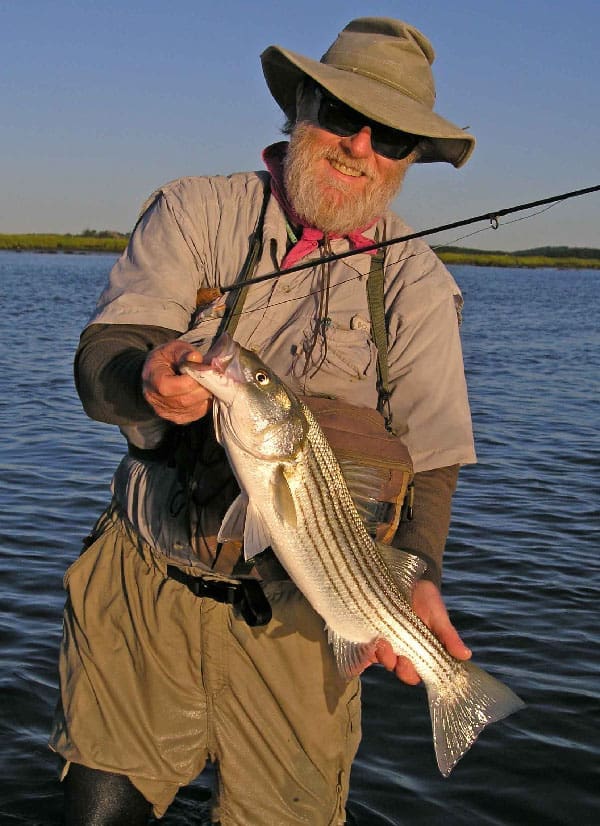
Fred Jennings is from Ipswich, MA, where he has spent most of his life. He is an ecological economist with a B.A. from Harvard and a Ph.D. from Stanford, both in economics. Fred is also an avid conservationist and fly fisherman. He enjoys the outdoors, and has written about natural processes and about economic theory. He has 40 years of teaching and research experience, first in academics and then in economic litigation. He also enjoys his seasonal practice as a saltwater fly fishing guide in Ipswich, MA. Fred joined Biodiversity for a Livable Climate in 2016.
Sources:
https://en.wikipedia.org/wiki/Mistletoe
https://www.britannica.com/plant/mistletoe
https://www.smithsonianmag.com/science-nature/biology-mistletoe-180976601
https://www.smithsonianmag.com/blogs/national-museum-of-natural-history/2021/12/21/five-things-you-didnt-know-about-mistletoe/
https://www.history.com/news/why-do-we-kiss-under-the-mistletoe
https://www.ambius.com/blog/the-curious-kisstory-of-mistletoe/
https://www.nccih.nih.gov/health/european-mistletoe
https://weather.com/science/nature/news/truth-mistletoe
https://blog.nwf.org/2012/12/12-things-to-know-about-mistletoe/
https://www.bbc.co.uk/newsround/16164453
https://www.reliasmedia.com/articles/87270-mistletoe-extract-in-cancer-an-anthroposophic-remedy
https://www.herbalgram.org/resources/herbalgram/issues/68/table-of-contents/article2901/
https://www.mistletoe-therapy.org/information-for-patients/interesting-facts-about-mistletoe