
What organism can take control of another animal’s body, force it to climb to a precise height, lock itself in place, and then use that body to spread its own offspring?
The Zombie-Ant Fungus! (Ophiocordyceps unilateralis)
Bio4Climate intern Allison Eckard was drawn in by the science-fiction aspect of a creature that exists in real life, quietly impacting forests around the world.
Ophiocordyceps unilateralis holds a rare distinction in the Featured Creature archive: it is the only creature to have been featured twice. Fittingly, a fungus that compels its host to act against its own nature has apparently done the same to our editorial judgment. For a deeper scientific exploration — including the fungus’s evolutionary origins, its connections to The Last of Us, and its medicinal potential — see Fred Jennings’s 2023 Featured Creature article on the zombie-ant fungus.
The Fungus That Rewrites a Mind
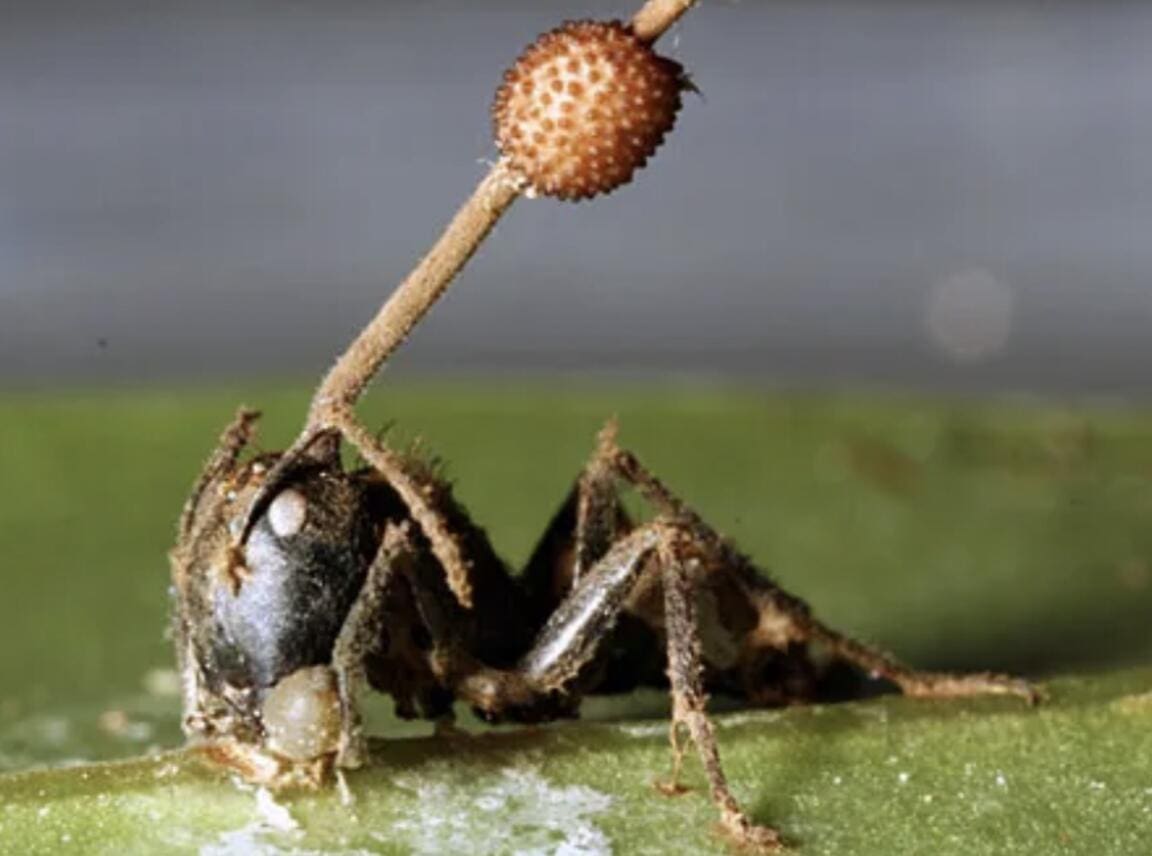
Meet Ophiocordyceps unilateralis, often called the “zombie-ant fungus”—a parasitic fungus that infects ants and alters their behavior in ways that seem almost deliberate.
At first glance, it’s easy to overlook. It begins as microscopic spores drifting through humid forest air. But when one of those spores lands on the body of a susceptible ant, something extraordinary begins.
Unlike predators that kill quickly or parasites that simply feed, Ophiocordyceps does something far more complex: it turns its host into its own survival vehicle.
A Mind Not Its Own: How Infection Begins
Infection begins when fungal spores attach to the ant’s outer surface. From there, the fungus penetrates the exoskeleton and begins to grow inside the body. As it spreads, it consumes nutrients from the host while avoiding immediate detection or death. For a time, the ant continues behaving normally—walking, feeding, interacting with its colony.
But beneath the surface, something is changing. The fungus begins interacting with the ant’s internal systems, producing compounds that interfere with its physiology and behavior. Rather than destroying the host outright, it keeps it alive long enough to control it.
Climb, Bite, Hold: The Death Grip
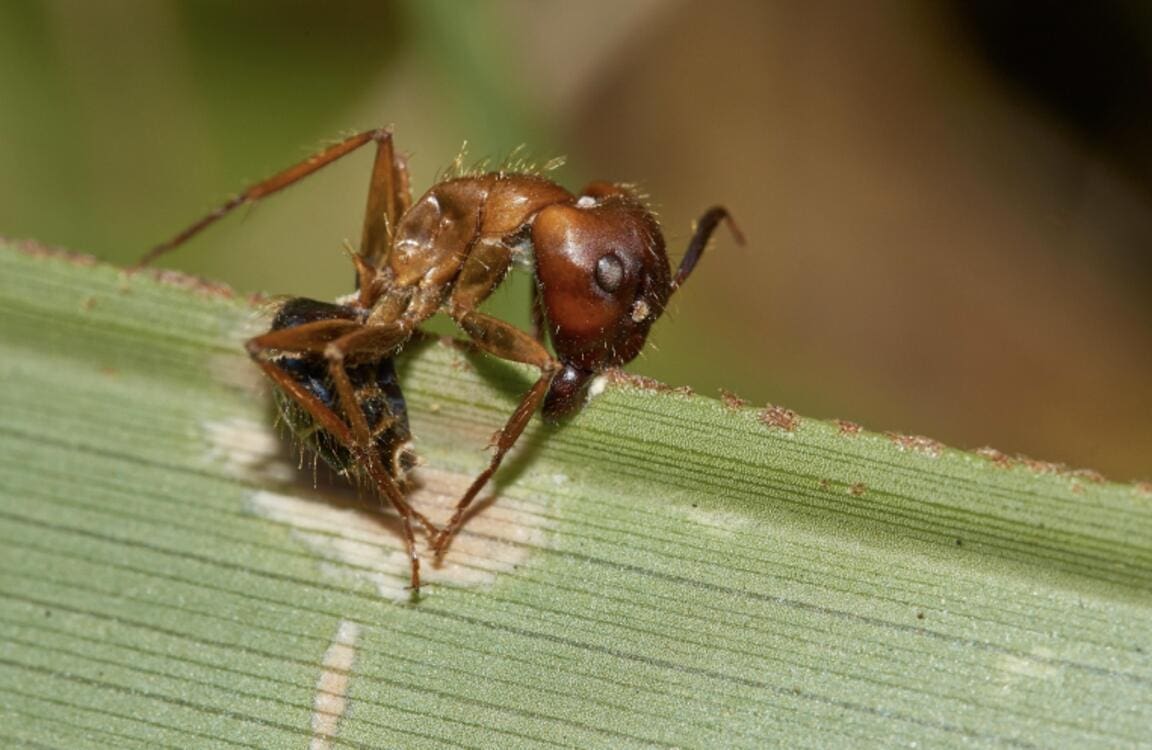
At a critical stage of infection, the fungus triggers a dramatic shift. The ant leaves its colony. It begins to wander, often disoriented, until it climbs vegetation—usually to a very specific height and location where temperature and humidity are optimal for fungal growth.
In its final act, the ant bites down onto a leaf vein or stem in what is often called the “death grip.” Its jaws lock into place. Shortly afterward, the ant dies—but the fungus is just beginning its next phase.
Who’s Really in Control?
For years, scientists believed the fungus might directly invade and control the ant’s brain. But more recent research suggests something even more intriguing. Instead of taking over the brain itself, Ophiocordyceps appears to form an extensive network throughout the ant’s body, surrounding muscle fibers and releasing chemicals that influence movement and behavior.
In other words, the fungus may not “possess” the ant’s mind in the way we imagine. It may instead control the body—coordinating actions from the outside in. This challenges assumptions about how behavior is generated and controlled. If movement can be directed without directly controlling the brain, it raises deeper questions about where control in biological systems truly resides.
A Precise Ending with a Purpose
Once the ant is fixed in place, the fungus begins to grow outward. A stalk emerges from the ant’s body—often from the head—and eventually releases spores into the environment below.
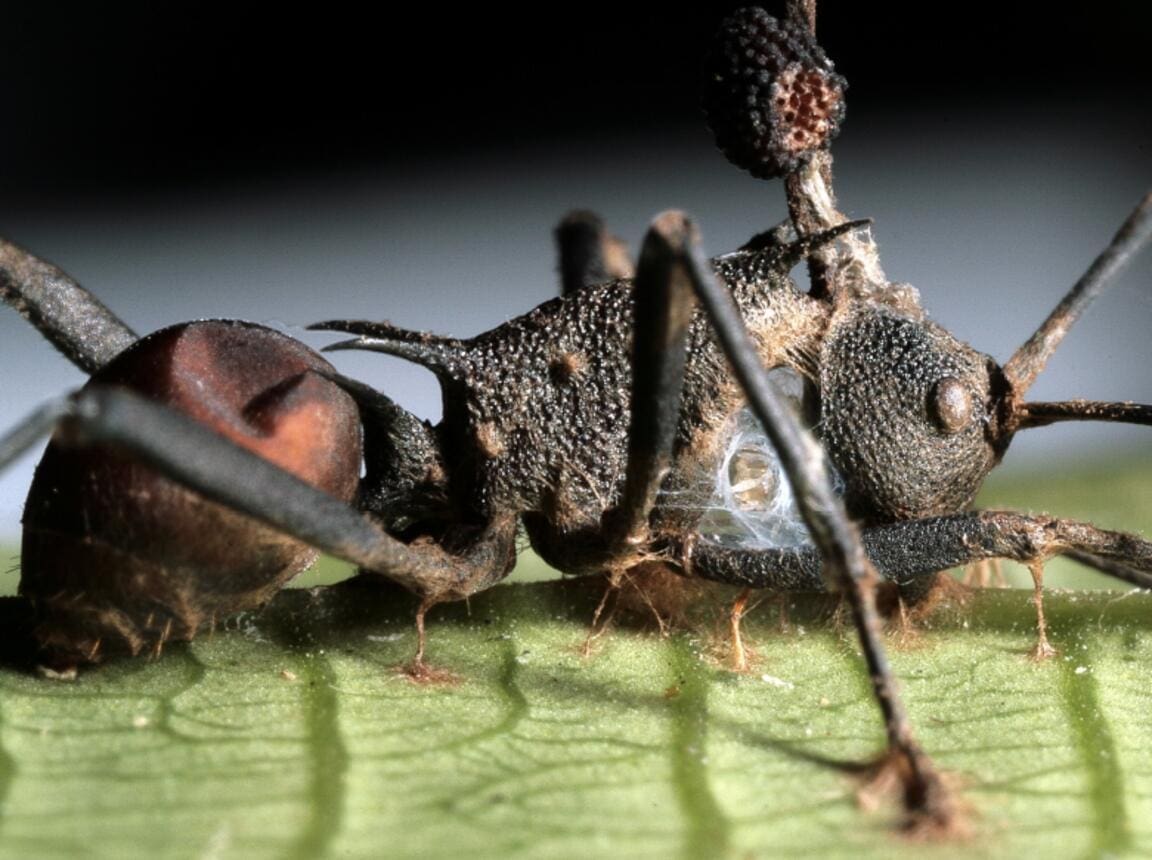
Because the ant climbed to an optimal location, those spores are more likely to land on other ants passing through the area, continuing the cycle.
This is not random. The height, humidity, and positioning of the host all influence the success of transmission. The fungus doesn’t just infect—it guides its host to the exact conditions needed for its own reproduction.
Forest Ecosystems Impact
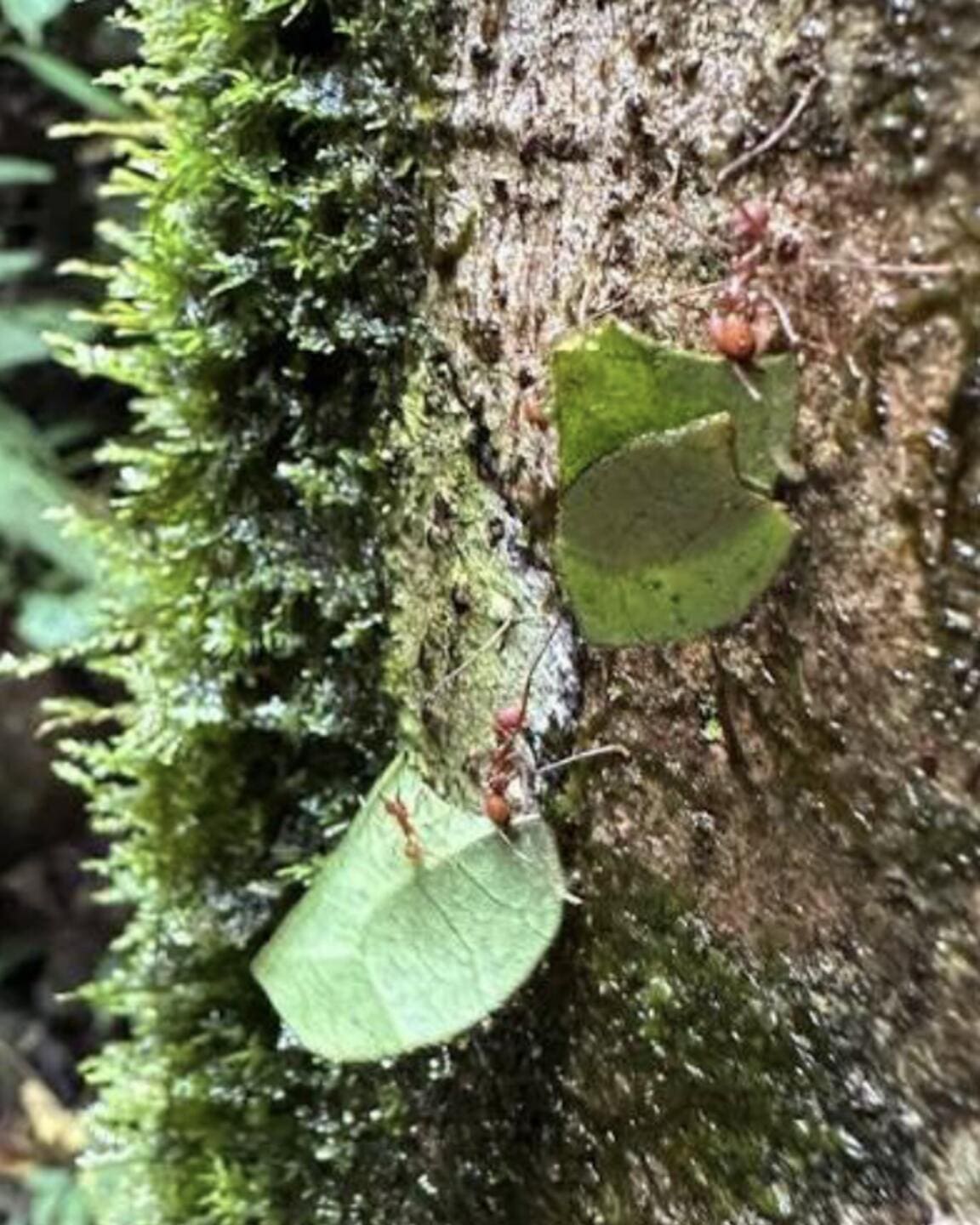
As unsettling as this process may seem, the interaction plays a role in maintaining ecological balance. By infecting and killing certain ant populations, Ophiocordyceps helps regulate colony density, influencing everything from soil turnover to plant interactions, since ants are key players in many ecosystems.
It’s part of a broader network of relationships where organisms don’t just compete—they influence each other’s behavior, population, and distribution.
In tropical forests especially, these dynamics contribute to the complexity and stability of the system as a whole.
A Network of Influence
The zombie-ant fungus is not a single isolated phenomenon. It belongs to a larger group of parasites capable of altering host behavior in various ways.
But Ophiocordyceps stands out for its precision. It doesn’t just affect movement—it directs a sequence of actions: the ant leaves its colony, climbs vegetation, bites down onto a surface, and holds its position. Each step increases the likelihood of the fungus’s survival.
This level of coordination suggests a finely tuned evolutionary relationship between parasite and host—one shaped over millions of years.
A Different Way to Think About Control
We often think of behavior as something generated internally—by a brain, a nervous system, a single organism acting on its own.
Ophiocordyceps unilateralis complicates that idea. It shows that behavior can be influenced, redirected, and even overridden by another organism entirely. Not through brute force, but through subtle biochemical interaction. It’s a reminder that life is not just interconnected—it is, at times, deeply entangled.
The Cycle Continues
The zombie-ant fungus doesn’t chase, bite, or overpower its host. It waits. It infiltrates. And then, at the right moment, it turns another living organism into part of its own life cycle.
In the quiet understory of a forest, far from view, it carries out one of the most intricate and unsettling examples of biological control on Earth.

Allison Eckard is a senior Biology major with minors in Health and Environmental Science at Lesley University with a passion for ecological literacy and science communication. Through her internship with Bio4Climate, she explores the hidden relationships between neural systems, biodiversity, and climate resilience. She especially enjoys helping readers discover the surprising ways evolution shapes life in the smallest—and most unexpected—places.
References
- Andersen, S. B., Gerritsma, S., Yusah, K. M., Mayntz, D., Hywel-Jones, N. L., Billen, J., Boomsma, J. J., & Hughes, D. P. (2009). The life of a dead ant: The expression of an adaptive extended phenotype. The American Naturalist, 174(3), 424–433.
- Hughes, D. P., Andersen, S. B., Hywel-Jones, N. L., Himaman, W., Billen, J., & Boomsma, J. J. (2011). Behavioral mechanisms and morphological symptoms of zombie ants dying from fungal infection. BMC Ecology, 11, 13.
- de Bekker, C., Ohm, R. A., Evans, H. C., Brachmann, A., & Hughes, D. P. (2017). Ant-infecting Ophiocordyceps genomes reveal a high degree of host-specific adaptation and genes involved in behavioral manipulation. Scientific Reports, 7, 12508.
- Fredericksen, M. A., Zhang, Y., Hazen, M. L., Loreto, R. G., Mangold, C. A., Chen, D. Z., Hughes, D. P., & De Bekker, C. (2017). Three-dimensional visualization and a deep-learning model reveal complex fungal parasite networks in behavior-manipulated ants. PNAS, 114(47), 12590–12595.
- Evans, H. C., Elliot, S. L., & Hughes, D. P. (2011). Hidden diversity behind the zombie-ant fungus Ophiocordyceps unilateralis: Four new species described from carpenter ants in Minas Gerais, Brazil. PLoS ONE, 6(3), e17024.
- Loreto, R. G., & Hughes, D. P. (2019). Disease dynamics in ants: How pathogens regulate populations. Current Opinion in Insect Science, 34, 67–72.