
From Soil to Sky: Bio4Climate Launches Its First-Ever Education Program in Hyderabad, India during Earth Month
In April 2026, Bio4Climate marked a significant milestone—its first-ever educational event in Hyderabad, India, introducing the Soil to Sky biodiversity curriculum to a new global context.
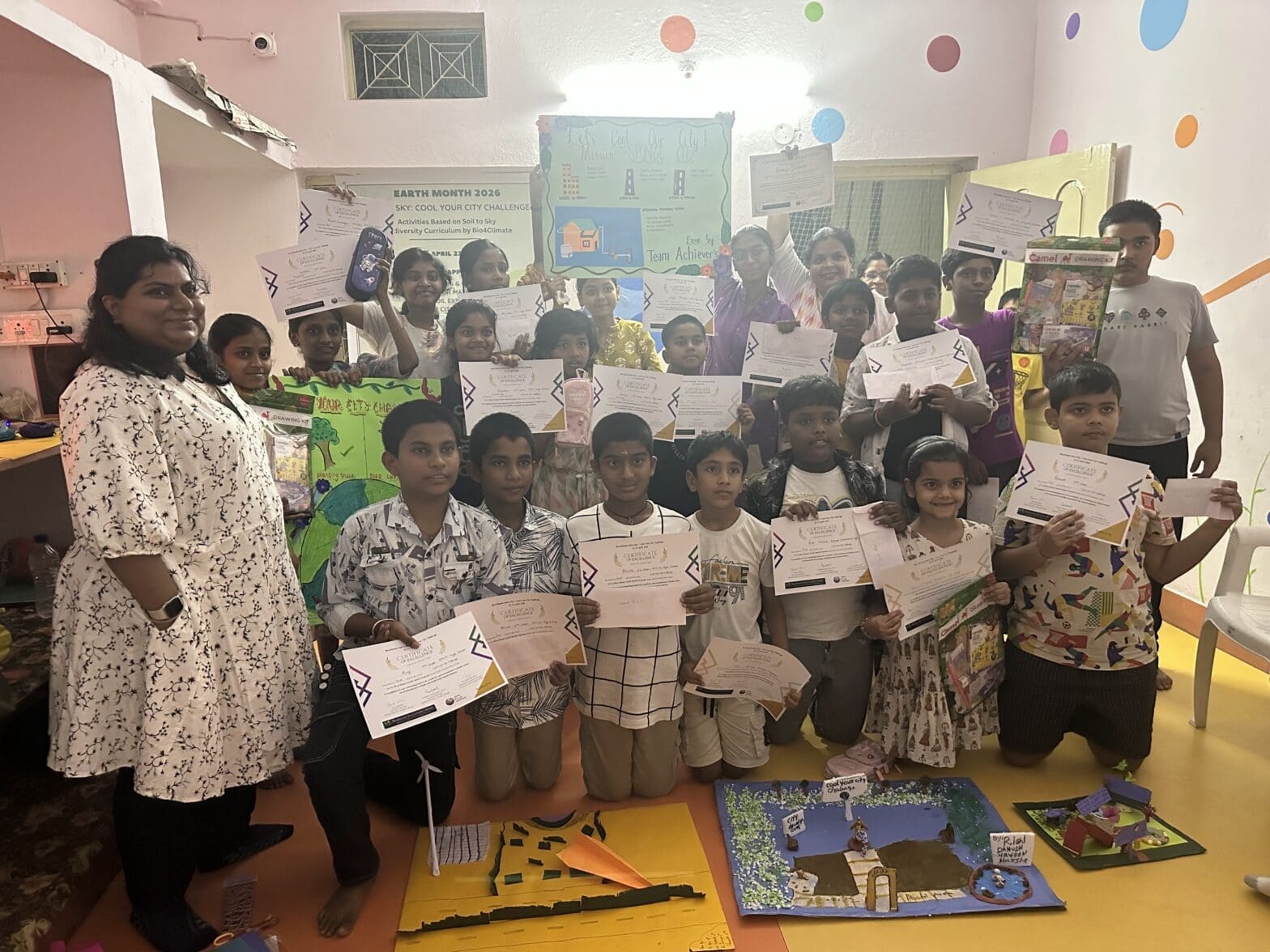
Held as part of Earth Month 2026, the three-day event titled “Soil to Sky: Cool Your City Challenge” took place from April 22–24 at the Rainbow Learning Space, an after-school program at Iris Florets School, Hyderabad, India. The program was locally hosted and by Varanya Sankarsri, a High School Science Educator, creating a bridge between global ecological knowledge and community-centered learning.
The event brought together more than 35 student participants (Grades 1–10), alongside 7 community elders and educators, who joined on the final day—transforming the space into a multi-generational learning environment grounded in dialogue, exploration, and shared inquiry.
The Soil to Sky Curriculum: A Layered Learning Model
All activities were adapted from the Soil to Sky Biodiversity Curriculum, developed by the Bio4Climate education team:
- Beck Mordini, JD – Executive Director
- Poulomi Chakravarty, PhD – Curriculum Designer and Facilitator
- Paul Barringer – Cambridge Program Lead Facilitator
- Jerald Katch, PhD – Director of Education
The curriculum is designed to integrate ecological systems vertically—from soil microbiomes to atmospheric processes—while also layering learning experiences horizontally across creativity, science, and real-world application.
This Hyderabad event represented the first international implementation of this curriculum in a community-based after-school setting.
A Collaborative Effort Rooted in Science and Education
This initiative was hosted by Bio4Climate in partnership with the Global Climate Association and Society & AI, reflecting a growing model of cross-institutional collaboration for climate education. The event was facilitated by Poulomi Chakravarty, PhD – Research Scientist, Bio4Climate; Founder, Global Climate Association and Sai Gattupalli, PhD – Principal Scientist, Society & AI.Their facilitation synthesized ecological science, systems thinking, and adaptive pedagogy, enabling learners to move fluidly between observation, experimentation, and design. Development of the Soil to Sky Curriculum was funded in part by the Sacred Heart Charitable Fund in 2025.
Day 1: Soil Exploration — Seeing the Hidden Living System
The program began at the foundation—soil as a living ecosystem.
Activity Design
Students worked with two contrasting soil samples, both collected locally:
- Dry Surface Red Soil (Roadside Sample)
- Texture: coarse, loose
- Composition: pebbles, sand particles
- Observation: no visible organic matter
- Moist Red Soil (Dug ~10 inches below ground, Garden Sample)
- Texture: dense, moist, cohesive
- Composition: rich in organic matter
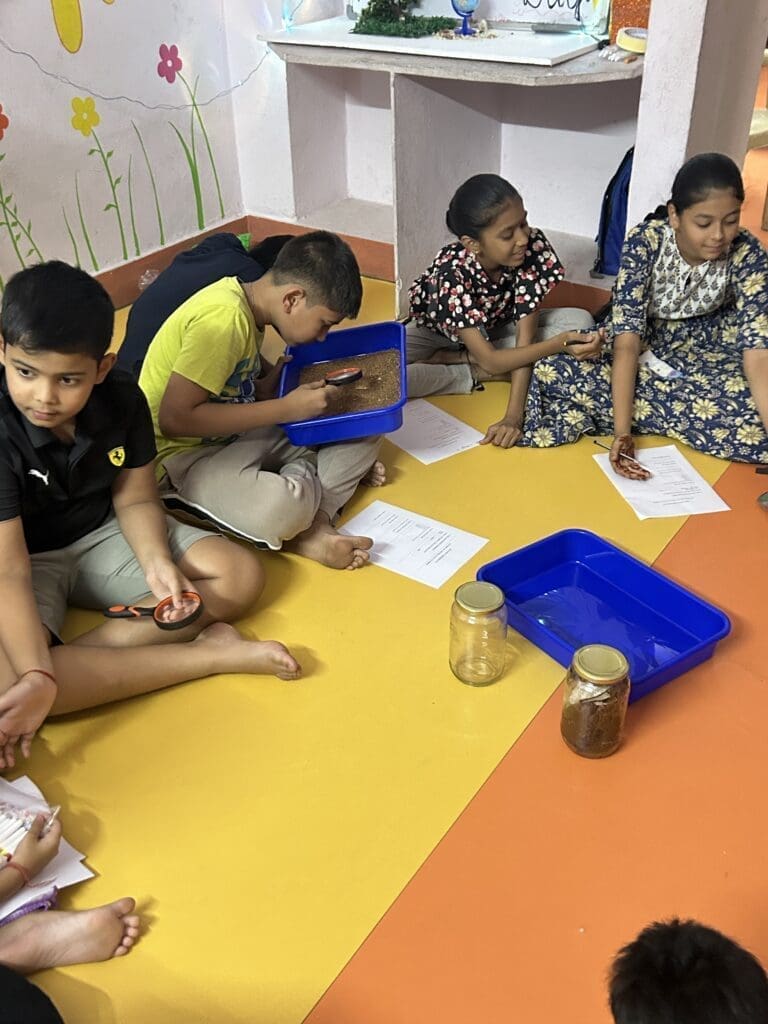
Using magnifying glasses, students conducted close observations of the moist soil sample. They identified:
- Fine roots threading through the soil
- Fungal networks (mycelial strands)
- Decayed fruit fragments, feathers
- Leaves with white fungal growth
- Small shell remnants embedded in the soil
In contrast, the dry roadside soil revealed:
- Pebbles and sand
- Fragmented mineral particles
- Absence of visible biological activity
Learning Outcome
This side-by-side comparison enabled students to distill a critical ecological insight by reframing their idea of soil :
Soil is not just dirt —it is a living system shaped by moisture, organic matter, and biological activity.




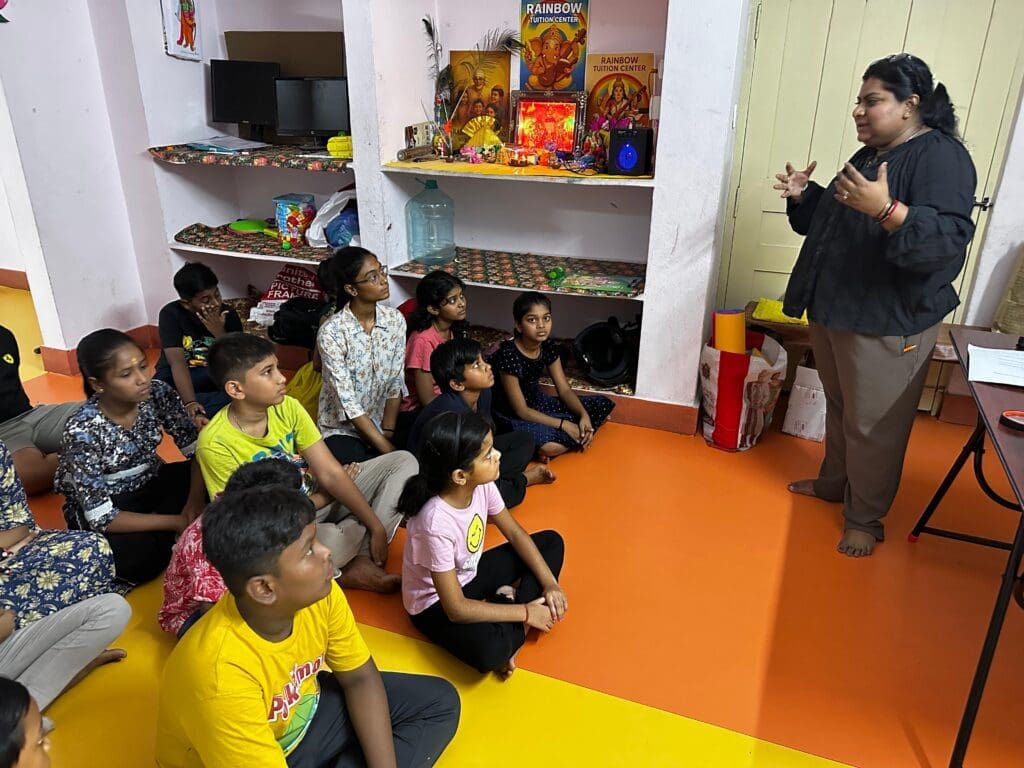
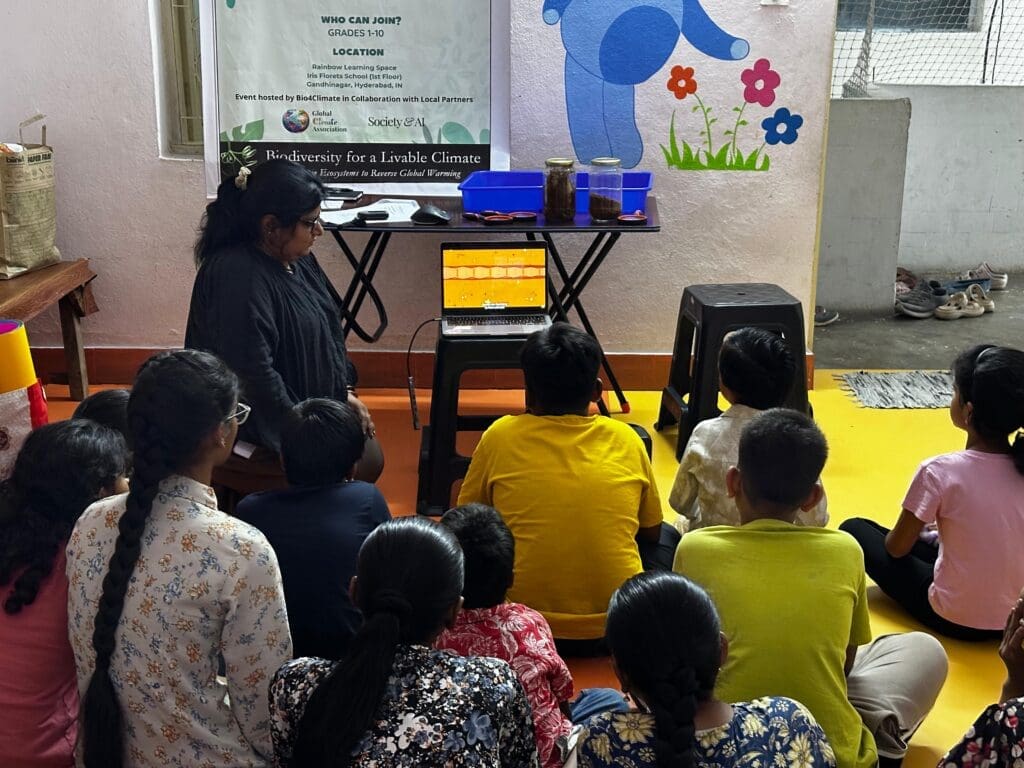
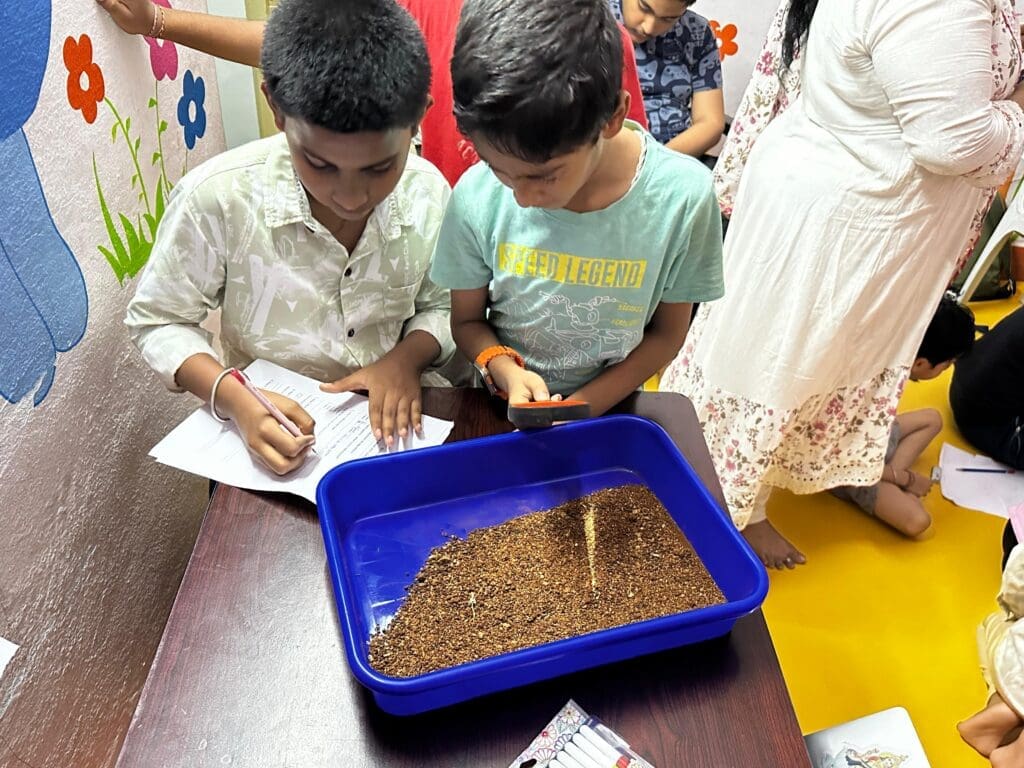
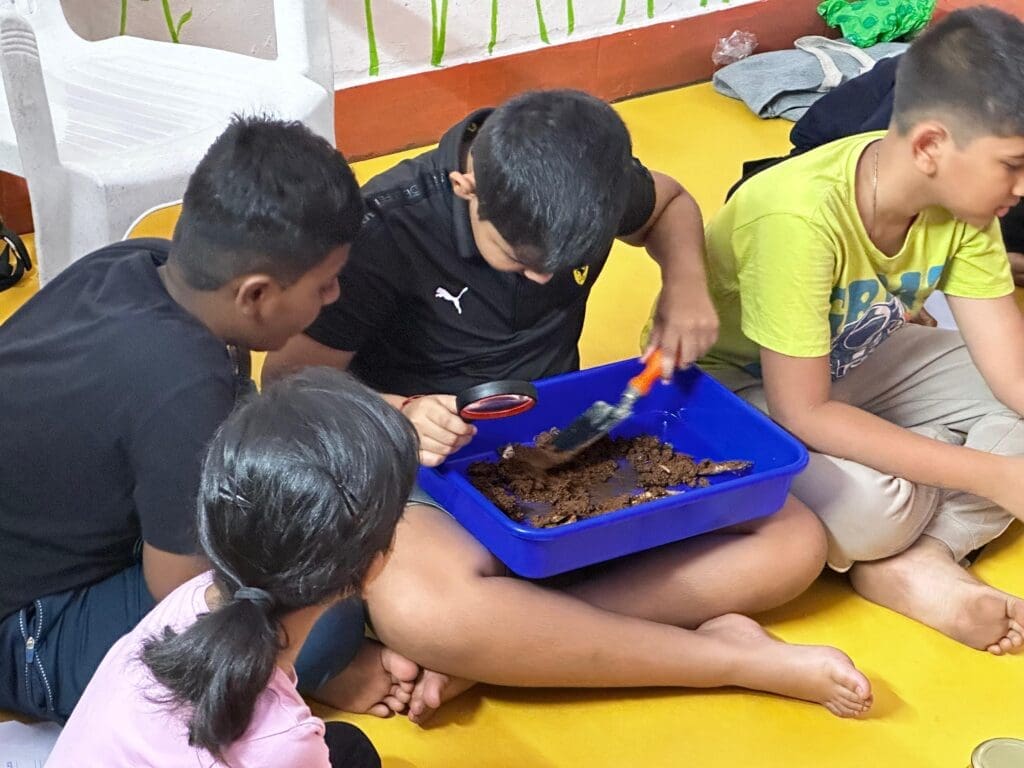
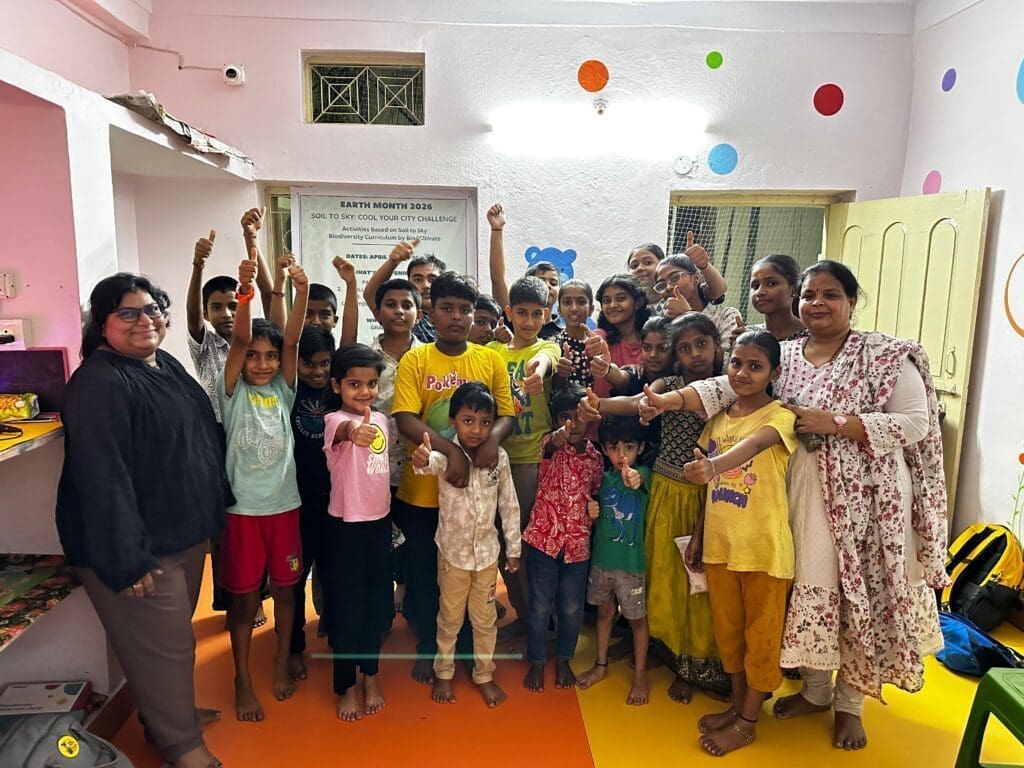
Day 1 Picture Gallery and Description
Students leaned in closely, holding magnifying glasses, pointing out discoveries with excitement. The moment of recognition was tangible—especially when comparing the “lifeless” dry soil with the biologically rich garden soil.
The activity reframed soil from background to protagonist—a foundational system that supports plants, regulates water, and ultimately influences climate.
Day 2: Pollinators and Local Biodiversity — Connecting Systems
Day 2 shifted from soil to above-ground ecological relationships, focusing on pollinators and plants.
Activity Design
Pollinator Match-Up Game (Localized to Hyderabad & Telangana)
The activity was customized to reflect regional biodiversity, introducing students to:
- Local pollinators (bees, butterflies, insects)
- Native or familiar plant species
- Real-world ecological pairings
Students worked to match pollinators with the plants they support, learning how pollination sustains ecosystems and food systems.
Ecosystems function through interdependence, not isolation”
Differentiated Learning by Age Group
Grades 5–9
- Participated in the Pollinator Match-Up Game
- Received an introduction to the “Cool Your City Challenge”
- Discussed urban heat
- Explored how trees, soil, and biodiversity can cool cities
- Began thinking about solutions for their own environments
Grades 1–4
- Engaged in the Pollinator Match-Up Game through simplified interaction
- Created Earth Day-themed paintings, expressing:
- Nature and animals
- Clean environments
- Green cities and ecosystems
Learning Outcome
Students began to integrate ecological relationships across layers:
- Soil supports plants
- Plants support pollinators
- Pollinators sustain ecosystems
For older students, this expanded into an early understanding of:
How biodiversity can directly influence urban climate systems, including heat and livability.
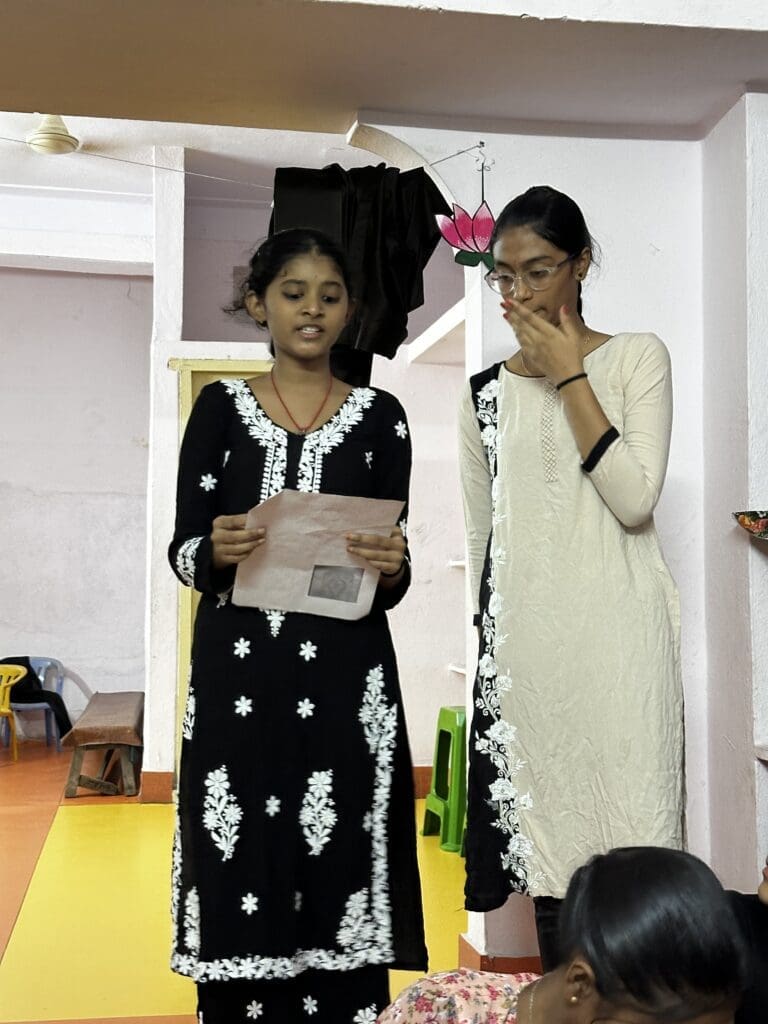




Day 2: Picture Gallery and Description
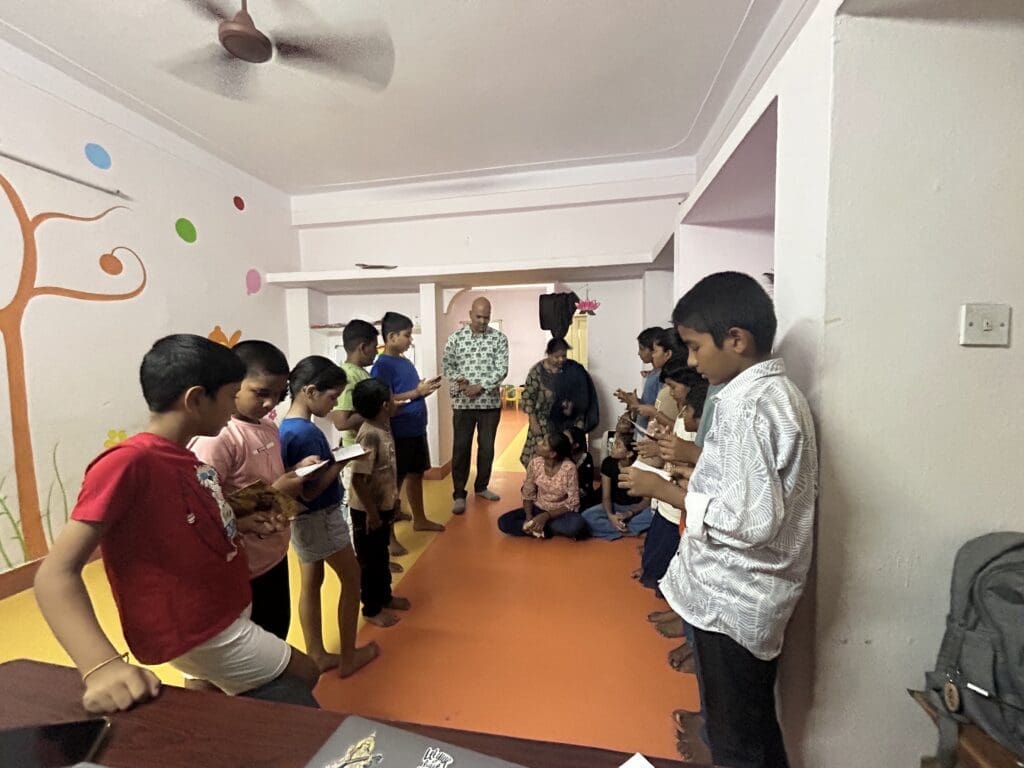
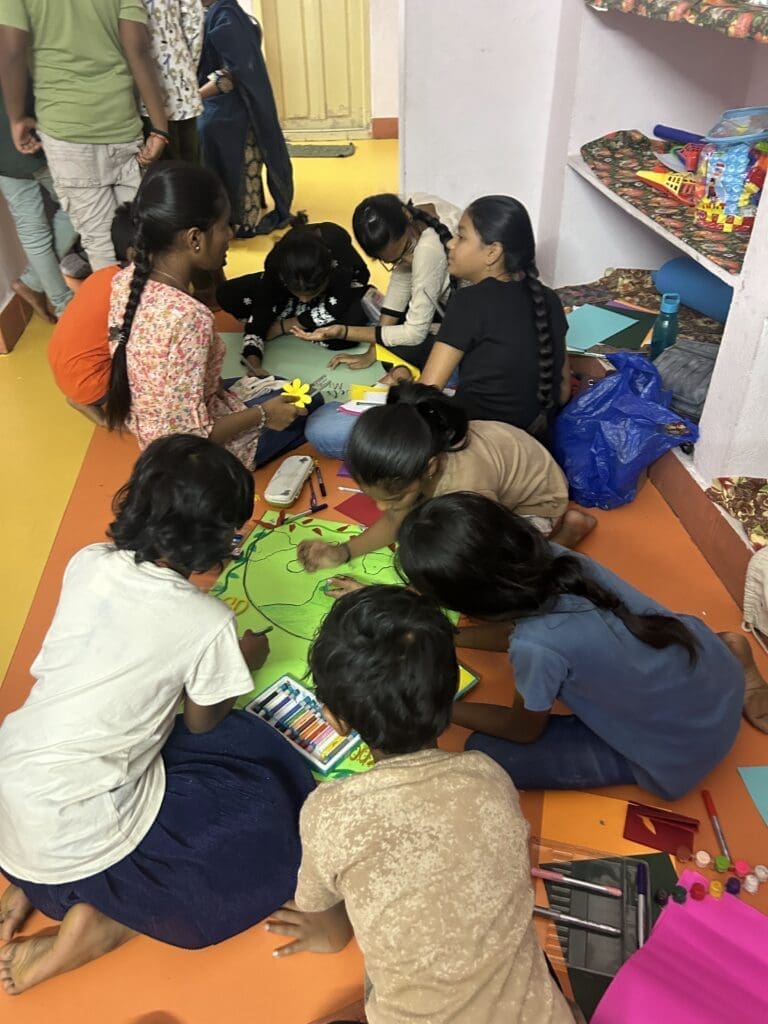
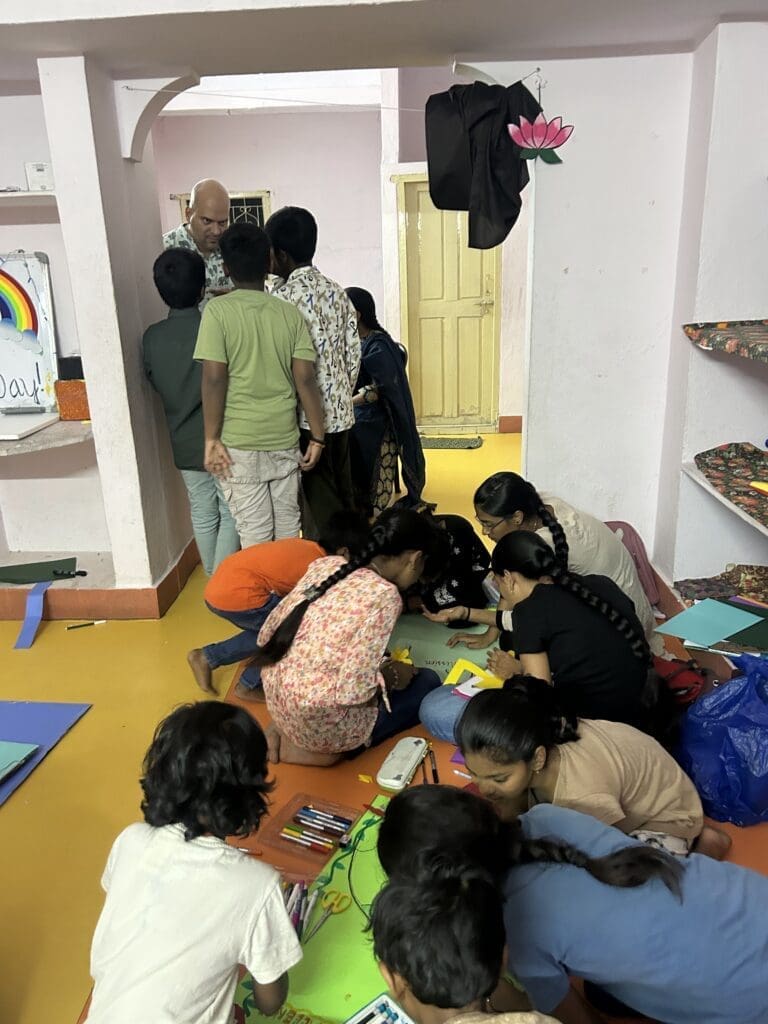
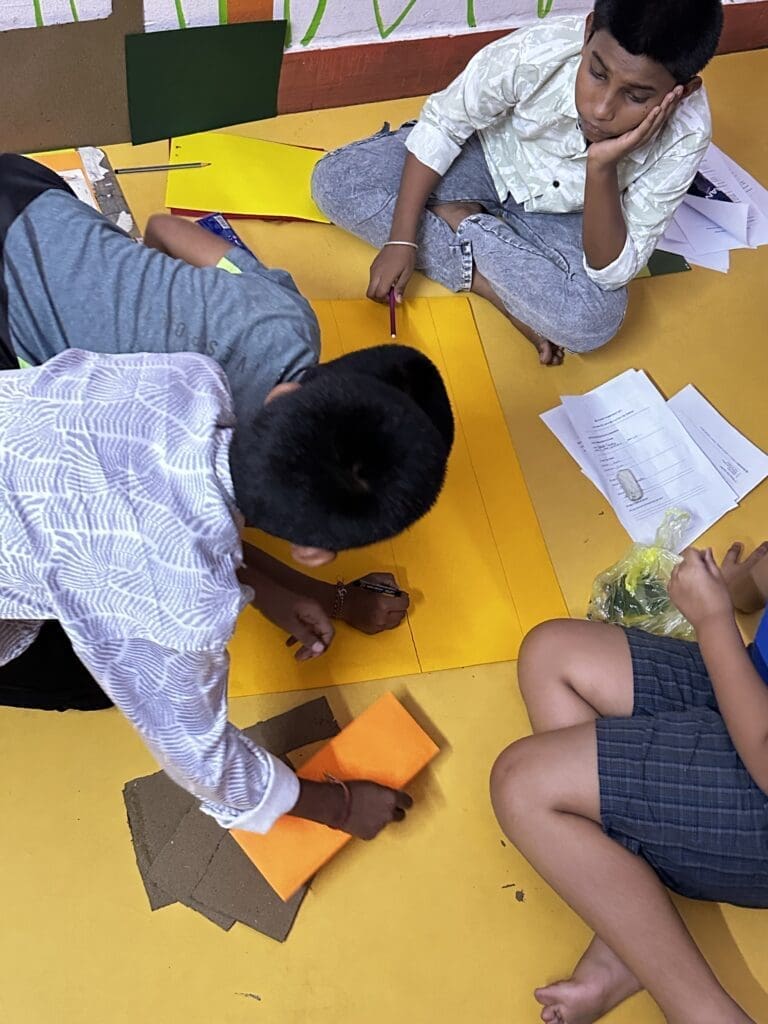
The space became highly interactive—students moving between matching activities, discussions, and creative expression.
- Younger students painted vibrant scenes of Earth and nature
- Older students engaged in more analytical conversations about cities and climate
- Moments of realization emerged as students connected pollinators to food, plants, and daily life
This day effectively bridged observation and systems thinking, preparing students for applied design work on Day 3.
Transition to Day 3
By the end of Day 2, a clear conceptual arc had formed:
- Day 1: Soil as a living foundation
- Day 2: Plants and pollinators as interconnected systems
This set the stage for Day 3, where students would transform understanding into action through the Cool Your City Challenge.
Key Learning Shift
Students began to integrate systems thinking:
- Soil supports plants
- Plants support pollinators
- Pollinators sustain ecosystems
This layered understanding prepared them for application.
Day 3: Cool Your City Challenge — Designing for Climate Action
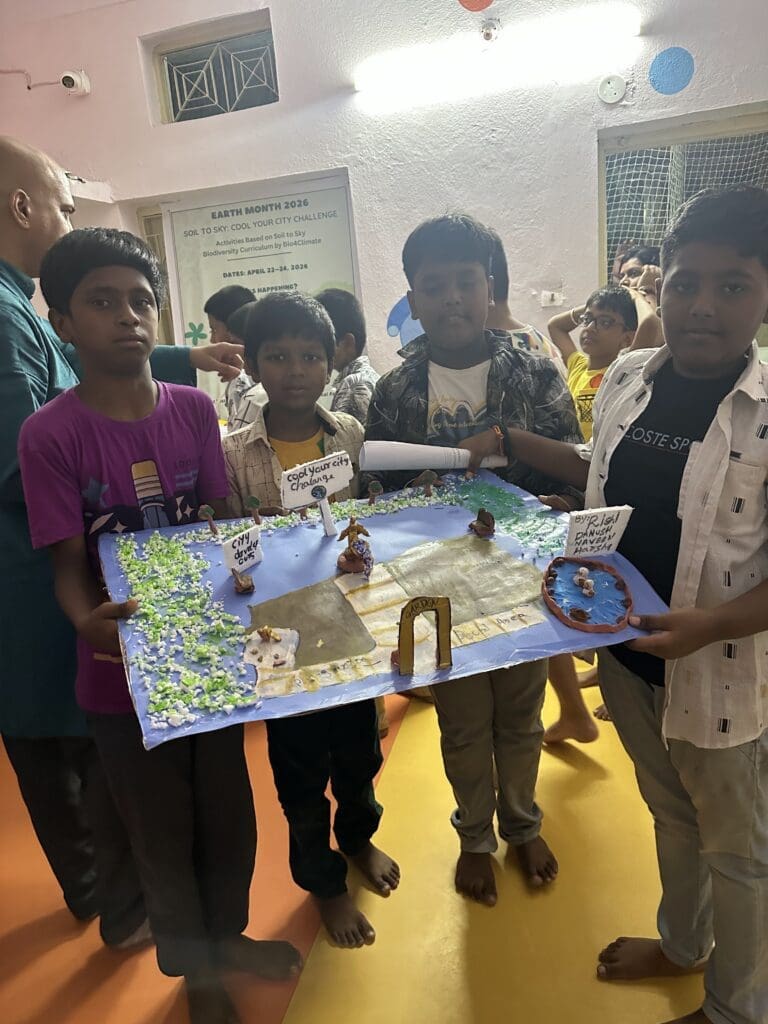
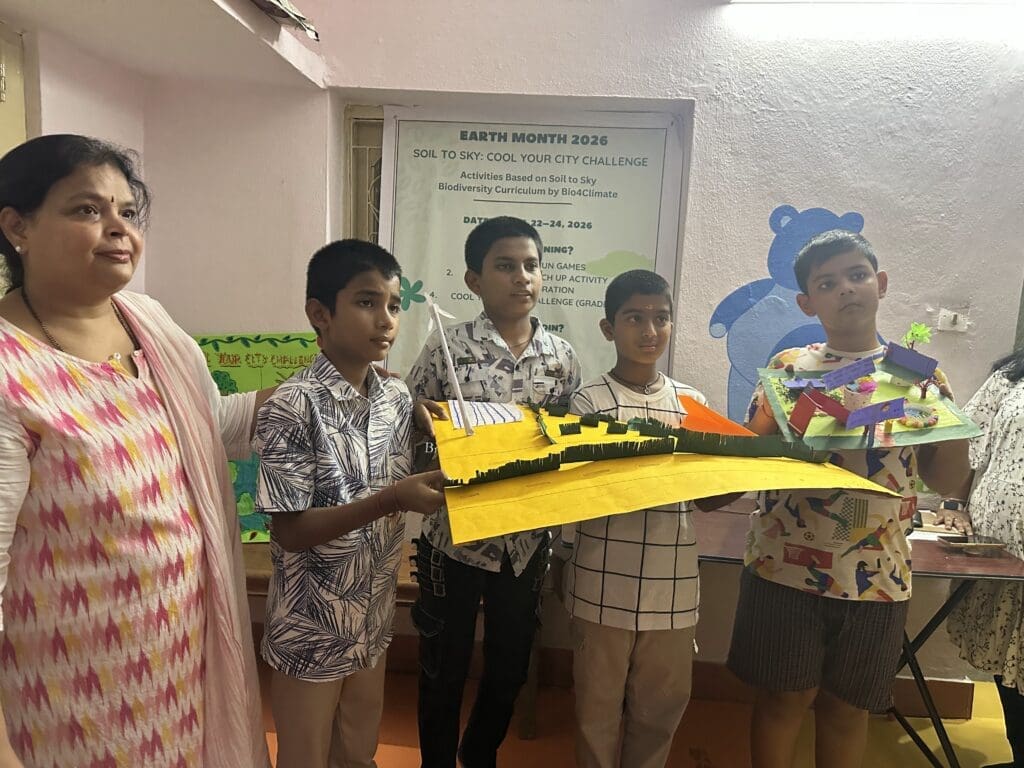
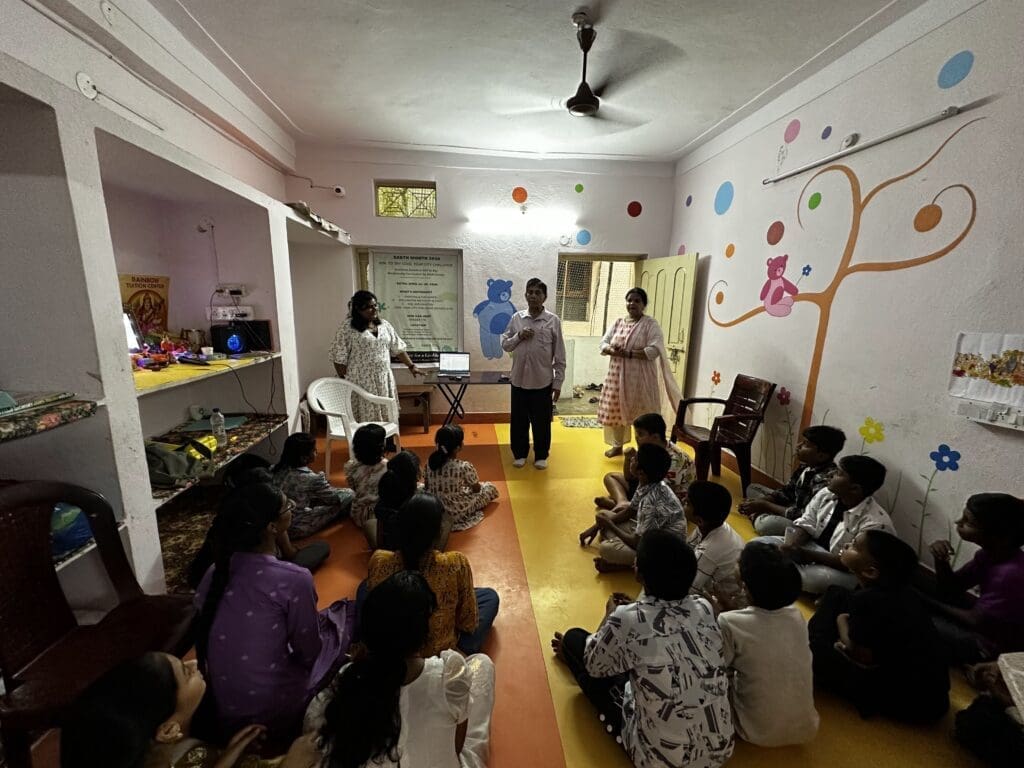
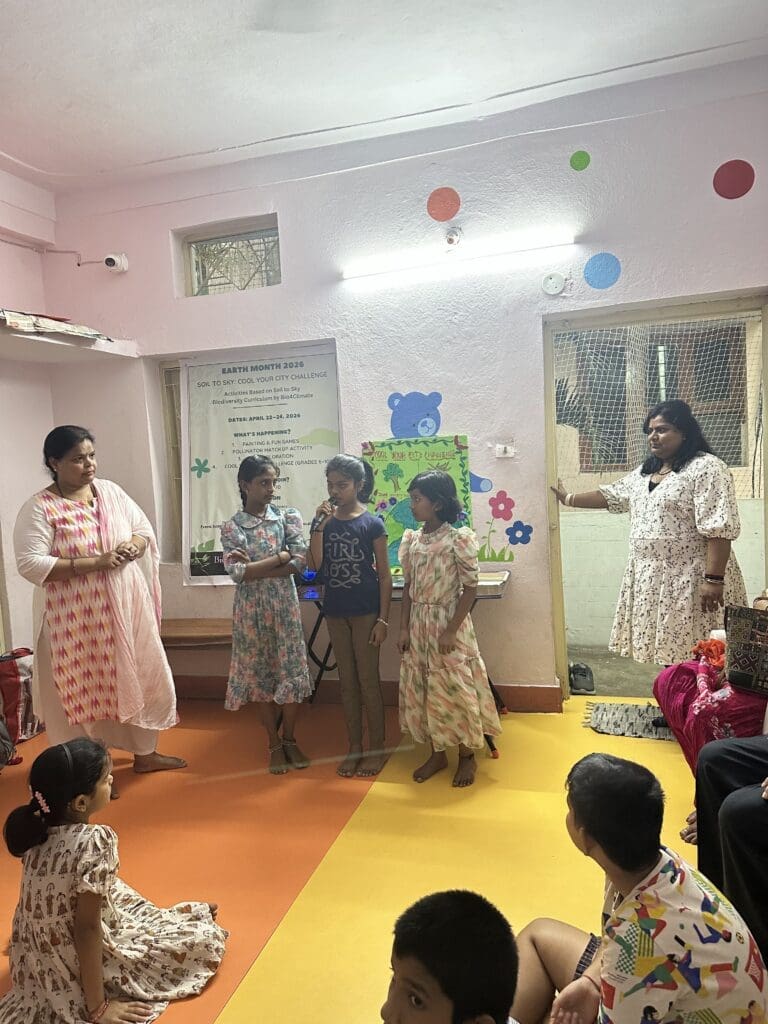
The final day marked a transition from learning to action and agency. The students in India were truly energized by a virtual interaction with Beck Mordini, who joined us live from Virginia, USA. Her presence on Zoom transformed the session—she engaged directly with the students, asking thoughtful questions about their projects and prompting them to articulate their ideas with greater clarity and confidence.
With community elders and teachers joining, the learning space evolved into a collaborative, multi-generational design studio.
What Students Did
Grades 5–9 students worked in groups to:
- Identify urban challenges:
- Heat
- Lack of green cover
- Limited biodiversity
- Design solutions based on their learning:
- Planting trees and increasing shade
- Restoring soil and green spaces
- Creating more livable, cooler environments
Grades 1–4 students contributed through:
- Drawings and visual storytelling
- Imagining greener, cooler cities


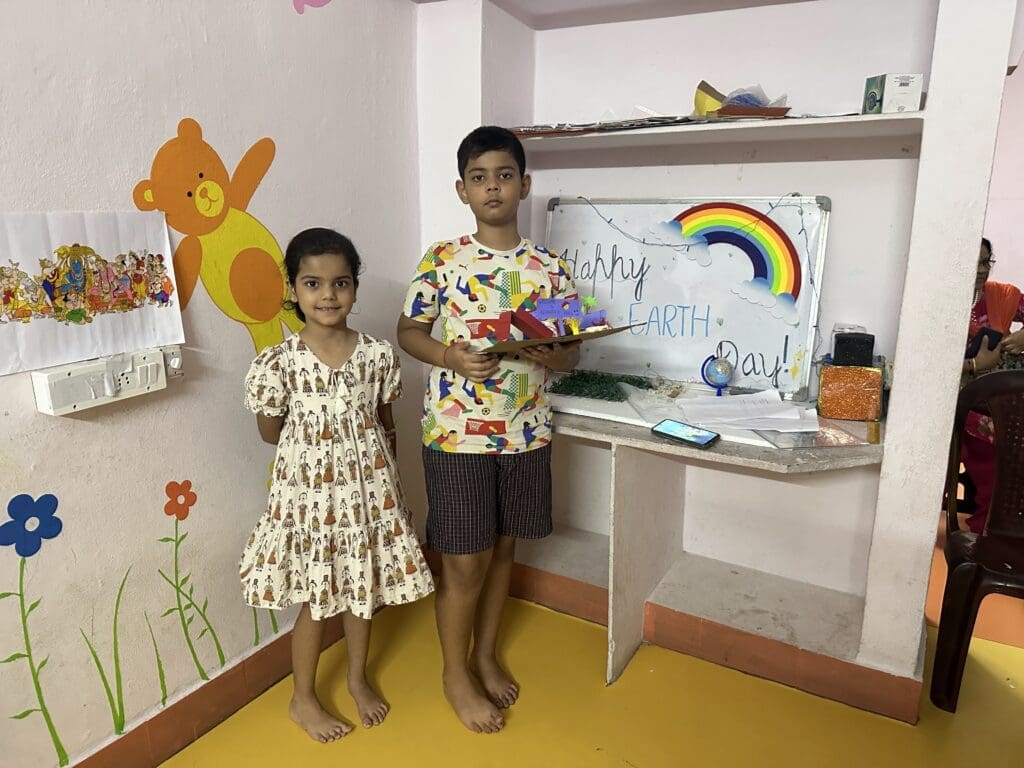
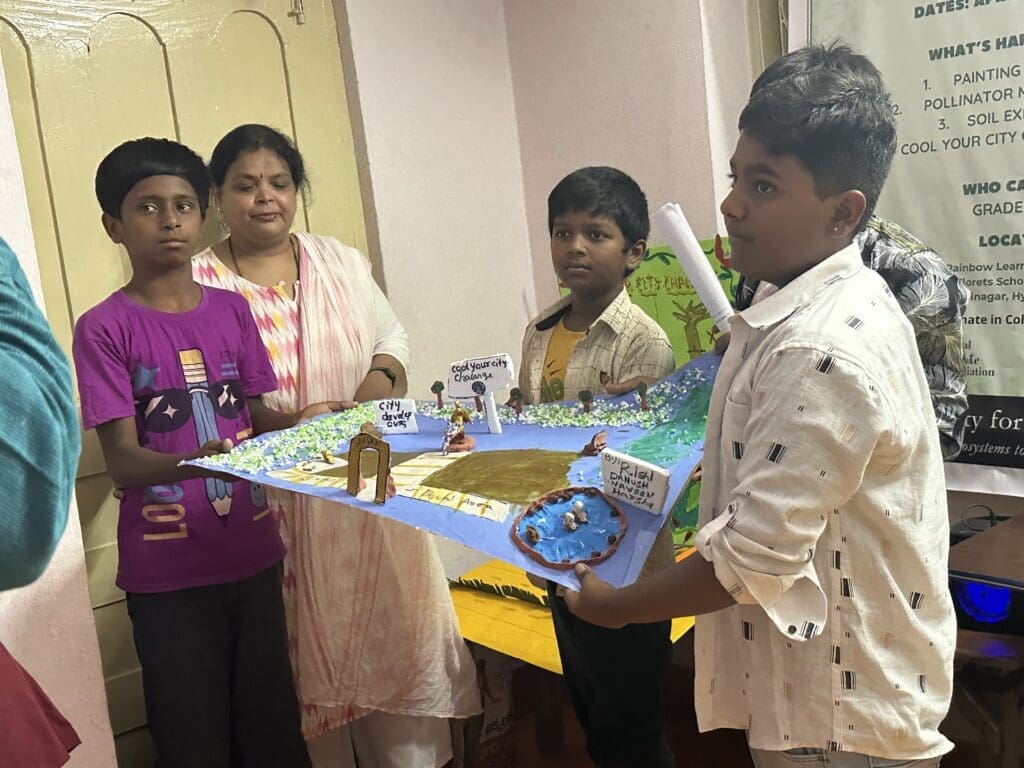
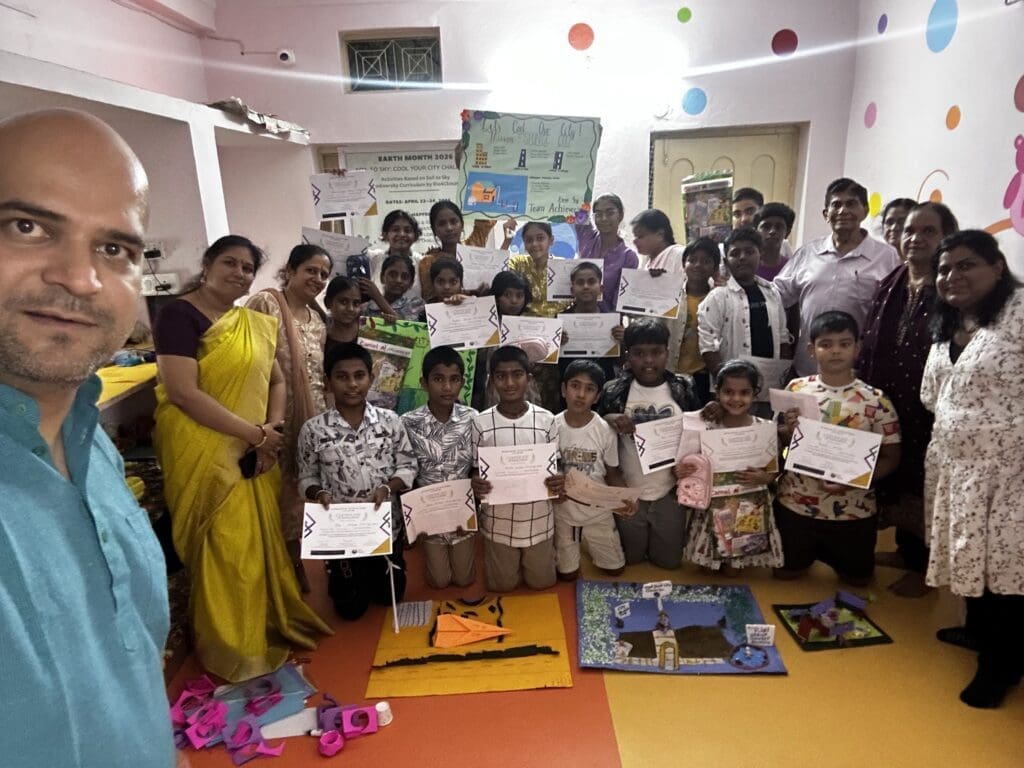
Day 3: Picture Gallery and Description
The atmosphere shifted noticeably:
- Students gathered in teams, sketching ideas and discussing solutions
- Drawings depicted cities filled with trees, shaded walkways, and biodiversity
- Facilitators guided conversations, pushing students to refine their thinking
Elders and teachers engaged directly—asking questions, offering feedback, and validating student ideas. This created a feedback-rich environment, where learning extended beyond the classroom into community dialogue.
What Shifted
Students began to:
See cities not just as built environments—but as ecological systems that can be redesigned.
More importantly, they began to see themselves as:
Participants in climate solutions—not just learners of the problem.
From Soil to Sky: A Complete Learning Arc
Across three days, the program unfolded as a clear progression:
- Day 1: Soil → Understanding foundational systems
- Day 2: Biodiversity → Integrating ecological relationships
- Day 3: City → Applying knowledge to real-world challenges
This reflects the core design of the Soil to Sky curriculum:
A layered model that moves from observation → connection → action
Why This Matters
This event demonstrates that climate education can be:
- Localized — grounded in students’ immediate environments
- Experiential — driven by hands-on exploration
- Transformative — leading to real-world thinking and design
Instead of framing climate change as a distant global issue, the program reframed it as:
A local, solvable challenge rooted in biodiversity and systems thinking.
Looking Ahead
The Hyderabad launch of Soil to Sky represents the beginning of a scalable model for future-forward climate education.
What emerged across these three days is a powerful insight:
When students engage with ecosystems directly, they don’t just learn science—they begin to think like ecological designers.”
From soil to sky, the learning unfolded.
And with it, a new pathway for climate education—grounded, connected, and action-oriented—took root.
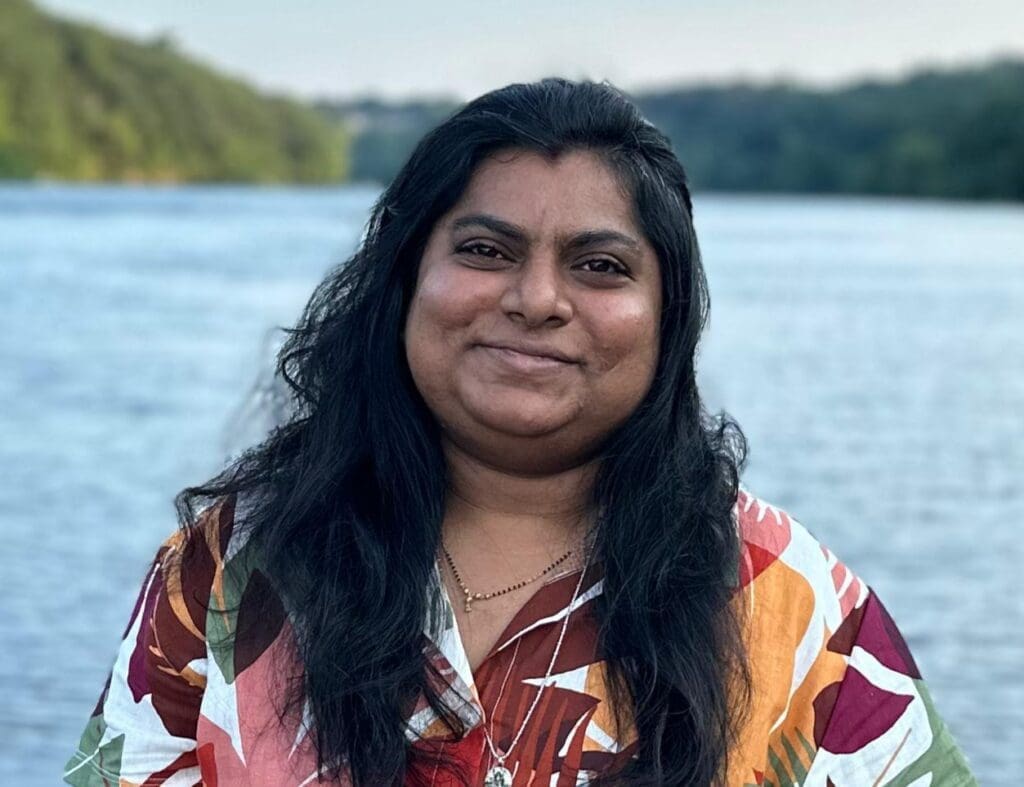
Poulomi Chakravarty, PhD is an environmental scientist, educator, and science communicator with expertise in micrometeorology, ecology, biodiversity, phytoremediation, climate extremes, remote sensing, and climate education. She serves as Scientific Advisor, India Program Director, and Education Lead at Biodiversity for a Livable Climate, where her work advances climate literacy, environmental education, ecosystem restoration, and nature-based climate solutions. Her work also focuses on integrating natural systems, Indigenous Knowledge, and AI-enabled approaches for climate resilience. As a facilitator of climate action programs, she designs curricula and leads community-based initiatives that help diverse learners engage with climate science, biodiversity, soil, water, and sustainability. Beyond her professional work, she is passionate about environmental protection, animal rescue, painting, cooking, and life as a devoted dog mom.