Meet the Eastern Screech Owl
It’s 9:30 on a cool summer night in the Upper Valley—the orogenous area surrounding the Connecticut River in New Hampshire and Vermont. My friends and I are making the steep journey up the unfamiliar grass-covered slopes of the Dartmouth Skiway. With sleeping bags, no signal, and only a slight idea of where our cabin is, we trek upwards using our phones’ flashlights. We hear the crunch of leaves under our feet, unspecified animals rustling, and echoes in the woods. Some of the less outdoorsy members seem on edge, eager to reach somewhere with walls and a roof. A loud whine startles Tom, not helped by the stories we’ve told of potential bear and coyote sightings. I chuckle and affirm, “Tom, that was an owl.”
Adapting to Urban and Suburban Life
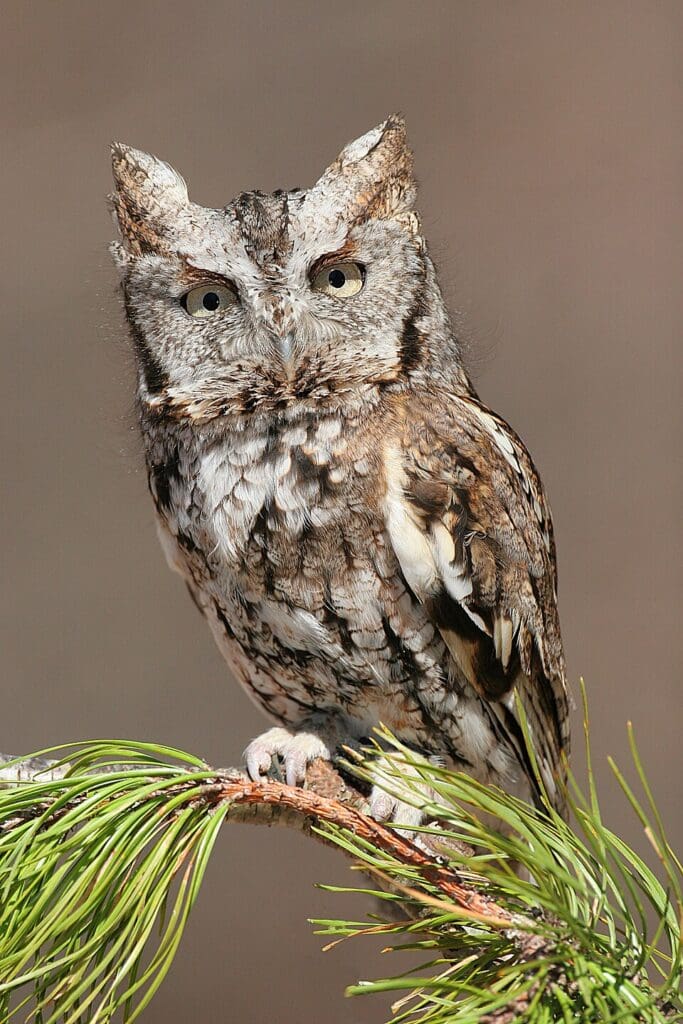
Identifiable in the darkness by its tremolo, an even-pitched trill that bounces through the trees, the eastern screech owl (Megascops asio) is one of the most common owls across the United States. They inhabit the Great Lakes down to the bottom of Texas, and from western Kansas to the Atlantic coast (Cornell Lab of Ornithology, 2024). Throughout such a vast range, they have adapted well to living alongside humans; it is one of the few birds of prey (raptors) that nest in New York City and other urban settings. Unlike many other raptors, the eastern screech owl has demonstrated a positive relationship with lower forest cover. In smaller green spaces, such as suburban parks, they thrive where larger predators cannot, thereby facing less competition for available prey (Nagy, 2012). However, smaller urbanized parks with impervious surfaces restrict their populations. Additionally, residing in concentrated residential or commercial areas increases their risk of human-related mortality and restricts movement to other populations.
Challenges of a Changing Climate
Eastern screech owls face danger from increasing development and changing conditions caused by climate change. A 30-year study in Texas, where annual temperatures rose by more than 20℉ due to the heat-island effect, saw changes in the timing of hatching (Gehlbach, 2012). Temporal change can alter how species intermix with their food, prey, and habitat as they adapt at different rates and may fall out of their population niches.
Masters of Camouflage and Adaptation
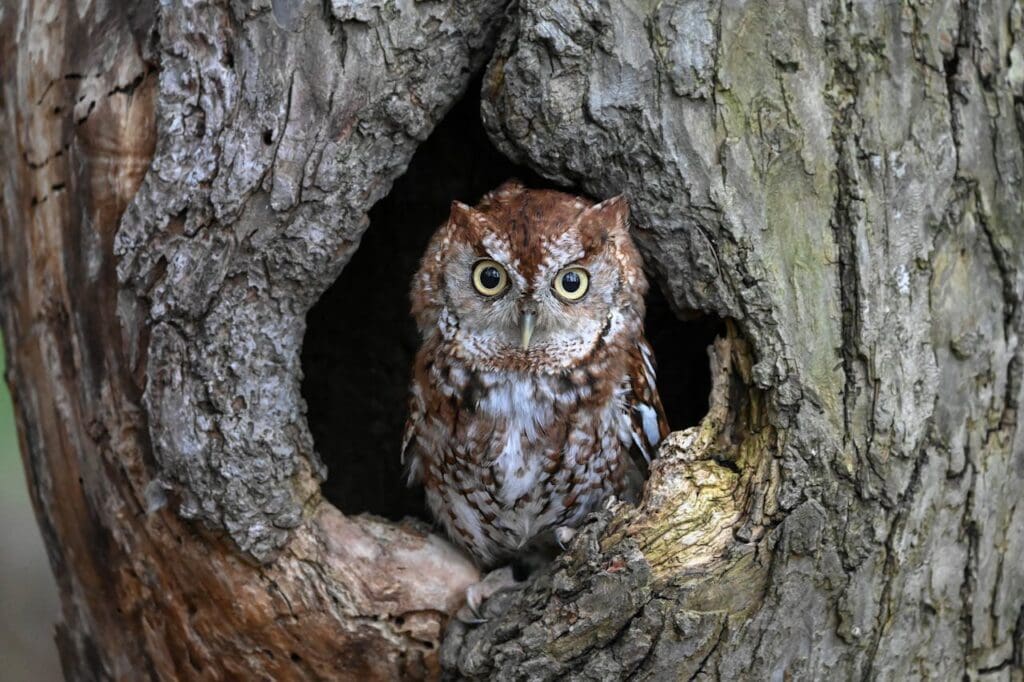
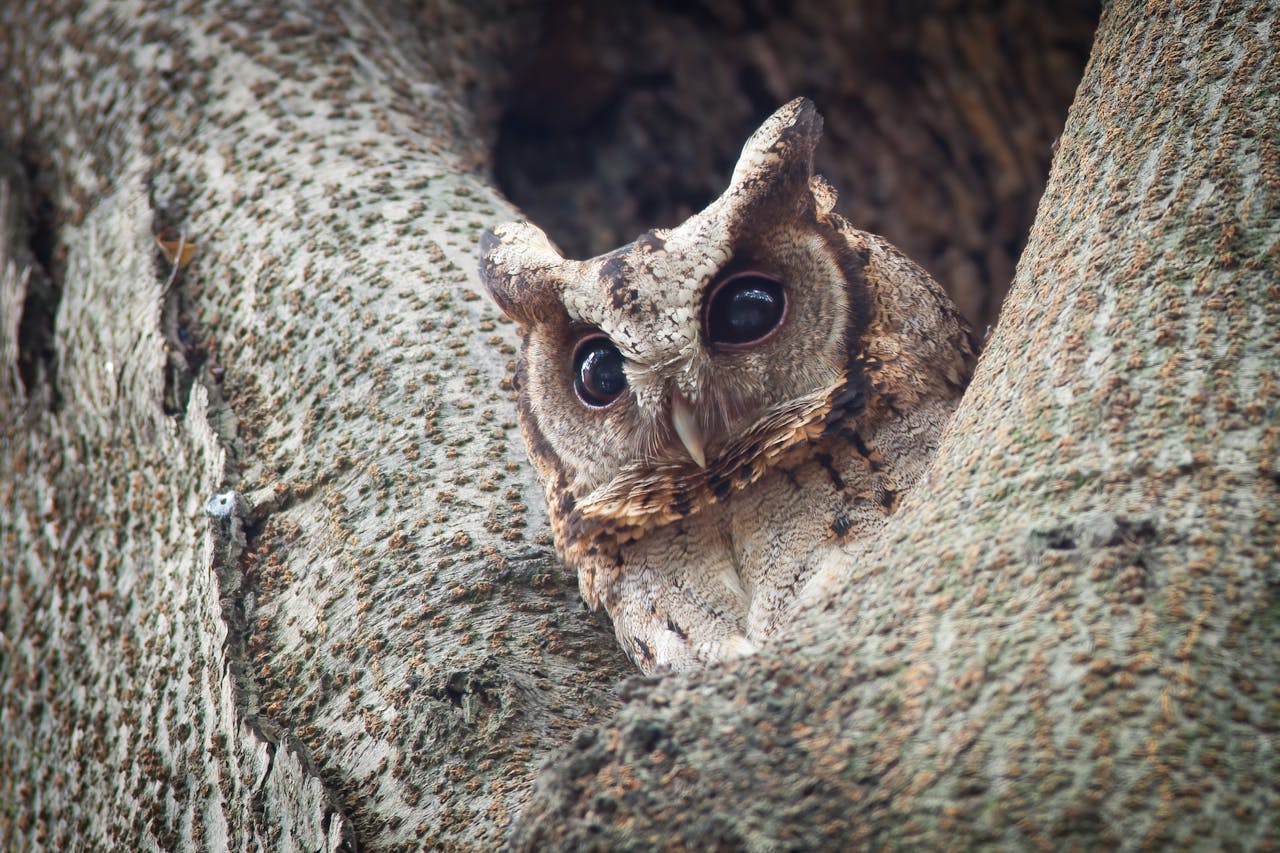
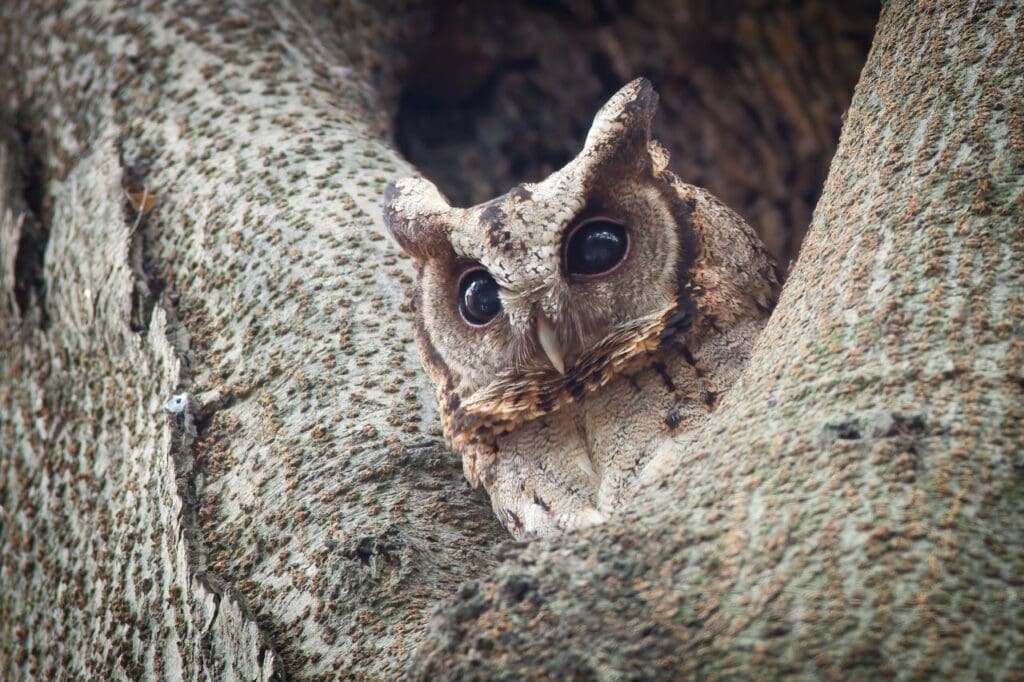
Their ability to thrive in such myriad environments comes from their variations in size and color. Their heights vary from roughly 6 to 10 inches, and their wingspan from 18 to 24 inches. This, combined with their lack of a neck, raised ear tufts, and short tail, gives them a rounded, unintimidating shape. Their smaller size contributes to their ability to camouflage into their environment. Most plumage ranges from grey to brown to a rusty red, adapted to the environment around them. Populations in southern states, like Texas, typically see higher numbers of red, and Northern states find more grey. In evergreen or deciduous forests, the eastern screech blends in meticulously with the trees (Lockwood, M. W., 2021).
This adaptation allows eastern screech owls to make quick work of their wide variety of prey. It’s a resourceful bird, consuming small rodents like mice, smaller birds, and insects. It plays an important role as a mesopredator, a mid-ranking role in the food web, that keeps lower populations in check, while also serving as prey for others. Still, their camouflage protects them from such predators. Larger owls and hawks, mammals like raccoons and mink, and even interspecies hunting by other eastern screech owls look to them for food; don’t be fooled by their small packages, these owls are fierce! (Chesapeake Bay Program). Whether waiting to swoop down from their perch, or in some cases fishing at water edges, the eastern screech owl is prepped to use its clawed feet against any foe (Peregrine Fund).
Conservation and Coexistence
While the eastern screech owl is resilient, they’re at risk too. By protecting existing populations through green spaces and human-based amenities, like nest boxes, we can contribute to their preservation. Community-led efforts like “Lights Out” campaigns, designed to reduce bird collisions and habitat disruptions, can also help.

Ryan Hill is currently an undergraduate student at Dartmouth College studying Environmental Studies and Studio Art. He is passionate about the conservation of local biodiversity and learning more about the ecosystems that make up our planet. He takes artistic inspiration from the natural world and admires the beauty of small insect colonies, to widespread old-growth forests.
Dig Deeper
Cornell Lab of Ornithology. (2024). Eastern Screech Owl – All About Birds. https://www.allaboutbirds.org/guide/Eastern_Screech-Owl
Nagy, C. M. (2012). Population dynamics and occupancy patterns of eastern screech owls (megascops asio) in new york city parks and adjacent suburbs (Order No. 3499268). Available from ProQuest Dissertations & Theses Global. (931548247). Retrieved from https://dartmouth.idm.oclc.org/login?url=https://www.proquest.com/dissertations-theses/population-dynamics-occupancy-patterns-eastern/docview/931548247/se-2
Lockwood, M. W. (2021). WESTERN SCREECH-OWL and EASTERN SCREECH-OWL. In Basic Texas Birds (pp. 172–173). University of Texas Press. https://doi.org/10.7560/713499-082
Peregrine Fund. (n.d.). Eastern Screech‐owl (Megascops asio). The Peregrine Fund. Retrieved [9/18/25], from https://peregrinefund.org/explore-raptors-species/owls/eastern-screech-owl peregrinefund.org
Chesapeake Bay Program. (n.d.). Eastern Screech Owl. Chesapeake Bay Program Field Guide. Retrieved [9/19/25], from https://www.chesapeakebay.net/discover/field-guide/entry/eastern-screech-owl
Gehlbach, F. R. (2012). Eastern Screech-Owl Responses to Suburban Sprawl, Warmer Climate, and Additional Avian Food in Central Texas. The Wilson Journal of Ornithology, 124(3), 630–633. https://doi.org/10.1676/11-157.1