
What animal floats upside down on the ocean’s surface, feeds on one of the most venomous sea creatures, and then steals the venom to use as its own defense?
The Blue Dragon! (Glaucus atlanticus)
What Even Is This Thing?
Meet Glaucus atlanticus, commonly known as the blue dragon—a species of sea slug that seems more mythical than biological, with a silver underside, electric blue markings, and branching, wing-like appendages. It’s no larger than your thumb—and it looks like a tiny, drifting dragon.
Most sea slugs live along the seafloor, crawling slowly over reefs or sand. Glaucus atlanticus does something entirely different. It spends its life floating at the surface of the ocean, carried by currents and wind, existing in the space where sky and sea meet.
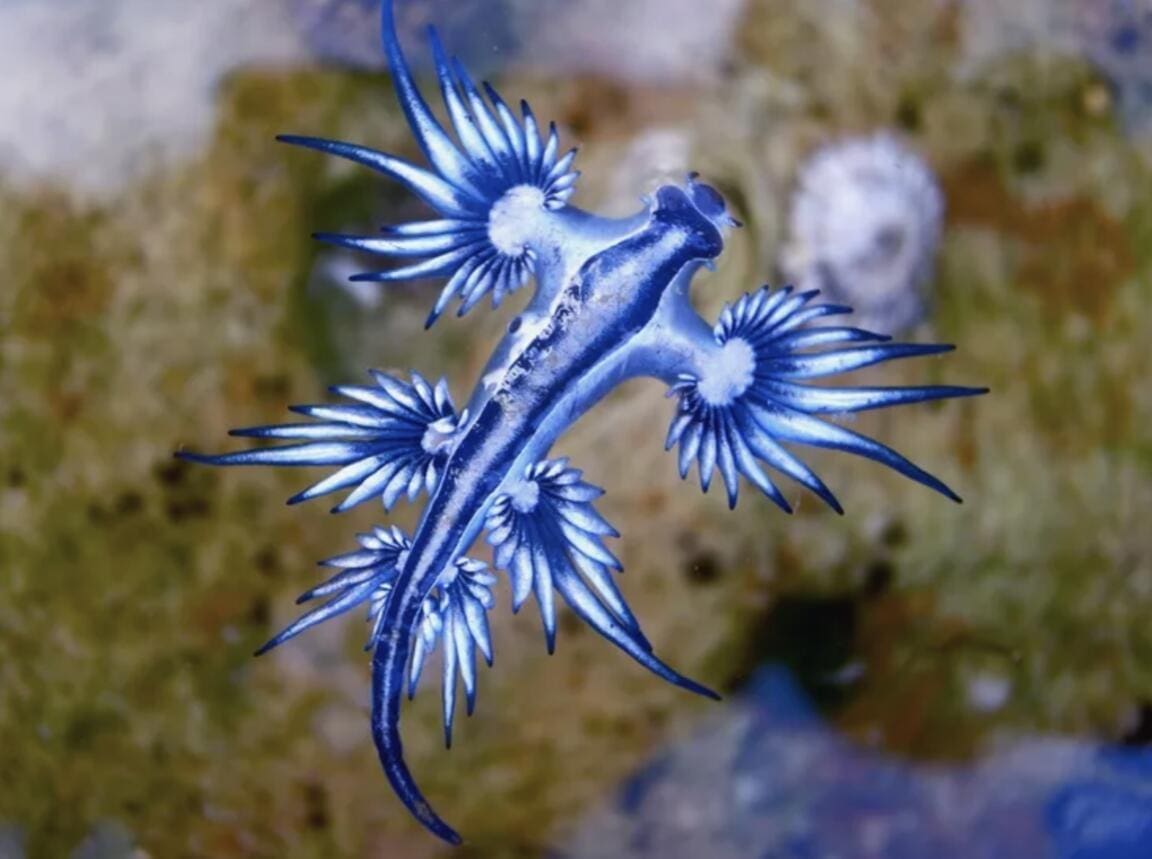
Blue Above, Silver Below: The Science of Camouflage
The blue dragon lives in a region of the ocean known as the neuston—the thin layer right at the surface.
Here, it floats upside down.
By swallowing a bubble of air and storing it in its stomach, Glaucus atlanticus maintains buoyancy as it drifts with its underside facing upward. This unusual orientation is not random—it plays a key role in how the animal avoids predators.
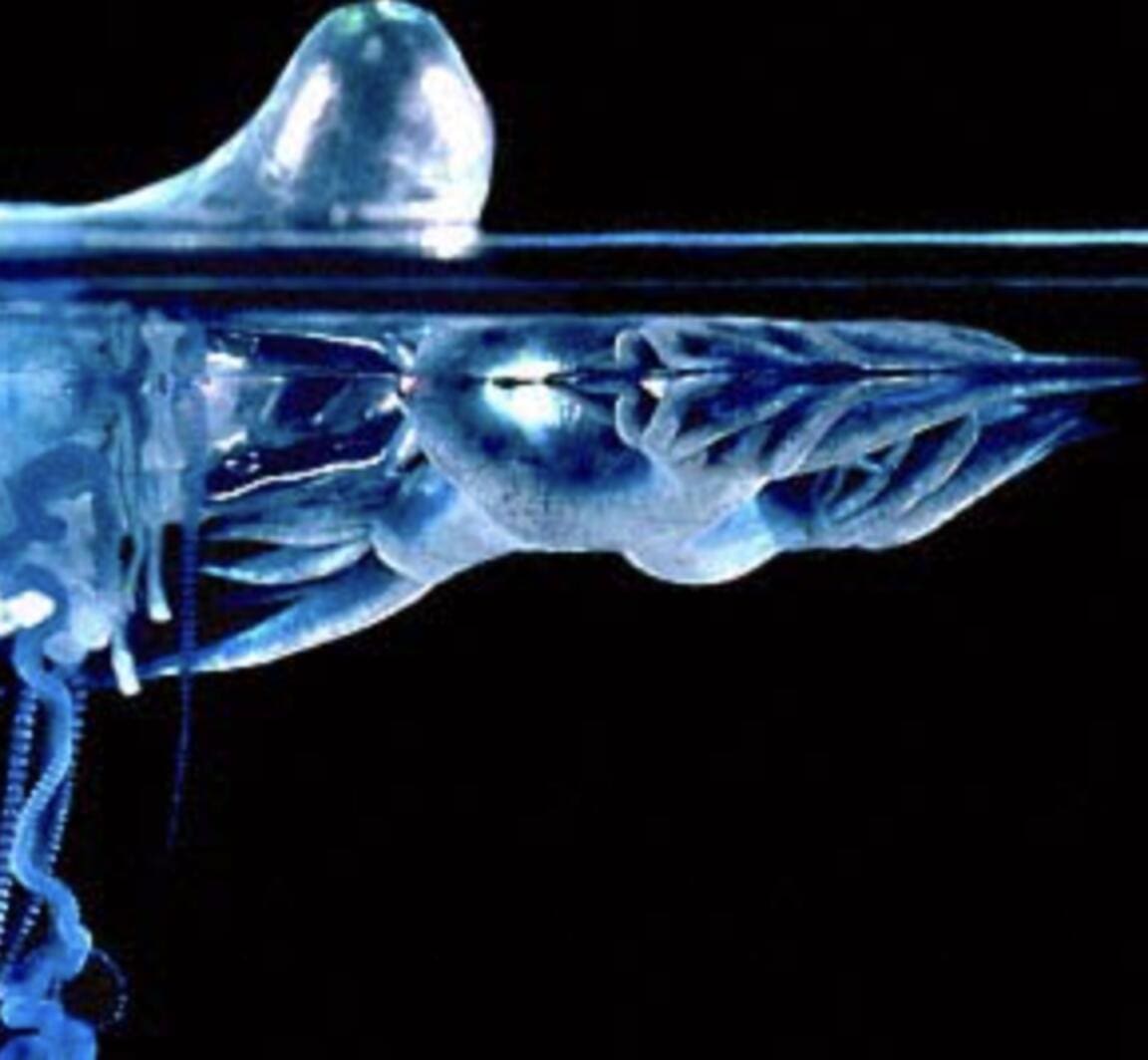
The blue dragon’s coloration is not just striking—it’s functional. Countershading (a pattern where different sides of the body match different lighting environments) reduces visibility depending on the viewer’s angle.
Glaucus atlanticus’s countershading is reversed compared to many animals because of its upside-down orientation. Its blue side faces downward toward the ocean, blending with the water, while its silver side faces upward, reflecting light from the sky.
This form of camouflage helps it remain nearly invisible in an environment with very little cover. It is a simple but highly effective strategy for survival in an otherwise exposed habitat. Combined with its small size and drifting behavior, the blue dragon is extremely difficult to detect. Its appearance may look dramatic to humans, but in its natural environment, it is designed to disappear.
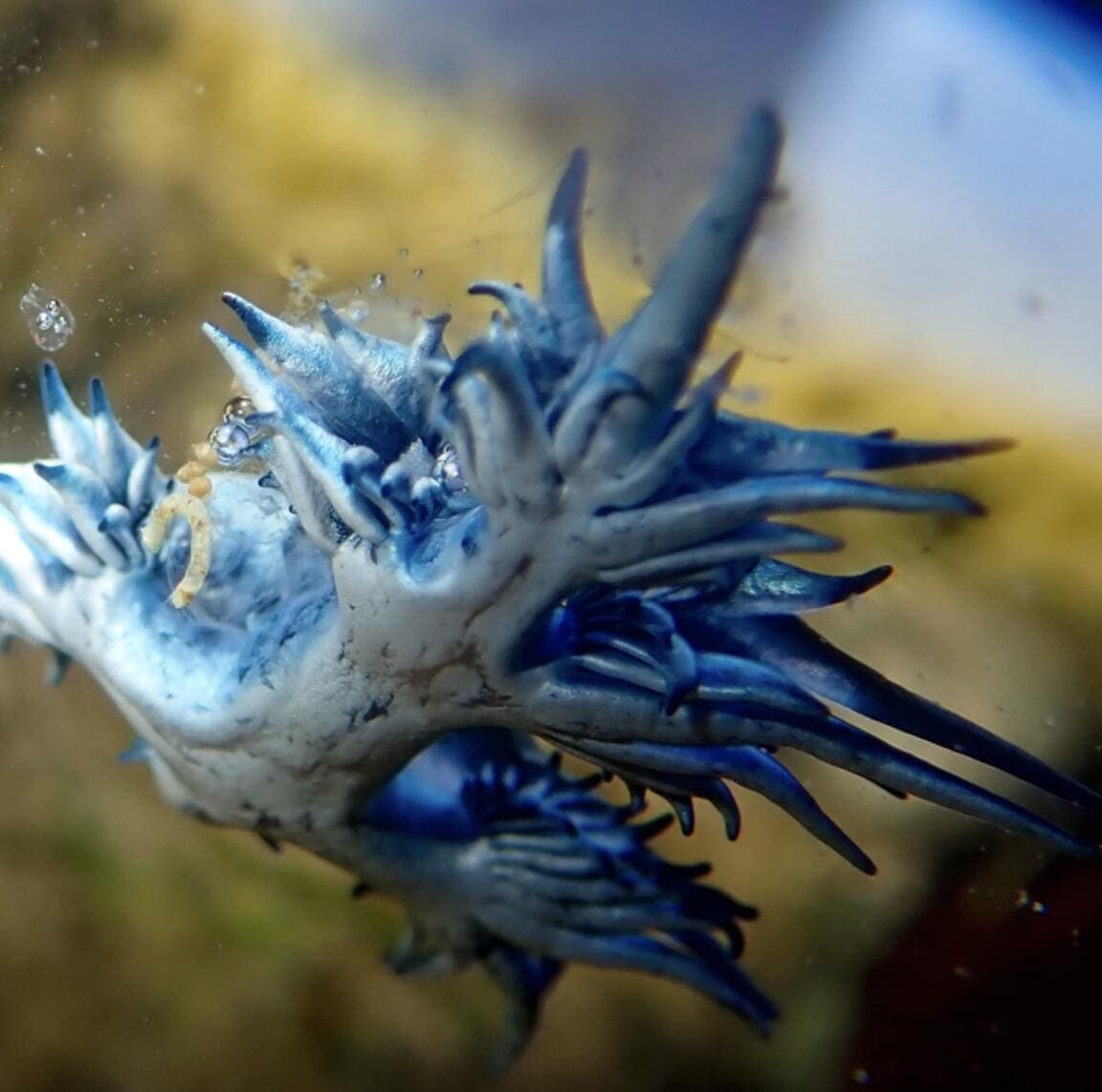
Borrowed Weapons: How It Steals a Sting
The blue dragon’s diet is as unusual as its lifestyle. It feeds on venomous organisms, most notably the Portuguese man o’ war (Physalia physalis), a floating colony known for its powerful sting. For most animals, this would be a dangerous—if not deadly—choice of prey. Glaucus atlanticus doesn’t just tolerate the venom. It repurposes it.
As it consumes the man o’ war, the blue dragon isolates the stinging cells, known as nematocysts, and transports them through its digestive system. Rather than breaking them down, it stores them in specialized structures at the tips of its appendages.
There, the nematocysts remain functional so that when the blue dragon is threatened, it can deliver a sting that is often stronger than the original organism it consumed. Instead of producing its own defense, it borrows one—turning its prey’s weapon into its own.
Because it concentrates stolen nematocysts, its sting can be painful—and in some cases, more intense than that of the Portuguese man o’ war itself. Contact with human skin can result in irritation, nausea, or more severe reactions depending on sensitivity.
Encounters are rare, but they do happen, especially when strong winds push surface-dwelling organisms toward shore.
Beautiful, Tiny, and Not to Be Touched
Despite its delicate size and striking appearance, the blue dragon is not harmless. It’s a reminder that in nature, appearance can be misleading. Something small and beautiful can still carry a powerful defense.
At first glance, the blue dragon can seem like a curiosity—a visually striking organism with unusual behavior. But it represents something deeper about how life adapts.
Its ability to exploit venomous prey, recycle biological defenses, and survive in an exposed environment highlights the flexibility of evolutionary strategies. Rather than evolving its own complex toxin system, it uses what already exists, conserving energy while increasing its effectiveness.
It also exists within a network of surface-dwelling organisms, interacting with species that are themselves shaped by ocean currents, climate, and environmental change.
Understanding organisms like Glaucus atlanticus helps build a more complete picture of marine ecosystems—especially those that are less visible but no less important.
A Species Without Borders
Carried by ocean currents and winds, blue dragons are found in tropical and subtropical waters around the world. They do not stay in one place, nor do they follow a fixed path. Their drifting distribution reflects the movement of the ocean itself—changing with seasons, weather patterns, and shifting environmental conditions. They are both inhabitants of the ocean and indicators of its dynamics; small, but a vital part of something much larger. At the edge of sea and sky, the blue dragon survives not by strength or speed, but by adaptation—by turning the world around it into something it can use. In doing so, it becomes something that seems almost impossible: a creature that is as functional as it is extraordinary.

Sienna Weinstein is a wildlife photographer, zoologist, and lifelong advocate for the conservation of wildlife across the globe. She earned her B.S. in Zoology from the University of Vermont, followed by a M.S. degree in Environmental Studies with a concentration in Conservation Biology from Antioch University New England. While earning her Bachelor’s degree, Sienna participated in a study abroad program in South Africa and Eswatini (formerly Swaziland), taking part in fieldwork involving species abundance and diversity in the southern African ecosystem. She is also an official member of the Upsilon Tau chapter of the Beta Beta Beta National Biological Honor Society.
Deciding at the end of her academic career that she wanted to grow her natural creativity and hobby of photography into something more, Sienna dedicated herself to the field of wildlife conservation communication as a means to promote the conservation of wildlife. Her photography has been credited by organizations including The Nature Conservancy, Zoo New England, and the Smithsonian’s National Zoo and Conservation Biology Institute. She was also an invited reviewer of an elephant ethology lesson plan for Picture Perfect STEM Lessons (May 2017) by NSTA Press. Along with writing for Bio4Climate, she is also a volunteer writer for the New England Primate Conservancy. In her free time, she enjoys playing video games, watching wildlife documentaries, photographing nature and wildlife, and posting her work on her LinkedIn profile. She hopes to create a more professional portfolio in the near future.
References
- Thompson, T. E., & Bennett, I. (1969). Physalia nematocysts: Utilized by mollusks for defense. Science, 166(3906), 1532–1533.
- Helm, R. R., Chichen, J., Denga, F. S., & Kocot, K. M. (2021). Natural history of neustonic animals in the Sargasso Sea: Reproduction, predation, and behavior of Glaucus atlanticus, Velella velella, and Janthina spp. Marine Biodiversity, 51, 42.
- Yamamoto, G., Abe, A., & Hirose, E. (2025). Predatory behavior using cerata in Glaucus atlanticus. Frontiers in Zoology, 22, 10.
- Churchill, C. K. C., Valdés, Á., & Foighil, D. Ó. (2014). Molecular and morphological systematics of neustonic nudibranchs, with descriptions of three new cryptic species. Invertebrate Systematics, 28(2), 174–195.
- Huang, H.-D. (2022). Observation of an aggregation of the neustonic nudibranch Glaucus atlanticus (Forster, 1777) in southern Taiwan. Collection and Research, 35, 33–39.
- Helm, R. R. (2021). The mysterious ecosystem at the ocean’s surface. PLOS Biology, 19(4), e3001046.
- Munro, C., Vue, Z., Behringer, R. R., & Dunn, C. W. (2019). Morphology and development of the Portuguese man of war, Physalia physalis. Scientific Reports, 9, 15522.