
What creature looks like a cartoon elephant, lives nearly four miles beneath the ocean’s surface, and moves by “flying” through the water?
The Dumbo Octopus! (Grimpoteuthis)
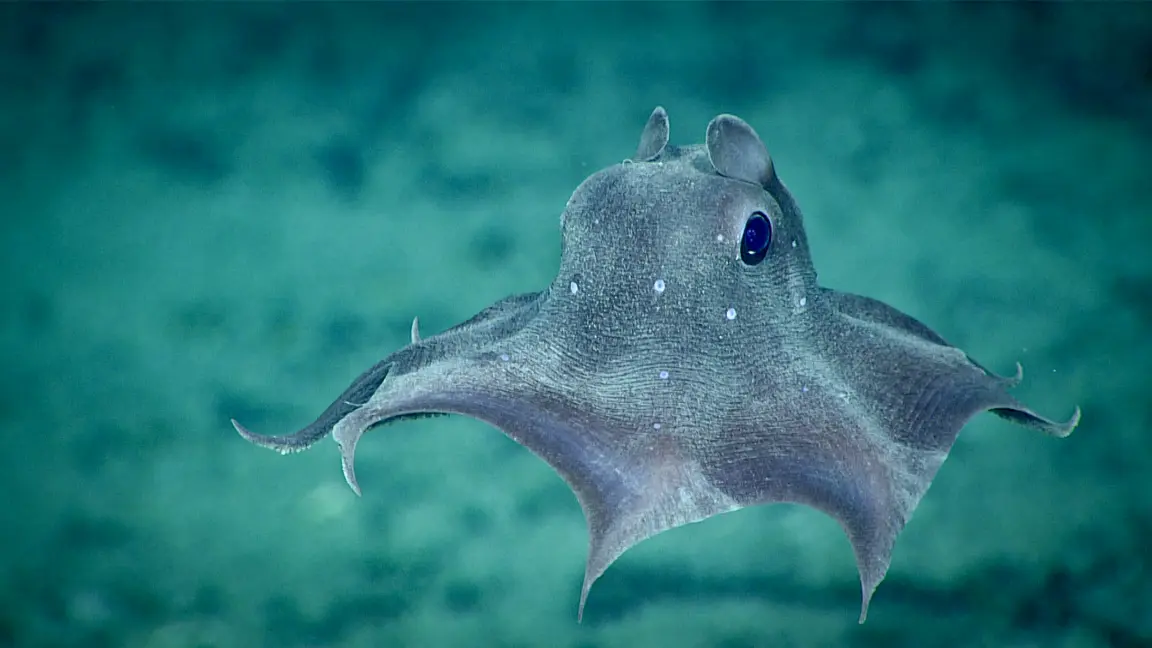
Bio4Climate intern Allison Eckard from Lesley University shares her fascination with this rarely seen deep sea creature.
I first saw a dumbo octopus in a deep-sea video, and my immediate thought was: there’s no way that’s real! It didn’t move like anything I recognized. No darting, no sudden bursts. Just a slow, drifting motion, as if it were suspended in space.
And in a way, it is.
The deep ocean, the place dumbo octopuses call home, is about as close as Earth gets to another world.
Dumbo octopuses, from the genus Grimpoteuthis, live at depths of roughly 3,000 to 7,000 meters. That far down, there is no sunlight, the water temperature is near-freezing, and pressure is extreme. Plants cannot grow, food is scarce, and whatever nourishment does exist often arrives slowly, drifting down from the surface as marine snow. The dumbo octopus exists in an environment defined by limitation and is one of the most elegant examples of adaptation to this extreme world.
Built for Restraint
Persistence is what makes the dumbo octopus so remarkable. Unlike shallow-water octopuses, they do not rely on jet propulsion to get around. Instead, they use two large, ear-like fins to gently propel through the water. The movement is slow and rhythmic, and it does not look much like swimming. It looks like flying.
This style of motion is not only beautiful to watch; it is also highly energy efficient, which is critical for survival in an underwater world where energy is everything and there is no room for waste.
Because energy is so limited, dumbo octopuses are not built for dramatic chases or flashy escapes. They drift along the seafloor and use their arms to gather small organisms such as crustaceans and worms. They don’t tear their food apart. They swallow it whole. No drama. No excess. Just enough.
They’ve also let go of things other octopuses rely on. They don’t have ink sacs because there’s no need for defense through spectacle. They don’t need to create a dramatic ink cloud escape because there’s nowhere to hide in the same way, and encounters with predators are relatively rare.
Instead, dumbos depend on low visibility, minimal movement, and the quiet advantage of being hard to notice in the first place. They survive by restraint, not intimidation.
Their bodies reflect this too. They’re soft, gelatinous, and built to withstand pressure. Their form allows them to hover just above the ocean floor, conserving energy while staying mobile enough to feed. Even their reproduction has adapted to unpredictability. Females can carry eggs at different stages of development, allowing them to reproduce whenever conditions are favorable rather than being tied to a strict seasonal cycle. In an environment where timing is uncertain, flexibility is survival.
A Hidden Climate System
The dumbo’s adaptability makes it fascinating not only as a creature, but as part of a larger ecosystem. Even in the deep ocean, nothing exists in isolation. Dumbo octopuses are part of a food web that includes microscopic drifting matter, small invertebrates, and larger predators. By feeding on small organisms, they help regulate populations, move energy through deep water ecosystems, shape chemistry, carbon balance, and food systems throughout the entire body of water. They help break down and recycle organic matter.
Nothing exists in isolation, not even in the deepest parts of the ocean. Dumbo octopuses are part of a food web that includes microscopic drifting matter (marine snow), small invertebrates, and larger predators. By feeding on small organisms, dumbos help regulate populations and contribute to the flow of energy through deep-sea ecosystems. Yet again, nature is climate.
Even the creatures we rarely see are part of systems that shape the stability of the entire planet and these unseen ecosystems matter more than we might realize. The deep ocean plays a major role in carbon storage, nutrient cycling, and global climate regulation.
But here’s where things get complicated. For a long time, the deep sea was considered too remote to be significantly impacted by humans. That’s no longer true. Emerging industries like deep-sea mining threaten to disturb fragile habitats that took thousands, if not millions, of years to form. Fishing methods that drag heavy nets along the ocean floor can disrupt seafloor ecosystems.Climate change is altering ocean chemistry, affecting even the deepest environments.
The deep sea remains one of the least explored regions on Earth, and the dumbo octopus is part of that mystery. We don’t yet know how many species of dumbo octopus exist, nor do we know their population sizes.
We are still discovering the basics of how these systems function—while simultaneously putting them at risk.
A Lesson for Restoration
From a biomimicry perspective, there’s something fascinating here as well. The dumbo octopus represents efficiency over excess, movement adapted to constraint, and survival through balance rather than dominance. Their slow, controlled motion has even inspired interest in soft robotics—machines designed to move gently and efficiently through complex environments. Not by forcing their way through—but by adapting to what’s already there.
If the tuatara is a lesson in persistence across time, the dumbo octopus is a lesson in thriving within limits. It doesn’t rush. It doesn’t overpower. It doesn’t waste energy trying to be something it’s not. It simply exists—perfectly adapted to a world that, at first glance, seems unlivable.
And maybe that’s the quiet takeaway. Some of the most important parts of Earth’s systems are out of sight, slow-moving, and easy to overlook. But they’re still holding everything together.

Allison Eckard is a senior Biology major with minors in Health and Environmental Science at Lesley University with a passion for ecological literacy and science communication. Through her internship with Bio4Climate, she explores the hidden relationships between neural systems, biodiversity, and climate resilience. She especially enjoys helping readers discover the surprising ways evolution shapes life in the smallest—and most unexpected—places.
References
- NOAA / deep-sea cephalopods: Vecchione, M. (2019). ROV Observations on Reproduction by Deep-Sea Cephalopods in the Central Pacific Ocean. Frontiers in Marine Science, 6, 403. https://doi.org/10.3389/fmars.2019.00403
- MBARI observations: Monterey Bay Aquarium Research Institute. Octopus Garden. https://www.mbari.org/project/the-octopus-garden/
- Collins, M. A. et al. (2001): Collins, M. A., Yau, C., Allcock, L., & Thurston, M. H. (2001). Distribution of deep-water benthic and bentho-pelagic cephalopods from the north-east Atlantic. Journal of the Marine Biological Association of the United Kingdom, 81(1), 105–117.
- Vecchione, M. et al. (2014): The study of deep-sea cephalopods. Advances in Marine Biology, 67, 235–359. https://doi.org/10.1016/B978-0-12-800287-2.00003-2
- National Geographic – Dumbo octopus overview: National Geographic. Dumbo Octopus Facts. https://www.nationalgeographic.com/animals/invertebrates/facts/dumbo-octopus