What creature is unable to jump and is known as a “speed goat”?
Meet the Pronghorn!
Ow!
An especially prolific cactus digs its spines through my kneepad. Wincing in pain, I peer through the thicket of bramble… My heart sinks.
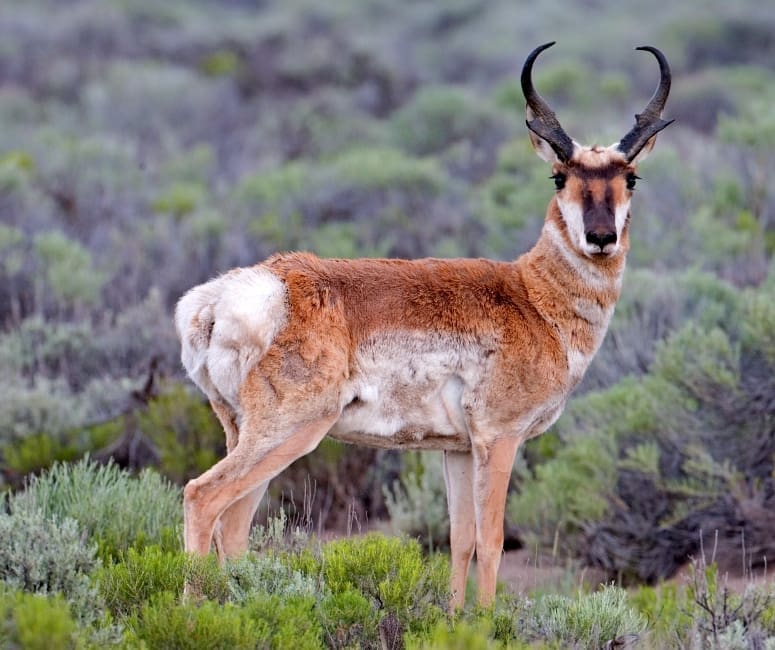
Three hundred yards out, a cloud of dust rises from the dry Montana ground, stirred up by North America’s speediest land animal: The Pronghorn. At 50 miles-per-hour, the herd crests the hill, disappearing as quickly as they entered my field of vision. I groan in frustration, begrudgingly picking the cactus spines out of my knees.
I crash through the remaining bramble to find myself surrounded by a mosaic of small, heart-shaped indentations, a telltale sign of the “speed goats” themselves. The herd’s tracks bob and weave through the sagebrush, slowly converging in their hasty escape.
I make my way up the hill, tensing with anticipation.
The horizon drops, and I look out into a field of gold. Wheat stubble extends for miles in every direction, broken up only by farmhouses, service roads, and the faintest lines of barbed wire fences.
Among this hegemony, a unified clump of brown and white races across the landscape. After a mere two minutes, the Pronghorn and I are now separated by a mile of gold.
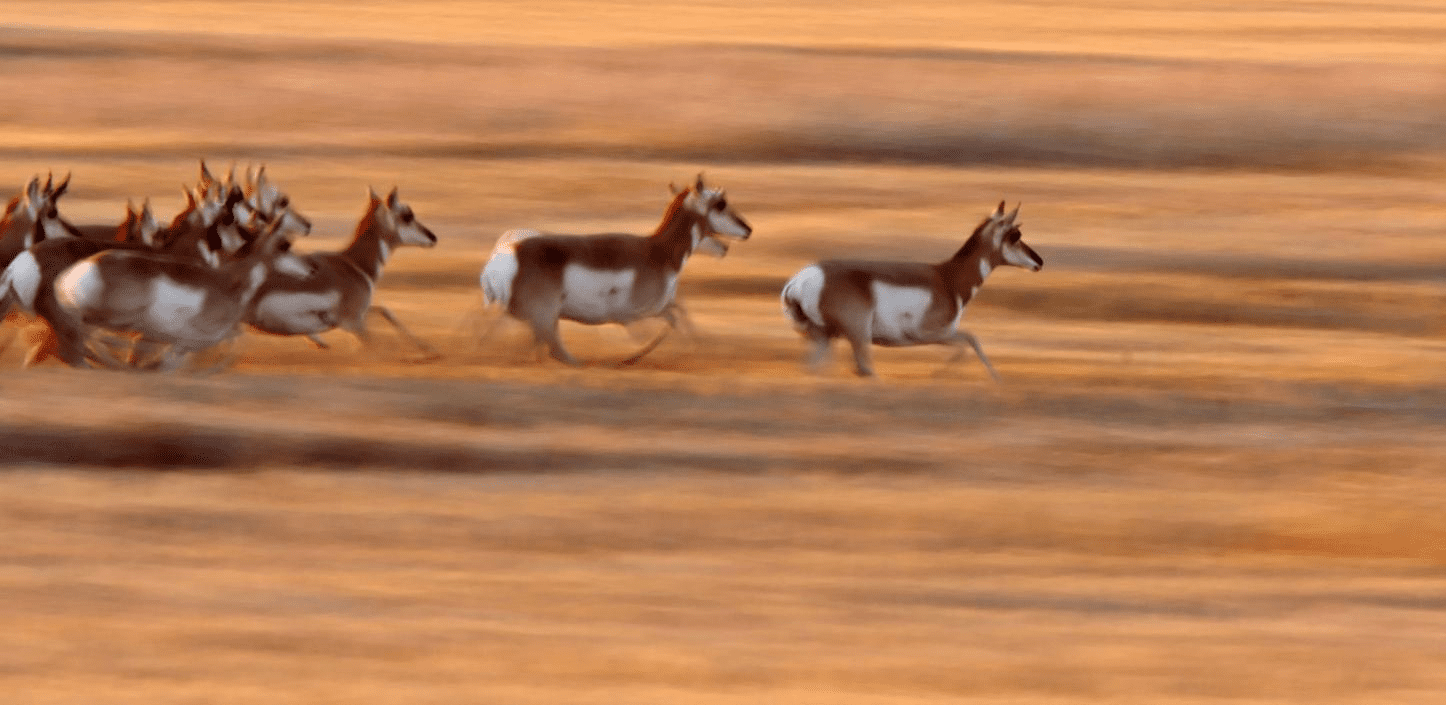
(Photo Credit: Path of the Pronghorn — NFWF)
There is no simple introduction for this charismatic creature. The Pronghorn is a story of unmatched speed, of a creature evolved to outsprint even the fastest predators. To understand why, we have to go way back…During the Pleistocene epoch (2.5 million to 16,000 years ago), North America was home to Miracinonyx, North America’s cheetah species. Over eons, the Miracinonyx and Pronghorn were locked in a race of sorts, a competition to outrun the other. Over thousands of years, the two species pushed each other to go faster, to maximize their bodies for the art of sprinting. Scientists describe the phenomenon as “an evolutionary arms race,” a label for these constantly escalating adaptations.
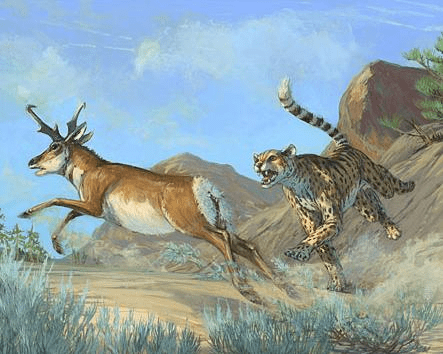
(Photo Credit: Blue Line American Cheetah — Rayan)
But, like any good drama, there is a plot twist. The Miracinonyx went extinct, and the Pronghorn no longer had anything to give it a good chase. On the flip side, nothing could catch it. So, the Pronghorn continued to flourish on the prairie, sprinting through sage brush, munching on bushes, and taunting predators who couldn’t run fast enough. This strategy worked for thousands of years, and besides the tough winters, life was good for the Pronghorn. Unfortunately their speed came at a cost: the Pronghorn never learned how to jump.
You might wonder, why does this matter today? Why does a prairie creature need to be able to jump? Four reasons: four strands of barbed wire fencing.
The American west is crisscrossed with fences, dividing property lines; ranches from farms, state land from private land. Barbed wire fence is one of the landscape’s constants: a dependable division of land.
When a Pronghorn meets one of these fences, it can be a battle to the death. As they try to duck under the bottom strand of barbed wire, the hide on their back is commonly scraped off by the barb, causing issues like infection and frostbite. Even worse, Pronghorn find themselves entangled in these fences beyond escape, sentenced to a cruel and unusual punishment for the Pronghorn: a stationary death.
For an animal that loves to run as much as the Pronghorn, these four strands hit hard.
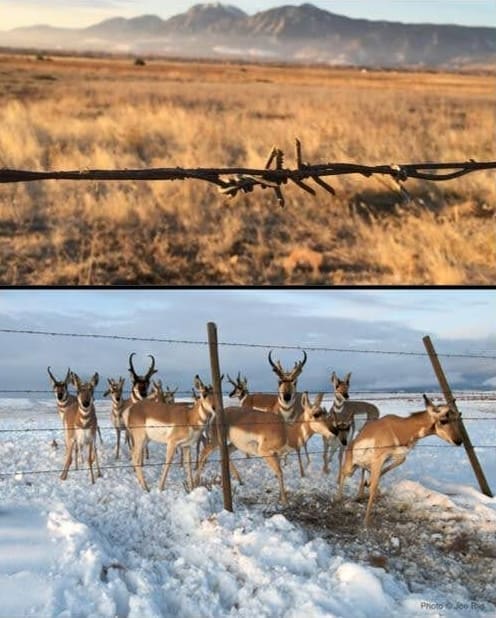
(Photo Credits: 1. Out West — Joe Wilkins, 2.The Great Migration: the Path of the Pronghorn — Vance Martin)
So, how do we coexist with and protect a creature built for openness in an increasingly divided landscape? The first steps are surprisingly simple.
A study from the Alberta Conservation Association (ACA) experimented with different strategies that either raised the strand height or got rid of the barbs, one way or another.
Many of these strategies come at the cost of the landowner. Fence work is expensive, it’s time intensive, and downright frustrating. But, ACA found one time-efficient and inexpensive strategy that stood out: carabiners!
By clipping the bottom wire to the one above it, ranchers create just enough space for a pronghorn to slide under safely, without losing the barrier they need for their cattle. A low cost and time efficient first step. While an elevated bottom strand may not look like much, for a Pronghorn it could turn an obstacle into a doorway. With enough doorways, entire migration corridors stay intact, mortalities plummet, and Pronghorn thrive.
For the Pronghorn, strategies of mitigating harm are out there. Yet, there are so many places they haven’t been implemented; where we need to take that first step.
If we take enough of these first steps, I will be able to stand in that same prairie with our next generation. I will hear the squeal of excitement a young hunter makes as they proudly discover a trail of hoofmarks. I will give an annoyed “Shush! It’s right there!” as a Pronghorn ambles in the pre-dawn light. If we’re so lucky, simple acts like a carabiner could bridge generations, in awe of that patch of brown racing through a field of gold.

Cyrus Kiely is an undergraduate at Dartmouth College, studying Quantitative Social Science and Environmental Studies. He is an avid skier, hunter, and lifelong outdoorsman with a passion for biodiversity conservation. His experiences growing up in Montana, combined with environmentally focused opportunities abroad in Mongolia and Namibia ,have shaped his commitment to fighting environmental challenges. Particularly the importance of large landscape conservation in the face of rapid development.
Dig Deeper
- https://blog.nature.org/2017/06/26/how-Pronghorn-cross-fence-wildlife-connectivity/
- https://www.nationalgeographic.com/animals/mammals/facts/Pronghorn
- https://www.nationalgeographic.com/science/article/did-false-cheetahs-give-Pronghorn-a-need-for-speed
- https://www.inaturalist.org/taxa/42429-Antilocapra-americana
- https://www.ab-conservation.com/downloads/report_series/aca_project_report_2023_pronghorn_fence_evaluation_final.pdf
- https://wild.org/blog/the-great-migration-the-path-of-the-Pronghorn/
- https://orionmagazine.org/article/out-west/
- https://blueline2011.wordpress.com/2011/12/03/extinct-animals/
- https://www.nfwf.org/media-center/videos/path-Pronghorn
- https://blog.nature.org/2024/05/29/six-spectacular-places-to-experience-the-sagebrush-sea/
- https://mtlandhome.com/blog/eastern-montana-is-where/
- https://www.wheatmontana.com/our-story
- http://en.wikipedia.org/wiki/Pronghorn#/media/File:Antilocapra_americana.jpg