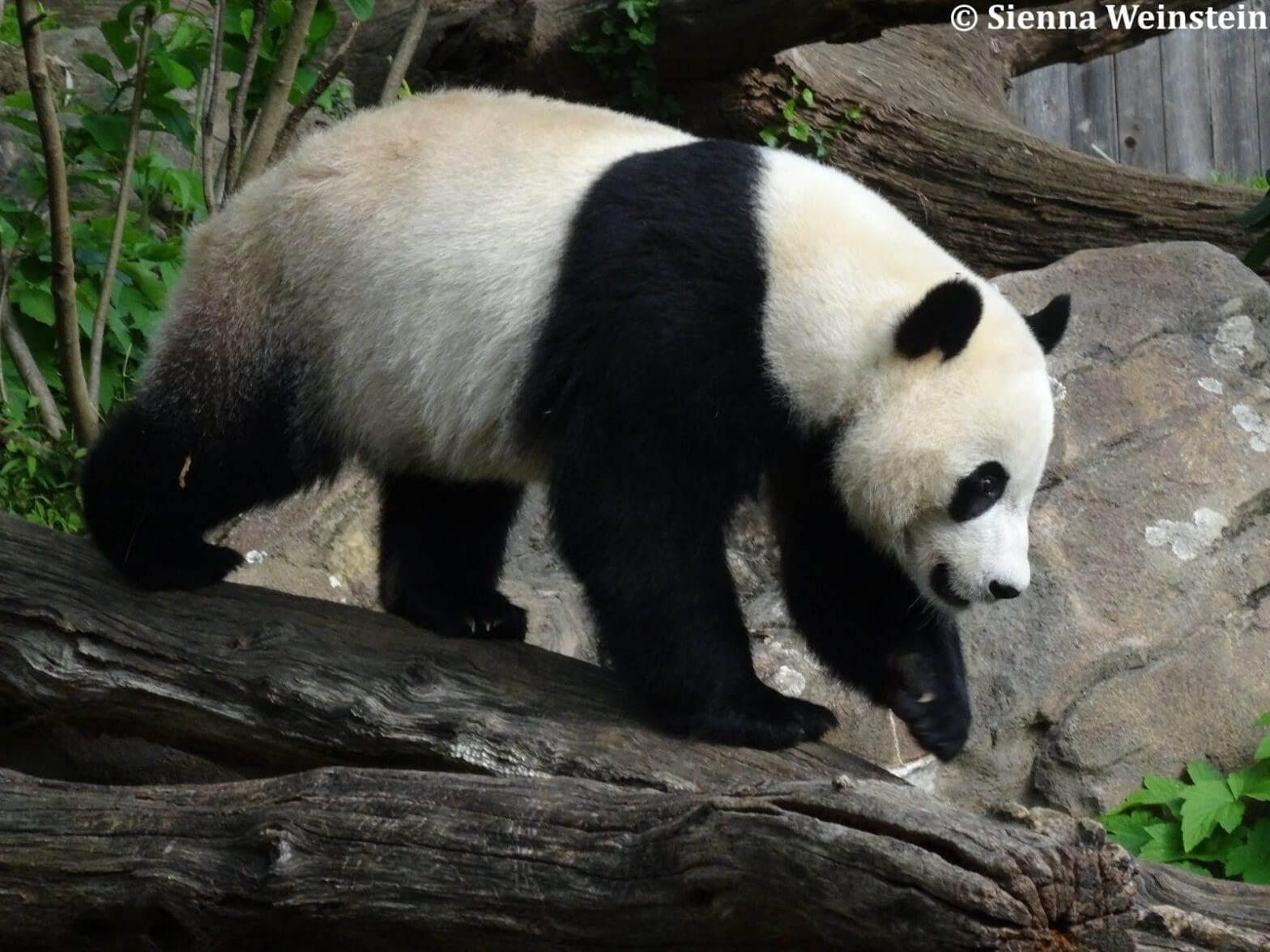
Can you name a carnivore that eats no meat, has a pseudo opposable thumb, but is not a primate?
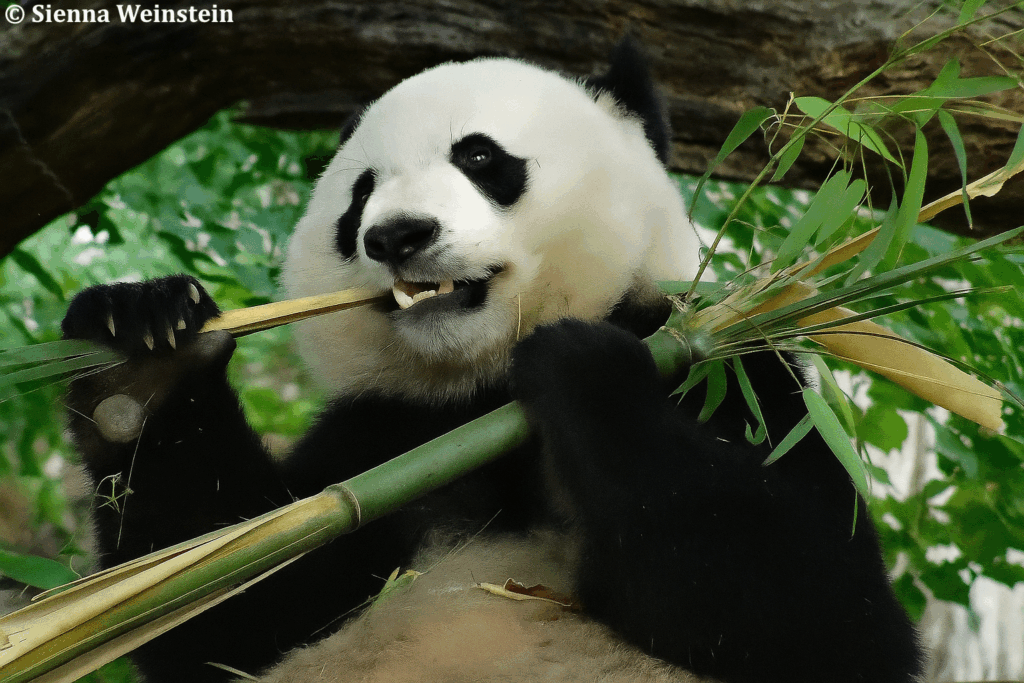
Meet the Giant Panda!
(Image credit: Sienna Weinstein)
In the summer of 2018, I took on a photography and videography internship at the Smithsonian’s National Zoo in Washington, D.C. to do what I love: take photos of animals. Photographing animals is more than just shooting images. For me, it’s promoting the natural beauty of animal species that may or may not be in danger of becoming extinct. I feel that photography is a medium that can be used to promote the conservation of wildlife worldwide. And what better example than one of the National Zoo’s most famous residents, the giant panda?
Eat, Sleep, Poop, Repeat
A symbol of China and the mission of wildlife conservation alike, the giant panda needs minimal introduction. The rarest of all bear species, the solitary giant panda is native to just a few mountain ranges in south central China where it spends up to 16 hours a day munching and crunching on one particular food: bamboo. When it comes to sleep, pandas take short, incremental naps between meals, typically lasting two to four hours for a total of 8-12 hours per day. Though this may sound like an idyllic lifestyle, there’s one major catch: bamboo is a poor source of nutrients.
Evolution is a slow process, and the giant panda’s digestive system hasn’t evolved to support their low protein, high cellulose diet. As a result, they only digest about 17% of the bamboo they eat. Pandas spend the majority of their days eating between 26 to 84 pounds of bamboo in order to secure sufficient nutrients. This also means that the giant panda defecates more than 100 times a day!
Despite their leafy diet (of which 99% is bamboo), giant pandas are still classified as carnivores, as they have a short digestive tract with gut bacteria more similar to those of other carnivores rather than herbivores. Luckily, evolution has provided them with one advantageous adaptation to assist with their bamboo obsession: a pseudo-thumb (an elongated wrist bone) on each paw, designed to help them manipulate and maintain a sturdy grip on the bamboo.
Unlike other bears, pandas neither store fat nor hibernate as bamboo doesn’t provide enough nutrients to sustain hibernation. Since they need to search for food year-round, pandas move to lower elevations during the winter for warmth and more plentiful bamboo than can be found at higher elevations. When warmer temperatures return in spring and summer, the pandas migrate back to the higher elevations to cool down and allow the bamboo in lower regions of the forest time to grow and recover. This unique (for a bear) feeding pattern influences the animal’s black and white coloration!
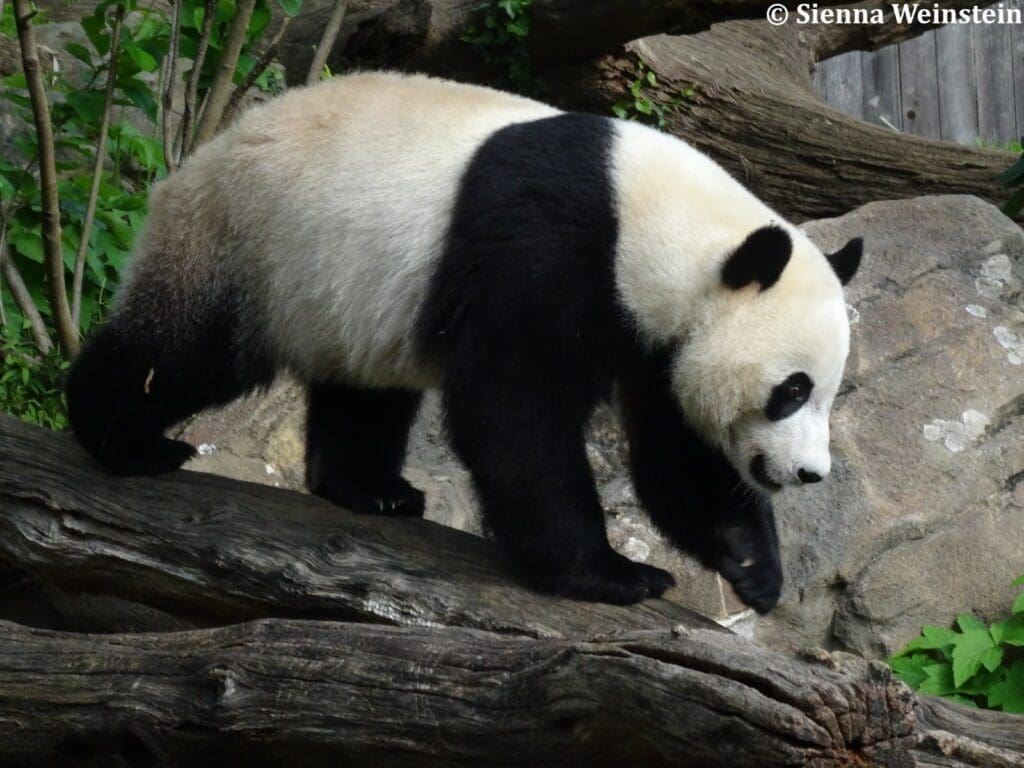
But how? Well, the types of habitats the panda travels through in its endless quest for food vary between elevations, from snowy mountains above, to tropical forests down below. The white areas of fur serve as camouflage in the snow, while the black legs, arms, and band across the back connecting the forelimbs help the panda hide in the shade of the forest. Their black and white coloration serves another purpose as well: communication. Pandas are solitary, and only meet for breeding. Their communication primarily consists of scent-based cues such as urine. Scientists at the University of California Davis, however, determined that a panda’s black ears are likely used to signal ferocity, while their dark eye patches may enable them to recognize distinct individuals.[1] [2]
(Image credit: Sienna Weinstein)
A Cute Keystone Species and Conservation Success Story
The panda plays a crucial role in maintaining the health and diversity of their native ecosystems, as their actions significantly impact the environment and other species. As they lumber, climb, and even swim within the bamboo forests of China, plant and tree seeds often attach to their fur and get deposited in scattered locations. This, along with the large quantities of bamboo seeds that get deposited from their feces during their travels, assists in spreading the growth of native vegetation, which in turn enhances the overall health of the forest ecosystem. It also helps that, like any other fertilizer, panda poop enriches the soil with helpful nutrients and promotes plant growth.
Their voracious appetite for fast-growing bamboo has a surprising benefit: it prevents forests from becoming overgrown with bamboo and inhospitable for other species that share the panda’s home. Like the black and white yin-yang symbol, the panda is a black and white representation of balance between the abundance of bamboo in their native forests with the damage caused by humans. This balance is important in a historical context, as the panda’s current range is highly fragmented due to centuries of human encroachment and habitat loss at lower elevations. Exacerbated by human activity and climate change, habitat loss and fragmentation remains the primary threat facing pandas today.
Luckily, the panda has one indisputable advantage: their cuteness. Their fluffy, round appearance and affinity for lounging around while eating bamboo makes them an adorable, captivating species to fawn over on TV screens and local zoos alike. Their resulting popularity has extended to their becoming an ambassador species for conservation worldwide, including as the iconic symbol of the World Wildlife Fund (also known as the World Wide Fund for Nature everywhere except in the United States and Canada), a global conservation organization. Ultimately, this strategy has been successful: Thanks to conservation efforts, as of July 2021, the giant panda was downgraded from Endangered to Vulnerable on the International Union for Conservation of Nature (IUCN) Red List of Threatened Species! Wild populations currently stand at above 1,800 individuals, and are increasing. While they’re not out of the (bamboo) woods yet, the panda is certainly a conservation success story, and an example of how humans can come together to take action against the looming threat of extinction for animal species worldwide.

Sienna Weinstein is a wildlife photographer, zoologist, and lifelong advocate for the conservation of wildlife across the globe. She earned her B.S. in Zoology from the University of Vermont, followed by a M.S. degree in Environmental Studies with a concentration in Conservation Biology from Antioch University New England. While earning her Bachelor’s degree, Sienna participated in a study abroad program in South Africa and Eswatini (formerly Swaziland), taking part in fieldwork involving species abundance and diversity in the southern African ecosystem. She is also an official member of the Upsilon Tau chapter of the Beta Beta Beta National Biological Honor Society.
Deciding at the end of her academic career that she wanted to grow her natural creativity and hobby of photography into something more, Sienna dedicated herself to the field of wildlife conservation communication as a means to promote the conservation of wildlife. Her photography has been credited by organizations including The Nature Conservancy, Zoo New England, and the Smithsonian’s National Zoo and Conservation Biology Institute. She was also an invited reviewer of an elephant ethology lesson plan for Picture Perfect STEM Lessons (May 2017) by NSTA Press. Along with writing for Bio4Climate, she is also a volunteer writer for the New England Primate Conservancy. In her free time, she enjoys playing video games, watching wildlife documentaries, photographing nature and wildlife, and posting her work on her LinkedIn profile. She hopes to create a more professional portfolio in the near future.
Dig Deeper
- https://academic.oup.com/beheco/article-abstract/28/3/657/3058530
- https://www.cbsnews.com/news/giant-pandas-off-endangered-species-list-china/
- https://en.wikipedia.org/wiki/Giant_panda
- https://www.ifaw.org/journal/15-fascinating-facts-giant-pandas
- https://www.iucnredlist.org/species/712/121745669
- https://nationalzoo.si.edu/animals/giant-panda
- https://www.nature.org/en-us/get-involved/how-to-help/animals-we-protect/giant-panda/
- https://www.pandasinternational.org/education-2/panda-facts/
- https://pmc.ncbi.nlm.nih.gov/articles/PMC4442137/
- https://www.theguardian.com/world/2021/jul/09/giant-pandas-no-longer-endangered-in-the-wild-china-announces
- https://www.universityofcalifornia.edu/news/why-are-pandas-black-and-white-uc-davis-scientists-have-answer
- https://www.washingtonpost.com/news/speaking-of-science/wp/2015/05/20/giant-pandas-somehow-exist-despite-having-guts-that-can-barely-process-the-only-food-they-eat/
- https://www.worldwildlife.org/stories/what-do-pandas-eat-and-other-giant-panda-facts