Which species of bear is the smallest and most arboreal, has the longest tongue of all bears, and are so smart, they can pick locks with their claws?
Made for the trees
If there is perhaps one thing to know about the sun bear, it’s that they are built for life in the trees.
If you were to design a near-perfect specimen for the arboreal life, you might end up with something pretty close to a sun bear.
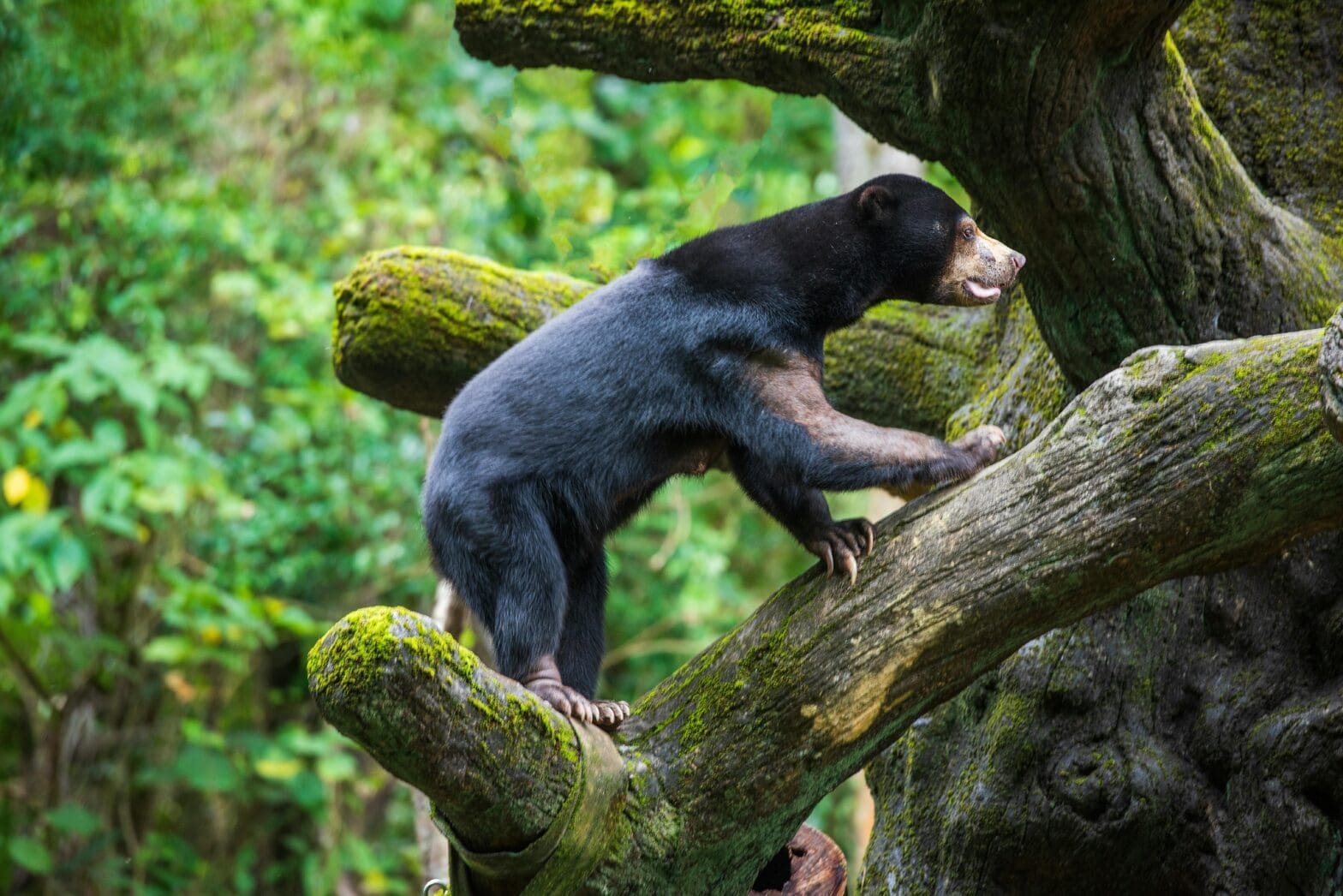
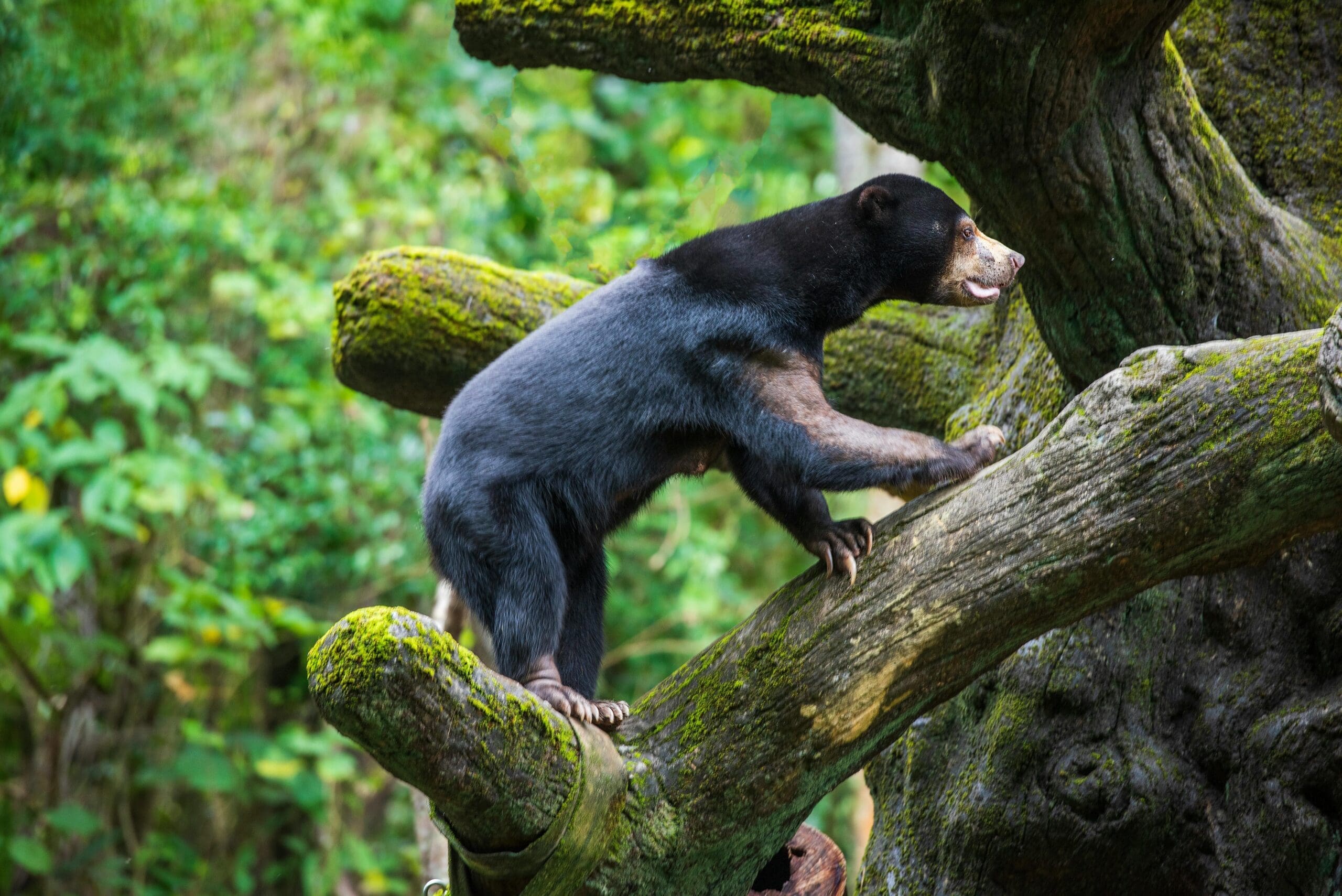
Think about it. Its front paws turn inward like a pigeon’s, giving extra grip when climbing, while its strong, curved claws act like hooks to pull it upward. A flattened chest streamlines the body, reducing drag as the bear moves among a complex array of branches. Bare paw pads help add even more traction. And that thick coat? It helps protect these climbers from stings, scrapes, and tropical downpours…regular hazards of the trade. Even its eyes are set slightly forward compared to other bears, improving depth perception and giving their balance a boost high off the ground.
Sun bears are the smallest of all bear species, at 3.5-4.5 feet (1.1-1.4 m) long, and weighing 60-145 pounds (23-65 kg); males are almost 25 percent larger than females. Despite their awkward-looking gait on the ground due to their inward-facing front paws, their small size allows them to be quick-moving and flexible within their habitat, resulting in an ability to climb up to 40 feet (12.2 m) into the canopy! This impressive climbing feat makes the sun bear the one of the highest-climbing bear species of them all.
By hugging the tree more effectively with those inward-turned paws we just learned about, the sun bear can use its powerful forearm and chest muscles to climb. The inward angle essentially helps the front paws act like grappling hooks–preventing slipping while the hind legs push upward. For such a small bear, there’s a lot of muscle involved!

(Photo by Max Vanl)
Shy and reclusive, sun bears are largely solitary (except for a mother and her cubs), and are typically most active during the day, foraging for food in the trees, and sunbathing in tree crevices, fallen logs, and especially nests they create out of twigs and leaves among the branches of the trees. They tend to be found far from human activity and can adjust their activities to be more nocturnal in order to avoid humans and any potential consequences that may result from such an encounter.
Sun bears are opportunistic omnivores, primarily eating fruits, insects (especially bees and termites), lizards, rodents, and their absolute(ly cliché) favorite: honey! Using their sharp claws, they break tree bark and beehives and use their impressive 8-10 inch (20-25 cm) long tongue (!!!) to lick up the insect and honey goodies. Their love for honey has unsurprisingly given them the nickname of “honey bear”, beruang madu, in Malay and Indonesian.
And they’re smart, too. A 2019 study discovered that, like humans and gorillas, sun bears use facial mimicry to communicate with one another. The study concluded that sun bears use distinct open-mouthed expressions during play, which could be used to communicate an interest in play or to strengthen social bonds. This power of observation extends to a little harmless tomofoolery, too. A captive sun bear was once observed carefully watching as sugar was locked away in a cupboard. Later, it used one of its claws like a key to open the lock and reward itself by snatching the sweet treat.
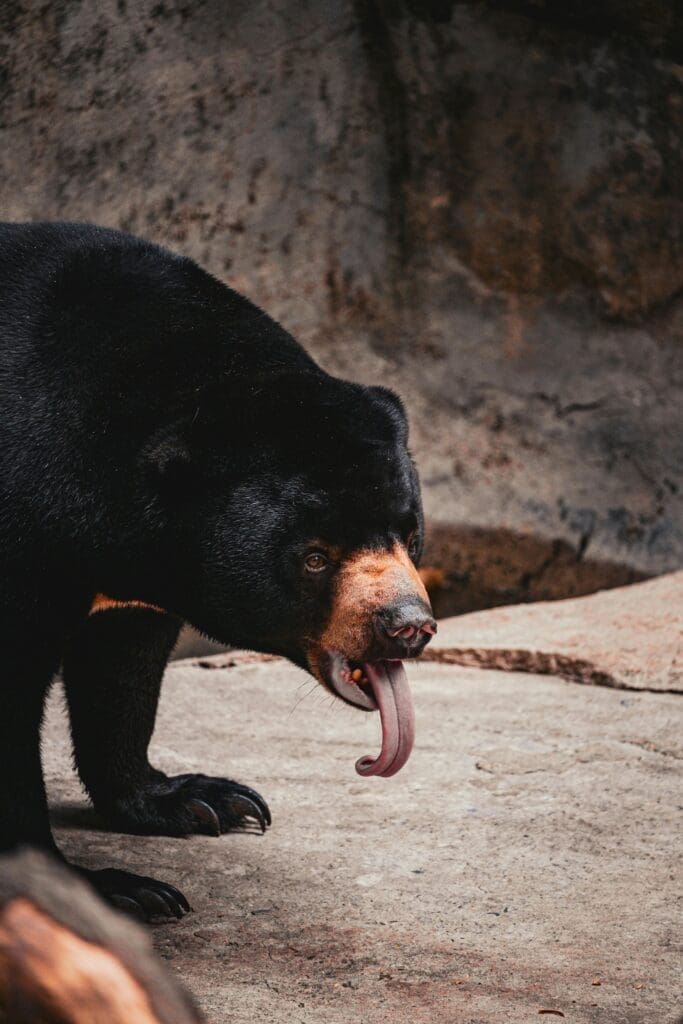

Image by Kridati
A species in danger
Sun bears play an important role in helping maintain the health and diversity of their native ecosystems, as their actions, routines, and behaviors significantly impact the environment and other species. While searching for beetles and other insects to eat, sun bears tear into tree trunks with their claws, leaving behind gashes and hollows. What begins as a little collateral damage later becomes a gift to the forest: the openings provide nesting spots and shelter for birds, reptiles, and other smaller animals. In addition, as fruit and seed-eaters, sun bears aid in the regeneration of their forest habitats by dispersing seeds through their feces as they move around. Finally, they can be considered pest controllers as a result of their diet consisting of insects and small rodents.
The sun bear is listed as Vulnerable on the IUCN Red List. Due to their secretive nature, it is unknown just how many wild individuals remain. But we do know they are in steep decline, with observable populations shrinking by more than 30% over the past three decades. Farming, logging, and poaching for meat or traditional medicine have stripped away both their habitat and safety, while the illegal pet trade adds further pressure. Their tendency to raid palm oil plantations and other crops has also fueled conflict with people.
While it is illegal to kill sun bears, laws protecting them are rarely enforced, and those laws that exist are poorly executed. There is A LOT that needs to be done in order to protect the sun bear on national, international, and local levels. Additional studies to further our knowledge of sun bear ecology, population distribution, conservation status, and the effect of threats, along with intense actions designed to reduce the trade in bear parts and to reduce habitat loss and degradation are some of the conservation actions needed to ensure that the smallest bear in the world remains free to climb trees and slurp up honey for years to come.

Sienna Weinstein is a wildlife photographer, zoologist, and lifelong advocate for the conservation of wildlife across the globe. She earned her B.S. in Zoology from the University of Vermont, followed by a M.S. degree in Environmental Studies with a concentration in Conservation Biology from Antioch University New England. While earning her Bachelor’s degree, Sienna participated in a study abroad program in South Africa and Eswatini (formerly Swaziland), taking part in fieldwork involving species abundance and diversity in the southern African ecosystem. She is also an official member of the Upsilon Tau chapter of the Beta Beta Beta National Biological Honor Society.
Deciding at the end of her academic career that she wanted to grow her natural creativity and hobby of photography into something more, Sienna dedicated herself to the field of wildlife conservation communication as a means to promote the conservation of wildlife. Her photography has been credited by organizations including The Nature Conservancy, Zoo New England, and the Smithsonian’s National Zoo and Conservation Biology Institute. She was also an invited reviewer of an elephant ethology lesson plan for Picture Perfect STEM Lessons (May 2017) by NSTA Press. Along with writing for Bio4Climate, she is also a volunteer writer for the New England Primate Conservancy. In her free time, she enjoys playing video games, watching wildlife documentaries, photographing nature and wildlife, and posting her work on her LinkedIn profile. She hopes to create a more professional portfolio in the near future.