
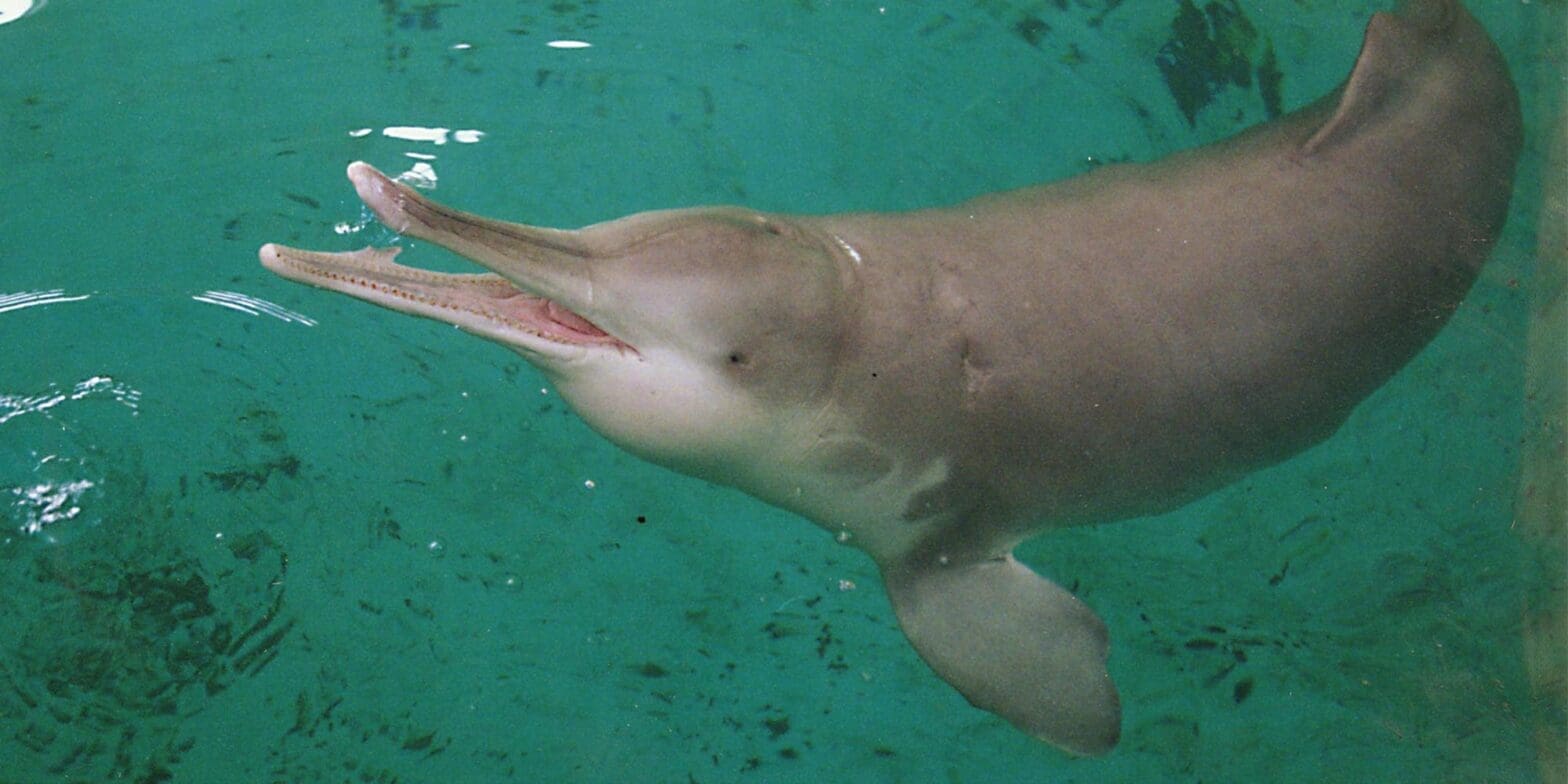
What river-dwelling goddess could navigate by sound alone, survived twenty million years of environmental change, yet disappeared within a few decades of human industrial expansion?
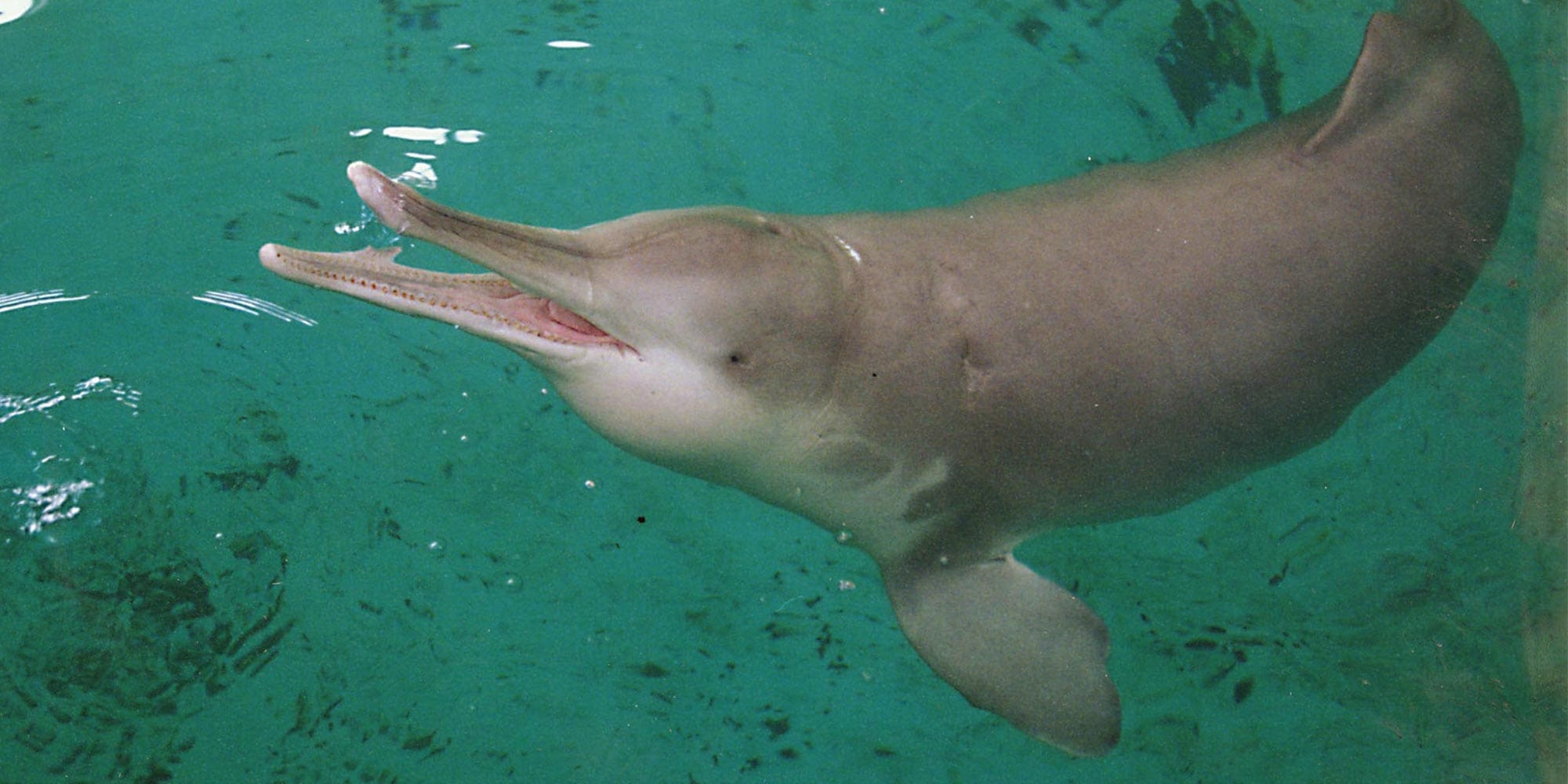
According to Chinese legend, the story of the baiji begins with a beautiful young girl who lived along the Yangtze River with her evil stepfather. One day he took her out by boat, with hopes to sell her at the local market. During this journey, he attempted to take advantage of the girl, and she dove into the welcoming arms of the Yangtze river to escape. Suddenly, a storm rose, capsizing the boat and drowning him. When the water calmed, a white dolphin appeared gliding across the current. The locals believed this to be the girl reborn as the baiji: Goddess of the Yangtze and guardian of fishermen.
For centuries, the baiji was more than a dolphin. She was deeply embedded in Chinese mythology, and fishermen considered encountering the baiji a good sign. The baiji embodied the river itself and served as a reminder of the river’s generosity, as well as the dangers. Unfortunately, in 2006, experts declared the baiji as functionally extinct.
The baiji fell victim to the one force she could not outswim: human industrial expansion.
A Living Fossil
The baiji, Lipotes vexillifer, was one of only five freshwater dolphin species in the world. Nicknamed the “living fossil,” the baiji was a subspecies that diverged about sixteen million years ago from two South American species: La Plata dolphins and the Amazonian river dolphin. The baiji was the only member of the mammal family called Lipotidae since they carried unique traits such as a single stomach rather than two and small eyes adapted to the Yangtze’s murky waters.
The Yangtze: Lifeline and Powerhouse
Stretching over 6,300 kilometres from the Tibetan Plateau to the East China Sea, the Yangtze is Asia’s longest river and the third longest in the world. Today it supports mega dams like the Three Gorges, shipping routes carrying millions of tonnes of cargo, and over 400 million people living in cities along its banks. Alongside this, it generates about $2 trillion annually, nearly 40% of China’s GDP and sustains hundreds of fish, mammal, amphibian and reptile species.
The baiji was perfectly adapted to this environment, with a long, narrow beak and echolocation ideal for shifting through silt and mud in search of carp and catfish. She often fed near sandbars, where nutrient-rich deposits attracted fish and fishermen alike. But even these adaptations could not save her against escalating industrialisation.
Sadly this is not the only extinction story from the Yangtze. The Chinese paddlefish, and last member of its genus Psephurus, was last seen in 2003. This species survived for at least two hundred million years, and was killed, with overfishing and dam construction to blame.

When Growth Outpaces Nature
Before China’s industrialisation in the 1950s, there were an estimated six thousand baiji living in the Yangtze’s thriving ecosystem. By the 1980s, only a few hundred remained, and by 1997, fewer than twenty were left. The baiji’s collapse reflects what can happen when economic growth is expedited at the expense of ecologies, both human and non-human.
China’s proto-industrialisation began in 1978, and while the baiji were initially hunted for meat, oil and leather, the greater threats came later from dredging, untreated waste, and the Three Gorges, which permanently altered the Yangtze’s flow. Studies suggest that it was not simply the changes to the river flow, but the relentless pursuit of artisanal fishing that posed a major threat to the baiji. Many small-scale fishers, trapped in poverty, ignored restrictions and turned to destructive methods such as electric shocks and dynamite. In 1981, extreme poverty affected 70% of urban and 97% of rural Chinese populations, thus leaving fishermen little choice but to prioritise survival over sustainability.
The baiji were not deliberately hunted to extinction but perished as bycatch, a concept economics call a ‘negative externality’ which reflects the hidden costs of rapid industrialisation. These costs include habitat destruction, pollution, and biodiversity loss; all of which were not factored into economic calculations that drove further development along the Yangtze. Each of these costs matter individually, yet when collectively overlooked they do not only lead to environmental damage, but also result in missed opportunities for intervention that could have prevented irreversible loss.
Missed Chances
The Yangtze can be described as a social-ecological system due to its interconnected importance for humanity and nature alike, thus making its management complex and politically charged. As baiji populations declined alongside other species, Chinese lawmakers implemented protective legislation in the late 1970s banning harmful fishing practices and creating reserves along the main channel. The issue of how to save the baiji was debated internationally, including in two IUCN reports, but the existence of differing opinions led to minimal financial or logistical support ever materialising. In-situ reserves (on-site conservation efforts) proved inadequate, and the later ex-situ (controlled preservation of a species outside of its natural habitat) programme at the Tian’e-Zhou oxbow lake came too late. In 1995, one baiji was successfully transferred, but perished due to summer flooding and thus the initiative collapsed.
Arguably, only a total fishing ban could have offered real protection, however given that the majority of Chinese households lived in extreme poverty in the 1980s, this would have been economically and socially unfeasible. Families depended on the river for survival, and there would have been a need to provide alternative income sources and livelihoods for river communities. It seems almost impossible for a developing nation to shoulder this economic burden. In 2021, China finally implemented a 10-year fishing ban. By 2020, studies show that the share of people living in extreme poverty in both urban and rural areas was below 1%, and now as the world’s second-largest economy China could absorb the financial cost of such policies.
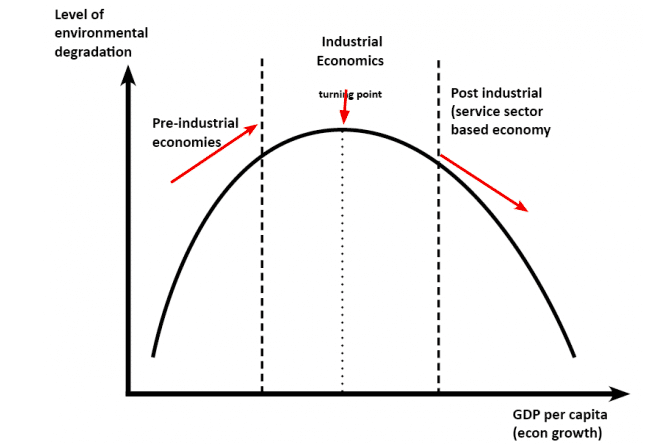
Sadly, it was too late for the baiji. This case is illustrated by the ‘environmental Kuznets curve’ (EKC), shown below, which describes the relationship between economic development and environmental degradation. EKC suggests that environmental degradation initially increases with economic growth in poorer countries, then decreases after reaching a certain income level. The idea is that countries often cannot afford environmental protection until a certain level of development is reached. But, by that point, often too much damage has been done to the most vulnerable species.
Beyond the Tragedy of the Commons
What happens when everyone has access to an abundant public resource? American ecologist and microbiologist, Garrett Hardin, considered this very question with his concept of the ‘Tragedy of the Commons.’ He describes a situation in which individuals with access to a finite public resource, such as the Yangtze, will all act in their own interest and thus overuse it, even possibly destroying the resource altogether. This concept links well to artisanal fishing. The regulation of common resources is a widely discussed concept, as it focuses on creating incentives to change individuals’ behaviour and use of shared resources, rather than relying on government ownership and direct control.
Yet Hardin’s model captures only one part of the baiji’s story. As mentioned earlier, much of the destructive fishing stemmed from economic desperation with families choosing to provide for themselves no matter the cost. Even those aware of the damage often continued because others did, a dynamic known as conditional cooperations. This reflects a wider reality that many of the ‘tragedies of the commoners’ are at heart, tragedies of inadequate social policy, where poverty traps leave communities without viable alternatives.
For the case of the baiji, the Yangtze required not only stronger top-down regulation, but also community-level institutions that Noble-prize winner Elinor Ostrom described within the concept of ‘polycentric governance.’ This governance system requires multiple, independent decision-making centres to interact and coordinate, rather than relying on a single, centralised authority. In the context of the Yangtze, this method requires not just regulation from Beijing, but also local fishing cooperatives collaborating and collectively developing economic incentives for conservation and alternative livelihoods for river-dependent communities. Economists now promote a scheme called ‘Payments for Ecosystem Services’, where communities are paid to conserve biodiversity. Had such frameworks been in place in the 1980s, fishermen might have been given both the means and the incentives to protect the baiji. Unfortunately, the absence of these mechanisms left short-term survival and extraction as the only rational choice.
Moving forward
All six river dolphin species in the world are classified as Endangered or Critically Endangered on the IUCN Red List of Threatened Species. In South Asia, the Ganges River Dolphin, scientifically known as Platanista gangetica, is officially endangered. Like the baiji, the Ganges River Dolphin holds significant cultural importance in Hinduism, but is struggling under mounting pressures from industrial runoff and accidental bycatch. Meanwhile, in South America, the Amazon River Dolphin faces mercury contamination from gold mining, entanglement in fishing gear, and deliberate killing for use as bait. It seems that the baiji’s extinction is not an isolated tragedy, but part of a global pattern for other river dolphins.
Despite these challenges, there are signs of hope for river dolphins around the world. Studies show that China’s 10-year ban has shown promising results for biodiversity recovery. Fish eggs and fry counts in 2023 from the Jianli monitoring section reached six billion in total which is 4.4 times higher than those in 2020. However, scholars debate whether the ban alone is enough to reverse the situation, particularly since overfishing contributed only 30% of the total fish decline, with human activities contributing more heavily. Globally, there is a clear increase in integrating ecological resilience into economic frameworks. For instance, Costa Rica’s Payments for Environmental Services Program (PES) is the first scheme of its type in the region. This program is designed to promote forest ecosystem conservation and combat land degradation In which landowners receive payments for adopting sustainable land-use and forest-management techniques. Additionally, WWF’s River Dolphin Initiative acts as a global knowledge hub of the best practices for river dolphin conservation and management.
The baiji’s extinction illustrates the cost of delayed regulation, undervalued ecosystem services tied together with short-term economic thinking. Extinction is final, and the baiji’s story reminds us that we must embed biodiversity into policy before it is too late.
Once revered as the Goddess of the Yangtze and guardian of fishermen, the baiji now endures as a warning, that treating rivers as merely resources erodes not just ecosystems but the very myths that bound us to them.

Marija Trendafiloska is a final-year BSc (Hons) Economics and Management student at King’s College London with a keen interest in environmental economics and climate policy. Her research experience has focused on turning complex economic concepts into clear, actionable policy insights, something she is motivated to deepen through postgraduate study. As the Co-President of KCL Green Finance Society, she also explores the intersection of sustainable finance, policy, and real-world impact. Beyond her academic commitments, Marija is passionate about reading, painting, and playing the piano, alongside being an avid gym-goer.
Dig Deeper
- Turvey ST, Pitman RL, Taylor BL, Barlow J, Akamatsu T, Barrett LA, Zhao X, Reeves RR, Stewart BS, Wang K, Wei Z, Zhang X, Pusser LT, Richlen M, Brandon JR, Wang D. First human-caused extinction of a cetacean species? Biol Lett. 2007 Oct 22
- Haijun Wang, et. al 2024, How to manage fish within and after the 10-year fishing ban
- The Chinese paddlefish, one of world’s largest fish, has gone extinct
- Markets and payments for environmental services, IIED