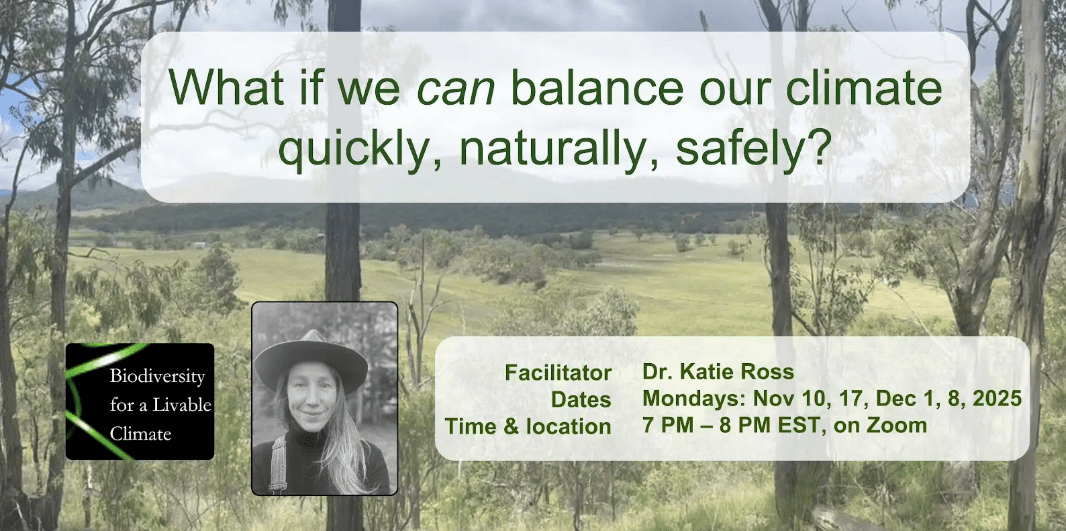
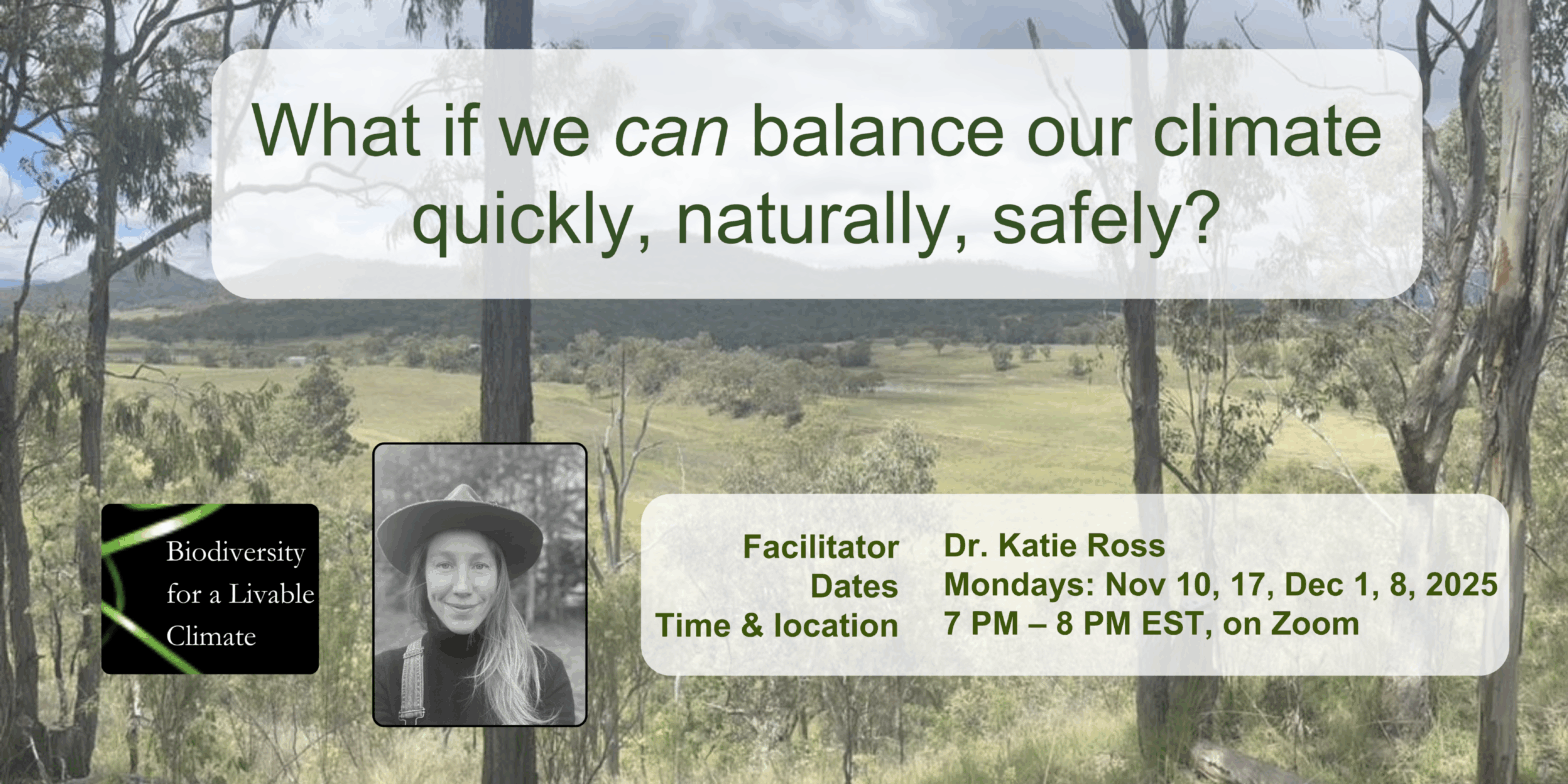
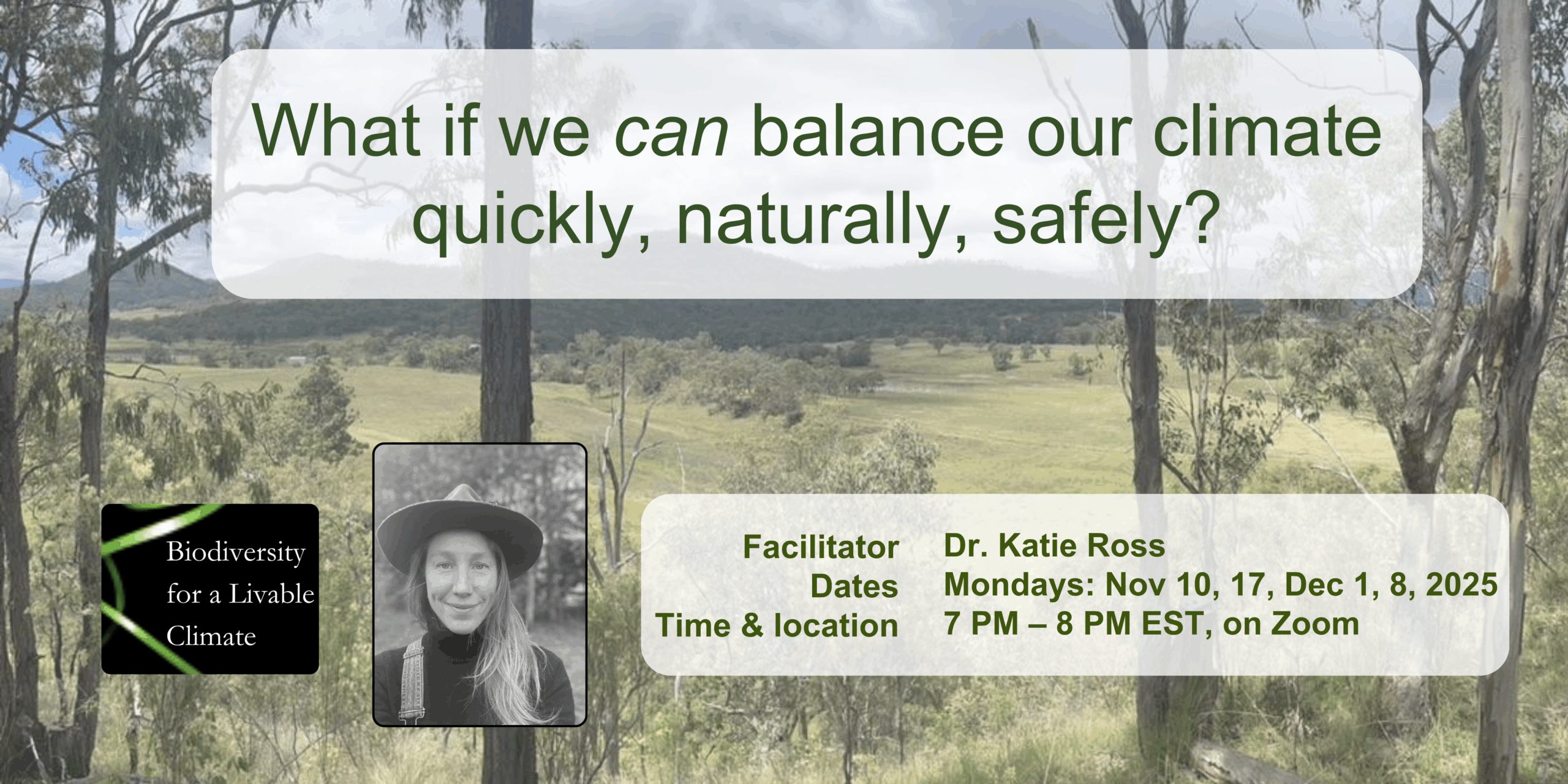
If you would prefer to send us a check, make it payable to “Biodiversity for a Livable Climate” and send it to us at 56 Broad Street, #89587, Boston, MA 02109. Please include a note with your name, email address and the name of the course.
Please note that we want you to join us more than anything, so we never turn anyone away based on ability to pay. If needed, we offer a few low-budget registration options below, or for volunteer or scholarship opportunities, you can email us at courses@bio4climate.org.
Looking forward to seeing you in class!
Please note that by registering, you will be added to our mailing list. You can unsubscribe or manage your email preferences at any time.
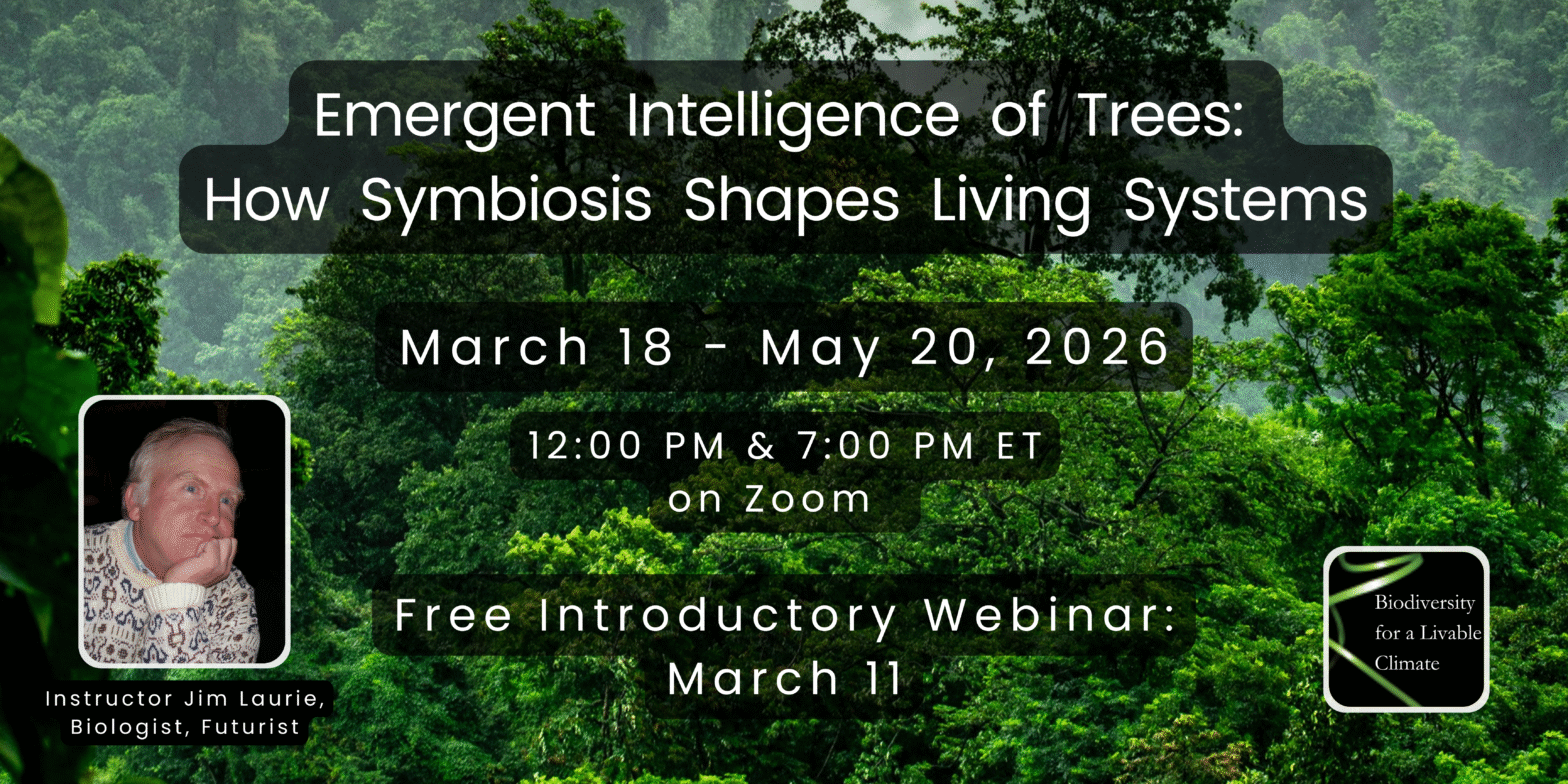
Trees are not passive features of the landscape. They are active agents in shaping Earth’s habitability.
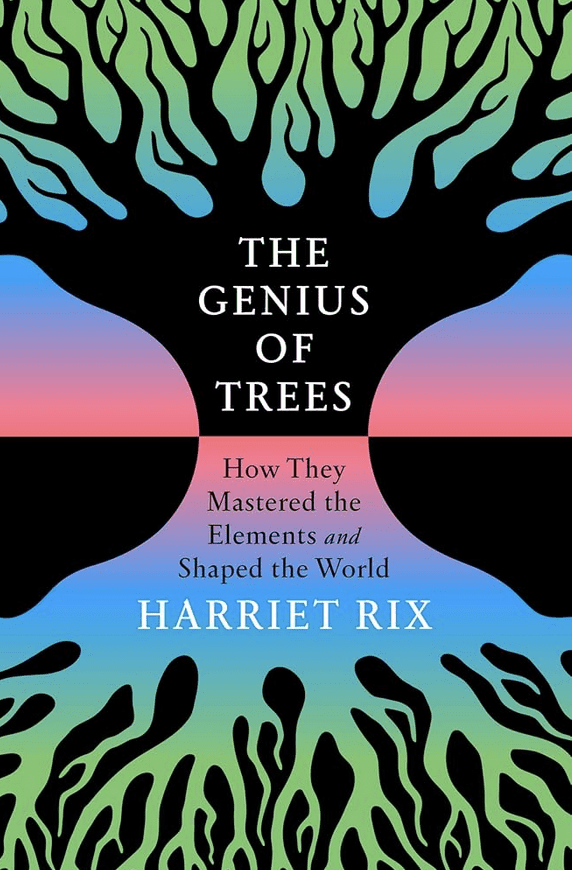
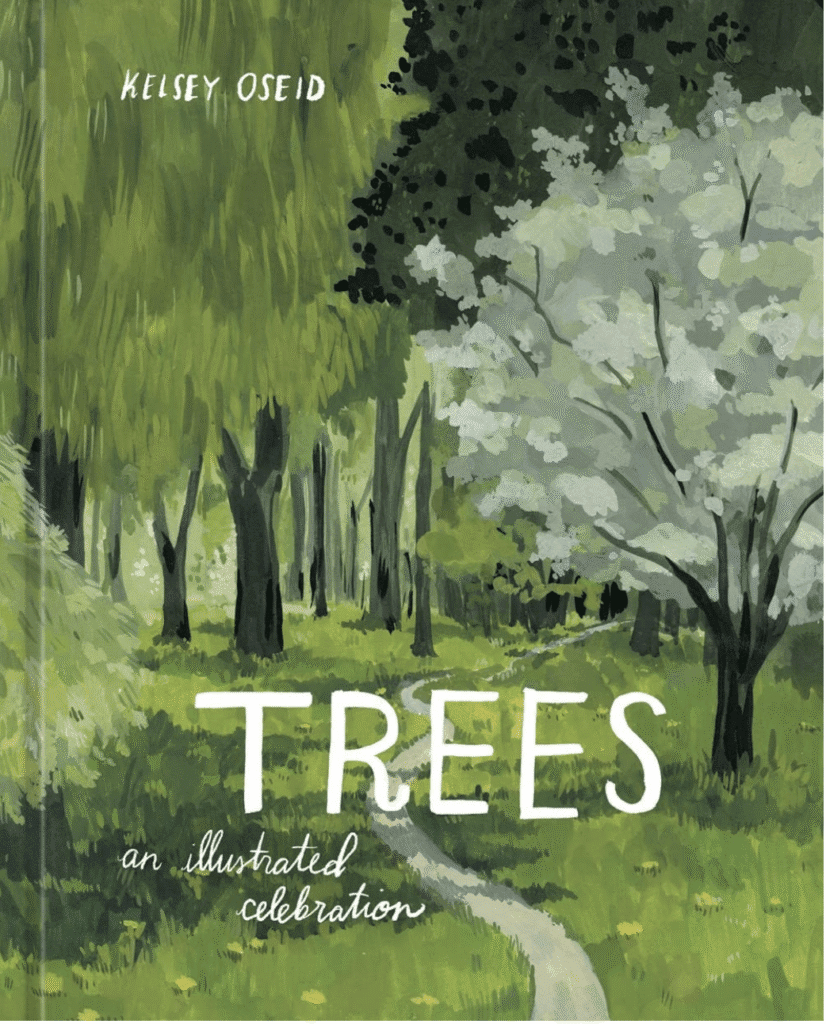
This course explores how trees create and sustain the conditions that allow life to flourish. Drawing on current ecological science and two companion texts—The Genius of Trees: How They Mastered the Elements and Shaped the World (Harriet Rix, 2025) and Trees: An Illustrated Celebration (Kelsey Oseid, 2023)—we examine how trees interact with climate, water, soil, and living communities across time.
Participants will learn how trees:
Build relationships with fungi, bacteria, soil microbes, animals, and humans
Regulate the water cycle through transpiration and cloud formation
Shape the carbon cycle through chemistry and photosynthesis
Contribute to the formation and stability of Earth’s atmosphere
Generate large-scale cooling effects through the biotic pump
Interact with fire, disturbance, and recovery in resilient ecosystems
We will also explore deep time—how forests and grasslands once covered far more of the planet, building carbon-rich soils that stored water, cooled continents, and supported ice ages. These historical perspectives help us understand what is possible again through restoration.
A central theme of the course is ecological intelligence. Rather than framing intelligence as a uniquely human trait, we will examine how trees and other living systems make decisions, adapt to constraints, and evolve cooperative strategies that improve shared habitats through symbiosis.
Classes combine short lectures, visuals, videos, discussion, and breakout conversations. Jim Laurie’s teaching style emphasizes clarity, participation, and mutual learning—ensuring that each session offers something new to learn and something meaningful to share.
Whether this is your first Biodiversity course or your fourteenth, you are warmly invited to join a growing learning community committed to understanding how life works—and how working with nature can help cool the planet.
This is a 10-week course that meets every Wednesday, starting March 18, 2026 and will run until May, 20, 2026. Classes will be held from 12 – 2 pm ET and 7 – 9 pm ET on Zoom. Students can choose either class time to accommodate their schedules (or participate in both).
The course will have reading assignments, slide presentations, videos, and breakout sessions to discuss topics raised in class and to get to know your classmates.
Instructor Jim Laurie’s goal is that each person shares something and learns something new in each class. There are many “old timers” who have taken several courses, but we also have new people in each course. The Old Timers are eager to encourage the “Newbies” and help them catch up and feel comfortable as part of the Symbiosis Team.
Course Books
In The Genius of Trees, Harriet Rix explores how trees have shaped the world by mastering water, carbon, chemistry, and time itself. Traveling across diverse landscapes, she examines how trees create soils, influence rainfall, regulate climate, and form enduring partnerships with fungi, animals, and microbes.
Alongside these journeys, Rix traces the deep evolutionary history of trees, revealing how their adaptive strategies helped build Earth’s atmosphere and sustain life through multiple extinction events.
Blending field observation, evolutionary science, and lucid storytelling, the book reframes trees as active agents in shaping habitable landscapes—inviting readers to see forests not as background scenery, but as intelligent participants in the living world.
In Trees: An Illustrated Celebration, Kelsey Oseid invites readers to explore the beauty, diversity, and quiet wonder of trees—one of the most essential life forms on Earth. Through elegant illustrations and accessible science, the book introduces how trees grow, communicate, and support life across the planet.
Oseid highlights the many ways trees sustain ecosystems: producing oxygen, storing carbon, shaping habitats, and forming underground partnerships with fungi to share water, nutrients, and signals of stress. Along the way, she reveals surprising facts—from the stories hidden in tree rings to the subtle clues found in leaf shapes—that deepen our appreciation of how trees work.
Blending art, science, and curiosity, this illustrated guide celebrates the world’s most remarkable trees, from towering redwoods to resilient mangroves and ancient baobabs. The book offers a visually rich and engaging companion for learning about trees as living, interconnected beings within Earth’s larger web of life.
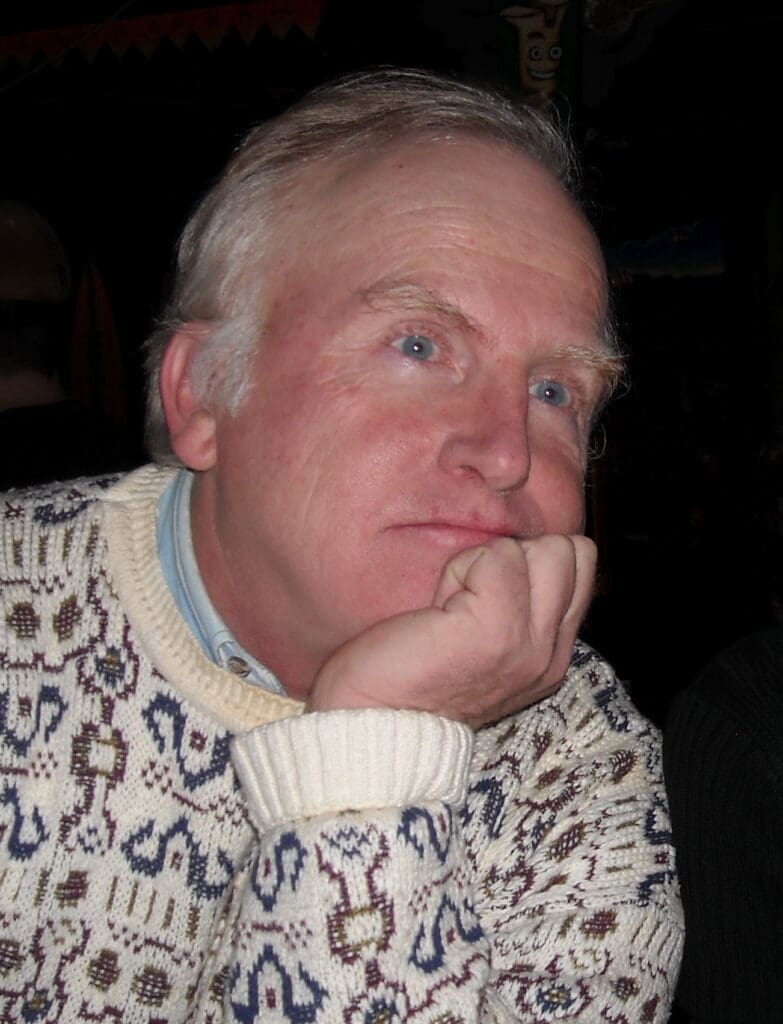
Jim Laurie Restoration Biologist, Futurist, Consultant, Co-founder, Biodiversity for a Livable Climate
Jim Laurie has worked for twenty years, as a biologist and technical trainer in the chemical industry in Houston, Texas, where he pioneered the use of living machines to biologically remediate wastewater more effectively than conventional technology. In 1995, he relocated to Vermont to manage the world’s largest “Living Machine” designed by ecological visionary John Todd to clean raw municipal sewage without toxic chemicals. He then consulted on projects to restore the redwood forests and Pacific salmon fisheries and implement flood prevention and ecological design. In 2017, he developed “Scenario 300,” an analysis demonstrating that if just half the available land on the planet were restored, atmospheric carbon concentrations could fall to 300 ppm within four decades.
Jim studied Holistic Management of grasslands with Allan Savory and the Savory Institute, built a lab to study fungi and grow mushrooms, learning from the work of Paul Stamets, and worked with the International Wolf Center in Minnesota to learn about predators and the biology of the North woods. Jim received his B.S. in Biology at Rice University and his M.S. in Future Studies at the University of Houston in 1997 where he completed his thesis on “Biological and Educational Tools for Reversing the Loss of Biodiversity in the 21st Century.”
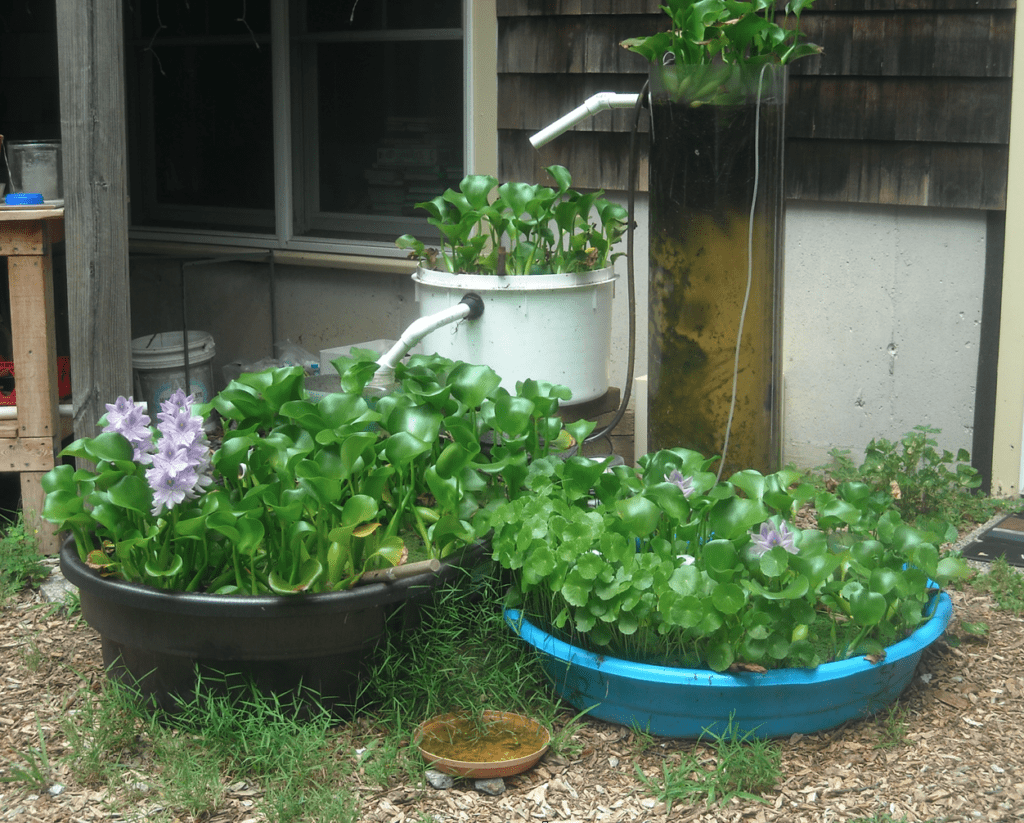
Living Machine built by Jim’s homeschool students (Photo: Jim Laurie)
Jim discovered the magical power of nature in his work as a biologist in the chemical industry to clean toxic wastewater with “Living Machines.” His career turned to restoration biology and teaching. You will enjoy his interactive and thought provoking style which makes science accessible, while still being comprehensive.
This Series of Biodiversity Courses
Are you ready to transform your understanding of how life on the planet works and how we can play a role? Join us as we follow the transformation of leading writers and thinkers to a deeper understanding of natural systems, our role, and the ability of nature to cool the planet.
While each course builds on our understanding, you do not need to have taken any of the previous Biodiversity Courses. Whether this is your first or tenth course, please join us if you are curious about nature and its power to restore ecosystems to abundance. The veterans of previous classes will help you catch up in your learning. We are developing into a “Symbiosis Team” to ameliorate or reverse the impacts of global warming. Everyone has much to learn and share and there is much to be done. We need and appreciate your enthusiasm on the team, and encourage people to join at the level that they are able to. Sliding scale pricing is available, as are scholarship options. To join us, register below!
PLEASE NOTE: The following registration questions help us offer more relevant programs to our community members and expand Bio4Climate’s educational programming.
Please enter your coupon code below and then click on the light blue button “$175 – Regular Price” to reset it to your discounted price and then complete your registration.
Loading Registration Form….
You’ll receive a confirmation email, receipt and Zoom link after you register..
Please note: Once you register for the film series, you will be added to the Bio4Climate mailing list. You can unsubscribe or manage your email preferences at any time.
Privacy & Use of Information
We respect your privacy and are committed to using your information responsibly. The information collected through this registration form is used to better understand our audience, improve programming, guide outreach, and strengthen community engagement.
Your answers are never sold or shared with third parties and are not used for commercial marketing purposes.
We store data securely and retain it only for as long as necessary to support program planning, evaluation, and reporting.
If you have questions about how your information is used or wish to request removal of your data, please contact films@bio4climate.org.
FAQS:
Must I attend each live weekly discussion group?
Much of the value comes from the live discussions each week. We strongly encourage you to participate in the live discussions. If you are unable to attend a live conversation, we will be sharing with registrants a recording of each week’s discussion on Thursdays.
How does Bring A Friend registration work?
The Bring A Friend discount is a promotional offer where you and a friend can each get a reduced price.
How Can I Join the Film Series Facebook group?
All registrants will receive an email with a link to the private Bio4Climate Film Series Facebook group. This is an invitation-only group for participants of the film series to continue the conversations, share knowledge and resources, and build community.
In this course, you will examine the ways in which trees and forests benefit our climate, while preventing flooding and drought and also providing habitat for a myriad of wildlife species. Hart brings his unique perspective and values to an exploration of the false notions, narratives and mythologies that are used to justify cutting down trees.
You will also engage with a range of highly qualified experts, and we will ask and answer questions like these:
What are the mechanisms within forests that cool our climate—through shade, water evaporation, water cycling, and sponge-like absorption that prevents floods, droughts, wildfires and extreme heat?
What role do microbes, fungi and wild species play in the climate-regulating mechanisms of a forest?
What is the difference between a forest and a tree plantation?
What is the extent of logging in North America?
How do we choose between a forest and a solar array?
PLEASE NOTE: The following registration questions help us offer more relevant programs to our community members and expand Bio4Climate’s educational programming.
Loading Registration Form….
You’ll receive a confirmation email, receipt and Zoom link after you register.
Please note: Once you register for the film series, you will be added to the Bio4Climate mailing list. You can unsubscribe or manage your email preferences at any time.
Privacy & Use of Information
We respect your privacy and are committed to using your information responsibly. The information collected through this registration form is used to better understand our audience, improve programming, guide outreach, and strengthen community engagement.
Your answers are never sold or shared with third parties and are not used for commercial marketing purposes.
We store data securely and retain it only for as long as necessary to support program planning, evaluation, and reporting.
If you have questions about how your information is used or wish to request removal of your data, please contact films@bio4climate.org.
FAQS:
Must I attend each live weekly discussion group?
Much of the value comes from the live discussions each week. We strongly encourage you to participate in the live discussions. If you are unable to attend a live conversation, we will be sharing with registrants a recording of each week’s discussion on Thursdays.
How does Bring A Friend registration work?
The Bring A Friend discount is a promotional offer where you and a friend can each get a reduced price.
How Can I Join the Film Series Facebook group?
All registrants will receive an email with a link to the private Bio4Climate Film Series Facebook group. This is an invitation-only group for participants of the film series to continue the conversations, share knowledge and resources, and build community.
PLEASE NOTE: The following registration questions help us offer more relevant programs to our community members and expand Bio4Climate’s educational programming.
Loading resitration form….
You’ll receive a confirmation email, receipt and Zoom link after you register.
Please note: Once you register for the film series, you will be added to the Bio4Climate mailing list. You can unsubscribe or manage your email preferences at any time.
Privacy & Use of Information
We respect your privacy and are committed to using your information responsibly. The information collected through this registration form is used to better understand our audience, improve programming, guide outreach, and strengthen community engagement.
Your answers are never sold or shared with third parties and are not used for commercial marketing purposes.
We store data securely and retain it only for as long as necessary to support program planning, evaluation, and reporting.
If you have questions about how your information is used or wish to request removal of your data, please contact films@bio4climate.org.
FAQS:
Must I attend each live weekly discussion group?
Much of the value comes from the live discussions each week. We strongly encourage you to participate in the live discussions. If you are unable to attend a live conversation, we will be sharing with registrants a recording of each week’s discussion on Thursdays.
How does Bring A Friend registration work?
The Bring A Friend discount is a promotional offer where you and a friend can each get a reduced price.
How Can I Join the Film Series Facebook group?
All registrants will receive an email with a link to the private Bio4Climate Film Series Facebook group. This is an invitation-only group for participants of the film series to continue the conversations, share knowledge and resources, and build community.
PLEASE NOTE: The following registration questions help us offer more relevant programs to our community members and expand Bio4Climate’s educational programming.
Loading Registration Form….
You’ll receive a confirmation email, receipt and Zoom link after you register.
Please note: Once you register for the film series, you will be added to the Bio4Climate mailing list. You can unsubscribe or manage your email preferences at any time.
Privacy & Use of Information
We respect your privacy and are committed to using your information responsibly. The information collected through this registration form is used to better understand our audience, improve programming, guide outreach, and strengthen community engagement.
Your answers are never sold or shared with third parties and are not used for commercial marketing purposes.
We store data securely and retain it only for as long as necessary to support program planning, evaluation, and reporting.
If you have questions about how your information is used or wish to request removal of your data, please contact films@bio4climate.org.
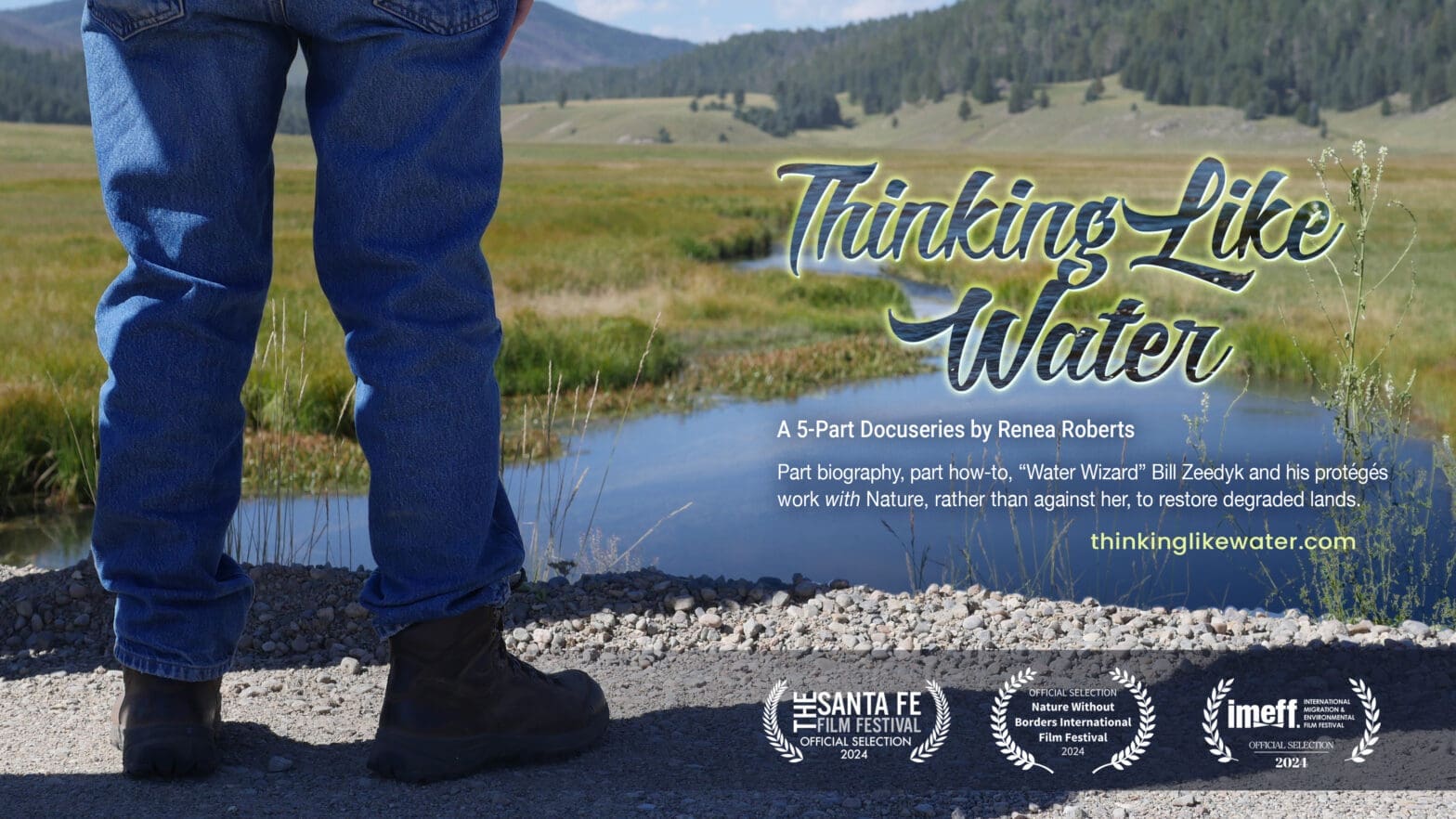
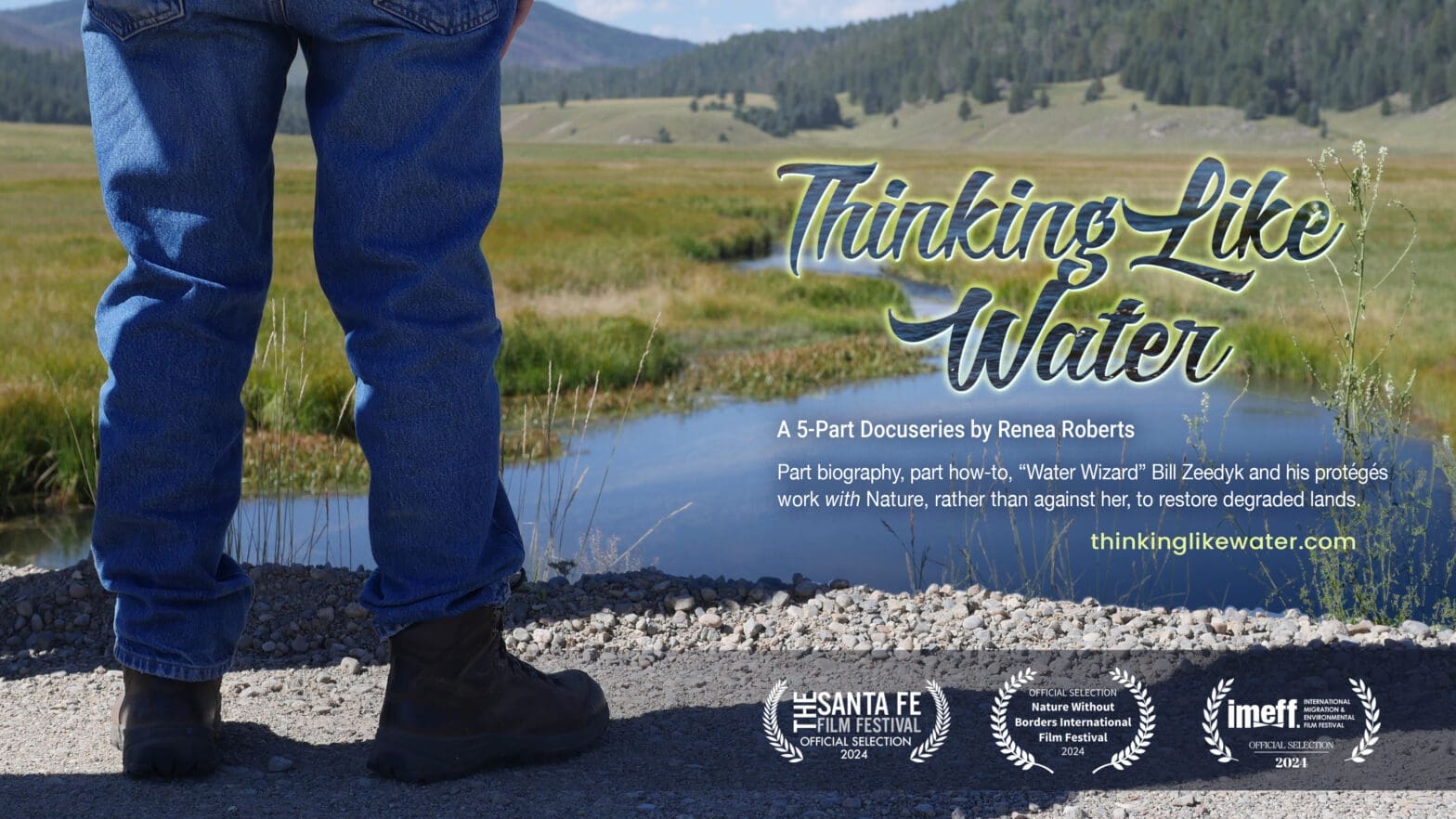
Thank you for joining us for this important series that brings water back to the center of climate action—showing how simple, practical restoration strategies can transform degraded landscapes, revive watersheds, and build real resilience to drought, flooding, wildfire, and extreme heat.
Included in your registration:
Exclusive access to the five-part docuseries to watch prior to the live discussions on Tuesdays.
Invitation-only live discussions with the producer and other special guests to be announced throughout the series.
Weekly reminders and calendar invitations for each week’s episode and live chat.
Recorded transcript of each week’s conversation.
Invitation to join the Bio4Climate Film Series private Facebook group to continue the conversations and engage with peers.
Schedule:
January 20 – February 17, 2026 Weekly on Tuesdays
6:00 PM ET — Optional film screening 7:30 PM ET — Live discussion
A small number of sponsored seats are available on a case by case basis. Please contact us at films@bio4climate.org with the details of your request.
PLEASE NOTE: The following registration questions help us offer more relevant programs to our community members and expand Bio4Climate’s educational programming.
Loading Registration Form….
You’ll receive a confirmation email, receipt and Zoom link after you register.
Please note:Once you register for the film series, you will be added to the Bio4Climate mailing list. You can unsubscribe or manage your email preferences at any time.
Privacy & Use of Information
We respect your privacy and are committed to using your information responsibly. The information collected through this registration form is used to better understand our audience, improve programming, guide outreach, and strengthen community engagement.
Your answers are never sold or shared with third parties and are not used for commercial marketing purposes.
We store data securely and retain it only for as long as necessary to support program planning, evaluation, and reporting.
If you have questions about how your information is used or wish to request removal of your data, please contact films@bio4climate.org.
FAQS:
Must I attend each live weekly discussion group?
Much of the value comes from the live discussions each week. We strongly encourage you to participate in the live discussions. If you are unable to attend a live conversation, we will be sharing with registrants a recording of each week’s discussion on Thursdays.
How does Bring A Friend registration work?
The Bring A Friend discount is a promotional offer where you and a friend can each get a reduced price.
How Can I Join the Film Series Facebook group?
All registrants will receive an email with a link to the private Bio4Climate Film Series Facebook group. This is an invitation-only group for participants of the film series to continue the conversations, share knowledge and resources, and build community.
Live Classes every week! A 12:00 Noon and 7:00 PM live class each week for a total of 8 live sessions, recorded for your convenience
Guest Speakers will share their research and experience
Membership in a private email group to ask questions, share resources and build community
Advocacy Coaching for you to be effective in your community
Plus Resources you can use to help decision makers create truly effective climate action plans
Course Price = $145
For Group Discounts off the full course price for groups of five or more and for Reduced Rates for students or those on a restricted budget, contact us at courses@bio4climate.org.
Frequently Asked Questions
Do I need to come to both sessions each week?
You may attend one or both sessions in a week. Most students attend one class session per week. All sessions are recorded and you may watch the recording at your convenience. We will keep you informed every step of the way via the email group.
What is the Group Discount?
Groups of five or more can negotiate a discount rate depending on the size of the group and your budget. Rates range from a 20-40% discount off the full price—so invite your friends or classmates to get the best rate.
Are the classes recorded?
Yes, both sessions are recorded and made available in the Google Group immediately following the class. You never need to worry about missing a great speaker or important information.
What is the Reduced Rate and how do I get it?
We realize that everyone is in a different financial position so if you need a different rate, we trust you to tell us how much you can pay, within reason. We want everyone to get the training they need and we want to keep offering these great courses and programs. To get the Reduced Rate, email us at courses@bio4climate.org and let us know your situation and how much you can pay.
Looking forward to seeing you in class!
Please enter your coupon code below and then click on the light blue button “$145 – Regular Price” to reset it to your discounted price and then complete your registration.
Please note that by registering, you will be added to our mailing list. You can unsubscribe or manage your email preferences at any time.
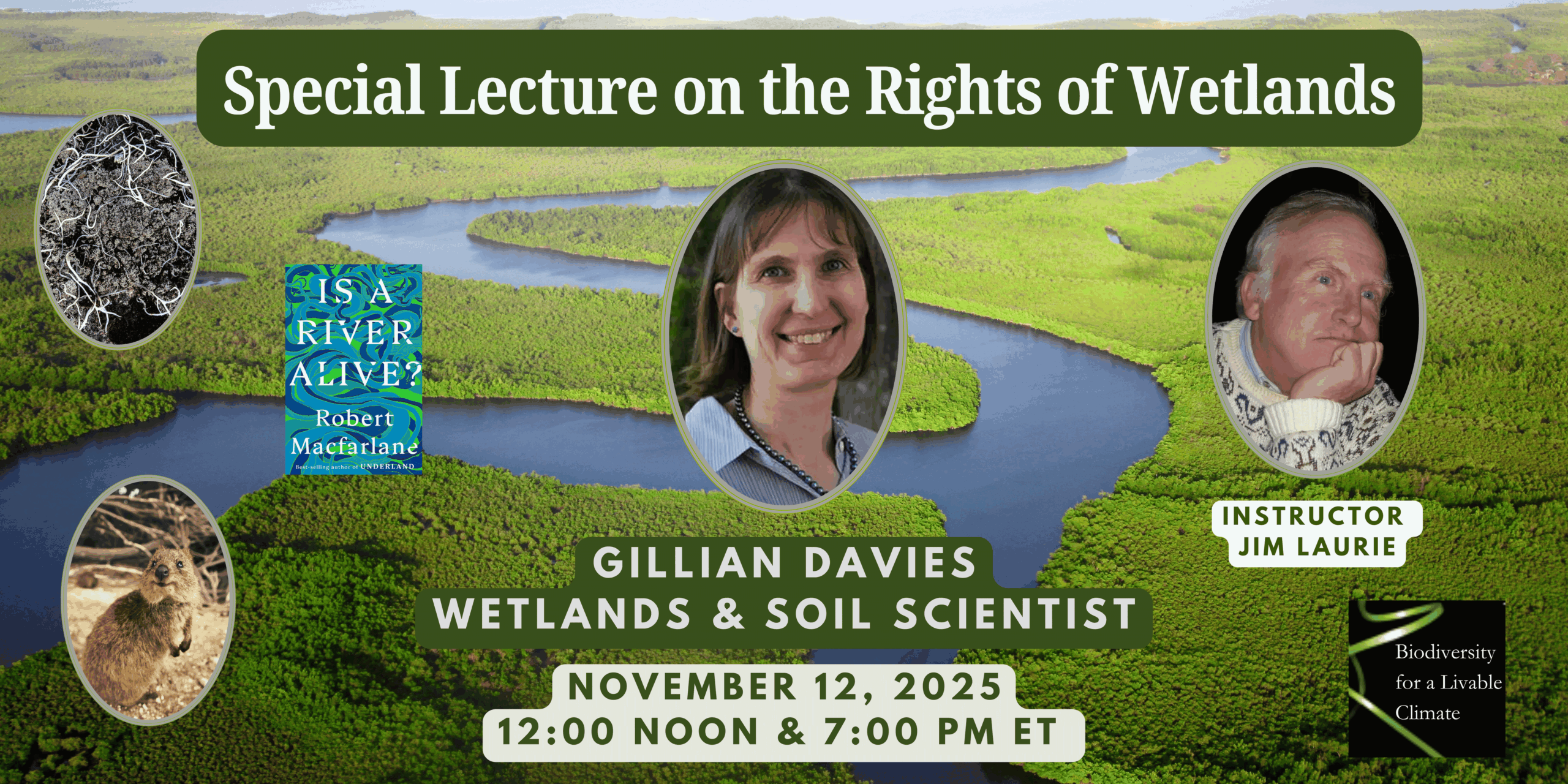
Registration – Special Lecture on the Rights of Wetlands
Please fill out the form below to register for this special lecture on the rights of wetlands with Special Guest Gillian Davies, Wetlands and Soil Scientist with the Rights of Wetlands Initiative.
Gillian is a global leader in developing the Universal Declaration of the Rights of Wetlands, working with scientists, policymakers, and local communities to recognize wetlands as vital living systems that sustain biodiversity, water cycles, and climate balance.
The lecture will take place on Wednesday, November 12, 2025 at 12:00 Noon ET and at 7:00 PM ET. Two class options are provided to accommodate participant’s schedules. You can attend either session or both.
Come listen, learn, and be part of this inspiring dialogue on how honoring the rights of nature can help restore harmony between people and the planet.
Free and open to all.
Speaker Bio: Gillian Davies
Gillian Davies is a senior wetlands and soil scientist, and an advocate working at the intersection of ecology, climate resilience, and community engagement. She specializes in developing nature-based solutions for wetland, forest, and soil conservation and restoration, and collaborates with local communities to design projects that protect ecosystems while addressing climate change.
Gillian is a Visiting Scholar at the Tufts University Global Development and Environment Institute and serves as the Immediate Past President of the Society of Wetland Scientists (SWS) Professional Certification Program. She was the 2016–2017 SWS President, co-leads the SWS Climate Change and Wetlands Initiative, and chairs both the SWS Rights of Wetlands Section and the WOTUS ad hoc subcommittee. Additionally, she contributes her expertise to the International Association for Ecology (INTECOL) Wetlands Working Group and the Massachusetts Healthy Soils Action Plan.
Looking forward to seeing you in class!
Please note that by registering, you will be added to our mailing list. You can unsubscribe or manage your email preferences at any time.
To register for the “Bring A Friend” Discount, please fill out the form below.
If you would prefer to send us a check, make it payable to “Biodiversity for a Livable Climate” and send it to us at P.O. Box 390469, Cambridge, MA 02139. Please include a note with your name, email address and the name of the course.
What’s included in the course
Live Classes Every Week! A live 60-minute class each week for a total of 4 live sessions, recorded for your convenience
Mondays – November 10, 17 & December 1, 8, 2025 from 7:00 – 8:00 PM EST
Membership in a private email group to ask questions, share resources and connect with a like-minded community
Plus Articles and Videos you can use to help decision makers create truly effective climate action plans
Pricing
Bring a Friend Price: $50 per person
Bring a friend to take this course with you and turn solo learning into a shared adventure—with a 30% savings off the full course price for each of you!
Frequently Asked Questions
Do I need to come to all classes each week?
All sessions are recorded and you may watch the recording at your convenience. We will keep you informed every step of the way via the email group.
Are the classes recorded?
Yes, classes are recorded and made available in the Google Group immediately following the class. You never need to worry about missing a great speaker or important information.
How does the “Bring a Friend” Discount work?
The “Bring a Friend” Discount is a promotional offer where you and a friend can get a reduced price. When you register with another person, each of you will receive a 30% discount off of the registration price.
What is the Reduced Rate and how do I get it?
We realize that everyone is in a different financial position so if you need a different rate, we trust you to tell us how much you can pay, within reason. We want everyone to get the training they need and we want to keep offering these great courses and programs. To get the Reduced Rate, email us at courses@bio4climate.org and let us know your situation and how much you can pay.
Looking forward to seeing you in class!
Be sure to click on the light blue button below “$50 – Bring a Friend Program” to complete your registration.
Also, be sure to enter the name of your friend who you are doing this course with (see below).
Please note that by registering, you will be added to our mailing list. You can unsubscribe or manage your email preferences at any time.
If you would prefer to send us a check, make it payable to “Biodiversity for a Livable Climate” and send it to us at 56 Broad Street, #89587, Boston, MA 02109. Please include a note with your name, email address and the name of the course.
What’s included in the course
Live Classes every week! A live, 60-minute class each week on Zoom for a total of 4 live sessions, recorded for your convenience
Mondays – November 10, 17 & December 1, 8, 2025, 7:00 – 8:00 PM ET
Membership in a private email group to ask questions, share resources and connect with a like-minded community
Plus articles and videos you can use to help decision makers create truly effective climate action plans.
Pricing
We have several pricing options:
Full Price: $75
Bring a FriendPrice: $50 per person — (more than 30% off!) Bring a friend and split the savings—because wisdom is better when shared (and discounted)! To register, click here:Register – Bring a Friend Programand be sure to list the name of your friend in your registration.
We also offer scholarships for those with financial limitations. Please contact us at courses@bio4climate.org with the details of your request.
Frequently Asked Questions
Do I need to come to all classes each week?
All sessions are recorded and you may watch the recording at your convenience. We will keep you informed every step of the way via the email group.
Are the classes recorded?
Yes, classes are recorded and made available in the Google Group immediately following the class. You never need to worry about missing a great speaker or important information.
How does the Bring A Friend discount work?
The Bring A Friend discount is a promotional offer where you and a friend can get a reduced price. When you register with another person, each of you will receive more than a 30% discount on the course registration price.
Looking forward to seeing you in class!
Be sure to click on the light blue button below “$75 – Course Price” to complete your registration.
Please note that by registering, you will be added to our mailing list. You can unsubscribe or manage your email preferences at any time.
Over the course of four gatherings, we’ll discuss how the living skin of our landscapes and oceans creates our climate from the ground up.
Spoiler alert: it’s through the profoundly fascinating intelligence of Nature, and how water flows from soil to branch to leaf to cloud and back again, powered entirely by the sun and life.
While the dominant perception of climate change is focused on carbon and technological fixes, a holistic understanding of climate can be described as: a living process emerging from the relationships between soil, plants, landscapes, microbiomes, water, wildlife, and humans. In other words, how we treat or mistreat the land and the oceans has a significant influence on our climate. The benefits of expanding our focus to include the restoration of living processes to our farms, cities and homes are many, and a topic perhaps less divisive and quite profound.
Crucially, restoring living processes and relationships will call in the rains and restore small water cycles. For example, when soil is stewarded into a vibrant ecosystem (holding water like a sponge) and populated with diverse plants, these trees and grasses breathe out water vapor carrying bacteria, and other bits of life.
In the atmosphere, these bacteria help water to condense into clouds and rain. Rain in turn needs healthy soil to soak into its depths, and help the plants continue to grow. It is by care-taking these relationships that we will allow our climate to balance itself naturally, quickly and safely through powerful cooling dynamics.
In our time together, we’ll discuss how altering our Earth’s living skin has hindered Nature’s inherent ability to create and balance our climate, and together, we’ll explore the potential at our fingertips for building coalitions of regeneration.
The distinction between the bottom-up (ecological, living systems) and top-down (atmospheric) perceptions of climate
How Nature cools the landscape (via shade, transpiration, clouds, rain, night-time reradiating windows, winds, etc) and the crucial role of diverse life in these processes
How we have disrupted Nature’s inherent climate balancing processes
Why most of the climate conversation focuses primarily on carbon, and how a complementary life-based perspective adds to the conversation
Actions we can do individually and collectively
What’s Included in the Course
Live Classes every week! A live 60-minute class each week on Zoom for a total of 4 live sessions, recorded for your convenience
Mondays – November 10, 17 & December 1, 8, 2025 from 7:00 – 8:00 PM EST
Membership in a private email group to ask questions, share resources and connect with a like-minded community
Plus articles and videos you can use to help decision makers create truly effective climate action plans.
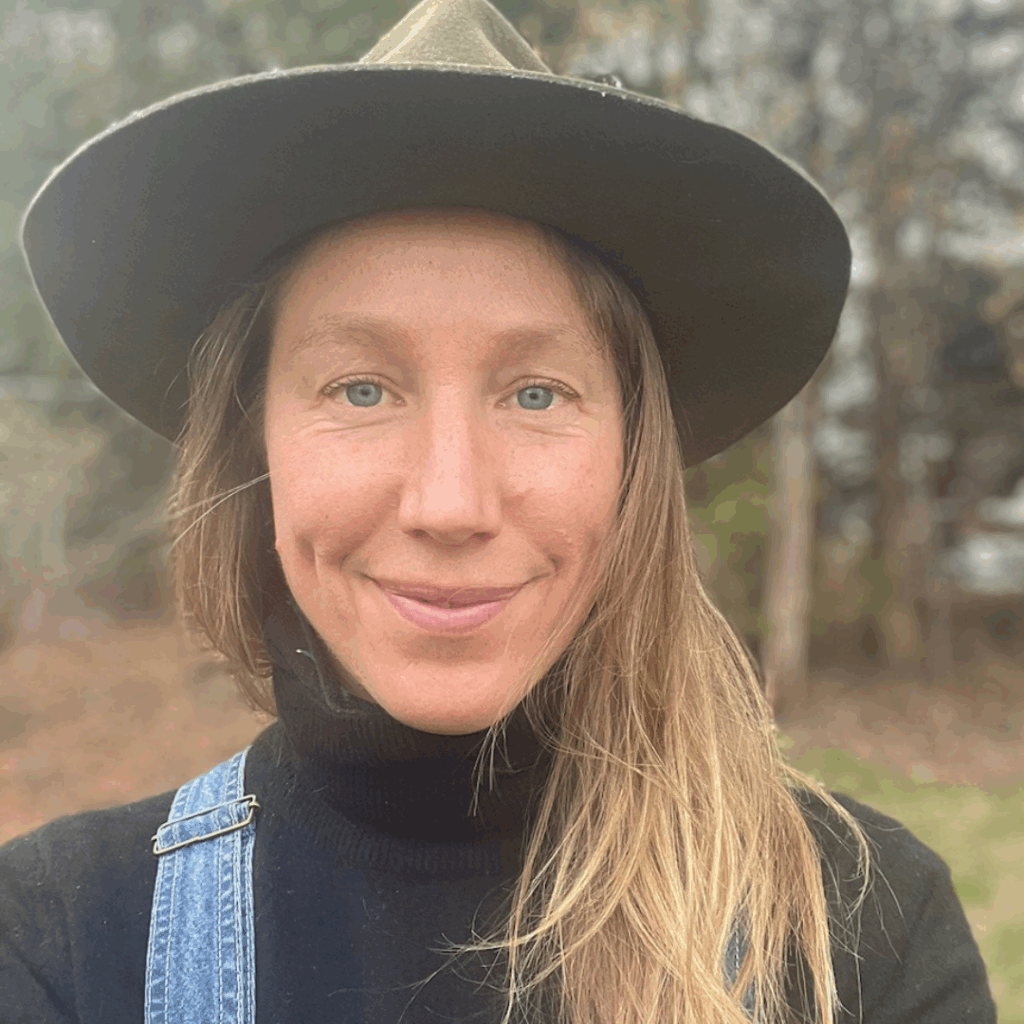
Katie was raised in central Wisconsin, often feeling a deep sense of awe and empathy with our natural world. After graduating with a degree in Ecology, Evolution and Environmental Biology at Columbia University, she focused on climate change by supporting Tribes and rural communities in their transition away from fossil fuels, both in Wisconsin and later in Australia. After 15 years as a transdisciplinary action researcher and Research Director at the Institute for Sustainable Futures within the University of Technology Sydney and an internationally commended doctoral inquiry into transformative learning, her focus shifted to the life within our soils. She began working for, and had the privilege of leading, Soils for Life, an Australian organization that supports farmers transitioning to regenerative agriculture. And it was here that many interwoven threads revealed a beautiful story of how landscape restoration is a profound point of agency to cool our climate, regenerate water cycles, grow nutritious food, foster biodiversity and reconnect with ourselves.
To review and subscribe to Katie’s important work, visit her:
If you have any registration or general course questions, email us at courses@bio4climate.org. If you have specific questions about the course for Dr. Katie Ross, you can contact her at katie.elizabeth.ross@gmail.com
To register for the “Bring A Friend” Discount, please fill out the form below.
If you would prefer to send us a check, make it payable to “Biodiversity for a Livable Climate” and send it to us at P.O. Box 390469, Cambridge, MA 02139. Please include a note with your name, email address and the name of the course.
What’s included in the course
Live classes every week! A 90-minute class is hosted live each week on Zoom over 8 weeks
Recordings of each class are made available weekly
Expert guest speakers share their research and experience in select classes
Talk directly with our expert speakers live on Zoom
Membership in a private email group to ask questions, share resources and stories, and build connections within our like-minded community
Advocacy coaching for you to be effective in your community
Resources you can use to help decision makers create truly effective climate action plans
Pricing
Bring a Friend Price: $108 per person — started January 18 — Register BELOW
Bring a friend and split the savings—because wisdom is better when shared (and discounted)!
Other Course Registration Options: Full Course Price: $145 — started January 18
We also offer other Generous Reduced Rates, Group Rates and Scholarships for those with greater financial limitations. Please email us at courses@bio4climate.org with the details of your request
Frequently Asked Questions
Do I need to come to all classes each week?
All sessions are recorded and you may watch the recording at your convenience. We will keep you informed every step of the way via the email group.
Are the classes recorded?
Yes, classes are recorded and made available in the Google Group immediately following the class. You never need to worry about missing a great speaker or important information.
How does the “Bring a Friend” Discount work?
The “Bring a Friend” Discount is a promotional offer where you and a friend can get a reduced price. When you register with another person, each of you will receive a 25% discount off of the Full Course Price.
What is the Reduced Rate and how do I get it?
We realize that everyone is in a different financial position so if you need a different rate, we trust you to tell us how much you can pay, within reason. We want everyone to get the training they need and we want to keep offering these great courses and programs. To get the Reduced Rate, email us at courses@bio4climate.org and let us know your situation and how much you can pay.
Looking forward to seeing you in class!
Be sure to click on the light blue button below “$108 – Bring a Friend Program” to complete your registration.
Also, be sure to enter the name of your friend who you are doing this course with (see below).
Please note that by registering, you will be added to our mailing list. You can unsubscribe or manage your email preferences at any time.
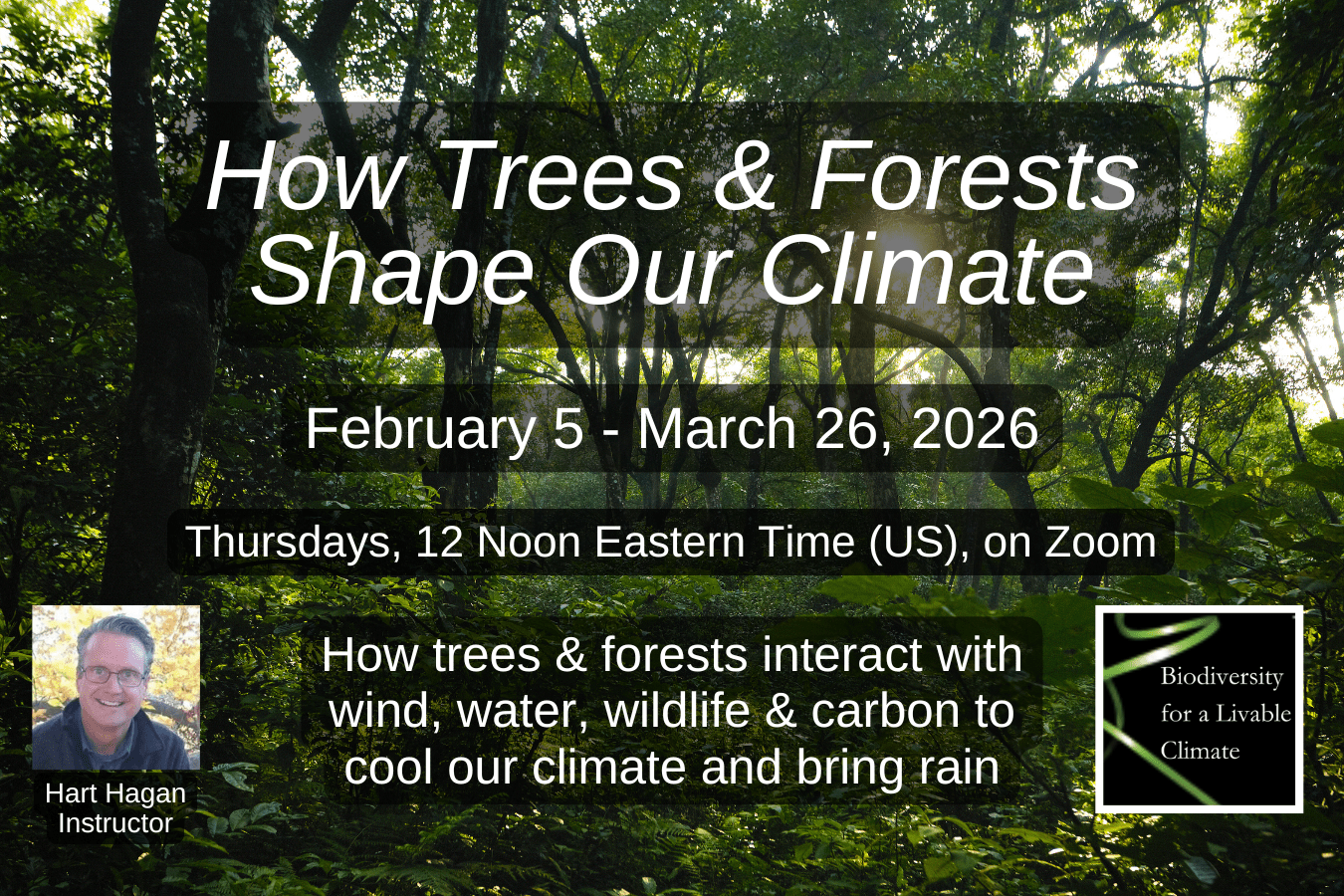
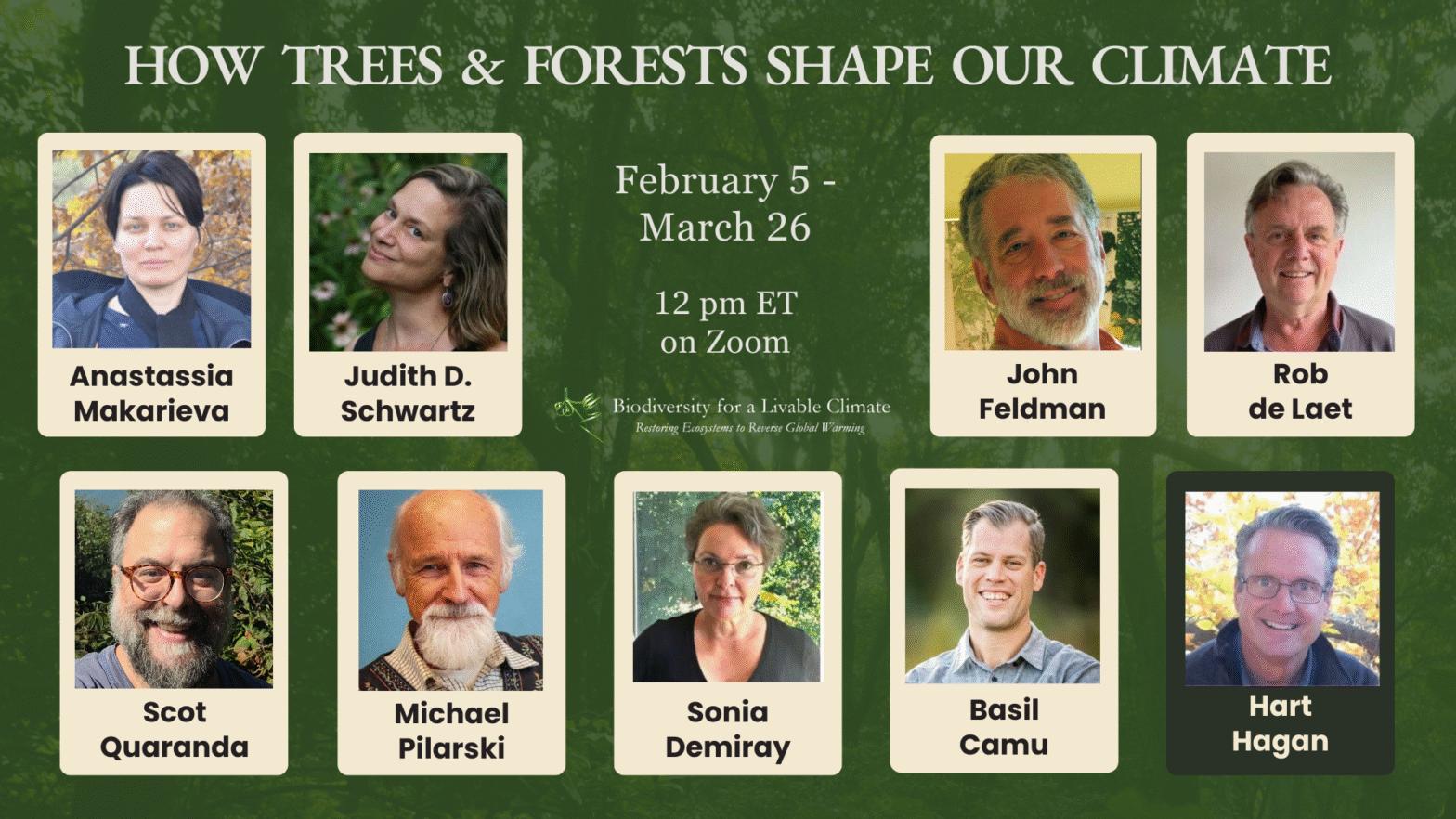
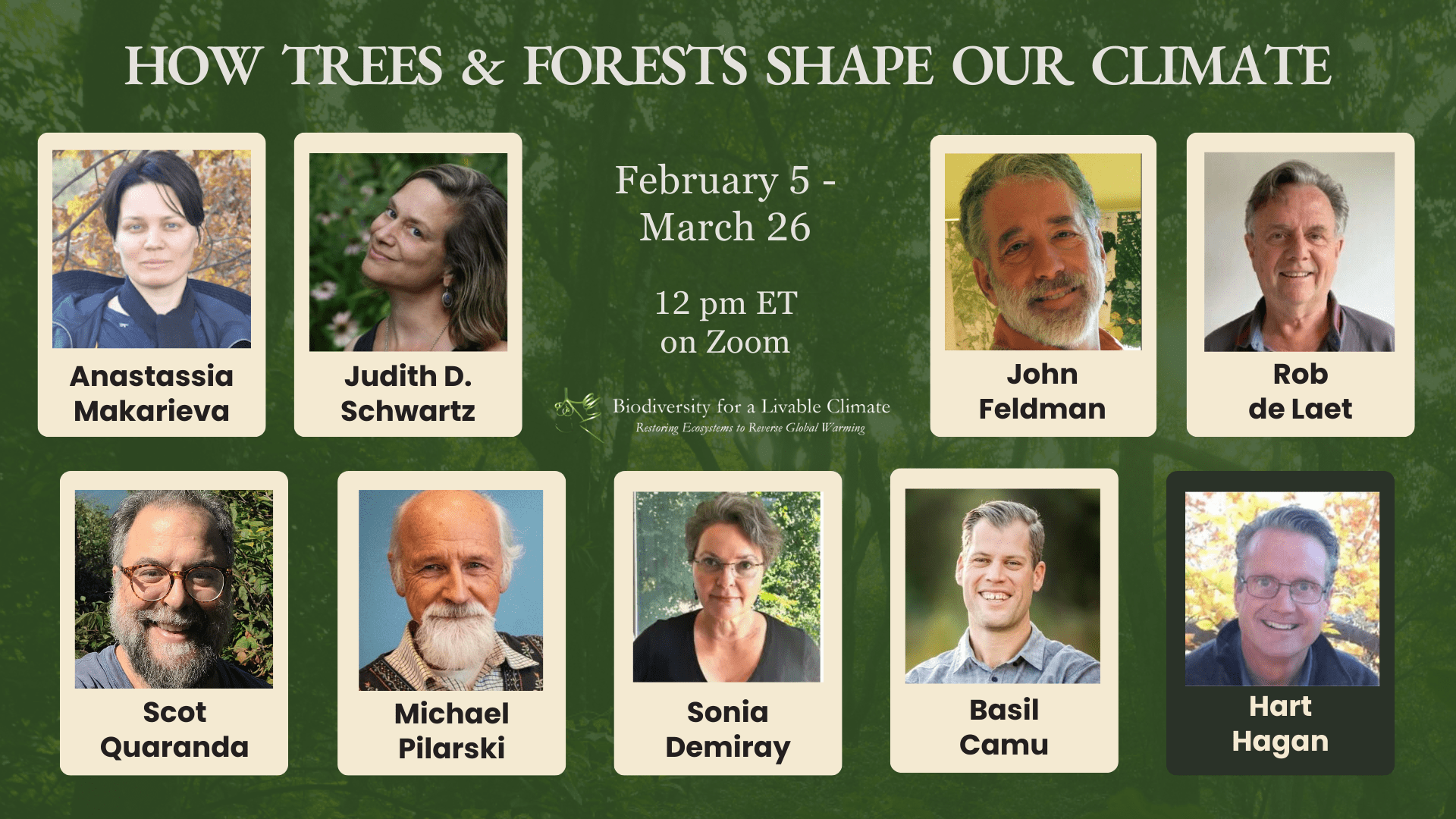
Registration Form – How Trees & Forests Shape Our Climate
Please fill out the form below to register for this special mini-course.
If you would prefer to send us a check, make it payable to “Biodiversity for a Livable Climate” and send it to us at 56 Broad Street, #89587, Boston, MA 02109. Please include a note with your name, email address and the name of the course.
What’s included in the course
Live classes every week! A 90-minute class is hosted live each week on Zoom over 8 weeks
Recordings of each class are made available weekly
Expert guest speakers share their research and experience in select classes
Talk directly with our expert speakers live on Zoom
Membership in a private email group to ask questions, share resources and stories, and build connections within our like-minded community
Advocacy coaching for you to be effective in your community
Resources you can use to help decision makers create truly effective climate action plans
Pricing
Full Course Price: $145
Bring a FriendPrice: $108 per person (more than 25% off!) Bring a friend and split the savings—because wisdom is better when shared (and discounted)! To register, click here:Register – Bring a Friend Programand be sure to list the name of your friend in your registration.
We also offer Group Rates and partial and full Scholarships for those with greater financial limitations. Please contact us at courses@bio4climate.org with the details of your request.
Frequently Asked Questions
Do I need to come to all classes each week?
All sessions are recorded and you may watch the recording at your convenience. We will keep you informed every step of the way via the email group.
Are the classes recorded?
Yes, classes are recorded and made available in the Google Group immediately following the class. You never need to worry about missing a great speaker or important information.
How does the Bring A Friend discount work?
The Bring A Friend discount is a promotional offer where you and a friend can get a reduced price. When you register with another person, each of you will receive a 25% discount on the course registration price.
What is the Reduced Rate and how do I get it?
We realize that everyone is in a different financial position so if you need a different rate, we trust you to tell us how much you can pay, within reason. We want everyone to get the training they need and we want to keep offering these great courses and programs. To get the Reduced Rate, email us at courses@bio4climate.org and let us know your situation and how much you can pay.
Looking forward to seeing you in class!
Be sure to click on the light blue button below “$145 – Full Course Price” to complete your registration.
Please note that by registering, you will be added to our mailing list. You can unsubscribe or manage your email preferences at any time.
He continues: “Since 2023, extreme weather events have shattered most model projections of the Intergovernmental Panel on Climate Change. Meteorologists are grappling with this new reality. Standard climate models were designed for a stable world that we have irrevocably left behind. But wait, there was a crucial omission. The dynamic land-atmosphere water cycle — powerfully mediated by living forests — has inexplicably been relegated to a mere footnote in the carbon story.”
This “dynamic land-atmosphere water cycle” is only one of many ways in which forests provide benefits to our climate, our fellow species and our society. And yet, deforestation in the United States continues at record levels.
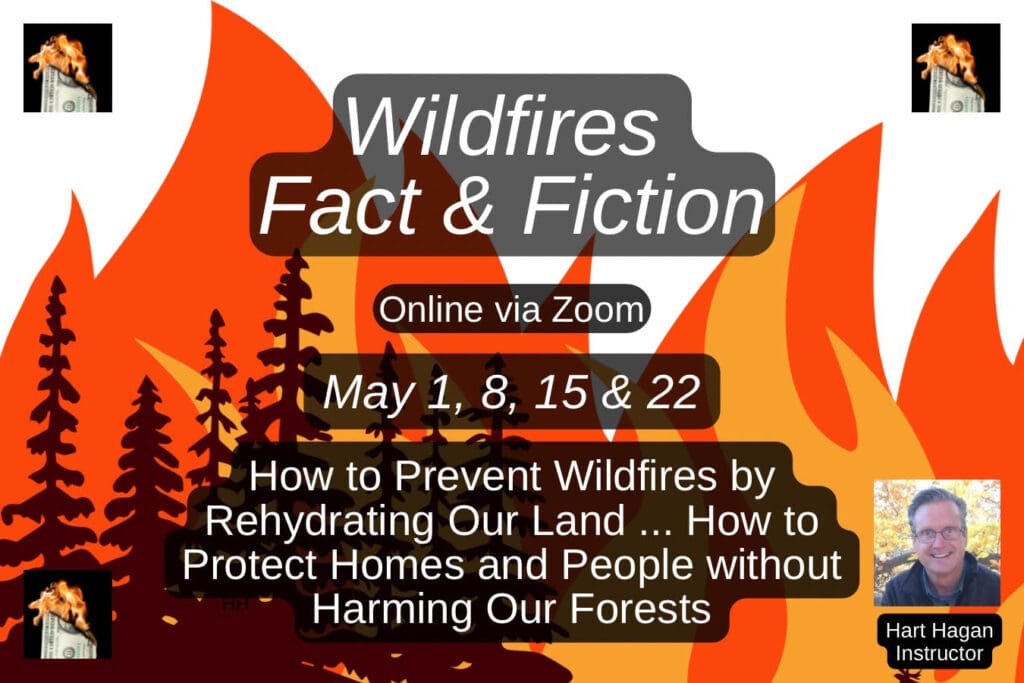
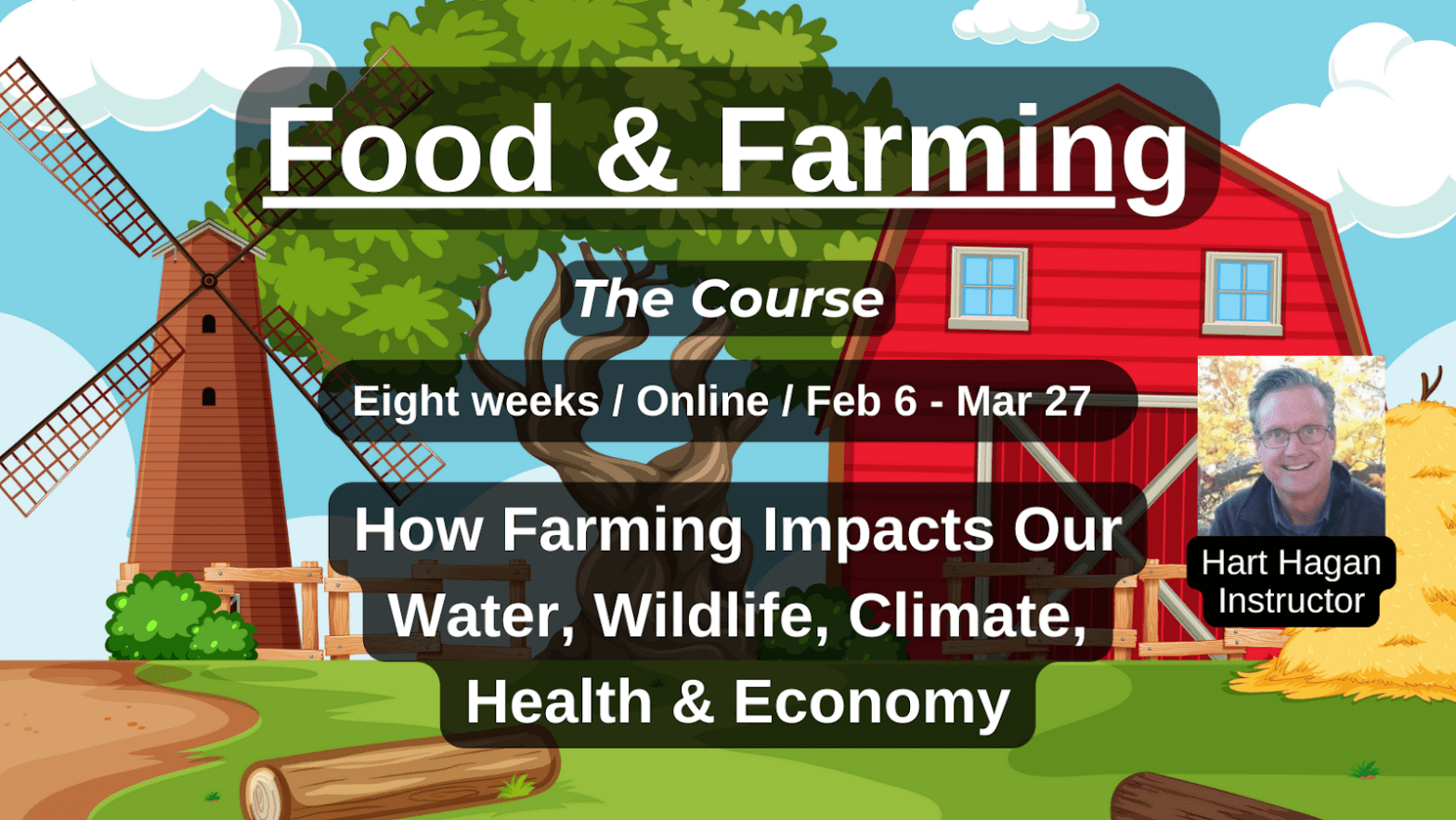
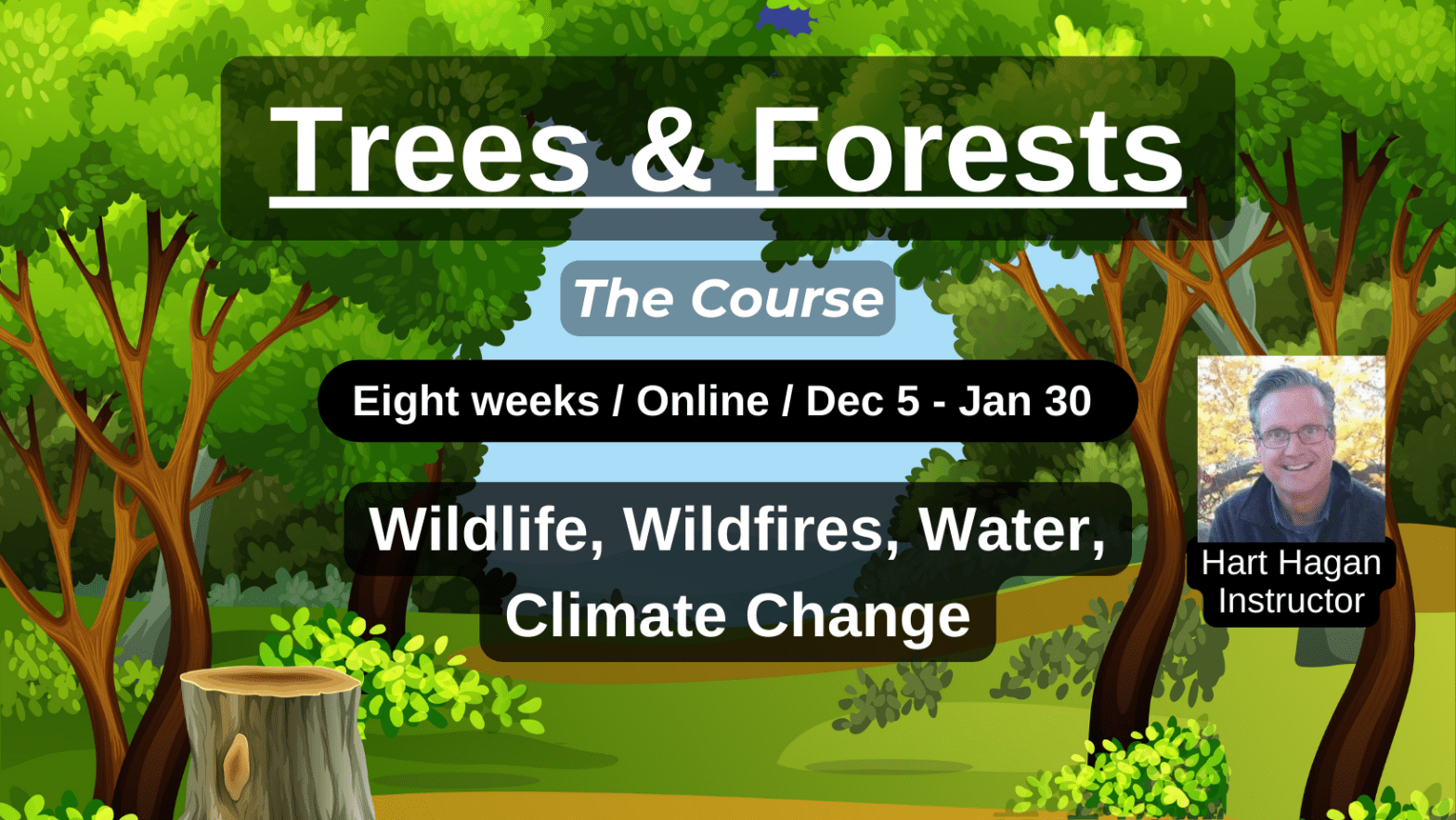
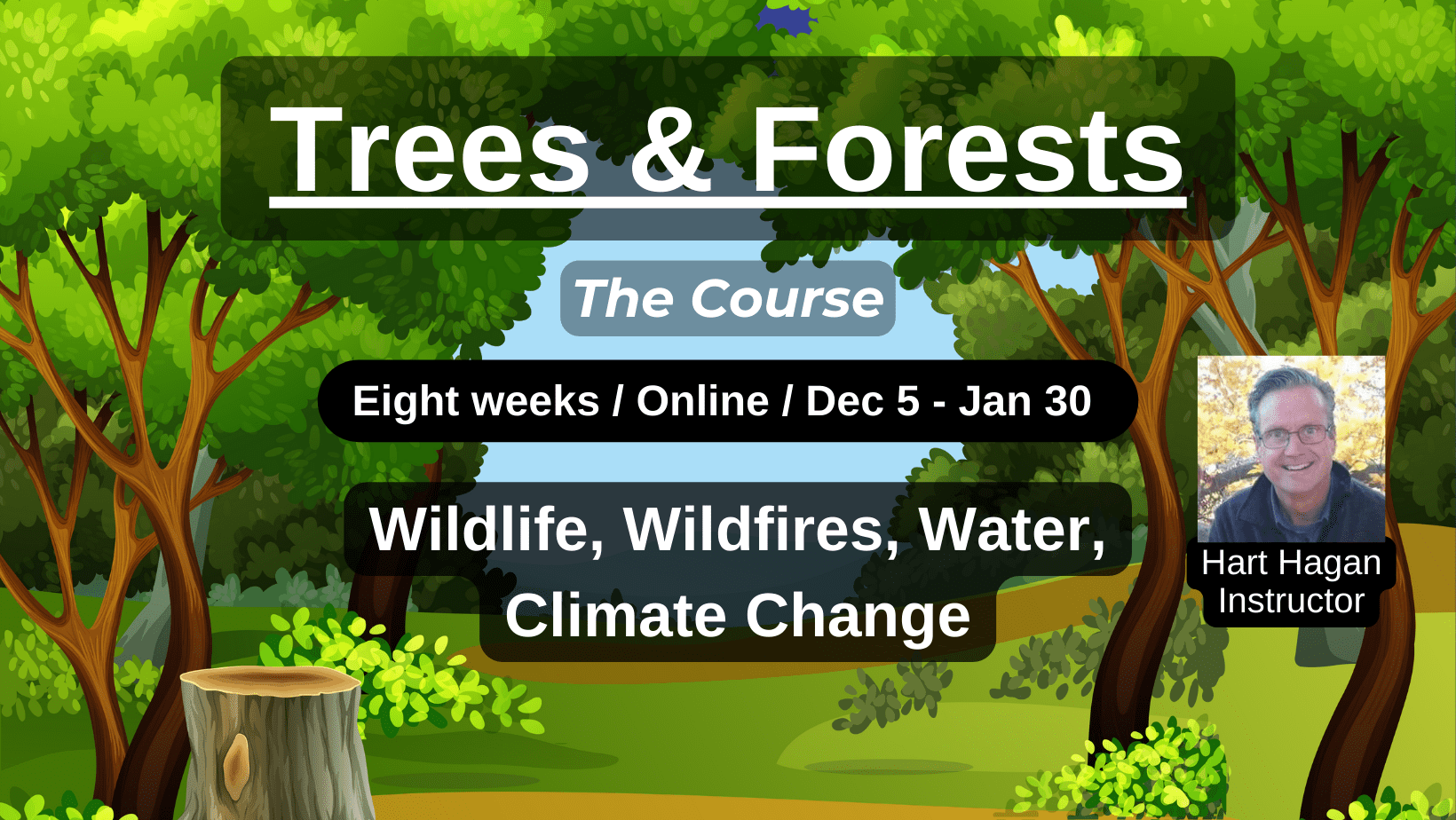
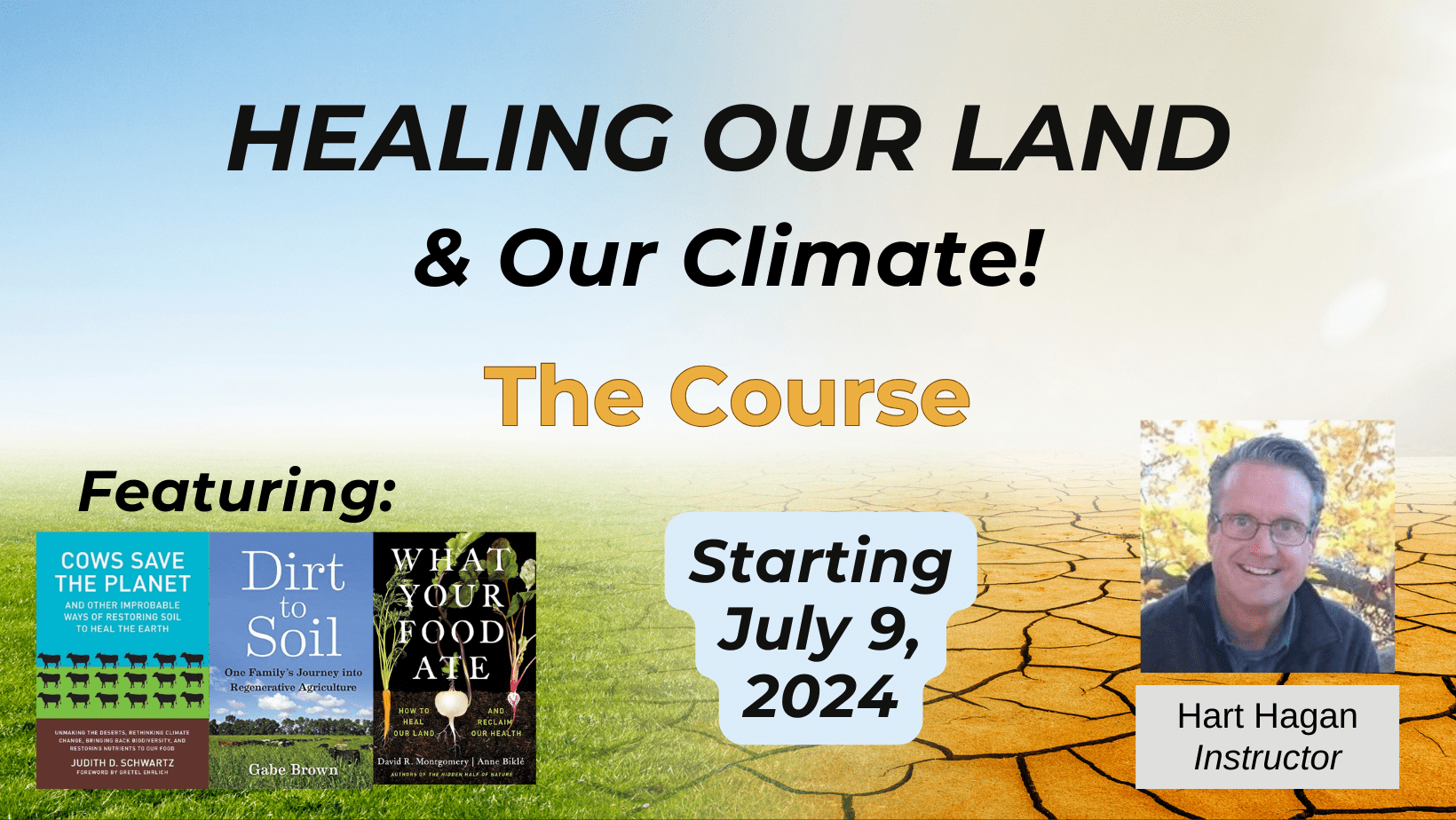
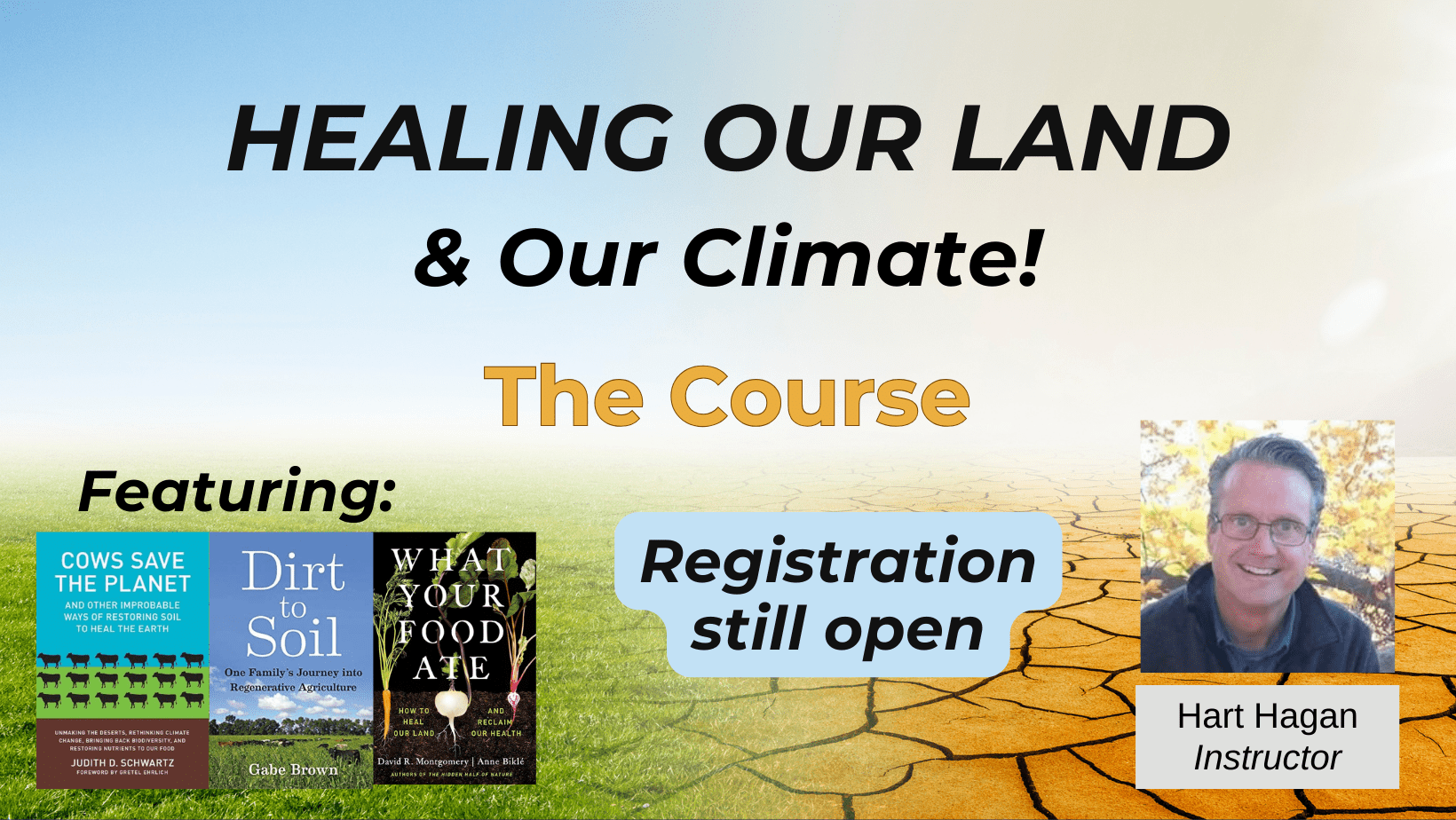
In this course, instructor Hart Hagan will examine the ways in which trees and forests benefit our climate, while preventing flooding and drought and also providing habitat for a myriad of wildlife species. Hart brings his unique perspective and values to an exploration of the false notions, narratives and mythologies that are used to justify cutting down trees.
Participants will engage with a range of highly qualified experts, and we will ask and answer questions like these:
What are the mechanisms within forests that cool our climate—through shade, water evaporation, water cycling, and sponge-like absorption that prevents floods, droughts, wildfires and extreme heat?
What role do microbes, fungi and wild species play in the climate-regulating mechanisms of a forest?
What is the difference between a forest and a tree plantation?
What is the extent of logging in North America?
How do we choose between a forest and a solar array?
When is logging justified for solar installation?
What’s the deal with biomass logging, and who benefits?
What is forest thinning, and when is it recommended?
Should we promote post-fire logging? Why or why not?
How to identify timber industry propaganda
How to protect wild species such as owls and woodpeckers
What is the catastrophic wildfire narrative? How is it harmful and misleading?
Under what circumstances do fires burn at higher intensity? What are the factors, and what can we do?
When is wood the best building material, and when should we search for substitutes?
Who are some of the leading experts whom we can trust for guidance?
What can we do as a community to safeguard and restore our forests?
This will be a nuanced exploration of how to respect our forests while pushing back against false narratives that call for clearcutting, thinning, logging, burning and spraying.
Major issues to be addressed:
Learning how our forests work as ecosystems
In this course, you will learn what constitutes a healthy, high functioning forest ecosystem, which is biologically diverse, with many bees, butterflies, birds and small mammals, all of which require insects and their larvae, which in turn require a variety of native trees and dead wood.
Dead wood
We will explore the untold story of dead wood. Did you know that a dead tree is home to more species than a living tree? We will explore the value of dead wood—and why it’s important not to remove it from a forest— since it’s a source of food, water and shelter for myriad insects, birds, mammals and amphibians.
How caterpillars infuse energy into the forest ecosystem
We will learn the surprising importance of caterpillars, and the trees that support them. Did you know that just one pair of Carolina chickadees, each weighing ⅓ oz., require 6,000 caterpillars to raise their young in the spring? If you need 6,000 for one nest of baby chickadees, how much more do you need to support North America’s 2,000 bird species?
Wildfires
We will explore the causes, solutions and mythology around wildfires. We will discuss how homeowners can keep themselves and their homes safe and protected. We will look at the benefits of natural wildfires and the limitations of “prescribed burns.” Did you know that the black-backed woodpecker and the spotted owl are specifically adapted to thrive in a forest after a wildfire? The same is true of Melanophila beetles.
Timber industry talking points
We will study timber industry “talking points” so that we can identify them in the media. The timber industry uses terms like “fuel reduction” and “forest thinning” to extract the least flammable trees under the guise of wildfire prevention.
Biomass energy
The “biomass energy” industry cuts down our forests and burns them in place of coal. This is neither clean nor energy efficient. Nor is it smart from a carbon standpoint. Quite the opposite.
Anastassia Makarieva graduated from Leningrad Polytechnic Institute, Faculty of Physics and Mechanics, in 1996 and obtained her PhD in atmospheric physics from St. Petersburg State University in 2000. Since 1996, she has been working in the Theoretical Physics Division of Petersburg Nuclear Physics Institute investigating the life-environment interactions in the framework of the biotic regulation concept founded by Prof. Victor Gorshkov. In co-authorship with V.G. Gorshkov, Anastassia formulated the concept of the biotic pump of atmospheric moisture highlighting key ecological feedbacks on atmospheric moisture transport (2007) and, in cooperation with an international team of colleagues, demonstrated the existence of life’s metabolic optimum (broadly universal rate of energy consumption across life’s kingdoms) (2008). Combining theoretical work with field observations, Anastassia spent over sixty months doing forest research in the Russian wilderness. Her current research interests focus on deepening the physical understanding of ecosystem feedbacks on the water cycle and moisture transport.
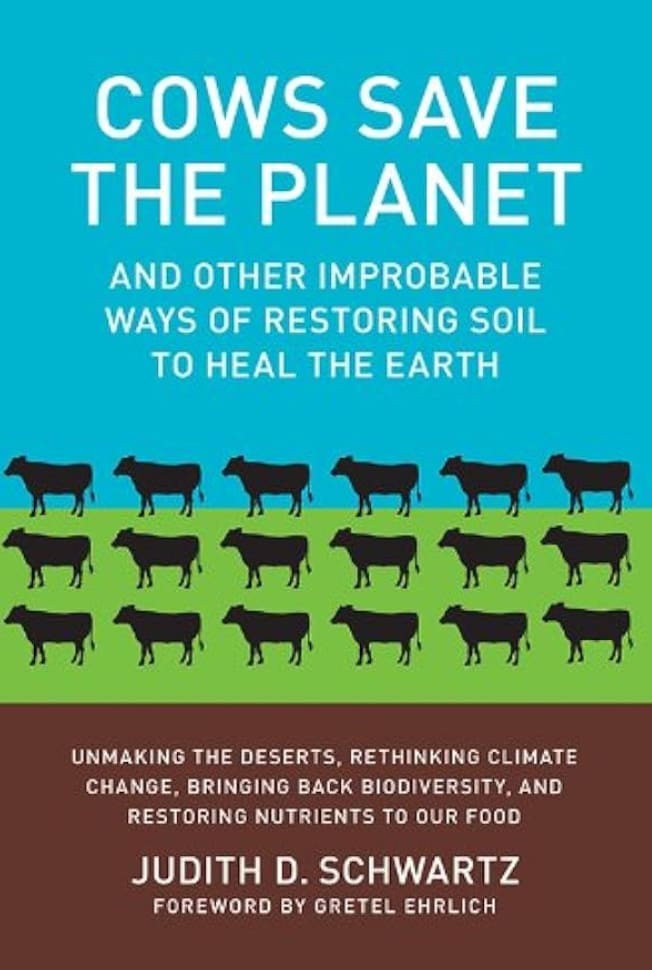
Judith D. Schwartz is an author and journalist known for illuminating scientific ideas through compelling stories that reveal the cultural, ecological, and economic dimensions of global challenges. Her work focuses on nature-based solutions, drawing insight from how living systems heal land, restore water cycles, and rebuild resilience. Judith writes for publications such as The American Prospect, The Guardian, Scientific American, Discover, and Yale E360, and speaks internationally on restoration ecology and regenerative approaches to climate and landscape repair.
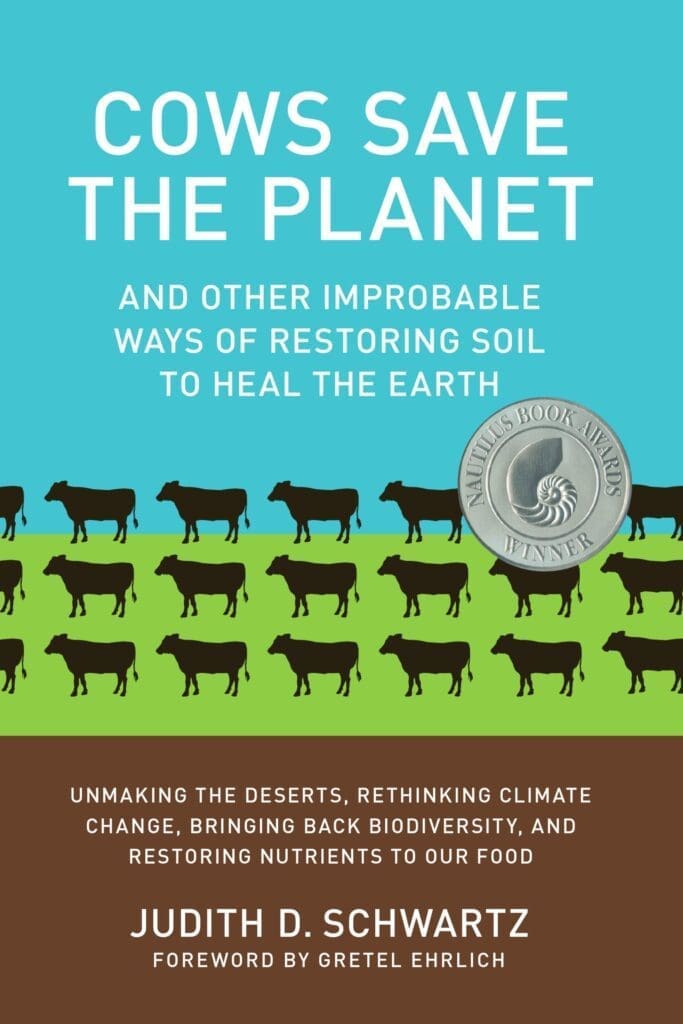
She is the author of several influential books, including Cows Save the Planet, Water in Plain Sight, and The Reindeer Chronicles, a global journey through successful ecosystem restoration efforts from Norway to Hawai‘i to New Mexico.
Judith holds degrees from Brown University (B.A.), the Columbia Graduate School of Journalism (M.S.J.), and Northwestern University (M.A. in Counseling Psychology). She lives in southern Vermont on the side of a mountain with her husband, author Tony Eprile, and enjoys cross-country skiing, gardening, and training in Uechi-Ryu karate, in which she holds the rank of Sandan.
John Feldman is a highly original and critically acclaimed filmmaker who works as a writer, director, cinematographer, and editor. His career spans over 40 years and covers a wide range of genres, including independent dramatic feature films, documentaries, experimental shorts, and educational films.
Feldman’s recent film Regenerating Life, How to cool the planet, feed the world, and live happily ever after (2023) looks at the climate crisis from an ecological perspective. Screening globally, it is translated into 11 languages. “John Feldman’s film is a masterpiece in which he puts life, in terms of healthy ecosystems, centre-stage as the Earth’s extraordinary global-temperature regulator. (Peter Bunyard, The Ecologist Magazine, UK).
Symbiotic Earth: How Lynn Margulis Rocked the Boat and Started a Scientific Revoultion (2018), “is a vivid portrait of a bold scientist who took us to an understanding of evolution very different than any previous one. This film represents an effervescent intelligence leading the way to a revolution in understanding life on Earth.” (Thomas Lovejoy, Professor, George Mason University, known as “The Godfather of Biodiversity”)
Rob de Laet is the founder of Cooling the Climate and a climate strategist and co-author of Cooling the Climate – How to Revive the Biosphere and Cool the Earth Within 20 Years. He is the project lead for the Cooling the Climate Amazon Rainforest Project and works in collaboration with organizations including the Global Evergreening Alliance and the EcoRestoration Alliance.
Born in the Netherlands in 1956, Rob is a world traveler, serial entrepreneur, philosopher, and climate activist. He has built an international ecotourism company with partnerships in seventeen countries and is actively involved in rewilding degraded areas of the Brazilian Amazon. His work focuses on preventing the dieback of the Amazon Rainforest by strengthening the biotic pump and restoring natural water cycles.
As a principal member of the EcoRestoration Alliance and a fellow of the Global Evergreening Alliance, Rob is developing the Cooling Climate Chaos project alongside Peter Bunyard and others. Working from a Lovelockian Gaia perspective, he advocates for rapid action to restore Earth’s metabolisms through biosphere regeneration and water cycle restoration, emphasizing the urgent need to avert critical tipping points affecting the Amazon Rainforest, ocean biology, and Arctic sea ice.
Scot Quaranda has been a driving force at Dogwood Alliance since 2000, serving in roles ranging from campaign organizer to field director to campaign director, and now Communications Director. For nearly 25 years, he has shaped the organization’s storytelling, creative strategy, media relations, and public communications—helping bring national attention to the urgent need to protect Southern U.S. forests and the communities who depend on them.
Dogwood Alliance is a leading environmental organization working across the Southern United States to end destructive industrial logging practices, advance climate-smart forest protection, and support frontline communities disproportionately affected by deforestation and biomass expansion. Through policy advocacy, grassroots organizing, and powerful communication campaigns, Dogwood Alliance challenges corporate forestry interests and champions ecological integrity, environmental justice, and community resilience.
Scot’s professional background blends advocacy and creative communication. Prior to joining Dogwood Alliance, he worked with the Fund for Public Interest and in music public relations, representing artists such as Buddy Guy and Ani DiFranco. He holds dual bachelor’s degrees in Psychology and Philosophy from Drew University.
With decades of experience at the intersection of environmental policy, storytelling, and movement-building, Scot brings a seasoned perspective on how communication can shift public narratives and drive meaningful forest protection.
Michael Pilarski is the founder and director of Friends of the Trees Society and the Global Earth Repair Foundation. He is a permaculturist, educator, and expert in earth repair with decades of experience in grassroots ecosystem restoration and regenerative agriculture. He began farming organically in the early 1970s and has focused his work on permaculture, forestry, agroforestry, wildcrafting, ethnobotany, and sustainable land stewardship, working hands-on with over 1,000 plant species.
Michael founded Friends of the Trees Society in 1978 as a hub for community-based ecological education and restoration, and he has taught more than 36 permaculture design courses in the United States and abroad since the late 1980s
Michael’s work emphasizes practical, site-based earth repair and regenerative design, integrating learning with action to strengthen landscapes and communities for climate resilience.
SoniaDemiray is the Director of the Climate Communications Coalition and a strong advocate for the permanent protection of lands and waters, with a focus on forest ecosystems, for the recovery of biodiversity and rebalancing of Earth systems processes. Sonia builds regional and national coalitions to advance environmental health and climate justice, works on public education, and on the development of grassroots movements such as Keep It In the Forest and Down to Earth. In addition to leading the Climate Communications Coalition, she is a member of the Environmental Paper Network’s Steering Committee, which coordinates International Biomass Action Network for the Americas, and a member of the Sierra Club Maryland Chapter’s Executive Committee, of Eastern Forests, Heartwood, and the Climate Forest Campaign -among others.
Sonia is enrolled in a Graduate Program on Forests and Climate Change at Oregon State University to ensure that she works with the latest science in these fast-developing fields. Her studies and ample experience from an earlier career as a communications strategist serving international, federal, and regional clients across the Americas and Europe, strengthen and support her advocacy and outreach.
When asked what he thinks about himself, Basil will tell you he is incredibly lucky. He has a family he loves dearly, friends and colleagues who inspire him, and every day he gets to care for trees, soil, and flowers. He pursues his purpose and passions through his work as a Treecologist, ISA Board Certified Master Arborist, Duke graduate, Wizard of Things, and author.
His work has been featured in the New York Times, Seattle Times, Forbes, Gardenista, The Joe Gardener Show, and a number of other publications and podcasts. When he’s not having fun at work, he enjoys pulling invasive plants from his pocket forests, contemplating on his front porch, and hiking with his family.
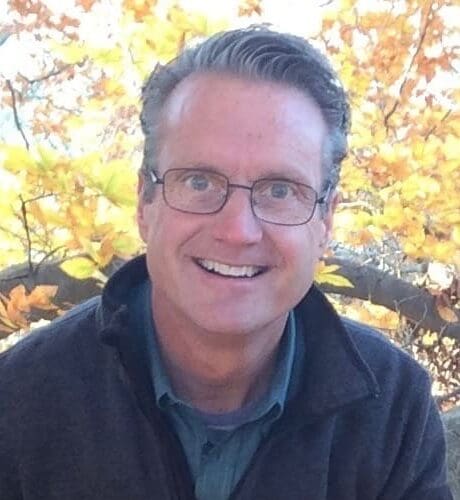
Hart Hagan is an environmental reporter who has produced nearly 400 radio shows and close to 300 videos since 2018. He is the founder of Water & Climate, a Facebook group with over 4,600 members. Six years as a climate reporter has led him to focus on the value of ecosystems and water cycles as a key driver of climate, and the primary means of curbing extinction and providing habitat for our fellow species.
Hart is passionate about educating people that in order to understand flooding, drought, heatwaves and wildfires, we must look beyond CO2 and examine how we treat our land. He is an avid gardener with a focus on native wildflowers and creating landscapes that capture all the rainfall.
Hart is also an educator, a native plant expert, an Accredited Organic Land Care Professional certified through the Northeast Organic Farming Association, and he has been trained by the Savory Institute in the ecological evaluation of pastures through a process known as Ecological Outcome Verification.
Whether this is your first course or your tenth course, please join us if you are curious about Trees & Forests, as they relate to our Water, our Wildlife, Wildfires and our Climate. Everyone has much to learn and share, and there is much to be done. We are all on a journey of expanding our knowledge on nature’s climate solutions, and we each bring something valuable to the conversation.
If you have any registration or general course questions, email us at courses@bio4climate.org. If you have specific questions about the course for Hart Hagan, you can contact him at nhhagan@gmail.com.
Please note that we want you to join us more than anything, so we never turn anyone away based on ability to pay. If needed, we offer a few low-budget registration options below, or for volunteer or scholarship opportunities, you can email us at courses@bio4climate.org.
Looking forward to seeing you in class!
Please note that by registering, you will be added to our mailing list. You can unsubscribe or manage your email preferences at any time.
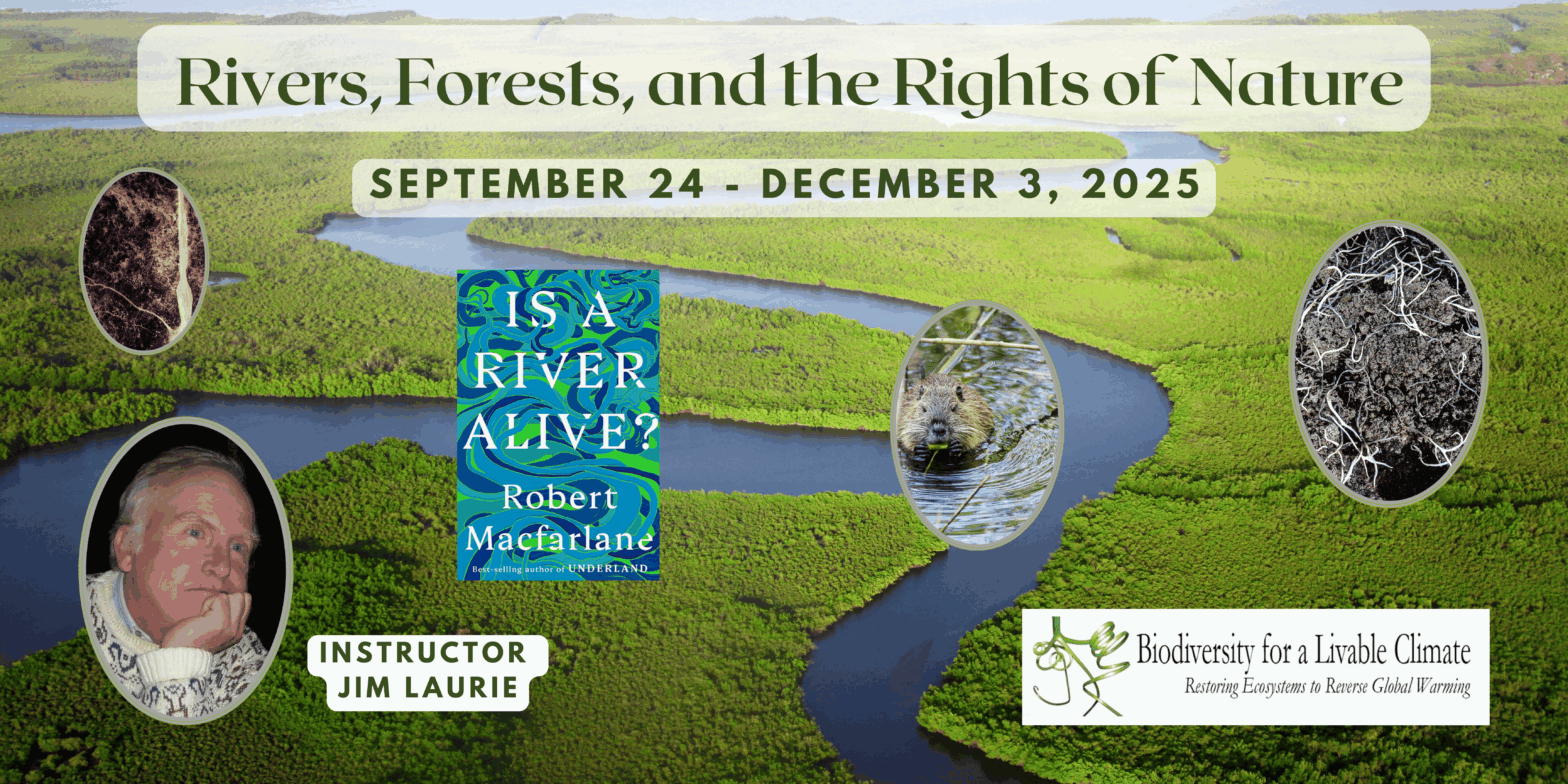
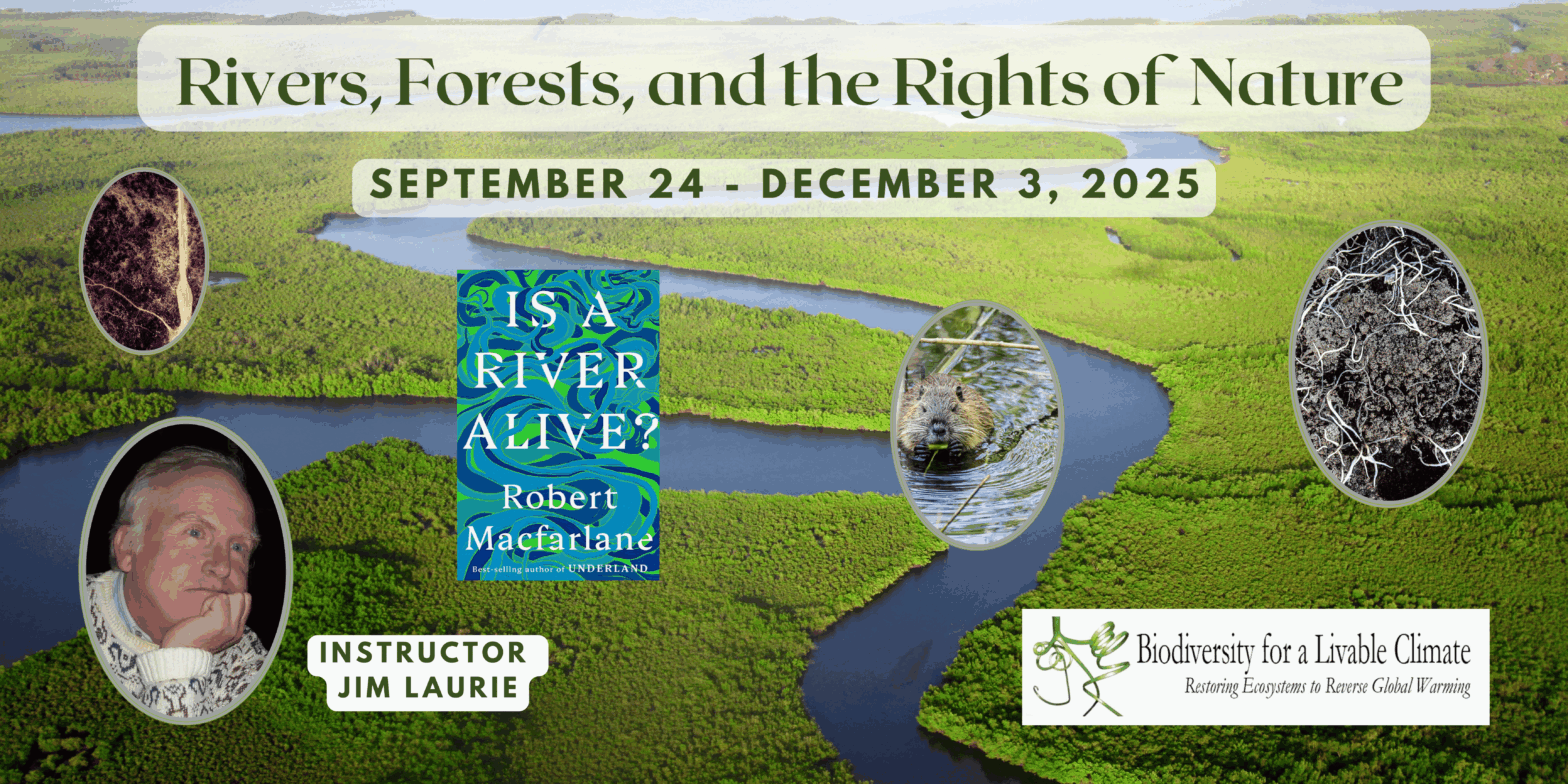
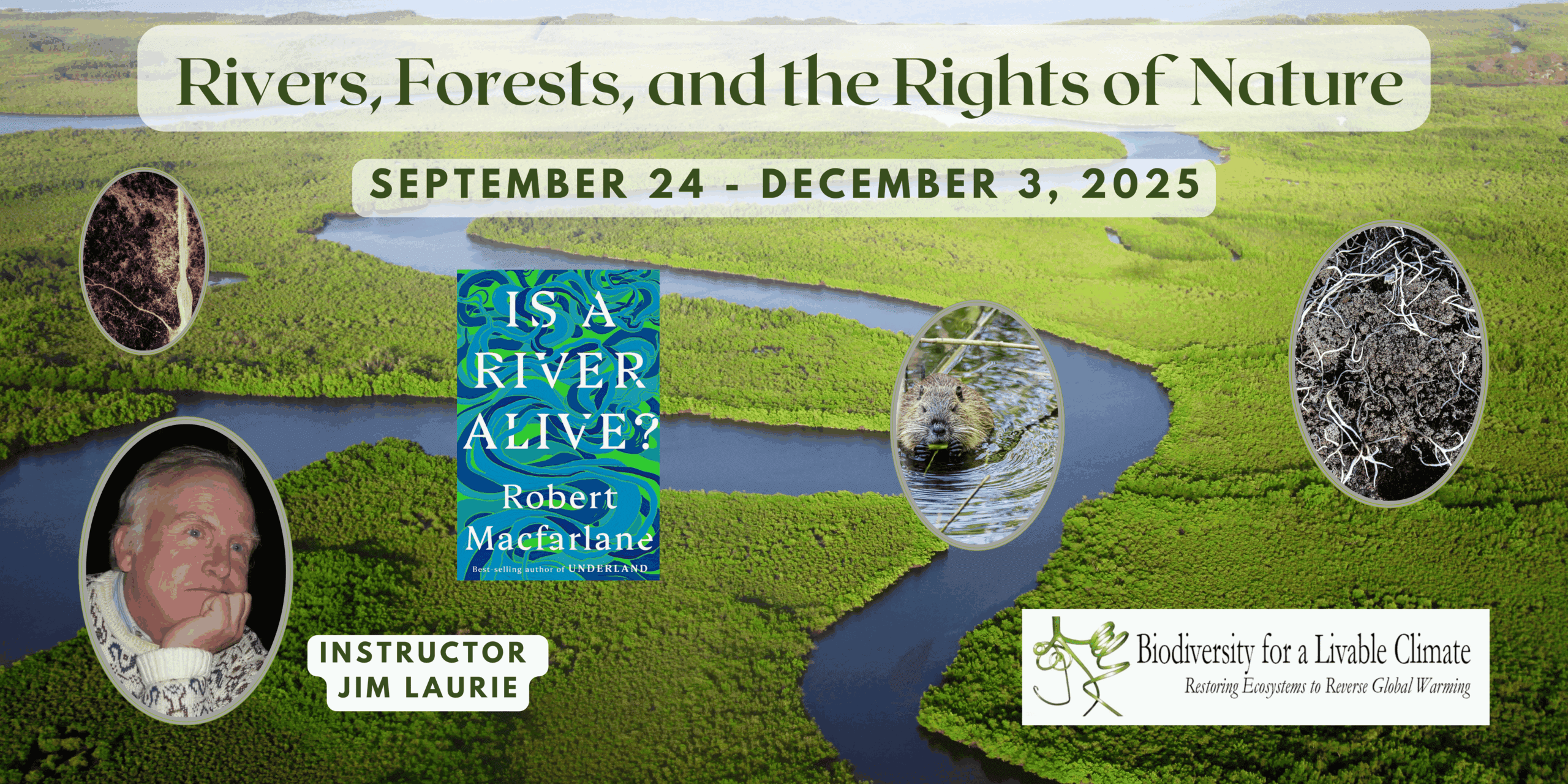
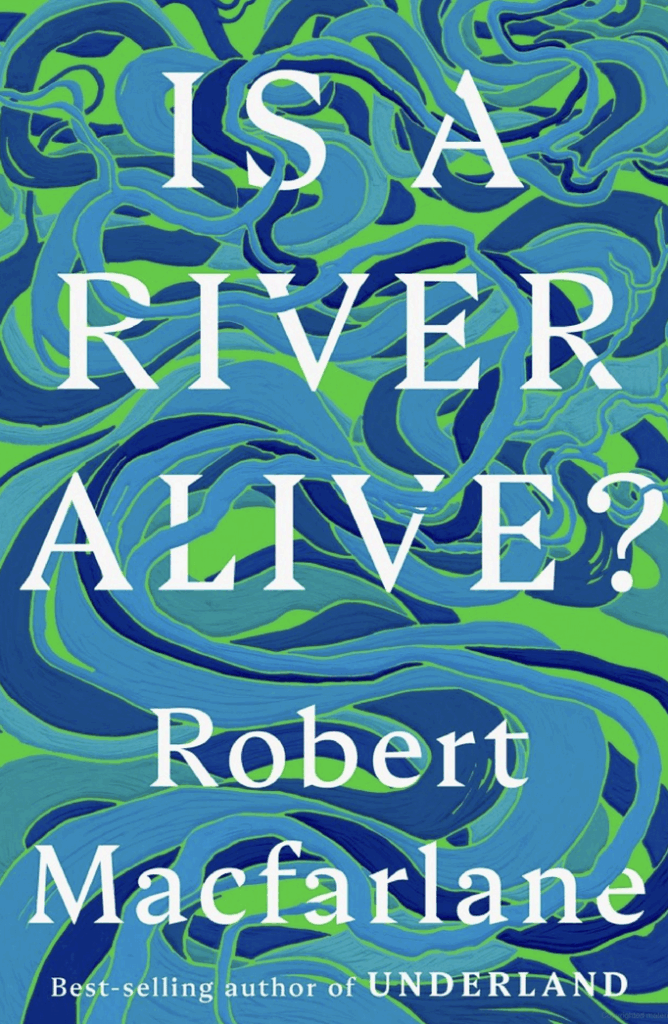
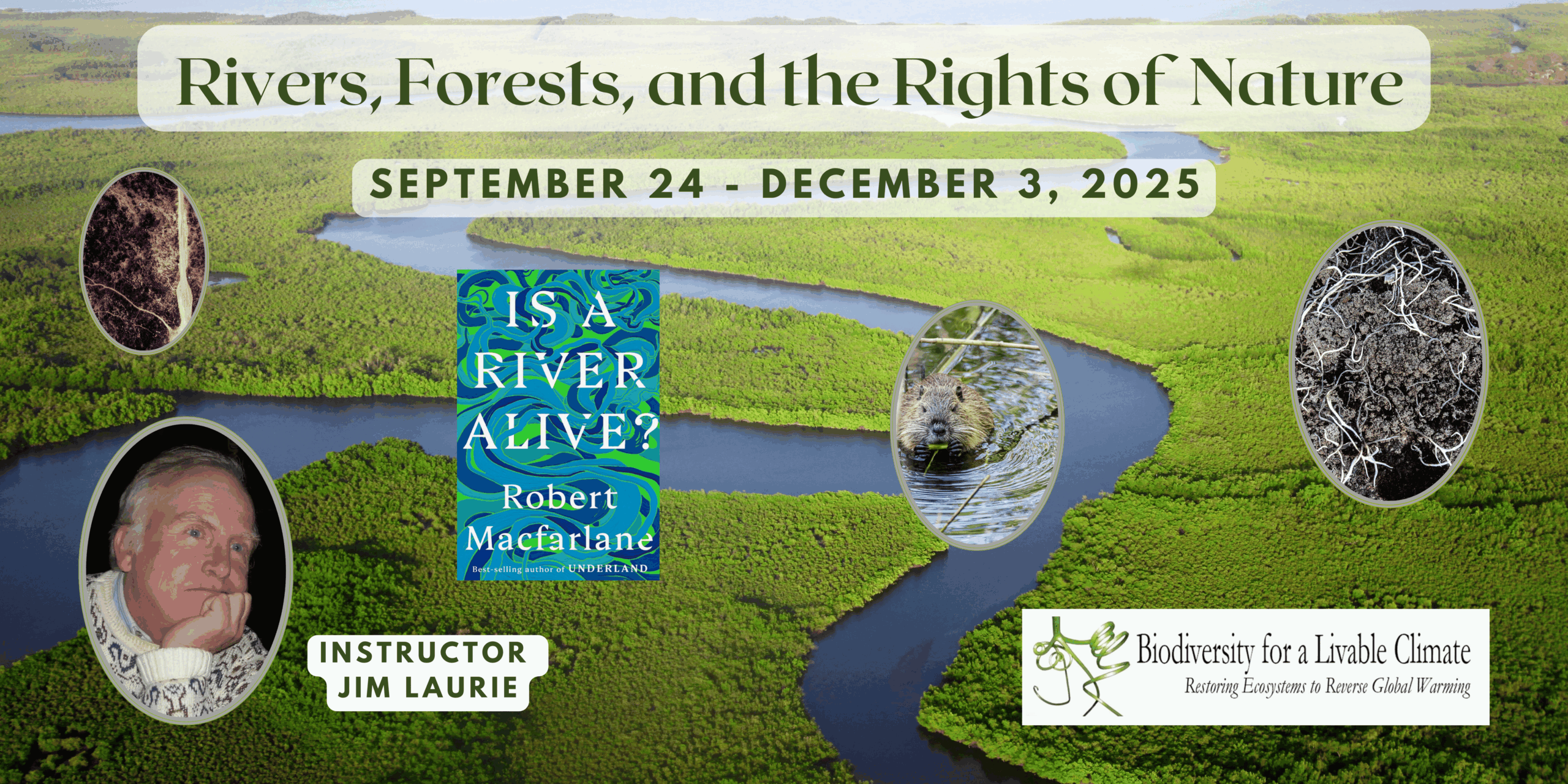
In this 10-week journey, we will explore the profound question raised by Robert Macfarlane in his new book Is a River Alive? (2025)—can rivers, forests, and other ecosystems be recognized as living beings with rights?
Macfarlane’s travels take us across three continents—Ecuador, India, and Quebec—where communities, scientists, and activists are protecting rivers through law, culture, and ecological restoration. Along the way we meet in Giuliana Furci, the Chilean fungi expert advancing the rights of fungi; Yuvan Aves, a South Indian naturalist and activist, restoring rivers and protecting birds, insects, and sea turtles; and Indigenous leaders in Quebec working to safeguard wild rivers from massive hydroelectric projects.
Each week we’ll connect these stories to larger ecological truths: that rivers, forests, wetlands, and fungi-rich soils function as one interconnected system, critical to rehydrating continents and cooling the climate. We’ll also examine how biodiversity infiltrates water into soils, how plants cover and protect landscapes, how fungal networks sustain resilience, and how living shorelines can buffer rising seas.
Course Projects
Totem Rivers – Share the story of a river that has shaped your life
Nature’s Rights – Investigate cases where legal or cultural rights have been recognized for ecosystems, such as Lake Erie, New Zealand’s Whanganui River, and Ecuador’s Amazon.
Future Rights – Imagine where and how you would like to see “rights of nature” declared in the future.
By weaving together science, law, philosophy, and personal reflection, this course offers a holistic perspective on rivers as lifelines of the planet. As global warming dries out continents and fresh water and ice flow rapidly to the oceans, we will ask: how can biodiversity, guided by human wisdom and humility, restore the water cycle and help heal the Earth?
This is a 10-week course that meets every Wednesday, starting September 24, 2025 and will run until December 3, 2025. Classes will be held from 12 – 2 pm ET and 7 – 9 pm ET on Zoom. Students can choose either class time to accommodate their schedules.
The course will have reading assignments, slide presentations, videos, and breakout sessions to discuss topics raised in class and to get to know your classmates.
Instructor Jim Laurie’s goal is that each person shares something and learns something new in each class. There are many “old timers” who have taken several courses, but we also have new people in each course. The Old Timers are eager to encourage the “Newbies” and help them catch up and feel comfortable as part of the Symbiosis Team.
Course Book
In this book Is a River Alive?, author Robert Macfarlane asks whether rivers can be considered living beings with rights. Traveling to Ecuador, India, and Quebec, he documents struggles to protect rivers from Ecuador’s constitutional recognition of nature’s rights, to India’s sacred river restorations, to Quebec’s fight against damming.
Alongside these journeys, he reflects on his own local river in England and explores how rivers, forests, and fungal networks reveal the intelligence of ecosystems.
The book blends adventure, philosophy, and law to challenge our relationship with nature and inspire recognition of the living world as kin rather than resource.
Jim Laurie is a restoration biologist, consultant, and co-founder of Biodiversity for a Livable Climate. For twenty years, Jim worked as a biologist and technical trainer in the chemical industry in Houston, Texas, where he pioneered the use of living machines to biologically remediate wastewater more effectively than conventional technology. In 1995, he relocated to Vermont to manage the world’s largest “Living Machine” designed by ecological visionary John Todd to clean raw municipal sewage without toxic chemicals. He then consulted on projects to restore the redwood forests and Pacific salmon fisheries, and implement flood prevention and ecological design. In 2017, he developed “Scenario 300,” an analysis demonstrating that if just half the available land on the planet were restored, atmospheric carbon concentrations could fall to 300 ppm within four decades.
Jim studied Holistic Management of grasslands with Allan Savory and the Savory Institute, built a lab to study fungi and grow mushrooms, learning from the work of Paul Stamets, and worked with the International Wolf Center in Minnesota to learn about predators and the biology of the North woods. Jim received his B.S. in Biology at Rice University and his M.S. in Future Studies at the University of Houston in 1997 where he completed his thesis on “Biological and Educational Tools for Reversing the Loss of Biodiversity in the 21st Century.”
Living Machine built by Jim’s homeschool students (Photo: Jim Laurie)
Jim discovered the magical power of nature in his work as a biologist in the chemical industry to clean toxic wastewater with “Living Machines.” His career turned to restoration biology and teaching. You will enjoy his interactive and thought provoking style which makes science accessible, while still being comprehensive.
This Series of Biodiversity Courses
Are you ready to transform your understanding of how life on the planet works and how we can play a role? Join us as we follow the transformation of leading writers and thinkers to a deeper understanding of natural systems, our role, and the ability of nature to cool the planet.
While each course builds on our understanding, you do not need to have taken any of the previous Biodiversity Courses. Whether this is your first or tenth course, please join us if you are curious about nature and its power to restore ecosystems to abundance. The veterans of previous classes will help you catch up in your learning. We are developing into a “Symbiosis Team” to ameliorate or reverse the impacts of global warming. Everyone has much to learn and share and there is much to be done. We need and appreciate your enthusiasm on the team, and encourage people to join at the level that they are able to. Sliding scale pricing is available, as are scholarship options. To join us, register below!
In this 10-week journey, we will explore the profound question raised by Robert Macfarlane in his new book Is a River Alive? (2025) describes how rivers, forests, and other ecosystems be recognized as living beings with rights? Macfarlane’s travels take us across three continents—Ecuador, India, and Quebec—where communities, scientists, and activists are protecting rivers through law, culture, and ecological restoration. Along the way we meet in Giuliana Furci, the Chilean fungi expert advancing the rights of fungi; Yuvan Aves, a South Indian naturalist spiring figures:and activist restoring rivers and protecting birds, insects, and sea turtles; and Indigenous leaders in Quebec working to safeguard wild rivers from massive hydroelectric projects.
Each week we’ll connect these stories to larger ecological truths: that rivers, forests, wetlands, and fungi-rich soils function as one interconnected system, critical to rehydrating continents and cooling the climate. examine how biodiversity infiltrates water into soils, how plants cover and protect landscapes, how fungal networks sustain resilience, and how living shorelines can buffer rising seas.
Course Projects
Totem Rivers – Share the story of a river that has shaped your life
Nature’s Rights – Investigate cases where legal or cultural rights have been recognized for ecosystems, such as Lake Erie, New Zealand’s Whanganui River, and Ecuador’s Amazon.
Future Rights – Imagine where and how you would like to see “rights of nature” declared in the future.
By weaving together science, law, philosophy, and personal reflection, this course offers a holistic perspective on rivers as lifelines of the planet. As global warming dries out continents and fresh water and ice flow rapidly to the oceans, we will ask: how can biodiversity, guided by human wisdom and humility, restore the water cycle and help heal the Earth?
This is a 10-week course that meets every Wednesday, starting September 24, 2025 and will run until December 3, 2025. Classes will be held from 12 – 2 pm ET and 7 – 9 pm ET on Zoom. Students can choose either class time to accommodate their schedules.
The course will have reading assignments, slide presentations, videos, and breakout sessions to discuss topics raised in class and to get to know your classmates.
Instructor Jim Laurie’s goal is that each person shares something and learns something new in each class. There are many “old timers” who have taken several courses, but we also have new people in each course. The Old Timers are eager to encourage the “Newbies” and help them catch up and feel comfortable as part of the Symbiosis Team.
Books for the Course
Main Book
In Is River Alive, author Robert Macfarlane asks whether rivers can be considered living beings with rights. Traveling to Ecuador, India, and Quebec, he documents struggles to protect rivers from Ecuador’s constitutional recognition of nature’s rights, to India’s sacred river restorations, to Quebec’s fight against damming. Alongside these journeys, he reflects on his own local river in England and explores how rivers, forests, and fungal networks reveal the intelligence of ecosystems. The book blends adventure, philosophy, and law to challenge our relationship with nature and inspire recognition of the living world as kin rather than resource.
Jim Laurie discovered the magical power of nature in his work as a biologist in the chemical industry to clean toxic wastewater with “Living Machines.” His career turned to restoration biology and teaching. You will enjoy his interactive and thought provoking style which makes science accessible, while still being comprehensive.
Living Machine built by Jim’s homeschool students (Photo: Jim Laurie)
Are you ready to transform your understanding of how life on the planet works and how we can play a role? Join us as we follow the transformation of leading writers and thinkers to a deeper understanding of natural systems, our role, and the ability of nature to cool the planet.
While each course builds on our understanding, you do not need to have taken any of the previous Biodiversity Courses. Whether this is your first or tenth course, please join us if you are curious about nature and its power to restore ecosystems to abundance. The veterans of previous classes will help you catch up in your learning. We are developing into a “Symbiosis Team” to ameliorate or reverse the impacts of Global Warming. Everyone has much to learn and share and there is much to be done. We need and appreciate your enthusiasm on the team, and encourage people to join at the level that they are able to. Sliding scale pricing is available, as are scholarship options. To join us, register below!
To register for the “Bring A Friend” Discount, please fill out the form below.
If you would prefer to send us a check, make it payable to “Biodiversity for a Livable Climate” and send it to us at P.O. Box 390469, Cambridge, MA 02139. Please include a note with your name, email address and the name of the course.
What’s included in the course
Live Classes Every Week! A 12:00 Noon and 7:00 PM ET live, 90-minute class each week for a total of 8 live sessions, recorded for your convenience
Guest Speakers will share their research and experience
Membership in a private email group to ask questions, share resources and connect with a like-minded community
Advocacy Coaching for you to be effective in your community
Plus Resources you can use to help decision makers create truly effective climate action plans
Pricing
Bring a Friend Price: $108 each
Bring a friend to take this course with you and turn solo learning into a shared adventure—with a 25% savings off the full course price for each of you!
Frequently Asked Questions
Do I need to come to both sessions each week?
You may attend one or both sessions in a week. Most students attend one class session per week. All sessions are recorded and you may watch the recording at your convenience. We will keep you informed every step of the way via the email group.
Are the classes recorded?
Yes, both sessions are recorded and made available in the Google Group immediately following the class. You never need to worry about missing a great speaker or important information.
How does the “Bring a Friend” Discount work?
The “Bring a Friend” Discount is a promotional offer where you and a friend can get a reduced price. When you register with another person, each of you will receive a 25% discount off of the Early Bird Registration Price.
What is the Reduced Rate and how do I get it?
We realize that everyone is in a different financial position so if you need a different rate, we trust you to tell us how much you can pay, within reason. We want everyone to get the training they need and we want to keep offering these great courses and programs. To get the Reduced Rate, email us at courses@bio4climate.org and let us know your situation and how much you can pay.
Looking forward to seeing you in class!
Be sure to click on the light blue button below “$108 – Bring a Friend Program” to complete your registration.
Also, be sure to enter the name of your friend who you are doing this course with (see below).
Please note that by registering, you will be added to our mailing list. You can unsubscribe or manage your email preferences at any time.
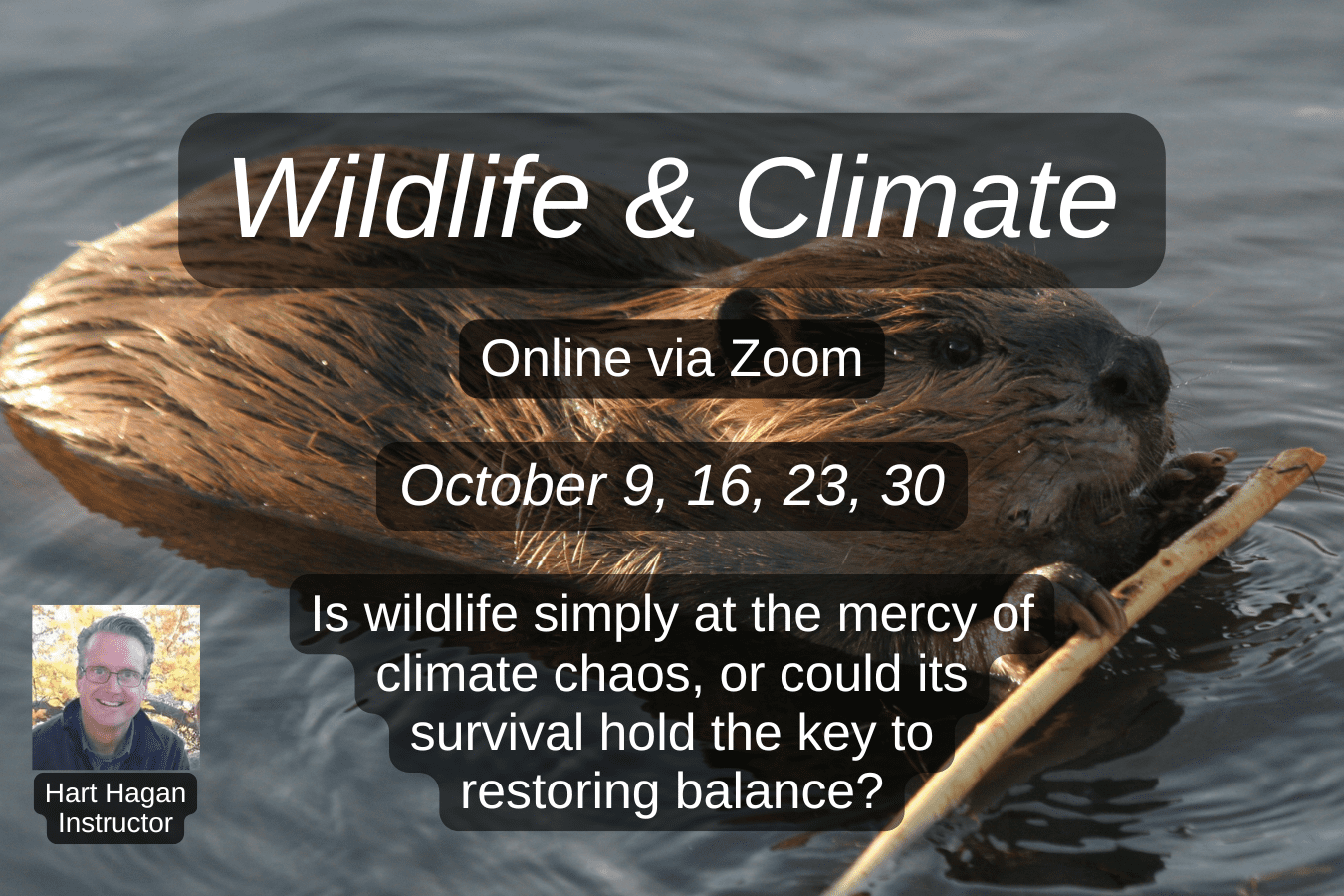
Please fill out the form below to register for this special mini-course Wildlife & Climate.
What’s included in the course
Live Classes every week! A 12:00 Noon and 7:00 PM live class each week for a total of 8 live sessions, recorded for your convenience
Guest Speakers will share their research and experience
Membership in a private email group to ask questions, share resources and build community
Advocacy Coaching for you to be effective in your community
Plus Resources you can use to help decision makers create truly effective climate action plans
Course Price = $145
For Group Discounts off the full course price for groups of five or more and for Reduced Rates for students or those on a restricted budget, contact us at courses@bio4climate.org.
Frequently Asked Questions
Do I need to come to both sessions each week?
You may attend one or both sessions in a week. Most students attend one class session per week. All sessions are recorded and you may watch the recording at your convenience. We will keep you informed every step of the way via the email group.
What is the Group Discount?
Groups of five or more can negotiate a discount rate depending on the size of the group and your budget. Rates range from a 20-40% discount off the full price—so invite your friends or classmates to get the best rate.
Are the classes recorded?
Yes, both sessions are recorded and made available in the Google Group immediately following the class. You never need to worry about missing a great speaker or important information.
What is the Reduced Rate and how do I get it?
We realize that everyone is in a different financial position so if you need a different rate, we trust you to tell us how much you can pay, within reason. We want everyone to get the training they need and we want to keep offering these great courses and programs. To get the Reduced Rate, email us at courses@bio4climate.org and let us know your situation and how much you can pay.
Looking forward to seeing you in class!
Please enter your coupon code below and then click on the light blue button “$145 – Regular Price” to reset it to your discounted price and then complete your registration.
Please note that by registering, you will be added to our mailing list. You can unsubscribe or manage your email preferences at any time.
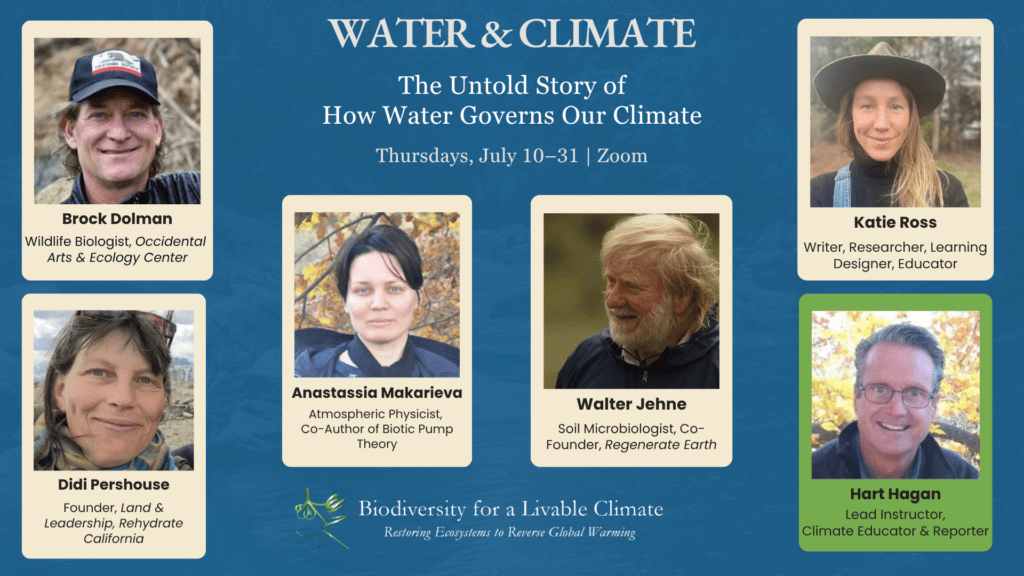
Thank you for your interest in the transformative work of Walter Jehne, whose research shows how soil biology and water cycles regulate Earth’s climate. Walter’s work highlights the soil‑carbon sponge, vegetation cover, and restored hydrological systems as powerful tools for cooling the Earth within years, not decades.
To watch the video recording of Walter’s presentation during our Water &Climate course, please fill in your name and email address below. You will then receive an email with the link to the video recording.
To read Walter Jenhe’s bio, and for the links to his important work, visit our Water & Climate course page.
Stay tuned for our upcoming courses with more guest speakers who are on the cutting edge of how to restore our land, our soil and our ecosystems in order to cool the planet and stabilize the climate.
Looking forward to seeing you in class!
Please note that by registering, you will be added to our mailing list. You can unsubscribe or manage your email preferences at any time.
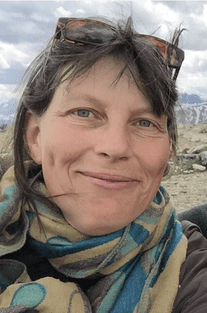
Thank you for your interest in the essential work of Didi Pershouse that draws powerful connections between soil health, public health, and climate resilience, showing how diverse microbial communities create the living soil-carbon sponge that regulates water and climate. She highlights the often-overlooked role of biodiverse soils in regenerating water cycles, cooling the land, and strengthening community wellness.
To watch the video recording of Didi’s presentation during our Water & Climate course, please fill in your name and email address below. You will then receive an email with the link to the video recording.
To read Didi Pershouse’s bio, and for the links to her important work, visit our Water & Climate course page.
Stay tuned for our upcoming courses with more guest speakers who are on the cutting edge of how to restore our land, our soil and our ecosystems in order to cool the planet and stabilize the climate.
Looking forward to seeing you in class!
Please note that by registering, you will be added to our mailing list. You can unsubscribe or manage your email preferences at any time.
Thank you for your interest in the significant work of Dr. Katie Ross and her research on the role of soil, ecosystems, and communities in governing Earth’s water systems and climate. Her insightful studies show how regenerative landscapes, healthy soils, and biodiverse ecosystems can restore water cycles, promote rainfall, and stabilize climate, especially in rural and tribal communities.
To watch the video recording of Katie’s presentation during our Water & Climate course, please fill in your name and email address below. You will then receive an email with the link to the video recording.
To read Katie Ross’ bio, and for the links to her important work, visit our Water & Climate course page.
Stay tuned for our upcoming courses with more guest speakers who are on the cutting edge of how to restore our land, our soil and our ecosystems in order to cool the planet and stabilize the climate.
Looking forward to seeing you in class!
Please note that by registering, you will be added to our mailing list. You can unsubscribe or manage your email preferences at any time.
Thank you for your interest in the vital work of Dr. Anastassia Makarieva on the biotic pump theory that shows how intact forests actively generate and transport atmospheric moisture, playing a crucial role in stabilizing rainfall patterns and regulating Earth’s climate.
To watch the video recording of Anastassia Makarieva’s presentation during our Water & Climate course, please fill in your name and email address below. You will then receive an email with the link to the video recording.
To read Anastassia Makarieva’s bio, and for the links to her important work, visit our Water & Climate course page.
Stay tuned for our upcoming courses with more guest speakers who are on the cutting edge of how to restore our land, our soil and our ecosystems in order to cool the planet and stabilize the climate.
Looking forward to seeing you in class!
Please note that by registering, you will be added to our mailing list. You can unsubscribe or manage your email preferences at any time.
The article holds that conservation biologists do not list climate change as a frequent cause of wildlife extinctions. Instead, they list habitat loss (e.g., deforestation), pollution (including pesticides) and overexploitation (overhunting and overfishing) as major causes of wildlife extinctions.
So, saving our wildlife requires that we deal with the real causes and not be swept up in a false narrative about how climate change, per se, is the culprit.
Besides, forests, wetlands and grasslands serve as habitat AND climate regulators. So we have a powerful rationale for protecting–and creating–habitat in our farms, our forests, our landscapes and even our deserts.
Furthermore, wildlife is an essential component of each ecosystem. Every species plays a role in the function of an ecosystem as a whole, including the roles of our ecosystems in regulating a livable climate. Thus humans and all of the other species depend on wildlife for our survival, providing an extra incentive for us to create the conditions for wildlife to return and thrive by restoring their habitat and food supply.
Finally, according to Canadian scientist Vaclav Smil, we have eliminated 50% of the Earth’s biomass in the last 5,000 years. If we could reverse this trend, we could regain some of the habitat and climate regulating capacity that we have lost.
Combine this with the idea that the total quantity of human made things (known as anthropogenic mass), now equals the biomass of the world, and is set to double and redouble in this century.We are literally crowding out nature. If we don’t stop, it will not matter how much we reduce emissions.
We can live with nature. We can be a keystone species, creating habitat for other species. But we need to understand what’s going on and not be deceived by those who want us to ignore nature or make token changes, changes that are profitable for business but not people or the planet. We need real change, without which we will never address climate change.
This course explores the actual connections between wildlife and climate change and gives us a real and viable framework for living with nature, restoring habitat and addressing climate change in a way that actually works and can be implemented wherever we live, work and play.
What’s Included in the Course
Live Classes every week! A 12:00 Noon and 7:00 PM live, 90-minute class each week on Zoom for a total of 10 live sessions, recorded for your convenience
Thursdays – October 9, 16, 23 & 30, 2025 – from 12:00 – 1:30 PM and 7:00 – 8:30 PM ET (attend either or both classes)
Guest Speakers will share their research and experience
Membership in a private email group to ask questions, share resources and connect with a like-minded community
Advocacy Coaching for you to be effective in your community
Plus Resources you can use to help decision makers create truly effective climate action plans.
Special Guest Speakers
Jonathan Lundgren, PhD
October 9 – 12:00 noon ET
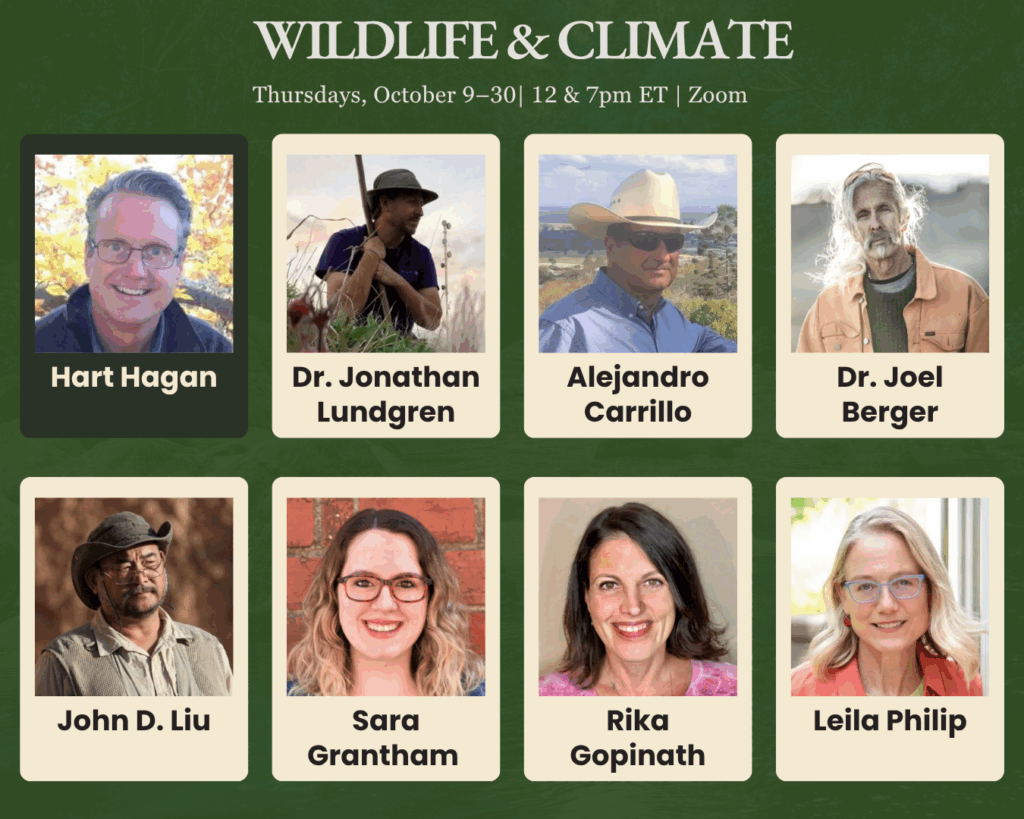
Dr. Jonathan Lundgren is an agroecologist, Executive Director of Ecdysis Foundation, and CEO for Blue Dasher Farm, in South Dakota. Lundgren’s research and education programs are helping applied science evolve in ways that foster the evolution of a regenerative food system. He regularly interacts with the public and farmers around the world regarding ecologically intensive farming and how biodiversity fuels the resilience and productivity of an agroecosystem and rural communities.
Alejandro Carrillo is a fourth-generation rancher in the Chihuahuan desert. Rarely does his precipitation go beyond 9” per year (< 225mm). He is not willing to waste any water in such a brittle environment because he wants to graze year-round without inputs (such as irrigation, seeds and fertilizer).
Alejandro’s ranch, Las Damas Cattle Ranch, has been part of multiple documentaries and studies focused on regenerative ranching and “greening the desert” using livestock such as Common Ground, Sacred Cow, To Which We Belong, and Water in Plain Sight.
Alejandro’s Grasslands Regeneration Project company assists ranchers and organizations on regenerative grazing projects in the Americas, Europe, Africa, Australia, China and the Middle-East. He also participates as a delegate to the United Nations Convention to Combat Desertification.
Before joining the ranch, Alejandro worked as a software engineer in multiple countries. He holds a MS in Technical Management from The Johns Hopkins University and BS in Computer Science from the Monterrey Institute of Technology.
Dr. Joel Berger is a wildlife conservation biologist known for his research on large mammals and their survival in changing environments. He holds the Barbara Cox Anthony Chair in Wildlife Conservation at Colorado State University and is a senior scientist with the Wildlife Conservation Society (WCS). Much of his work focuses on species at the edge of survival from muskoxen in the Arctic, to wild yak in the Himalayas, to saiga antelope in Mongolia.
Across decades of fieldwork, Berger has investigated how climate change, habitat loss, and human-wildlife conflict affect animal populations. He is particularly interested in:
Using science and storytelling to influence conservation policy, often by drawing attention to overlooked species or ecosystems.
How large mammals adapt – or fail to adapt – to rapidly shifting climates and landscapes.
The intersection of human activity (development, hunting, resource extraction) with wildlife survival.
John D. Liu worked as a television producer and camera man for CBS News, RAI, and ZDF in the 1980s and 1990s covering geo-political events including the rise of China from poverty and isolation and the collapse of the Soviet Union. In the mid-1990s the World Bank asked John to document the extraordinary rehabilitation of the Loess Plateau.
Since learning that it is possible to rehabilitate large-scale damaged ecosystems John has devoted his life to understanding and communicating about the potential and responsibility to restore degraded landscapes on a planetary scale.
Since 2009 John has worked with Willem Ferwerda the Founder and CEO of the Commonland Foundation, which is catalyzing privately invested large-scale restoration in many parts of the world. John is also the founder of the Ecosystem RestorationCamps movement that began in 2016 and has grown to currently 80 camps in 6 continents and continues to grow.
Mr Liu, has produced, filmed, written, directed and presented numerous films on Environment and Ecology for the BBC, National Geographic, Discovery, PBS and other networks. John also spent 3 years as senior research fellow for the International Union for the Conservation of Nature (IUCN) and has also had numerous academic fellowships in the UK, Netherlands, and the United States, China, and Costa Rica.
Sara Grantham is the Science, Regulatory, and Advocacy Manager at Beyond Pesticides, where she advances science-driven advocacy to protect public health and the environment. She holds dual bachelor’s degrees in Biology and Marine/Environmental Science and a master’s in Chemical and Life Sciences. Inspired early by Rachel Carson’s work on the dangers of DDT, Sara has built a career at the intersection of research and advocacy, spanning cancer research, marine ecotoxicology, and science education. Drawing on this diverse background, she translates complex science into meaningful action, working to safeguard communities locally while shaping environmental protection on a global scale.
Rika Gopinath is the Community Policy and Action Manager at Beyond Pesticides, where she leads the Parks for a Sustainable Future program. With a long history of grassroots leadership in California, she has served as a founding member and chair of YardSmart Marin, and as co-chair of Moms Advocating Sustainability, a San Francisco Bay Area organization dedicated to protecting children from toxic exposures in homes and environments. Drawing on years of community advocacy, Rika brings both practical experience and policy insight to her work, championing sustainable practices that prioritize public health and ecological resilience.
Leila Philip is an award-winning author whose nonfiction books chronicle personal journeys across cultures and landscapes, from apprenticing with a master potter in Japan (The Road Through Miyama) to exploring her family’s Hudson Valley farm (A Family Place). A Guggenheim Fellow and recipient of fellowships from the National Endowment for the Arts and Humanities, she also publishes poetry, essays, and theatrical scripts, and is currently working on a documentary film. Leila has been a contributing columnist for the Boston Globe and teaches in the Environmental Studies Program at the College of the Holy Cross, where she is Professor of English.
Leila writes to know about the world and her place in it. She writes to better understand and connect with worlds, ideas and realities that are not her own. She researches and documents and observes as rigorously as she can, then she sits down at her desk and tries to make sense of all that she has taken in. For Leila, writing is always a journey with a wonderfully uncertain end; Leila writes to discover what she doesn’t know yet. She strives to find the story, then shape that story with words and share. We live in a time of ongoing environmental crisis and fear is an appropriate response once we acknowledge the extent to which we have altered every aspect of life on earth. But so is hope. In writing Beaverland, Leila discovered the natural wonder of beavers and the powerful ways they restore damaged environments. Beavers demonstrate the incredible powers of resilience and healing available to us as concrete solutions to help us meet the urgent challenges of climate change. Beavers can teach us. We can learn.
Hart Hagan is an environmental reporter who has produced nearly 400 radio shows and close to 300 videos since 2018. He is the founder of Water & Climate, a Facebook group with over 4,600 members. Six years as a climate reporter has led him to focus on the value of ecosystems and water cycles as a key driver of climate, and the primary means of curbing extinction and providing habitat for our fellow species.
Hart is passionate about educating people that in order to understand flooding, drought, heatwaves and wildfires, we must look beyond CO2 and examine how we treat our land. He is an avid gardener with a focus on native wildflowers and creating landscapes that capture all the rainfall.
Hart is also an educator, a native plant expert, an Accredited Organic Land Care Professional certified through the Northeast Organic Farming Association, and he has been trained by the Savory Institute in the ecological evaluation of pastures through a process known as Ecological Outcome Verification.
Whether this is your first course or your tenth course, please join us if you are curious about nature and its power to restore the soil and other ecosystems to abundance. Everyone has much to learn and share, and there is much to be done. We are all on a journey of expanding our knowledge on nature’s climate solutions, and we each bring something valuable to the conversation.
If you have any registration or general course questions, email us at courses@bio4climate.org. If you have specific questions about the course for Hart Hagan, you can contact him at nhhagan@gmail.com.
Please fill out the form below to register for this special mini-course Wildlife & Climate.
If you would prefer to send us a check, make it payable to “Biodiversity for a Livable Climate” and send it to us at P.O. Box 390469, Cambridge, MA 02139. Please include a note with your name, email address and the name of the course.
What’s Included in the Course
Live Classes Every Week! A 12:00 Noon and 7:00 PM ET live, 90-minute class each week for a total of 8 live sessions, recorded for your convenience
Guest Speakers will share their research and experience
Membership in a private email group to ask questions, share resources and connect with a like-minded community
Advocacy Coaching for you to be effective in your community
Plus Resources you can use to help decision makers create truly effective climate action plans
Pricing
Course Price = $145 Bring a Friend = $108 each
Take the course with a friend and you each receive a 25% savings, because learning is fun when shared (and discounted)! To register for this discount, visit our Bring a Friend Registration Page.
Generous Reduced Rates and Scholarships are also available for those with greater financial limitations. Please contact us at courses@bio4climate.org with the details of your request.
Frequently Asked Questions
Do I need to come to both sessions each week?
You may attend one or both sessions in a week. Most students attend one class session per week. All sessions are recorded and you may watch the recording at your convenience. We will keep you informed every step of the way via the email group.
Are the classes recorded?
Yes, both sessions are recorded and made available in the Google Group immediately following the class. You never need to worry about missing a great speaker or important information.
How does the Bring A Friend discount work?
The Bring A Friend discount is a promotional offer where you and a friend can get a reduced price. When you register with another person, each of you will receive a 25% discount on the course registration price.
What is the Reduced Rate and how do I get it?
We realize that everyone is in a different financial position so if you need a different rate, we trust you to tell us how much you can pay, within reason. We want everyone to get the training they need and we want to keep offering these great courses and programs. To get the Reduced Rate, email us at courses@bio4climate.org and let us know your situation and how much you can pay.
Looking forward to seeing you in class!
Be sure to click on the light blue button below “$145 – Course Price” to complete your registration.
Please note that by registering, you will be added to our mailing list. You can unsubscribe or manage your email preferences at any time.
Please fill out the form below to register for this special mini-course Defending Cows.
What’s included in the course
Live Classes every week! A 12:00 Noon and 7:00 PM live class each week for a total of 8 live sessions, recorded for your convenience
Guest Speakers will share their research and experience
Membership in a private email group to ask questions, share resources and build community
Advocacy Coaching for you to be effective in your community
Plus Resources you can use to help decision makers create truly effective climate action plans
Early Bird Price = $97 — until May 31 Full Course Price = $145
For Group Discounts off the full course price for groups of five or more and for Reduced Rates for students or those on a restricted budget, contact us at courses@bio4climate.org.
Frequently Asked Questions
Do I need to come to both sessions each week?
You may attend one or both sessions in a week. Most students attend one class session per week. All sessions are recorded and you may watch the recording at your convenience. We will keep you informed every step of the way via the email group.
What is the Group Discount?
Groups of five or more can negotiate a discount rate depending on the size of the group and your budget. Rates range from a 20-40% discount off the full price—so invite your friends or classmates to get the best rate.
Are the classes recorded?
Yes, both sessions are recorded and made available in the Google Group immediately following the class. You never need to worry about missing a great speaker or important information.
What is the Reduced Rate and how do I get it?
We realize that everyone is in a different financial position so if you need a different rate, we trust you to tell us how much you can pay, within reason. We want everyone to get the training they need and we want to keep offering these great courses and programs. To get the Reduced Rate, email us at courses@bio4climate.org and let us know your situation and how much you can pay.
Looking forward to seeing you in class!
Be sure to click on the light blue button below “$97 – Early Bird Price” to complete your registration.
Please note that by registering, you will be added to our mailing list. You can unsubscribe or manage your email preferences at any time.
There’s a crucial piece missing from the climate conversation.
The planet has a built-in cooling system—through the cycling of water—and it’s one of nature’s most powerful, yet most overlooked, climate regulators.
We’ve already passed 1.5°C of warming. We’re beyond the safety zone. Now, we must not only prevent further heating—but also start cooling the planet using fast, affordable strategies that are proven to work!
This eye-opening course reveals how nature manages heat through water. Forests, grasslands, wetlands, and oceans are nature’s air conditioners—cycling water, forming clouds, generating rain, and releasing heat into space. When ecosystems are healthy, they keep the temperatures livable.
But human activities—like deforestation, pavement, and soil degradation—are shutting down these powerful natural systems. Here’s the good news—we can reactivate these vital cooling and hydrological cycles—starting right in our own yards and communities.
Join us for this course and discover:
How water, not just carbon, governs the planet’s temperatures
Why increasing plant cover can cool your community
Simple, affordable techniques already working around the world
The surprising role animals play in rehydrating the land
Why forests are more than carbon sinks—they’re climate stabilizers
Clear, practical steps to restore water cycles where you live
You already know the cooling power of water. Our bodies sweat on a hot day to cool down. All species and ecosystems work the same way—plants, trees, wildlife, people, wetlands, and oceans all help move heat and moisture through nature’s cycles—stabilizing Earth’s temperatures. Let’s harness that power—because nature can cool the planet, if we let it.
Uncover this essential part of Earth’s climate-regulating system—and learn how we can work with nature to restore a safe, livable future.
Brock Dolman is a wildlife biologist and is nationally recognized as a restoration ecologist and renowned innovator in watershed management and Permaculture design. Brock integrates wildlife biology, native California botany and watershed ecology with education about regenerative human settlement design, ethno-ecology, and ecological literacy to illuminate what it is to live in partnership with a living, emergent Earth and engender societal transformation. In 1994 Brock co-founded the Sowing Circle, LLC Intentional Community & Occidental Arts and Ecology Center (OAEC) where he continues to reside and act as director of OAEC’s Permaculture/Resilient Community Design Program, Wildlands Program and WATER Institute. He has taught Permaculture courses and consulted on regenerative project design and implementation in 15 countries and widely in the U.S. He has been active in promoting the idea of Bringing Back Beaver in California since the late 1990’s, which in part, has resulting in the creation of California Department of Fish & Wildlife’s Beaver Restoration Program. His latest effort, based on over 35 years of direct experience is OAEC’s Fuels to Flows Campaign. Brock graduated in 1992 with honors from the University of California Santa Cruz in Agro-Ecology and Conservation Biology.
Building on OAEC’s three decades of land stewardship and watershed restoration work, we are excited to formally launch our Fuels to Flows Campaign! The term “Fuels to Flows,” coined by the WATER Institute, asserts that our fire fears are connected to our water woes — drought, water quality issues, flooding, and the growing uncertainty about our water future. More than that, Fuels to Flows advocates for the reintegration of fire and “fuel” load management with the “flows” of the carbon, water and life cycles.
Anastassia Makarieva graduated from Leningrad Polytechnic Institute, Faculty of Physics and Mechanics, in 1996 and obtained her PhD in atmospheric physics from St. Petersburg State University in 2000. Since 1996, she has been working in the Theoretical Physics Division of Petersburg Nuclear Physics Institute investigating the life-environment interactions in the framework of the biotic regulation concept founded by Prof. Victor Gorshkov. In co-authorship with V.G. Gorshkov, Anastassia formulated the concept of the biotic pump of atmospheric moisture highlighting key ecological feedbacks on atmospheric moisture transport (2007) and, in cooperation with an international team of colleagues, demonstrated the existence of life’s metabolic optimum (broadly universal rate of energy consumption across life’s kingdoms) (2008). Combining theoretical work with field observations, Anastassia spent over sixty months doing forest research in the Russian wilderness. Her current research interests focus on deepening the physical understanding of ecosystem feedbacks on the water cycle and moisture transport.
Katie Ross was raised in central Wisconsin, often feeling a deep sense of awe and empathy with our natural world. Graduating with a degree in Ecology at Columbia University, she focused on climate change by supporting Tribes and rural communities in their transition away from fossil fuels, both in Wisconsin and later in Australia. After 15 years as a transdisciplinary action researcher at the Institute for Sustainable Futures within the University of Technology Sydney and a doctoral inquiry into transformative learning, her focus shifted to the life beneath our soles – within our soils. She began working for, and had the privilege of leading, Soils for Life, an Australian organisation that supports farmers transitioning to regenerative agriculture. And it was here that many interwoven threads revealed a beautiful story of how landscape restoration is a profound point of agency to cool our climate, regenerate water cycles, grow nutritious food, foster biodiversity and reconnect with ourselves. Knowing how stories hold, transmit and transform paradigms, Katie is keen to share these stories of regeneration.
To review and follow her important work, visit her LinkedIn page.
Hart Hagan is an environmental reporter who has produced nearly 400 radio shows and close to 300 videos since 2018. He is the founder of Water & Climate, a Facebook group with over 4,600 members. Six years as a climate reporter has led him to focus on the value of ecosystems and water cycles as a key driver of climate, and the primary means of curbing extinction and providing habitat for our fellow species.
Hart is passionate about educating people that in order to understand flooding, drought, heatwaves and wildfires, we must look beyond CO2 and examine how we treat our land. He is an avid gardener with a focus on native wildflowers and creating landscapes that capture all the rainfall.
Hart is also an educator, a native plant expert, an Accredited Organic Land Care Professional certified through the Northeast Organic Farming Association, and he has been trained by the Savory Institute in the ecological evaluation of pastures through a process known as Ecological Outcome Verification.
Whether this is your first course or your tenth course, please join us if you are curious about nature and its power to restore the soil and other ecosystems to abundance. Everyone has much to learn and share, and there is much to be done. We are all on a journey of expanding our knowledge on nature’s climate solutions, and we each bring something valuable to the conversation.
If you have any registration or general course questions, email us at courses@bio4climate.org. If you have specific questions about the course for Hart Hagan, you can contact him at nhhagan@gmail.com.
Please fill out the form below to register for this special mini-course Water & Climate.
What’s included in the course
Live Classes every week! A 12:00 Noon and 7:00 PM live class each week for a total of 8 live sessions, recorded for your convenience
Guest Speakers will share their research and experience
Membership in a private email group to ask questions, share resources and build community
Advocacy Coaching for you to be effective in your community
Plus Resources you can use to help decision makers create truly effective climate action plans
Course Price = $145
For Group Discounts off the full course price for groups of five or more and for Reduced Rates for students or those on a restricted budget, contact us at courses@bio4climate.org.
Frequently Asked Questions
Do I need to come to both sessions each week?
You may attend one or both sessions in a week. Most students attend one class session per week. All sessions are recorded and you may watch the recording at your convenience. We will keep you informed every step of the way via the email group.
What is the Group Discount?
Groups of five or more can negotiate a discount rate depending on the size of the group and your budget. Rates range from a 20-40% discount off the full price—so invite your friends or classmates to get the best rate.
Are the classes recorded?
Yes, both sessions are recorded and made available in the Google Group immediately following the class. You never need to worry about missing a great speaker or important information.
What is the Reduced Rate and how do I get it?
We realize that everyone is in a different financial position so if you need a different rate, we trust you to tell us how much you can pay, within reason. We want everyone to get the training they need and we want to keep offering these great courses and programs. To get the Reduced Rate, email us at courses@bio4climate.org and let us know your situation and how much you can pay.
Looking forward to seeing you in class!
Please enter your coupon code below and then click on the light blue button “$145 – Regular Price” to reset it to your discounted price and then complete your registration.
Please note that by registering, you will be added to our mailing list. You can unsubscribe or manage your email preferences at any time.
Please fill out the form below to register for this special mini-course Water & Climate.
If you would prefer to send us a check, make it payable to “Biodiversity for a Livable Climate” and send it to us at P.O. Box 390469, Cambridge, MA 02139. Please include a note with your name, email address and the name of the course.
What’s included in the course
Live Classes every week! A 12:00 Noon and 7:00 PM live class each week for a total of 8 live sessions, recorded for your convenience
Guest Speakers will share their research and experience
Membership in a private email group to ask questions, share resources and build community
Advocacy Coaching for you to be effective in your community
Plus Resources you can use to help decision makers create truly effective climate action plans
Course Price = $145
Generous Group Discounts for groups of three or more. Generous Reduced Rates and Scholarships for those with financial limitations. Please contact us at courses@bio4climate.org with the details of your request.
Frequently Asked Questions
Do I need to come to both sessions each week?
You may attend one or both sessions in a week. Most students attend one class session per week. All sessions are recorded and you may watch the recording at your convenience. We will keep you informed every step of the way via the email group.
What is the Group Discount?
Groups of five or more can negotiate a discount rate depending on the size of the group and your budget. Rates range from a 20-40% discount off the full price—so invite your friends or classmates to get the best rate.
Are the classes recorded?
Yes, both sessions are recorded and made available in the Google Group immediately following the class. You never need to worry about missing a great speaker or important information.
What is the Reduced Rate and how do I get it?
We realize that everyone is in a different financial position so if you need a different rate, we trust you to tell us how much you can pay, within reason. We want everyone to get the training they need and we want to keep offering these great courses and programs. To get the Reduced Rate, email us at courses@bio4climate.org and let us know your situation and how much you can pay.
Looking forward to seeing you in class!
Be sure to click on the light blue button below “$145 – Course Price” to complete your registration.
Please note that by registering, you will be added to our mailing list. You can unsubscribe or manage your email preferences at any time.
The Untold Story of How Water Governs Our Climate What Climate Models Miss About the Power of Water
July 10, 17, 24 & 31
Thursdays — 12:00 noon & 7:00 pm ET
Featuring 5 Expert Guest Speakers
Brock Dolman — July 10 – 12:00 noon ET
Anastassia Makarieva, PhD — July 17 – 12:00 noon ET
Katie Ross, PhD — July 24 – 12:00 noon ET
Walter Jehne — July 24 – 7:00 pm ET
Didi Pershouse— July 31 – 12:00 noon ET
Registration is now closed. Sign up here to receiveinvitationsto our upcoming courses.
There’s a crucial piece missing from the climate conversation.
The planet has a built-in cooling system—through the cycling of water—and it’s one of nature’s most powerful, yet most overlooked, climate regulators.
We’ve already passed 1.5°C of warming. We’re beyond the safety zone. Now, we must not only prevent further heating—but also start cooling the planet using fast, affordable strategies that are proven to work!
This eye-opening course reveals how nature manages heat through water. Forests, grasslands, wetlands, and oceans are nature’s air conditioners—cycling water, forming clouds, generating rain, and releasing heat into space. When ecosystems are healthy, they keep the temperatures livable.
But human activities—like deforestation, pavement, and soil degradation—are shutting down these powerful natural systems. Here’s the good news—we can reactivate these vital cooling and hydrological cycles—starting right in our own yards and communities.
Join us for this course and discover:
How water, not just carbon, governs the planet’s temperatures
Why increasing plant cover can cool your community
Simple, affordable techniques already working around the world
The surprising role animals play in rehydrating the land
Why forests are more than carbon sinks—they’re climate stabilizers
Clear, practical steps to restore water cycles where you live
You already know the cooling power of water. Our bodies sweat on a hot day to cool down. All species and ecosystems work the same way—plants, trees, wildlife, people, wetlands, and oceans all help move heat and moisture through nature’s cycles—stabilizing Earth’s temperatures. Let’s harness that power—because nature can cool the planet, if we let it.
Uncover this essential part of Earth’s climate-regulating system—and learn how we can work with nature to restore a safe, livable future.
What’s Included in the Course
Live Classes every week! A 12:00 Noon and 7:00 PM live class each week on Zoom for a total of 8 live sessions, recorded for your convenience
Thursdays – July 10, 17, 24 & 31, 2025 – at 12:00 – 1:30 pm and 7:00 – 8:30 pm ET (attend either or both classes)
Guest Speakers will share their research and experience
Membership in a private email group to ask questions, share resources and build community with the instructor and fellow students
Advocacy Coaching for you to be effective in your community
Plus Resources you can use to help decision makers create truly effective climate action plans
Guest Speakers
Brock Dolman is a wildlife biologist and is nationally recognized as a restoration ecologist and renowned innovator in watershed management and Permaculture design. Brock integrates wildlife biology, native California botany and watershed ecology with education about regenerative human settlement design, ethno-ecology, and ecological literacy to illuminate what it is to live in partnership with a living, emergent Earth and engender societal transformation. In 1994 Brock co-founded the Sowing Circle, LLC Intentional Community & Occidental Arts and Ecology Center (OAEC) where he continues to reside and act as director of OAEC’s Permaculture/Resilient Community Design Program, Wildlands Program and WATER Institute. He has taught Permaculture courses and consulted on regenerative project design and implementation in 15 countries and widely in the U.S. He has been active in promoting the idea of Bringing Back Beaver in California since the late 1990’s, which in part, has resulting in the creation of California Department of Fish & Wildlife’s Beaver Restoration Program. His latest effort, based on over 35 years of direct experience is OAEC’s Fuels to Flows Campaign. Brock graduated in 1992 with honors from the University of California Santa Cruz in Agro-Ecology and Conservation Biology.
Building on OAEC’s three decades of land stewardship and watershed restoration work, we are excited to formally launch our Fuels to Flows Campaign! The term “Fuels to Flows,” coined by the WATER Institute, asserts that our fire fears are connected to our water woes — drought, water quality issues, flooding, and the growing uncertainty about our water future. More than that, Fuels to Flows advocates for the reintegration of fire and “fuel” load management with the “flows” of the carbon, water and life cycles.
Anastassia Makarieva graduated from Leningrad Polytechnic Institute, Faculty of Physics and Mechanics, in 1996 and obtained her PhD in atmospheric physics from St. Petersburg State University in 2000. Since 1996, she has been working in the Theoretical Physics Division of Petersburg Nuclear Physics Institute investigating the life-environment interactions in the framework of the biotic regulation concept founded by Prof. Victor Gorshkov. In co-authorship with V.G. Gorshkov, Anastassia formulated the concept of the biotic pump of atmospheric moisture highlighting key ecological feedbacks on atmospheric moisture transport (2007) and, in cooperation with an international team of colleagues, demonstrated the existence of life’s metabolic optimum (broadly universal rate of energy consumption across life’s kingdoms) (2008). Combining theoretical work with field observations, Anastassia spent over sixty months doing forest research in the Russian wilderness. Her current research interests focus on deepening the physical understanding of ecosystem feedbacks on the water cycle and moisture transport.
Katie Ross was raised in central Wisconsin, often feeling a deep sense of awe and empathy with our natural world. Graduating with a degree in Ecology at Columbia University, she focused on climate change by supporting Tribes and rural communities in their transition away from fossil fuels, both in Wisconsin and later in Australia. After 15 years as a transdisciplinary action researcher at the Institute for Sustainable Futures within the University of Technology Sydney and a doctoral inquiry into transformative learning, her focus shifted to the life beneath our soles – within our soils. She began working for, and had the privilege of leading, Soils for Life, an Australian organisation that supports farmers transitioning to regenerative agriculture. And it was here that many interwoven threads revealed a beautiful story of how landscape restoration is a profound point of agency to cool our climate, regenerate water cycles, grow nutritious food, foster biodiversity and reconnect with ourselves. Knowing how stories hold, transmit and transform paradigms, Katie is keen to share these stories of regeneration.
To review and follow her important work, visit her LinkedIn page.
July 24 — 12:00 noon ET
Walter Jehne is an internationally recognized soil microbiologist and innovation strategist, and he is the co-founder of Regenerate Earth.
He has immense field and research experience in soils, grasslands, agriculture and forests at local, national (CSIRO and Science Adviser to Australia’s National Soil Advocate), and international (UN) level. Walter’s specialisation is the role of soil microbes’ symbiotic processes in the ecology of diseases, plant health, nutrient and waste cycling, soil pedogenesis and the regeneration of bio-systems.
Decades of research have made him expert in plant root ecology, mycorrhizal fungi, glomalin, and soil carbon formation. He also has worked on biology’s enormous influences in hydrological cycles, weather patterns, regional and global cooling, and cloud formation and rain precipitation. Recent work has focused on commercializing leading bio-innovations which will urgently help restore agro-ecosystems and urban agriculture and ecologies. Walter is determined to advance the practical verification, application and extension of these innovations, including for cities and their supply chains, to sustain the current 8 billion and projected 10 billion people by mid-century.
Hart Hagan is an environmental reporter who has produced nearly 400 radio shows and close to 300 videos since 2018. He is the founder of Water & Climate, a Facebook group with over 4,600 members. Six years as a climate reporter has led him to focus on the value of ecosystems and water cycles as a key driver of climate, and the primary means of curbing extinction and providing habitat for our fellow species.
Hart is passionate about educating people that in order to understand flooding, drought, heatwaves and wildfires, we must look beyond CO2 and examine how we treat our land. He is an avid gardener with a focus on native wildflowers and creating landscapes that capture all the rainfall.
Hart is also an educator, a native plant expert, an Accredited Organic Land Care Professional certified through the Northeast Organic Farming Association, and he has been trained by the Savory Institute in the ecological evaluation of pastures through a process known as Ecological Outcome Verification.
Whether this is your first course or your tenth course, please join us if you are curious about nature and its power to restore the soil and other ecosystems to abundance. Everyone has much to learn and share, and there is much to be done. We are all on a journey of expanding our knowledge on nature’s climate solutions, and we each bring something valuable to the conversation.
If you have any registration or general course questions, email us at courses@bio4climate.org. If you have specific questions about the course for Hart Hagan, you can contact him at nhhagan@gmail.com.
Registration is now closed. Sign up hereto receive invitations to our upcoming courses.
Please fill out the form below to register for the special mini-course Wildfires Fact & Fiction.
What’s Included
The Course Fee of $145 includes:
Live Classes every week! A noon and evening live class are offered each week for a total of 8 live participation sessions available for the course
Guest Speakers will share their research and experience in select classes
Membership in the private google group to share resources, questions and build your community
Advocacy coaching for participants to be effective in their community
Plus Resources you can take with you to help decision makers create truly effective fire resilience plans
Email us at courses@bio4climate.org about Group Discounts for groups of five or more and Reduced Rates for students and those on a restricted budget.
Frequently Asked Questions
Do I need to come to both sessions each week?
No, the same material is covered in both sessions but each session is unique. One session may feature a guest speaker, while other sessions take different paths due to class discussion. Choose the session that best fits your schedule, your interest in a guest speaker, or come to both!
What is the Group Discount?
Groups of five or more can negotiate a discount rate depending on the size of the group and their budget. Rates range from 20-40% discount- so invite your friends or classmates to get the best rate.
Are the Classes Recorded?
Yes, both sessions are recorded and available in the Google Group materials immediately following the class. You never need to worry about missing a great speaker or important information.
What is the Reduced Rate and how do I get it?
We realize that everyone is in a different financial position so if you need a different rate, we trust you to tell us how much you can pay, within reason. We want everyone to get the training they need, and we want to keep offering these great courses and programs. To get the Reduced Rate, email us at courses@bio4climate.org and let us know your situation and how much you can pay.
Register below
Looking forward to seeing you in class!
BE SURE TO CLICK ON THE BLUE BUTTON TO COMPLETE YOUR REGISTRATION
Please note that by registering, you will be added to our mailing list. You can unsubscribe or manage your email preferences at any time.
Please fill out the form below to register for the special mini-course Wildfires Fact & Fiction.
What’s included in the course
Live Classes every week! A 12:00 Noon and 7:00 PM live class each week for a total of 8 live sessions, recorded for your convenience
Guest Speakers will share their research and experience
Membership in a private email group to ask questions, share resources and build community
Advocacy Coaching for you to be effective in your community
Plus Resources you can use to help decision makers create truly effective fire resilience plans
Course Fee = $145
For Group Discounts off the full course price for groups of five or more and for Reduced Rates for students or those on a restricted budget, contact us at courses@bio4climate.org.
Frequently Asked Questions
Do I need to come to both sessions each week?
You may attend one or both sessions in a week. Most students attend one class session per week. All sessions are recorded and you may watch the recording at your convenience. We will keep you informed every step of the way via the email group.
What is the Group Discount?
Groups of five or more can negotiate a discount rate depending on the size of the group and your budget. Rates range from a 20-40% discount off the full price—so invite your friends or classmates to get the best rate.
Are the classes recorded?
Yes, both sessions are recorded and made available in the Google Group immediately following the class. You never need to worry about missing a great speaker or important information.
What is the Reduced Rate and how do I get it?
We realize that everyone is in a different financial position so if you need a different rate, we trust you to tell us how much you can pay, within reason. We want everyone to get the training they need and we want to keep offering these great courses and programs. To get the Reduced Rate, email us at courses@bio4climate.org and let us know your situation and how much you can pay.
Register below
Looking forward to seeing you in class!
Be sure to click below on the Blue Button “$145 – Course Fee” to complete your registration.
Please note that by registering, you will be added to our mailing list. You can unsubscribe or manage your email preferences at any time.
A Special Mini-Coursein Response to the Escalating Wildfire Crisis
Wildfires are a very real threat, and we should be prepared. But unfortunately, we have been sold a range of false solutions (e.g., fuel reduction, forest thinning and prescribed burns), all at taxpayer expense. Wildfires Fact & Fiction will equip you with the most essential knowledge to protect homes and communities, while giving our forests what they really need, which is to be naturally rehydrated and nurtured as ecosystems.
What’s Really Fueling Wildfires—And How Can We Stop Them?
Starting on January 7, 2025, wildfires tore through parts of Los Angeles taking 29 lives, destroying 18,000 homes, and scorching 57,000 acres. More than 200,000 residents were forced to evacuate as flames raged across parts of the city and the surrounding county. In the aftermath, politicians blamed one another for causing the fire and for failing to respond effectively.
The increasing urgency and growing pressure for a solution has led policymakers to push for aggressive forest thinning and controlled burns—often without environmental review. Unfortunately, these approaches can make the problems worse by drying out landscapes even further, making wildfires more intense, and putting communities and forests at greater risk.
But there’s a better way—rehydrate the land.
After all, wet wood doesn’t burn.
What Science—and Experience—Tell Us
Based on research and experience, in this course we will explore examples of some of the worst wildfires that have ignited in areas that had already been logged and thinned—like the devastating 2018 CampFire in Paradise, California. We will also examine the role of prescribed burns, both historically and in today’s hotter, drier world.
By restoring biodiversity, we can rebuild the soil sponge, rehydrate plants and trees, and reduce wildfire risks. Healthy, thriving ecosystems hold water, making them far less susceptible to fire.
This mini-course will show you how to apply these principles to protect your home, your community and advocate for policies that work.
What You’ll Learn
In Wildfires Fact & Fiction, we’ll separate fact from misinformation and explore real-world, science-backed solutions to wildfire prevention.
You’ll discover:
What the research says about forest thinning, fuel reduction, and prescribed burns for reducing the incidence of wildfires
How rehydrating forests, home landscapes, farms, and grasslands can dramatically reduce fire risks
The most effective “home hardening” and “defensible space” techniques to save lives and protect property
Real-life case studies of communities and farms that survived devastating wildfires—while neighboring communities burned
Why beavers are nature’s best firefighters—and how their ponds create fire-resistant landscapes
How to decipher wildfire policies—and what language to watch out for in local, state and federal policy
How to balance nature’s cycles, human safety and the health of entire ecosystems
Why You Should Attend
This special mini-course will give you a clear understanding of what truly causes wildfires—and what actually reduces their risk.
Whether you’re a homeowner, concerned community member, environmental advocate, or professional in conservation and forest management, this course will equip you with the knowledge and practical solutions you can implement at home and in your own community.
As the planet continues to become hotter and drier, wildfires will continue to increase. However, with the right approach, we can prevent destruction, build fire-resilient communities, and protect people, homes, wildlife and our forests.
Reserve your spot today!
Format
Online mini-course via Zoom x 4 weeks
May 1, 8, 15 & 22 – 2025
Thursdays at 12:00-1:30 PM and 7:00-8:30 PM (Eastern Time, US) – attend either class or both
Recordings available to students
In between classes, connect with the instructor and other students via an exclusive email group
George Wuerthner is an ecologist and writer who has published 38 books on various topics related to environmental and natural history. Among his book titles are Welfare Ranching-The Subsidized Destruction of the American West and Wildfire-A Century of Failed Forest Policy.
He has been on the board or a science advisor of numerous environmental organizations, including RESTORE the North Woods, Gallatin Yellowstone Wilderness Association, Park Country Environmental Coalition, Wildlife Conservation Predator Defense, Western Watersheds Project, Rewilding Institute, The Wildlands Project, Patagonia Land Trust, The Ecological Citizen, Montana Wilderness Association, Montana Wild Bison Restoration Council, Friends of Douglas Fir National Monument, Sage Steppe Wild, and others.
Chad Hanson earned his Ph.D. in Ecology from the University of California at Davis in 2007, with a research focus on forest and fire ecology and the rare wildlife species that depend upon post-fire habitat in forests of the Sierra Nevada and elsewhere in the western U.S.
He has published an impressive list of scientific research papers on forest and fire ecology, wildlife use of burned forest and fire history and trends.
Hart Hagan is an environmental reporter who has produced nearly 400 radio shows and close to 300 videos since 2018. He is the founder of Water & Climate, a Facebook group with over 4,600 members. Six years as a climate reporter has led him to focus on the value of ecosystems and water cycles as a key driver of climate, and the primary means of curbing extinction and providing habitat for our fellow species.
Hart is passionate about educating people that in order to understand flooding, drought, heatwaves and wildfires, we must look beyond CO2 and examine how we treat our land. He is an avid gardener with a focus on native wildflowers and creating landscapes that capture all the rainfall.
Hart is also an educator, a native plant expert, an Accredited Organic Land Care Professional certified through the Northeast Organic Farming Association, and he has been trained by the Savory Institute in the ecological evaluation of pastures through a process known as Ecological Outcome Verification.
Whether this is your first course or your tenth course, please join us if you are curious about nature and its power to restore the soil and other ecosystems to abundance. Everyone has much to learn and share, and there is much to be done. We are all on a journey of expanding our knowledge on nature’s climate solutions, and we each bring something valuable to the conversation.
If you have any registration or general course questions, email us at courses@bio4climate.org. If you have specific questions about the course for Hart Hagan, you can contact him at nhhagan@gmail.com.
How your food is grown and raised can determine the quality of your water, the health of your forests, the stability of your climate, and the nutrients you rely on for optimal health. Farming impacts everything—and you have the power to change it.
Join us for this Free Introductory Class to uncover 10 Powerful Ways You Can Change Our Food System. We’ll take a deep dive into the connections between our farming practices, our environment, and our health.
Register below.
Please note that by registering, you will be added to our mailing list. You can unsubscribe or manage your email preferences at any time.
Food & Farming is an eight week online course (Feb 6 – Mar 27) that explores the impact of farming on our water, our wildlife, our climate, our health and our economy.
Unfortunately, much of the impact of farming today has been detrimental to our climate, our water and our wildlife. The purpose of Food & Farming is to explore how this works and talk about how we can make changes in our role as citizens and consumers, and also in our home landscapes.
We will study the Five Principles of Soil Health, as set forth by North Dakota rancher Gabe Brown, in Dirt to Soil: One Family’s Journey Into Regenerative Agriculture. We will learn the DO’s and DON’Ts of building healthy, carbon-rich soil. This will help us be better gardeners, shoppers and citizens.
Our farms could be carbon sinks, absorbing massive amounts of excess carbon dioxide. Instead, most farms emit carbon. Our farms could be water-rich oases of biological diversity preventing both flooding and drought. Instead, many contribute to both flooding and drought.
And only good soil is capable of delivering nutrients to our food efficiently and consistently. We will study how nutrients flow from our soil to our bodies, via plants and animals.
We will visit regenerative farmers such as Bryan and Anita O’Hara of Tobacco Road Farm in Connecticut and Paul and Elizabeth Kaiser of Singing Frogs Farm in California. And we will explore the world of Will Harris of White Oak Pastures in Georgia and Joel Salatin of Polyface Farm in Virginia.
What are these people doing, and why should we value it? How does it work? How can we apply the principles of soil health in our own gardens and home landscapes?
Finally, we will compare regenerative agriculture with organic agriculture, take a close look at how legislation impacts farming practices, and also how climate change is affecting our food supply.
Food & Farming reimagines our relationship with our land. No single industry impacts our world more than farming. And we can change our world decisively by how we connect with our land.
As an introduction to the course and to provide you with a set of powerful takeaways as a small sample of the depth of knowledge you will learn in this course, we are hosting a Free Masterclass when we will uncover 10 Powerful Ways You Can Change Our Food System. It takes place on Tuesday, February 4 and you can choose either the 12:00 noon or the 7:00 pm ET class.
During this Masterclass, we’ll take a deep dive into the connections between our farming practices, our environment, and our health. You’ll discover eye-opening strategies you can use to create real change in your food choices and your community.
Secure Your Spot Today!
Format
FREE MASTERCLASS: 10 Powerful Ways You Can Change Our Food System Tuesday, February 4 12:00 noon or 7:00 pm ET
THE COURSE: Food & Farming: How Farming Impacts Our Water, Wildlife, Climate, Health & Economy
February 6 – March 27, 2025
Online via Zoom for 8 weeks
Thursdays at 12:00-1:30 PM -or- 7:00-8:30 PM (Eastern Time, US)
Recordings available to students
In between classes, connect with the instructor and other students via an exclusive email group
Hart Hagan is an educator, a native plant expert, an Accredited Organic Land Care Professional certified through the Northeast Organic Farming Association, and he has been trained by the Savory Institute in the ecological evaluation of pastures through a process known as Ecological Outcome Verification.
Hart is also an environmental reporter who has produced nearly 400 radio shows and over 250 videos since 2018. He is the founder of Water & Climate, a Facebook group with over 4,500 members. Six years as a climate reporter has led him to focus on the value of ecosystems and water cycles as a key driver of climate, and the primary means of curbing extinction and providing habitat for our fellow species.
Hart is passionate about educating people that in order to understand flooding, drought, heatwaves and wildfires, we must look beyond CO2 and examine how we treat our land. He is an avid gardener with a focus on native wildflowers and creating landscapes that capture all the rainfall.
Whether this is your first course or your tenth course, please join us if you are curious about nature and its power to restore the soil and other ecosystems to abundance. Everyone has much to learn and share, and there is much to be done. We are all on a journey of expanding our knowledge on nature’s climate solutions, and we each bring something valuable to the conversation.
If you have any registration or general course questions, email us at staff@bio4climate.org. If you have specific questions about the course for Hart Hagan, you can contact him at nhhagan@gmail.com.
Please note that we want you to join us more than anything, so we never turn anyone away based on ability to pay. We offer a few low-budget registration options below, or for volunteer or scholarship opportunities, you can email us at staff@bio4climate.org.
Looking forward to seeing you in class!
Please note that by registering, you will be added to our mailing list. You can unsubscribe or manage your email preferences at any time.
“Earth Alive – Exploring Our Home” will be the twelfth biodiversity course taught by our Restoration Biologist & Futurist Jim Laurie.
Earth is a living miracle in our corner of the Universe, full of symbiotic connections which cover the lands and oceans with a wide array of diverse ecosystems. We will be exploring how plants and wetlands create the atmosphere and rainfall. How did the grasslands co-evolve with huge grazing animals to build a deep rich soil sponge? How do fungi and microbes work together to mine the rock for life creating minerals like phosphorus, magnesium, and iron?
Humans have been very successful on this planet and we are learning so much about these intelligent living processes, but our rapid transformation of the Earth is creating a crisis for many species including ourselves. How can we deal with wildfires, heat domes, and increasingly powerful hurricanes? Can we solve the plastics pollution problem including PFAS?
You will meet many veterans of our Symbiosis Team and share thoughts in our breakout sessions. If this is your first course, you will make new friends and the team members will help you catch up. The only requirement is curiosity and a desire to learn.
This is a 12-week course that meets every Wednesday, starting February 26, 2025 and will run until May 14, 2025. Classes will be held from 12 – 2 pm ET and 7 – 9 pm ET on Zoom. Students can choose either class time to accommodate their schedules.
The course will have reading assignments, slide presentations, videos, and breakout sessions to discuss topics raised in class and to get to know your classmates. Instructor Jim Laurie’s goal is that each person shares something and learns something new in each class. There are many “old timers” who have taken several courses, but we also have new people in each course. The Old Timers are eager to encourage the “Newbies” and help them catch up and feel comfortable as part of the Symbiosis Team.
Books for the Course
Main Book
Our primary book for the course will be Becoming Earth: How Our Planet Came to Life by Ferris Jabr. The author has traveled from Siberia to Hawaii, from Rhode Island to the Amazon, to meet the concerned citizens and scientists working on these questions.
Jabr explores how humans and all living things are not just inhabitants of Earth—we are Earth. All of life on Earth has co-evolved over billions of years, transforming the planet from an orbiting rock into a cosmic wonder—that breathes, metabolizes, and regulates its climate.
Optional Book
We will also read from Robin Wall Kimmerer’s newest book The Serviceberry: Abundance and Reciprocity in the Natural World as she explores the serviceberry’s relationship with the natural world. She asks what we can learn from Indigenous wisdom and the plant world to move from an economy rooted in scarcity, competition and hoarding of resources to embody the principles of reciprocity, interconnectedness, and gratitude in our daily lives.
Jim Laurie discovered the magical power of nature in his work as a biologist in the chemical industry to clean toxic wastewater with “Living Machines.” His career turned to restoration biology and teaching. You will enjoy his interactive and thought provoking style which makes science accessible, while still being comprehensive.
Living Machine built by Jim’s homeschool students (Photo: Jim Laurie)
Are you ready to transform your understanding of how life on the planet works and how we can play a role? Join us as we follow the transformation of leading writers and thinkers to a deeper understanding of natural systems, our role, and the ability of nature to cool the planet.
While each course builds on our understanding, you do not need to have taken any of the previous Biodiversity Courses. Whether this is your first or tenth course, please join us if you are curious about nature and its power to restore ecosystems to abundance. The veterans of previous classes will help you catch up in your learning. We are developing into a “Symbiosis Team” to ameliorate or reverse the impacts of Global Warming. Everyone has much to learn and share and there is much to be done. We need and appreciate your enthusiasm on the team, and encourage people to join at the level that they are able to. Sliding scale pricing is available, as are scholarship options. To join us, register below!
Please fill out the form below to register for the course Food & Farming.
Please note that we want you to join us more than anything, so we never turn anyone away based on ability to pay. We offer a few low-budget registration options below, or for volunteer or scholarship opportunities, you can email us at staff@bio4climate.org.
Looking forward to seeing you in class!
Please note that by registering, you will be added to our mailing list. You can unsubscribe or manage your email preferences at any time.
Food & Farming is an eight week online course (Feb 6 – Mar 27) that explores the impact of farming on our water, our wildlife, our climate, our health and our economy.
Unfortunately, much of the impact of farming today has been detrimental to our climate, our water and our wildlife. The purpose of Food & Farming is to explore how this works and talk about how we can make changes in our role as citizens and consumers, and also in our home landscapes.
We will study the Five Principles of Soil Health, as set forth by North Dakota rancher Gabe Brown, in Dirt to Soil: One Family’s Journey Into Regenerative Agriculture. We will learn the DO’s and DON’Ts of building healthy, carbon-rich soil. This will help us be better gardeners, shoppers and citizens.
Our farms could be carbon sinks, absorbing massive amounts of excess carbon dioxide. Instead, most farms emit carbon. Our farms could be water-rich oases of biological diversity preventing both flooding and drought. Instead, many contribute to both flooding and drought.
And only good soil is capable of delivering nutrients to our food efficiently and consistently. We will study how nutrients flow from our soil to our bodies, via plants and animals.
We will visit regenerative farmers such as Bryan and Anita O’Hara of Tobacco Road Farm in Connecticut and Paul and Elizabeth Kaiser of Singing Frogs Farm in California. And we will explore the world of Will Harris of White Oak Pastures in Georgia and Joel Salatin of Polyface Farm in Virginia.
What are these people doing, and why should we value it? How does it work? How can we apply the principles of soil health in our own gardens and home landscapes?
Finally, we will compare regenerative agriculture with organic agriculture, take a close look at how legislation impacts farming practices, and also how climate change is affecting our food supply.
Food & Farming reimagines our relationship with our land. No single industry impacts our world more than farming. And we can change our world decisively by how we connect with our land.
As an introduction to the course and to provide you with a set of powerful takeaways as a small sample of the depth of knowledge you will learn in this course, we are hosting a Free Introductory Class when we will uncover 10 Powerful Ways You Can Change Our Food System. It takes place on Tuesday, February 4 and you can choose either the 12:00 noon or the 7:00 pm ET class.
During this Introductory Class, we’ll take a deep dive into the connections between our farming practices, our environment, and our health. You’ll discover eye-opening strategies you can use to create real change in your food choices and your community.
Secure Your Spot Today!
Format
FREE INTRODUCTORY CLASS: 10 Powerful Ways You Can Change Our Food System Tuesday, February 4 12:00 noon or 7:00 pm ET
THE COURSE: Food & Farming: How Farming Impacts Our Water, Wildlife, Climate, Health & Economy
February 6 – March 27, 2025
Online via Zoom for 8 weeks
Thursdays at 12:00-1:30 PM -or- 7:00-8:30 PM (Eastern Time, US)
Recordings available to students
In between classes, connect with the instructor and other students via an exclusive email group
Hart Hagan is an educator, a native plant expert, an Accredited Organic Land Care Professional certified through the Northeast Organic Farming Association, and he has been trained by the Savory Institute in the ecological evaluation of pastures through a process known as Ecological Outcome Verification.
Hart is also an environmental reporter who has produced nearly 400 radio shows and over 250 videos since 2018. He is the founder of Water & Climate, a Facebook group with over 4,500 members. Six years as a climate reporter has led him to focus on the value of ecosystems and water cycles as a key driver of climate, and the primary means of curbing extinction and providing habitat for our fellow species.
Hart is passionate about educating people that in order to understand flooding, drought, heatwaves and wildfires, we must look beyond CO2 and examine how we treat our land. He is an avid gardener with a focus on native wildflowers and creating landscapes that capture all the rainfall.
Whether this is your first course or your tenth course, please join us if you are curious about nature and its power to restore the soil and other ecosystems to abundance. Everyone has much to learn and share, and there is much to be done. We are all on a journey of expanding our knowledge on nature’s climate solutions, and we each bring something valuable to the conversation.
If you have any registration or general course questions, email us at staff@bio4climate.org. If you have specific questions about the course for Hart Hagan, you can contact him at nhhagan@gmail.com.
Please fill out the form below to register for the course Trees & Forests.
The course is from December 5, 2024 – January 30, 2025. Classes are on Thursdays on Zoom for 90 minutes and you can attend at 12:00 noon ET or at 7:00 pm ET.
Looking forward to seeing you in class!
Please note that by registering, you will be added to our mailing list. You can unsubscribe or manage your email preferences at any time.
Please fill out the form below to register for the course Trees & Forests.
Please note that we want you to join us more than anything, so we never turn anyone away based on ability to pay. We offer a few low-budget registration options below, or for volunteer or scholarship opportunities, you can email us at staff@bio4climate.org.
Looking forward to seeing you in class!
Please note that by registering, you will be added to our mailing list. You can unsubscribe or manage your email preferences at any time.
Trees & Forests Wildlife, Wildlife, Water and Climate Change
December 5, 2024 – January 30, 2025
Thursdays: 12 noon -or- 7 pm ET
Course Description
Trees & Forests is an eight week online course (Dec 5 – Jan 30) that explores the many benefits and wonders of our trees and forests, as well as the threats they face.
We will study Trees & Forests from four angles: Wildlife, Wildfires, Water Cycles and Climate Change.
Did you know?
Forests are home to 80% of land-based species, according to the World Wildlife Fund.
We have lost 16% of our forests since 2002, according to Global Forest Watch.
Forests are essential in addressing climate change, not only because they absorb carbon, but because they nurture our water cycles.
We have every reason to preserve our forests. But we need more people who understand our forests, how they work and the threats to them.
We need to understand:
How our forests work as ecosystems
How our forests absorb carbon
How our forests cool our climate by casting shade
How our forests cool our climate by causing water to evaporate
How a forest acts as a sponge, absorbing rainfall, so as to prevent both flooding and drought
In this course, you will learn what constitutes a healthy, high functioning forest ecosystem, which is biologically diverse, with many bees, butterflies, birds and small mammals, all of which require insects and their larvae, which in turn require a variety of native trees and dead wood.
Caterpillars are bird food
We will learn the surprising importance of caterpillars. Did you know? Just one pair of Carolina chickadees, each weighing ⅓ oz., require 6,000 caterpillars to raise their young in the spring. If you need 6,000 for one nest of baby chickadees, how much more do you need to support North America’s 2,000 bird species?
Wildfires
We will explore the mythology around wildfires. We will look at the benefits of natural wildfires and the limitations of “prescribed burns.” Did you know that the black backed woodpecker is specifically adapted to thrive in a forest after a wildfire? The same is true of Melanophila beetles.
Dead wood
We will explore the untold story of dead wood. Did you know that a dead tree is home to more species than a living tree? We will explore the value of dead wood as a source of food, water and shelter for myriad insects, birds, mammals and amphibians.
Biomass energy
The “biomass energy” industry cuts down our forests and burns them in place of coal. This is neither clean nor energy efficient. Nor is it smart from a carbon standpoint. Quite the opposite.
Timber industry talking points
We will study timber industry “talking points” so that we can identify them in the media. The timber industry uses terms like “fuel reduction” and “forest thinning” to extract the least flammable trees under the guise of wildfire prevention.
Knowledge is power
The good news is that knowledge is power. The more we know, the more we can teach and advocate. Much of the foul play is from our public officials, who will be responsive when we become aware.
Learn. Do. Teach.
We want to Learn, Do and Teach, then repeat the process. We want to become advocates. If you only want to learn, we have a place for you. But your instructor encourages you to apply your learning by teaching somebody, somewhere, somehow.
Format
Online via Zoom for 8 weeks
Thursdays at 12:00-1:30 PM -or- 7:00-8:30 PM (Eastern Time, US)
December 5, 2024 – January 30, 2025, except Christmas week
Recordings available to students
In between classes, connect with the instructor and other students via an exclusive email group
Hart Hagan is an educator, a native plant expert, and an environmental reporter who has produced nearly 400 radio shows and over 250 videos since 2018. He is the founder of Water & Climate, a Facebook group with over 4,500 members. Six years as a climate reporter has led him to focus on the value of ecosystems and water cycles as a key driver of climate, and the primary means of curbing extinction and providing habitat for our fellow species.
Hart has also studied marketing and communications extensively and currently trains environmentalists and climate activists in a program he calls Practice Your Pitch.
Hart is passionate about educating people that in order to understand flooding, drought, heatwaves and wildfires, we must look beyond CO2 and examine how we treat our land. He is an avid gardener with a focus on native wildflowers and creating landscapes that capture all the rainfall.
Whether this is your first course or your tenth course, please join us if you are curious about nature and its power to restore the soil and other ecosystems to abundance. Everyone has much to learn and share, and there is much to be done. We are all on a journey of expanding our knowledge on nature’s climate solutions, and we each bring something valuable to the conversation.
If you have any registration or general course questions, email us at staff@bio4climate.org. If you have specific questions about the course for Hart Hagan, you can contact him at nhhagan@gmail.com.
You will receive an email confirmation and the Zoom link for the class. The Zoom link is also listed below. Classes start Wednesday, September 18, 2024, with sessions at 12pm ET and 7pm ET.
Meeting ID: 640 747 4514 One tap mobile +13017158592,,6407474514# US (Germantown) +13126266799,,6407474514# US (Chicago)
Dial by your location +1 301 715 8592 US (Germantown) +1 312 626 6799 US (Chicago) +1 646 558 8656 US (New York) +1 253 215 8782 US (Tacoma) +1 346 248 7799 US (Houston) +1 669 900 9128 US (San Jose) Meeting ID: 640 747 4514 Find your local number: https://us02web.zoom.us/u/kcArzRulyr
Please note that we want you to join us more than anything, so we never turn anyone away based on ability to pay. We offer a few low-budget registration options below, or for volunteer or scholarship opportunities, you can email us at staff@bio4climate.org.
Looking forward to seeing you in class!
Please note that by registering, you will be added to our mailing list. You can unsubscribe or manage your email preferences at any time.
North Atlantic Ocean off Cape Breton in Nova Scotia, Canada Photograph by Jim Laurie
Are Antarctica’s glaciers stable?
Humanity may be facing the most challenging time in its history. The oceans are warming rapidly and causing larger storms and hurricanes. The polar regions are warming three times faster than the rest of the world. The Arctic Ocean is now ice free much of the year and many of Greenland’s glaciers are sliding into the sea. What about Antarctica? Scientists are very concerned about the stability of Thwaites Glacier.
Global sea level has risen about 4 inches in the last 30 years and it’s accelerating. Cities like Miami, Djakarta, and Bangkok are already seeing big changes on their coastlines. Scenarios for sea level rise by 2100 range from 2 feet to 6 feet to 20 feet. Why this huge variation? How will sea level rise affect Boston, Amsterdam, Tokyo and other cities in your neighborhood? How far will coastlines move inland in Louisiana and Bangladesh?
How are the warming oceans connected to the lethal heat domes and increasing forest fires we are now facing? Will this warming trend continue? When will we get back to normal? What can be done to break the ocean’s fever and cool the planet? Are the glaciers in Antarctica stable or will they soon be sliding out to sea? Let’s find out.
In the Biodiversity 11 course, we will be taking a Deep Dive into these questions to learn how the Earth’s systems interact. Can Nature’s ecosystems cool the oceans and slow sea level rise? Is it better to build sea walls to protect cities or retreat human communities upland and restore coastlines with Living Shorelines? Restoration possibilities include mangroves, sea grasses, kelp forests with sea otters, salt marshes, mussels, oysters & clams. Filter feeding forage fish like menhaden, anchovies & sardines could anchor food webs of predator fish & sea birds.
This is a 12-week course that meets every Wednesday, starting September 18, 2024 and running into December 2024. Classes will be held from 12 – 2 pm ET and 7 – 9 pm ET on Zoom. Students can choose either class time to accommodate their schedules.
The course will have reading assignments, slide presentations, videos, and breakout sessions to discuss topics raised in class and to get to know your classmates. Instructor Jim Laurie’s goal is that each person shares something and learns something new in each class. There are many “old timers” who have taken several courses, but we also have new people in each course. The Old Timers are eager to encourage the “Newbies” and help them catch up and feel comfortable as part of the Symbiosis Team.
Travel on the first research vessel ever to go to Thwaites Glacier in Antarctica with award winning author Elizabeth Rush. This is a true adventure story where we meet the ship’s crew and research teams. We see their successes as well as many disappointments. Rush has been documenting Sea Level Rise for years by meeting coastal people already affected. Her previous book “Rising” was nominated for a Pulitzer Prize.
Are you ready to transform your understanding of how life on the planet works and how we can play a role? Join us as we follow the transformation of leading writers and thinkers to a deeper understanding of natural systems, our role, and the ability of nature to cool the planet.
While each course builds on our understanding, you do not need to have taken any of the previous Biodiversity Courses.
Jim Laurie discovered the magical power of nature in his work as a biologist in the chemical industry to clean toxic wastewater with “Living Machines.” His career turned to restoration biology and teaching. You will enjoy his interactive and thought provoking style which makes science accessible, while still being comprehensive.
Living Machine built by Jim’s homeschool students (Photo: Jim Laurie)
Whether this is your first or tenth course, please join us if you are curious about nature and its power to restore ecosystems to abundance. The veterans of previous classes will help you catch up in your learning. We are developing into a “Symbiosis Team” to ameliorate or reverse the impacts of Global Warming. Everyone has much to learn and share and there is much to be done. We need and appreciate your enthusiasm on the team, and encourage people to join at the level that they are able to. Sliding scale pricing is available, as are scholarship options. To join us, register below!
Please note that we want you to join us more than anything, so we never turn anyone away based on ability to pay. We offer a few low-budget registration options below, or for volunteer or scholarship opportunities, you can email us at staff@bio4climate.org.
Looking forward to seeing you in class!
Please note that by registering, you will be added to our mailing list. You can unsubscribe or manage your email preferences at any time.
The course is from July 9 – September 24, 2024. Classes are on Tuesdays on Zoom for 90 minutes and you can attend at 12 noon ET or at 7:00 pm ET. You are also invited to attend one of our Free Introductory Sessions on Tuesday, June 11 at 7:00 pm or on Tuesday, June 25 at 12:00 noon.
Looking forward to seeing you in class!
Please note that by registering, you will be added to our mailing list. You can unsubscribe or manage your email preferences at any time.
What if we could deal with the causes of climate change and at the same time deal with its effects? What if we could prevent flooding, drought and wildfires and at the same time cool our climate quickly and safely? And what if we could start this process in our own home landscape, where we don’t have to wait for a change in government policy?
InHealing Our Land & Our Climate(The Course), we are exploring how gardeners, landowners, farmers, ranchers and foresters around the world are restoring ecosystems and producing healthy food for humans and our fellow species, while simultaneously cooling their local environment.
Restoring healthy soil and ecosystems can also prevent flooding, drought and wildfires, remove carbon from the atmosphere, and deliver nutrients to our plants, making them healthy, resilient and nutritious. Discover how to make the soil healthy, how healing the land increases our access to clean water and increased food security in our communities, and how you can implement or advocate for these critical solutions to restore a livable climate.
Finally, we will explore communication strategies we can use to become effective at sharing these solutions in our conversations with others.
There’s still time to register using the link below. Sign up today.
The course starts on July 9 and runs for twelve weeks until September 24, 2024. Classes are on Tuesdays on Zoom for 90 minutes each week. To accommodate participants’ schedules, you can attend the session from 12:00 noon – 1:30 pm ET or from 7:00 – 8:30 pm ET. The classes will be recorded and the recordings will be made available each week.
During the classes, Hart will host brief presentations, discuss the readings and videos, show you how to apply what you are learning in your own personal or professional life, and discuss effective communication strategies for sharing these solutions in your conversations with others.
Author Judith Schwartz will join us as our guest to discuss her book Cows Save the Planet and the critical lessons she has learned as an author of three books on how to heal the Earth and stabilize the climate. You will also connect with other course participants during the classes, and there are opportunities to connect in between classes as well.
Course Description
This course will explore the many ways to restore the land and the many benefits of healthy soil. This includes the power of healthy soil to prevent flooding, drought & desertification, remove carbon from the atmosphere and deliver nutrients to our plants, making them healthy, resilient and nutritious.
This course is for you if you want to learn …
How to restore our ecosystems as a major way of addressing climate change.
Why and how healthy soil and healthy forests, wetlands and grasslands can prevent both flooding and drought.
Why and how to grow food organically.
How to communicate effectively as an advocate for healthy soil and ecosystems.
We will mine the riches of Cows Save the Planet by Judith D. Schwartz which, as the subtitle of the book states, will educate us on “Unmaking Deserts, Rethinking Climate Change, Bringing Back Biodiversity and Restoring Nutrients to Our Food.” During the course, we will read and discuss one chapter of the book each week, studying how carbon and water flow through our ecosystems, how forests nurture our water cycles, and how ecosystems and water cycles impact our climate. We will learn that how we treat our land largely governs our climate.
We will review case studies throughout the world to provide real-life, practical examples of these principles:
Our deserts used to be grasslands. What happens when you take a desert and turn it into a grassland? It cools down and becomes habitat for wildlife, including migratory birds. We will visit (via video) Alejandro Carillo, who owns 30,000 acres in the Chihuahua region of Mexico and is rapidly turning the desert back into the grassland it once was. This is exactly what our climate needs, especially since the Western U.S. is rapidly becoming a desert.
We will travel (virtually) to China to study the work of journalist-turned-ecologist John D. Liu, who witnessed the transformation of the Loess Plateau. This region had been the cradle of Chinese civilization, but because of destructive land management practices, it became a barren desert by the 20th century and home to misery and poverty. Through John’s documentary work and the reporting of author Judith Schwartz, we will see the transformation of the Loess Plateau and millions rising out of poverty. This transformation cost only a few dollars per acre per year.
We will study the work of Allan Savory, who started as a Rhodesian wildlife conservationist and ended up as the world’s most famous–in some circles infamous–advocate for cattle ranching. After years of close observation and devastating mistakes, Savory concluded that–far from having too many animals–the grasslands of the world did not have enough animals, including large herbivores such as cattle and sheep. Savory pioneered a management philosophy known as Holistic Management, whose practitioners currently manage over 75 million acres per year, according to the Savory Institute.
Using the bestselling book Dirt to Soil, we will study the Five Principles of Soil Health developed by author Gabe Brown and we’ll explore how to make soil healthy. Gabe is a North Dakota farmer whose book tells the story of his family’s journey out of chemically intensive agriculture and into farming methods that are respectful of our ecosystems. After several consecutive years of bad luck, Gabe and his family could no longer afford expensive chemical fertilizers, so Gabe had to learn how to build soil fertility by nurturing the biological fertility in the soil. This turned out to be good for the soil and good for the profitability of Gabe’s farming operation.
We will also study specific components of the book What Your Food Ate, by David R. Montgomery and Anne Biklé, to learn how to restore the nutrients in our food by restoring the nutrients in our soil. This book is as well written as it is well researched. Montgomery and Biklé will teach us how healthy soil creates healthy plants and nutritious food while keeping our water clean. Conversely, they will teach us–specifically–how tillage, chemical fertilizers and toxic pesticides are bad for soil, water, livestock, other species and human health.
Finally, as we come to a greater understanding of how to heal our land and our climate, we will explore several communication strategies during the course so we can become effective advocates of these critical solutions in our conversations. You will have the option (if you choose) to strengthen your skills and “practice your pitch” in short practice sessions during or in between classes.
Hart Hagan is an environmental reporter who has produced nearly 400 radio shows and over 250 videos since 2018. He is the founder of Water & Climate, a Facebook group with over 4,500 members. Six years as a climate reporter has led him to focus on the value of ecosystems and water cycles as a key driver of climate, and the primary means of curbing extinction and providing habitat for our fellow species. Hart has also studied marketing and communications extensively and has begun training environmentalists and climate activists in a program he calls Practice Your Pitch.
Hart is passionate about educating people that in order to understand flooding, drought, heatwaves and wildfires, we must look beyond CO2 and examine how we treat our land. He is an avid gardener with a focus on native wildflowers and creating landscapes that capture all the rainfall.
Cows Save the Planet:and Other Improbable Ways of Restoring Soil to Health the Earth –by Judith D. Schwartz (2013)
Dirt to Soil: One Family’s Journey into Regenerative Agriculture – by Gabe Brown (2018)
Supplemental Book Used in the Course
What Your Food Ate:How to Heal Our Land and Reclaim Our Health – by David R. Montgomery and Anne Biklé (2022)
Whether this is your first course or your tenth course, please join us if you are curious about nature and its power to restore the soil and other ecosystems to abundance. Everyone has much to learn and share, and there is much to be done. We are all on a journey of expanding our knowledge on nature’s climate solutions, and we each bring something valuable to the conversation.
If you have any registration or general course questions, email us at staff@bio4climate.org. If you have specific questions about the course for Hart Hagan, you can contact him at nhhagan@gmail.com.
On Monday, April 8th at 12pm ET, Fred Jennings will offer prospective students a sneak-peak of his course An Economics of Love. Students will meet Fred, review a roadmap of the course, and have the opportunity to ask questions. To join that event, fill out the form below!
Please note that by registering, you will be added to our mailing list. You can unsubscribe or manage your email preferences at any time.
To register for An Economics of Love with Fred Jennings, please fill out the form below.
Please note that we want you to join us more than anything, so we never turn anyone away based on ability to pay. In addition to our low-budget option for students, listed below, we have volunteer and scholarship opportunities, so please contact staff@bio4climate.org for further information.
Looking forward to seeing you in class!
Please note that by registering, you will be added to our mailing list. You can unsubscribe or manage your email preferences at any time.
Meeting ID: 640 747 4514 One tap mobile +13017158592,,6407474514# US (Germantown) +13126266799,,6407474514# US (Chicago)
Dial by your location +1 301 715 8592 US (Germantown) +1 312 626 6799 US (Chicago) +1 646 558 8656 US (New York) +1 253 215 8782 US (Tacoma) +1 346 248 7799 US (Houston) +1 669 900 9128 US (San Jose) Meeting ID: 640 747 4514 Find your local number: https://us02web.zoom.us/u/kcArzRulyr
To register for Biodiversity 10 Deep Dive with Jim Laurie, please fill out the form below.
Please note that we want you to join us more than anything, so we never turn anyone away based on ability to pay. In addition to our low-budget option for students, listed below, we have volunteer and scholarship opportunities, so please contact staff@bio4climate.org for further information.
Looking forward to seeing you in class!
Please note that by registering, you will be added to our mailing list. You can unsubscribe or manage your email preferences at any time.
Biodiversity 10 Deep Dive: Beavers, Wetlands & Shorelines
Spring 2024, Wednesdays, February 21 – May 8
Photo by Ali Hashisho, Reuters
Are you ready to transform your understanding of how life on the planet works and how we can play a role? Join us as we follow the transformation of two leading writers and thinkers to a deeper understanding of natural systems, our role, and the ability of nature to cool the planet.
While each course builds on our understanding, you do not need to have taken any of the previous Biodiversity Courses.
This is a 12 week course that meets every Wednesday, starting February 21 and running through May 8, 2024. Sessions will be held from 12 – 2pm ET and 7 – 9pm ET on Zoom to accommodate students’ schedules.
Join a live class each week to discuss readings, enjoy expert presentations, and be challenged to do your own experiments. Past classes have even included discussions with the authors! You can also connect to the Biodiversity Deepdive community through an exclusive Google Groups forum.
Course Description
2023 was the hottest year ever experienced by humans and lands in many areas are drying out. Wildfires are increasing. How can we rehydrate the drylands? What processes can cool the continents?
The oceans have a fever and have broken heat records five years in a row. The ice in Greenland and Antarctica are melting at accelerating rates. How much sea level rise can we expect?
Coastlines are facing mammoth storms. How should we rebuild after floods and devastating winds? When should we raise seawalls and when could we focus on living shorelines? Seagrasses? Kelps? Shellfish? Spartina Marsh? Mangroves? Corals? Fish? Seabirds?
Our warming oceans are generating increasing amounts of water vapor. How can nature’s biodiversity bring more rainfall to the land? How do we avoid flash flooding and maximize the infiltration of this valuable freshwater into the soil?
We have lost over half our wetlands. Could restoring wetlands protect surrounding forests, grasslands, and even croplands? How do we bring beavers back, especially in less populated, desertifying areas? Can the “Deserts on the March” be reversed and bare ground be covered with cooling photosynthetic plants?
In densely populated areas where beavers may not be appropriate, how can we create mini-wetland “eco-machines” to help protect our urban vegetation, encourage birds and pollinators and cool the city?
We will answer these questions, and explore the solutions being deployed on the ground in communities around the world to build resilience, biodiversity, and pathways to survival and thriving on a living Earth.
Your Instructor
Jim Laurie discovered the magical power of nature in his work as a biologist in the chemical industry to clean toxic wastewater with “Living Machines.” His career turned to restoration biology and teaching. You will enjoy his interactive and thought provoking style which makes science accessible, while still being comprehensive.
Living Machine built by Jim’s homeschool students (Photo: Jim Laurie)
Books used in the course:
1. Beaverland: How One Weird Rodent Made America –by Leila Philip (2022)
2. Healing Earth: An Ecologist’s Journey of Innovation – by John Todd (2019)
Beaverland is the story of the Beaver in North America, but with an Eastern focus (primarily Connecticut, New York, and New England). Leila Philip is a great observer and this book is full of biology, history, anthropology. It is a love story for a precious species that is vital in our quest for a healthier climate.
John Todd’s Healing Earth is a good “how to book” for building eco-machines (or Living Machines). Jim aims to build a small system in the backyard and teach some of the principles involved. Maybe you can do a small project, too. This book will help us learn about many diverse species and self-organizing systems. (This is how Jim learned and became confident about the power of living things like duckweed, azolla, water hyacinths, and snails.)
Whether this is your first or tenth course, please join us if you are curious about nature and its power to restore ecosystems to abundance. The veterans of previous classes will help you catch up in your learning. We are developing into a “Symbiosis Team” to ameliorate or reverse the impacts of Global Warming. Everyone has much to learn and share and there is much to be done. We need and appreciate your enthusiasm on the team, and encourage people to join at the level that they are able to. Sliding scale pricing is available, as are scholarship options. To join us, register below!
You can join the course with this Zoom link (full info below). You will also receive an email receipt with the link for the class. Class runs from November 13 to December 18, 2023 1pm or 7pm ET.
You will receive an e-mail receipt with a Zoom link for the class. Class runs from September 20 to December 13, 2023, with sessions at 12pm ET and 7pm ET.
To register for Biodiversity 9 Deep Dive with Jim Laurie, please fill out the form below.
Please note that we want you to join us more than anything, so we never turn anyone away based on ability to pay. In addition to our low-budget option for students, listed below, we have volunteer and scholarship opportunities, so please contact staff@bio4climate.org for further information.
*Note: We are looking for a Teaching Assistant for this class. If you are interested in working with Jim Laurie to help manage the administration and discussion group, please contact us. A full class scholarship will be available for the TA.*
Looking forward to seeing you in class!
Please note that by registering, you will be added to our mailing list. You can unsubscribe or manage your email preferences at any time.
Biodiversity 9 Deep Dive Transformation to a Holistic Perspective – Nature Can Cool the Planet
Fall 2023, Wednesdays, September 20 – December 13
Photo by Jurgen from Pixabay
Are you ready to transform your understanding of how life on the planet works and how we can play a role? Join us as we follow the transformation of two leading writers and thinkers to a deeper understanding of natural systems, our role, and the ability of nature to cool the planet.
While each course builds on our understanding, you do not need to have taken any of the previous Biodiversity Courses.
This is a 12 week course that meets every Wednesday, starting September 20 and running through December 13, 2023. Sessions will be held from 12 – 2pm ET and 7 – 9pm ET on Zoom to accommodate students’ schedules.
Join a live class each week to discuss readings, enjoy expert presentations, and be challenged to do your own experiments. Past classes have even included discussions with the authors! You can also connect to the Biodiversity Deepdive community through an exclusive Google Groups forum.
Your instructor
Jim Laurie discovered the magical power of nature in his work as a biologist in the chemical industry to clean toxic wastewater with “living machines”. His career turned to restoration biology and teaching. You will enjoy his interactive and thought provoking style which makes science accessible, while still being comprehensive.
Living Machine built by Jim’s homeschool students (Photo: Jim Laurie)
Course Description
In our previous courses, we have taken a deep dive into Evolution and Nature’s ability to adjust and adapt to constant change. We found that symbiosis and cooperation between species can be good strategies in dealing with change. Competition is always present, but often not as effective as symbiosis. We are finding microbiomes in healthy soils and in our digestive system. Plants and animals nurture microbiomes to survive. We are learning that monocultures have many disadvantages to perennial polycultures where many species communicate and share resources. Cover crops, Miyawaki forests, and agroforestry are examples of dense polycultures. Suzanne Simard’s “Mother Tree” networks are another example.
Adopting a Holistic Perspective can help us to see and understand these connections more clearly and to make better decisions. “Seeing the Whole” however can be difficult if it challenges our long cherished beliefs. Yet as the planet warms, we are seeing climate change accelerating on many fronts. We are in a serious extinction episode. Many species are working to adapt to changing habitats, but other important species are disappearing and we are finding it harder for our human species to thrive. Are we in Danger?
It may not be necessary to explore new ways of thinking in stable times, but in our present world, seeing opportunities that nature offers us can be life saving. In this course, we will follow the Transformation of two wonderful observers and writers who have constantly been surprised at what Nature is teaching them from the cellular level to organisms to ecosystems to the global water cycles and climate.
Books used in the course:
1. Nourishment: What Animals Can Teach Us About Rediscovering Our Nutritional Wisdom – by Fred Provenza (2018)
2. Cows Save the Planet: and Other Improbable Ways of Restoring Soil to Heal the Earth – by Judith D. Schwartz
Fred Provenza has studied grazing animals as a field biologist and university professor for decades and found there is much nutritional wisdom in these animals interacting with plants as well as microbes in the gut. He applies this knowledge while looking at the human diet and asks, “What can animals teach us about rediscovering our nutritional wisdom?” Healthy microbes in the digestive tract help make a healthy animal or human. Fred’s amazing book published in 2018 is titled Nourishment. In this book, he examines how many of his beliefs about nature have changed over the years and how it transformed him.
Judy Schwartz is a journalist who was fascinated when she was told that “soil is wealth.” She has since written three books about environmental issues and solutions. In her first book, Cows Save the Planet published a decade ago, Judy documents her transformation. She learned from Peter Donovan and Christine Jones about the soil ecosystem where over 90% of land creatures live. She then introduces us to Allan Savory and his Holistic Planned Grazing which has helped tens of thousands of ranchers reverse desertification on tens of millions of acres on 5 continents. Allan realized that perennial grasslands and grazing animals co-evolved in “brittle” landscapes with dry seasons. Judy also explores new paradigms in the water cycle where we meet Michal Kravčík (small water cycles & infiltration) and Anatassia Makarieva (biotic pump & atmospheric rivers). These ideas and others described in Cows Save the Planet are increasingly valuable in our efforts to help Nature’s Biodiversity cool Planet Earth. If her schedule allows, Judy Schwartz might be able to attend a class or two in this course. She enjoys sharing ideas and hearing your feedback about her writing.
When grasslands evolved into major ecosystems rather recently in Earth’s history, they attracted large grazing herds bringing nutrients to build deep carbon rich soils. These deep soils sucked so much carbon from the air that the planet experienced many ice ages in the last few million years. Many of these lands are desertifying now. Could they be grasslands again?”
Jim Laurie
Whether this is your first or ninth course, please join us if you are curious about nature and its power to restore ecosystems to abundance. The veterans of previous classes will help you catch up in your learning. We are developing into a “Symbiosis Team” to ameliorate or reverse the impacts of Global Warming. Everyone has much to learn and share and there is much to be done. We need and appreciate your enthusiasm on the team, and encourage people to join at the level that they are able to. Sliding scale pricing is available, as are scholarship options. To join us, register below!
You can join the course with this Zoom link (full info below). You will also receive an e-mail receipt with the link for the class. Class runs from April 21 to May 26, 2023 12pm ET.
Meeting ID: 737 961 9555 Passcode: 271612 One tap mobile +13017158592,,7379619555# US (Washington DC) +13092053325,,7379619555# US
Dial by your location +1 301 715 8592 US (Washington DC) +1 309 205 3325 US +1 312 626 6799 US (Chicago) +1 646 558 8656 US (New York) +1 646 931 3860 US +1 253 215 8782 US (Tacoma) +1 346 248 7799 US (Houston) +1 386 347 5053 US +1 564 217 2000 US +1 669 444 9171 US +1 669 900 6833 US (San Jose) +1 719 359 4580 US Meeting ID: 737 961 9555 Find your local number: https://us06web.zoom.us/u/kcR8zL97W7
To register for Sustainability and Humankind’s Dilemma with Nancy Wood, please fill out the form below.
Please note that we want you to join us more than anything, so we never turn anyone away based on ability to pay. In addition to our low-budget option for students, listed below, we have volunteer and scholarship opportunities, so please contact staff@bio4climate.org for further information.
Looking forward to seeing you in class!
Please note that by registering, you will be added to our mailing list. You can unsubscribe or manage your email preferences at any time.
To register for Biodiversity 8 Deepdive with Jim Laurie, please fill out the form below.
Please note that we want you to join us more than anything, so we never turn anyone away based on ability to pay. In addition to our low-budget option for students, listed below, we have volunteer and scholarship opportunities, so please contact staff@bio4climate.org for further information.
Looking forward to seeing you in class!
Please note that by registering, you will be added to our mailing list. You can unsubscribe or manage your email preferences at any time.
Biodiversity 8 Deepdive: Symbiosis is Challenging Survival of the Fittest
Spring 2023, Wednesdays, March 1 – May 12
Photo by Jurgen from Pixabay
How has conventional interpretation of Darwin’s survival of the fittest shaped not only our understanding of science and extinction, but also economics and cultural values? Are we genetically doomed to compete with nature and with each other until our species joins the long list of other species headed for extinction?
It might surprise you to know that the theory of symbiosis in nature is as old as survival of the fittest. New discoveries showing how most species cooperate and communicate can give us a more hopeful view of the future.
Join us for a 12 week deep dive into the science, history, and cultural implications of how we understand evolution and interspecies relationships.
This is a 12 week course that meets every Wednesday, starting March 1 and running through May 12, 2023. Sessions will be held from 12 – 2pm ET and 7 – 9pm ET on Zoom to accommodate students’ schedules.
Join a live class each week to discuss readings, enjoy expert presentations, and be challenged to do your own experiments. Past classes have even included discussions with the authors! You can also connect to the Biodiversity Deepdive community through an exclusive Google Groups forum.
Your instructor
Jim Laurie discovered the magical power of nature in his work as a biologist in the chemical industry to clean toxic wastewater with “living machines”. His career turned to restoration biology and teaching. You will enjoy his interactive and thought provoking style which makes science accessible, while still being comprehensive.
Living Machine built by Jim’s homeschool students (Photo: Jim Laurie)
Course Description
In Biodiversity 7, we learned how to create Mini-Forests using the Miyawaki Method from author Hannah Lewis. Tony Hiss, the writer of Rescuing the Planet also visited class, sharing his ideas to protect large areas in North America and connect them with wildlife corridors. A third author, Kristin Ohlson, came to class and challenged us to look for connections and cooperation in nature.
Competition is an important process in nature, but building relationships and sharing resources may be essential if a species wants to survive on a changing planet for millions of years. Our human civilization is now facing a Climate Emergency and experiencing the 6th major extinction episode. Will humans survive another century with our present belief systems? Kristin Ohlson declares, “We need better metaphors.”
Course Books (Photo: Jim Laurie)
Biodiversity 8 Deepdive will explore recent discoveries in biology and the ancient wisdom of Indigenous observers in an effort to identify these better metaphors and weave together a more hopeful vision of the future than “survival of the fittest.” For example, the microbiome in our human gut was not appreciated until early in this century. Now we are finding that trees and mycorrhizal fungi work together in healthy soils to create a subsurface microbiome. Must multicellular organisms like plants, animals, and fungi nurture healthy microbiomes to ensure their own survival? Let’s find out.
Another important area of discovery is the field of epigenetics. It appears that much of our genetic code is acting like ‘switches’ which turn other genes on or off depending on environmental changes. The genetic code doesn’t change, but the organism does, and these changes in the switching can be passed on to future generations. Paleontologist Peter Ward believes this might explain how quickly biodiversity often returns after extinction episodes. Life seems to be more resilient than is explained by random mutations alone.
Robin Wall Kimmerer dives into these new discoveries and weaves into the narrative the stories of her Potawatomi Tribe in the Western Great Lakes and Midwest. Kimmerer asks us to listen to what the plants and animals are trying to teach us. Appreciating the communication between often very different species was obvious to many Indigenous scientists long before it was recognized in our research universities. Kimmerer’s book Braiding Sweetgrass has been recommended by many students in my previous Biodiversity courses, and will join the focus of this course.
Books used in the course:
1. Sweet in Tooth & Claw: Stories of Generosity & Cooperation in the Natural World – by Kristin Ohlson.
2. Braiding Sweetgrass: Indigenous Wisdom, Scientific Knowledge, and the Teachings of Plants – by Robin Wall Kimmerer
3.LaMarck’s Revenge: How Epigenetics is Revolutionizing Our Understanding of Evolution’s Past & Present – by Peter Ward
Whether this is your first or eighth course, please join us if you are curious about nature and its power to restore ecosystems to abundance. The veterans of previous classes will help you catch up in your learning. We are developing into a “Symbiosis Team” to ameliorate or reverse the impacts of Global Warming. Everyone has much to learn and share and there is much to be done. We need and appreciate your enthusiasm on the team, and encourage people to join at the level that they are able to. Sliding scale pricing is available, as are scholarship options. To join us, register below!