
Courses
Are Causes of Sharp Wildlife Decline Also Driving Climate Instability?
Wildlife & Climate, the new course from Bio4Climate taught by Hart Hagan and an exciting roster of guest experts, explores the actual connections between wildlife and climate change and gives us a real and viable framework for living with nature, restoring habitat and addressing climate change in a way that works and can be implemented wherever we live, work and play.
Meet your first guest instructor, agroecologist, Executive Director of the Ecdysis Foundation, and CEO of Blue Dasher Farm, Dr. Jonathan Lundgren. Lundgren will speak on Thursday, October 9 at 12:00 PM.
Lundgren’s work demonstrates how biodiversity fuels the resilience and productivity of agroecosystems, directly linking healthy wildlife populations to climate stability and rural vitality.
His remarkable story featured in What Your Food Ate reveals his courage and integrity as a scientist.
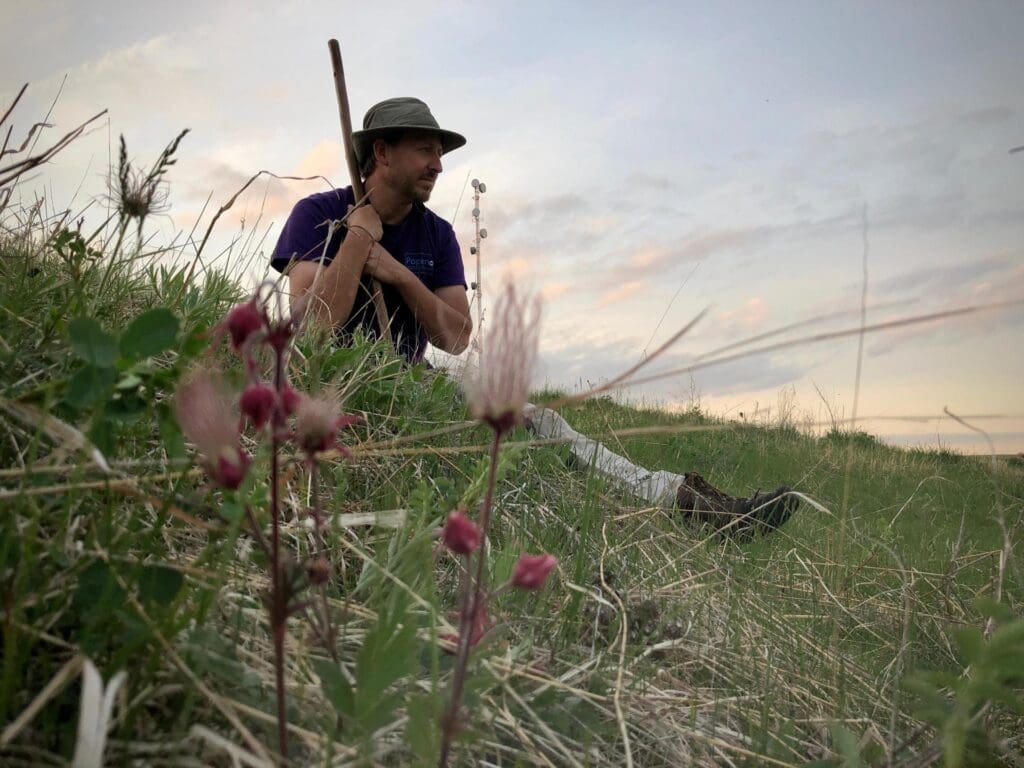
Lundgren’s work demonstrates how biodiversity fuels the resilience and productivity of agroecosystems, directly linking healthy wildlife populations to climate stability and rural vitality.
His remarkable story featured in What Your Food Ate reveals his courage and integrity as a scientist.
As a graduate student studying genetically modified Bt corn, he discovered that while lady beetles survived for ten days, they were all dead by day eleven. Bound by a nondisclosure agreement, he was barred from reporting the findings yet refused to stay silent. Later, at the USDA, he turned down a thinly veiled bribe to suppress research, choosing instead to publish his results.
Don’t miss this chance to hear Dr. Lundgren share how ecologically intensive farming can restore biodiversity, protect wildlife, and stabilize our climate.
Events and Community
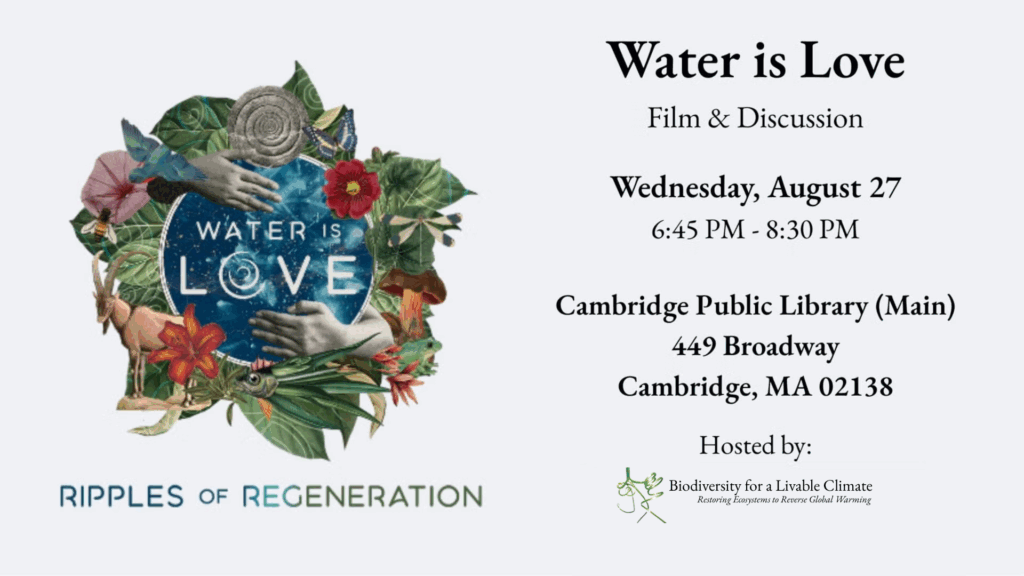
Water Is Love
Celebrate World Water Week with Bio4Climate in Cambridge, MA. Join us in person on Wednesday, August 27 from 6:45 to 8:30pm for a screening of the inspiring film, Water is Love, with brief discussion and snacks at the Cambridge Library Main Branch, 449 Broadway, Cambridge, MA 02138.
Water is Love follows a group of youth facing climate change challenges leading to a journey around the world with shared stories of regenerative practices such as ecosystem designs to create water retention in communities, villages, and regions.
The film weaves together traditional ecological knowledge, the role of water in shaping climate, and the urgency of restoring complete water cycles.
Protect Roadless Ecosystems
Bio4Climate joined 150 organizations to co-sign a letter urging Congress and the USDA to go above and beyond preserving the current Roadless Rule and instead enact strong, loophole-free, permanent protections for the nation’s inventoried roadless areas. The USDA announced on June 23, 2025 that the Roadless Rule would be rescinded.
Dear Members of Congress,
We, the undersigned public lands advocates, ask Congress to urge the U.S. Department of Agriculture to both immediately preserve the “Roadless Rule” (36 CFR, Part 294) and update the policy to enact permanent protection of these 58.2 million acres of priceless and irreplaceable ecosystems. A reformed Roadless Rule needs to end all forms of logging, grazing, mining, and drilling within Inventoried Roadless Area boundaries and close existing loopholes that allow logging and road-building…
News and Insights
International Law Now Demands Climate Action – Atmos
Ever since our GBH conversation with Ecocide International last year, we at Bio4Climate have been fascinated by global legal strategies and the rights of nature (if you can keep a secret, we’ve got a course coming up on this soon).
If you’ve been following along, you may know that Pacific Island nations have long been among the most powerful voices pushing for stronger international climate law. A new advisory ruling from the world’s highest court strengthens the case for reparative and protective interventions and gives advocates new legal ground to stand on.
A five-year quest by Pacific island countries to clarify states’ legal obligations to tackle climate change, triggered by an assignment given to 27 university students, has led to a landmark ruling delivered last week by the world’s highest court in The Hague.
The International Court of Justice ruled unanimously that failure to curb greenhouse gas emissions may be “internationally wrongful.” It said those responsible must stop polluting activities, and—where restoring infrastructure or ecosystems proves impossible—must compensate communities that suffered as a result. The decision also holds states accountable for companies under their jurisdiction which fuel the climate crisis.