
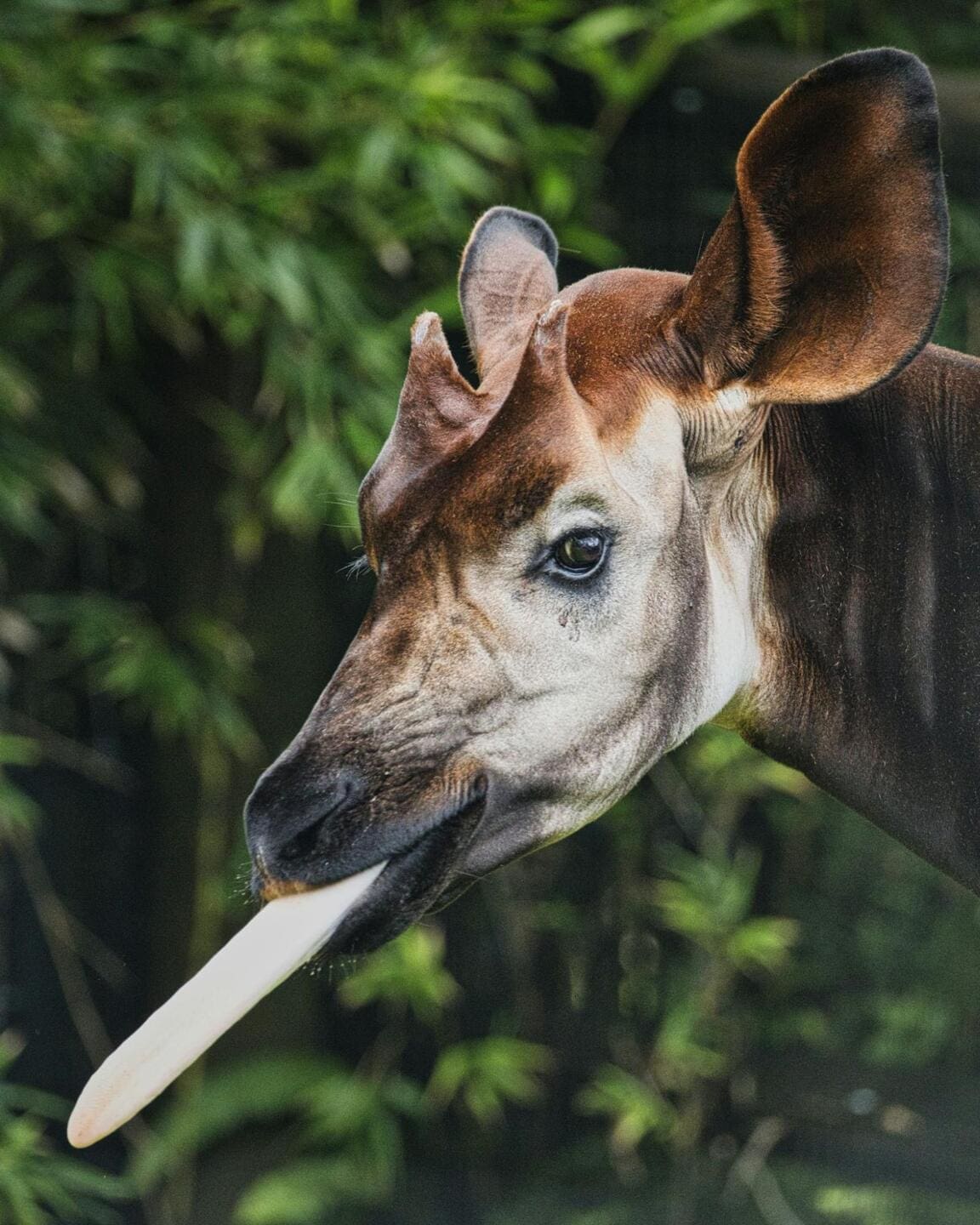
What animal was considered a cryptid for decades, has a foot-long black tongue, and looks like someone crossed a zebra with a giraffe?
The Okapi! (Okapia johnstoni)
When Bio4Climate intern Ellie Downey was three or four, her mom took her to a cryptozoology museum in Portland, Maine. She doesn’t remember much, but what does stick in her mind is the gift shop featuring items showing now-debunked creatures like the Bigfoot silhouette and the blurry Loch Ness monster image. Beside them, was a tiny figurine that looked half zebra, half giraffe that caught Ellie’s eye. She carried it around for the rest of the trip and called it by its name: Okapi. Why did people think the okapi was made up?
The okapi live in one of the strongest carbon-storing forests left on Earth, the Ituri rainforest in the Democratic Republic of the Congo, under a canopy so thick that sunlight barely reaches the ground. When you look at the okapi, it’s hard not to see the resemblance to its giraffe cousin. While the okapi and giraffe share some traits as they are both members of the family Giraffidae, the okapi evolved its own set of adaptations to survive in one of the densest, darkest forests on the planet. One of the most distinctive is its tongue.
Why Does the Okapi Have Such a Long Tongue?
The okapi’s prehensile tongue is dark, purplish-black, and runs about a foot long, long enough to clean its eyes, ears, and nostrils. Okapis are browsers, stripping leaves, buds, and shoots off branches rather than grazing on grass. Okapis wrap their tongues around foliage to pull into its mouth without relying on its teeth to do all the work. It helps them reach past thorns or into tight gaps in the tangled understory that its mouth alone couldn’t manage.
Scientists believe the tongue is dark-colored to protect it from sun damage. Because the tongue spends so much time extended outside the mouth while foraging, the dark coloring is thought to help protect it from sun damage.
Okapis browse across dozens of plant species, which helps keep the understory from being dominated by any one plant. Their feeding leaves “pruning lines” and trails through the vegetation that smaller animals use to get around. When they eat fruit, the seeds go with them and are dispersed in their droppings somewhere else in the forest, feeding the insects and fungi that keep the forest’s nutrient cycle running.
Okapis are sensitive to disturbance, which makes them perfect indicator species. A healthy okapi population is a good sign the surrounding forest is healthy too. When okapis start to disappear from an area, it’s often an early warning that something’s wrong.
How Much Forest Does a Single Okapi Cover?
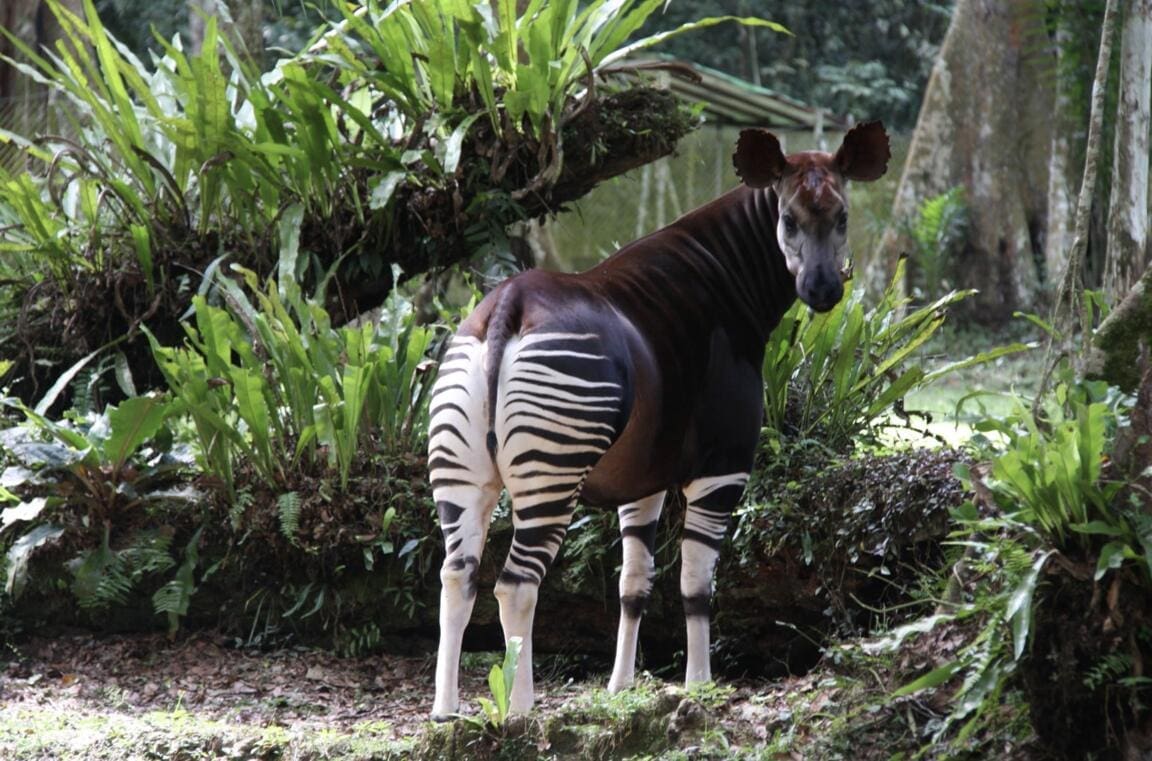
Okapis are solitary and have large individual territories. Their feeding and seed dispersal is spread across wide stretches of the Ituri. Males space themselves out to defend their own territory, and young males usually roam farther from home than females. This means that a healthy okapi population supports a lot of land.
Unfortunately, the okapi is on the IUCN’s endangered list. The wild population is currently estimated at about 5,000–10,000, down from 40,000+ a few decades ago. Their numbers continue to trend down.
Artisanal mining is the single biggest threat to the okapi. A 2025 study attributed about 98 percent of the population loss since 2009 to small-scale mining operations that destroy habitat directly and bring roads, camps, and bushmeat hunting. Armed conflict in the region makes things even worse.
Fewer okapi means less browsing that keeps the understory balanced, less seed dispersal in new areas of forest, and less pruning of the lines and trails that keep the ecosystem cycling.
Okapi and the Larger Carbon Picture
Scientists are beginning to study the link between large plant-eating animals like the okapi and forest carbon storage. When big seed-dispersing animals get hunted out of a forest, some tree species, especially dense, slow-growing ones that store the most carbon, struggle to regenerate without something to carry their seeds away. Field studies have found this shrinks a forest’s carbon storage by about 2–12%, depending on the forest.
The okapi’s influence hasn’t been specifically studied yet, but it’s likely they play a similar role in the Ituri region. The Ituri is the world’s second-largest rainforest after the Amazon, and it’s one of the biggest carbon reservoirs. Researchers estimate that the Ituri has about 50 billion tons of carbon above ground, and even more in the soil underneath.
Sadly, the Ituri’s carbon sink is under heavy strain. In 2020, a study that tracked hundreds of forest plots across Africa found the Congo Basin carbon sink has been weakening for years and could flip into a net carbon source as soon as the mid-2030s if destructive factors like deforestation and climate stress continue unabated. A more recent study found that African tropical forests as a whole may have already crossed the line. Right now, the Congo Basin is still absorbing more carbon than it releases, but there’s no guarantee that will continue.
All Hope Is Not Lost
The good news is that there’s still a path forward for both the okapi and its habitat. Okapis carry high genetic diversity, which means the species has the ability to bring its numbers back if given the chance.
In late 2025, CITES, the Convention on International Trade in Endangered Species of Wild Flora and Fauna, voted to ban all international commercial trade in okapis. This doesn’t solve the mining risks, but it does eliminate one challenge.
The Okapi Wildlife Reserve, a UNESCO World Heritage Site that covers part of the Ituri, provides a safe home to more than 40% of the world’s remaining okapis. Groups like the Okapi Conservation Project, the Wildlife Conservation Society, and the Congolese Institute for Nature Conservation run anti-poaching patrols and community programs there, and often work directly with the Mbuti communities who have lived side-by-side with the okapi for generations.

Ellie Downey is a college student studying Literature and visual arts at Bennington College. She has worked primarily in the visual art sphere in the past, and is currently interning with a nearby city’s Public Arts and Culture department. In working with Biodiversity for a Liveable Climate writing Featured Creature articles, Ellie endeavours to combine her lifelong love of animals with her interest in writing.
Sources
- Britannica: Okapi
- Britannica: Ituri Forest
- Animal Diversity Web: Okapia johnstoni
- Journal of Zoology (ZSL): Okapi Research
- IUCN Red List: Okapi
- African Journal of Ecology: Okapi Study
- Scientific Reports: Artisanal Mining and Okapi Population Loss
- PMC: Seed Dispersers and Forest Carbon Storage
- Current Biology: Congo Basin Carbon Sink
- PMC: African Tropical Forest Carbon Study
- Wildlife Conservation Society: Okapi News Release
- Wikipedia: Okapi Wildlife Reserve