
What bird is the tallest in North America, is named for the calls it emits, and has small white airplanes to thank for its comeback from near extinction?
The whooping crane (Grus americana)
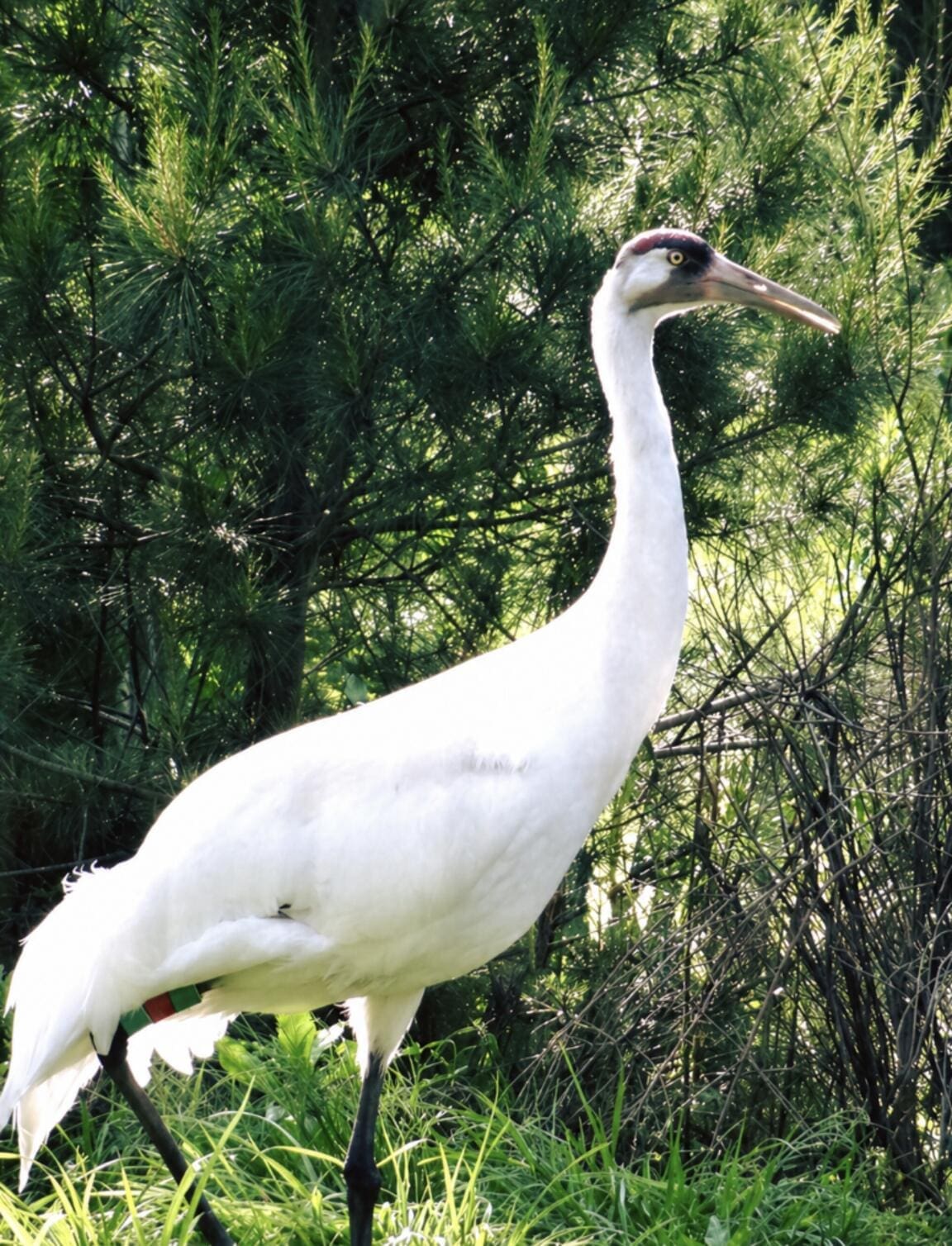
My formal introduction to the whooping crane came in 2016, when I interned at the Stone Zoo in Stoneham MA. My project was to behaviorally condition the zoo’s whooping crane to step onto a scaled platform so I could record his weight. It was a multi-week process of getting him used to my presence and then to the scale itself during feeding time. It involved plenty of trial and error, waiting, hisses, and a few bloody bites from the weary crane. In the end, he grew comfortable feeding near the platform but never stood on it long enough for me to get a reading.
As a consolation prize, I nicknamed him “Alec,” since he was a real smart aleck. The name stuck, apparently; years later, the zoo posted a video of a newly acquired female crane named Sunflower sharing the enclosure with the resident male, still known as Alec.
Tall, Smart, and Mighty!
One of only two crane species native to North America, the whooping crane is named for the loud “whooping” call it emits. It’s the tallest bird in North America standing anywhere from 49–62 inches (1.24 to 1.6 m) in height. Its typical wingspan ranges from 79–91 inches (2 to 2.3 m). It’s the fifth largest crane species on Earth and among the heaviest as well. In the wild, these big birds can live between 22 and 30 years. Conservationists consider whooping cranes an indicator species based on their need for large, undisturbed, high-quality wetlands. If whooping cranes are thriving, the wetland itself is generally thriving too, along with the many other species that share it.
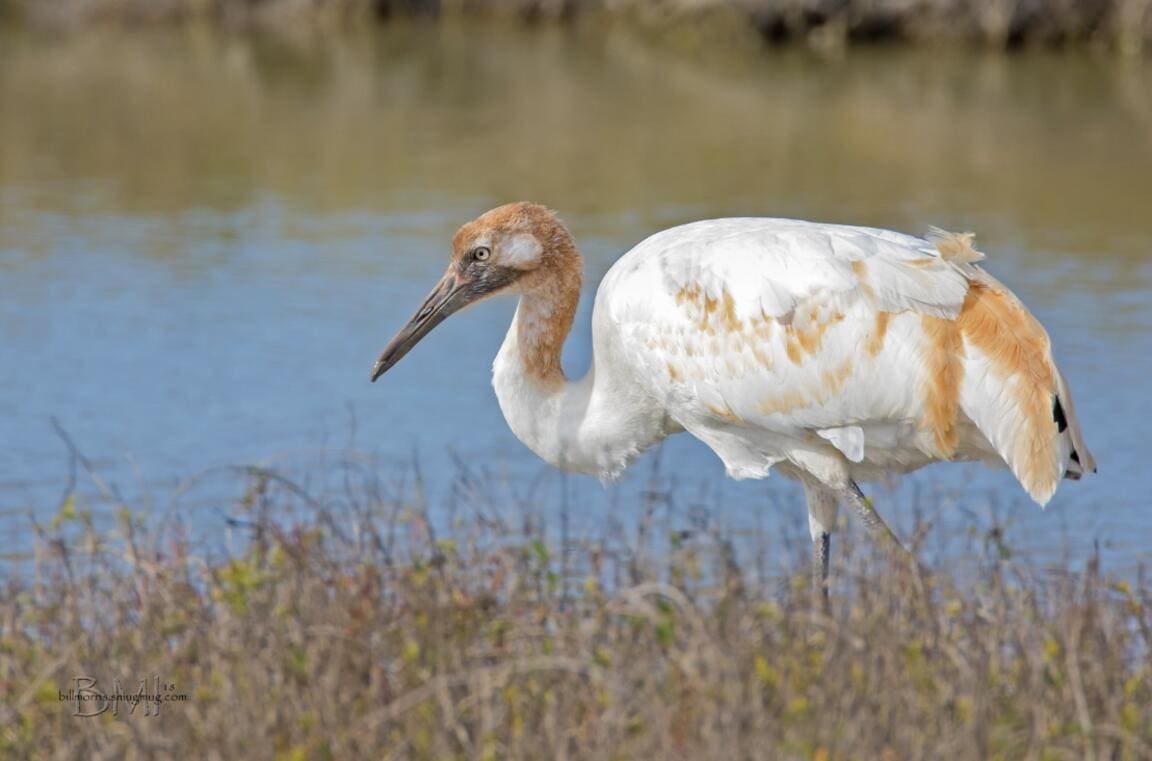
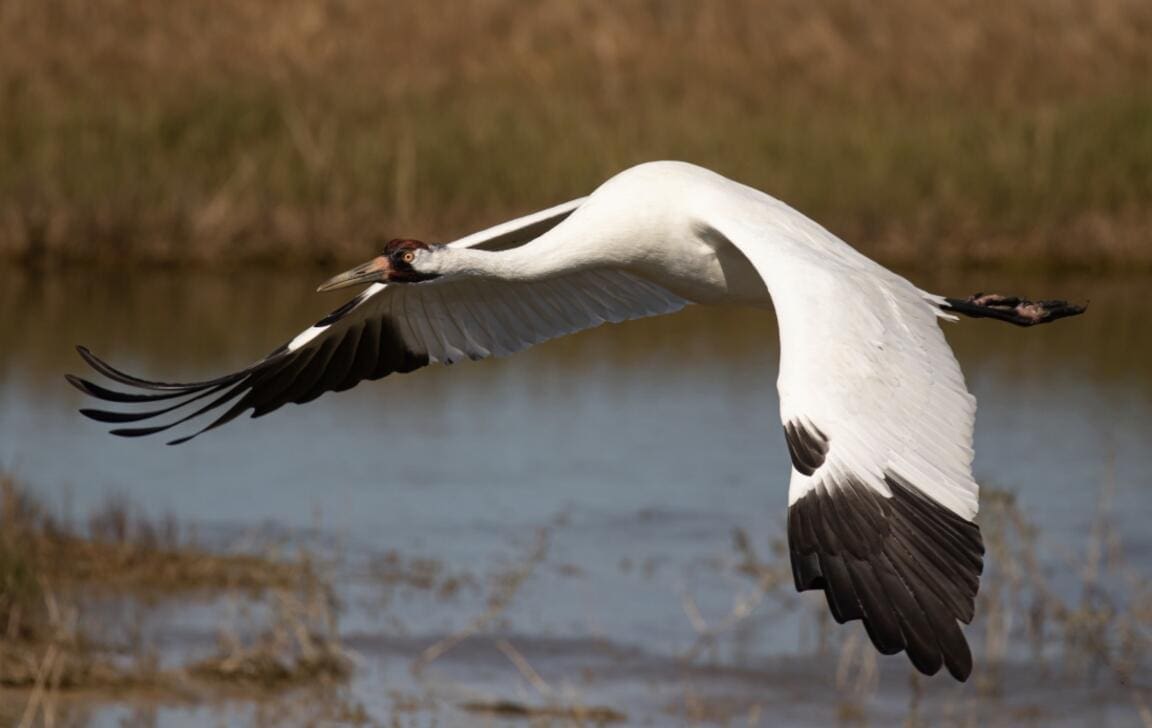
Adult whooping cranes are white with a red crown and a long, dark, pointed bill that measures, at most, close to 6.5 inches (17 cm). Immature whooping cranes are cinnamon brown, becoming whiter as they age and mature. In flight, the crane’s long neck stays straight and its long dark legs trail behind rather than tucking in. The black wing tips of adults are also visible during flight.
Whooping cranes are intelligent, consistently alert and definitely not shy. They defend their territories strongly, especially during breeding season, and use a range of displays that include hissing, wing-thrashing, biting, and jumping in order to rake the perceived enemy with their sharp talons. This behavior from the tallest bird in North America makes an angry whooping crane quite an intimidating opponent. I can confirm all of this first-hand, as I had to defend myself with a rake from any potential hits after being attacked the first time.
Of Marshes, Mates, and Migrations
Today, there are two migratory and one nonmigratory populations of whooping cranes, but it wasn’t always this way. By 1941, hunting and habitat loss had reduced the species to a single flock of just 15 birds, migrating between Wood Buffalo National Park and Aransas National Wildlife Refuge. That original flock is still the largest today, and is the only naturally occurring migratory population. It winters in Aransas National Wildlife Refuge in Texas and breeds in Wood Buffalo National Park, the largest National Park in Canada, bordering northeastern Alberta and the Northwest Territories. The other two populations exist because of decades of reintroduction work. One of these migratory flocks was established using small planes to teach young cranes a new route from Wisconsin to Florida. It now winters at the Chassahowitzka National Wildlife Refuge in Florida and breeds at the Necedah National Wildlife Refuge in Wisconsin. A nonmigratory flock, also formed through reintroduction, lives year-round near Kissimmee, Florida.
Whooping cranes depend on wetlands, marshes, mudflats, wet prairies and fields for food, shelter, and safe breeding grounds. Breeding happens in prairie wetlands alongside the shallow lakes, ponds, and marshes that offer plenty of vegetation. Cranes choose their breeding habitats based on safety from predators. The wetlands give them the ability to visually scan their surroundings and detect potential threats, and food availability. During their 2,500-mile (4,000 km) migration, whooping cranes seek out wetlands and agricultural fields. They prefer brackish bays and coastal marshes for wintering.
Whooping cranes are diurnal and roost on the ground at night. They are also omnivores, with a diet that depends upon available food in the region. As one of the largest predators hunting in wetland habitats, their feeding helps keep prey populations like crabs, insects, and small vertebrates in check while cycling nutrients back through the ecosystem. Staples of their diet include blue crabs and wolfberries, also known as goji berries. In their Texas wintering grounds, cranes feed on crustaceans, mollusks, grasshoppers, fish, small reptiles, mice, voles, aquatic plants, acorns, and berries. In the summer, they feed on frogs, snakes, small rodents and birds, fish, aquatic insects, crayfish, clams, snails, aquatic tubers, and berries. During their seasonal migration, they feed on waste grain, including barley, corn, and wheat. Unlike the sandhill crane (the other crane species native to North America), whooping cranes digest grains less efficiently, and don’t use gizzard stones, stones swallowed to help grind down foodstuffs to aid in digestion.
Partners, Parents, and Predators
Whooping cranes live primarily in breeding pairs or small family groups, and walk or fly to cover territory. Newly paired cranes often locate their first territory near that of their parents, and learn migration routes and behaviors from their parents as well.
Whooping cranes form monogamous pair bonds around age two or three, typically while still in their winter feeding grounds. Courtship involves elaborate displays, dancing, wing flapping, bowing, tossing tufts of grass into the air, and trumpeting “whooping” calls. Pairs begin nesting around age four, building a mound of vegetation surrounded by water. The female typically lays two eggs in April or May, which hatch after about a month, though usually only one chick survives. Both parents raise the offspring, who becomes independent at around nine months and reaches adulthood at age four.
Whooping cranes defend against predators like the black bear, lynx, raven, coyote, eagle, fox, wolverine, and wolf using their keen eyesight across their open, water-filled habitat, calls to intimidate threatening species and, when needed, fight back. Their water habitat works as a defense system, but warming conditions risk drying out the nesting marshes as soon as 2050. This would make it easier for predators to access crane eggs and chicks, threatening the survival of the species.
A Comeback Story on the Wing
The whooping crane is currently listed as Endangered on the International Union for the Conservation of Nature (IUCN) Red List. Its recovery from near-extinction has been slow but steady. Conservationists worked with local, federal, and international governments to protect the surviving flock, restore and manage wetland habitats, and encourage captive breeding. In 1970, there were 57 cranes, and that increased to 214 by 2005.
Much of the crane habitat at Aransas National Wildlife Refuge is unoccupied, waiting for the population to grow and expand in that area. Unfortunately, developers are trying to obtain the land to build housing. Oil spills and river inflows to Aransas are also a risk, as is reduced water flows in the central Platte River Valley, Nebraska, a key stopover site for migrating cranes. Illegal shooting is also an increasing threat, with 27 confirmed shooting mortalities between 1967 and 2016.
Conservationists are working to protect and enhance the cranes’ wetland stopover sites, reduce powerline collisions, factor stopover sites into development planning for projects like wind farms, especially in Texas, continue raising cranes for reintroduction, and build further self-sustaining populations. With help from innovative scientists, such as those from the International Crane Foundation, the slow recovery of the whooping crane seems poised to continue.

Sienna Weinstein is a wildlife photographer, zoologist, and lifelong advocate for the conservation of wildlife across the globe. She earned her B.S. in Zoology from the University of Vermont, followed by a M.S. degree in Environmental Studies with a concentration in Conservation Biology from Antioch University New England. While earning her Bachelor’s degree, Sienna participated in a study abroad program in South Africa and Eswatini (formerly Swaziland), taking part in fieldwork involving species abundance and diversity in the southern African ecosystem. She is also an official member of the Upsilon Tau chapter of the Beta Beta Beta National Biological Honor Society.
Deciding at the end of her academic career that she wanted to grow her natural creativity and hobby of photography into something more, Sienna dedicated herself to the field of wildlife conservation communication as a means to promote the conservation of wildlife. Her photography has been credited by organizations including The Nature Conservancy, Zoo New England, and the Smithsonian’s National Zoo and Conservation Biology Institute. She was also an invited reviewer of an elephant ethology lesson plan for Picture Perfect STEM Lessons (May 2017) by NSTA Press. Along with writing for Bio4Climate, she is also a volunteer writer for the New England Primate Conservancy. In her free time, she enjoys playing video games, watching wildlife documentaries, photographing nature and wildlife, and posting her work on her LinkedIn profile. She hopes to create a more professional portfolio in the near future.
Sources
- Audubon Field Guide: Whooping Crane
- Audubon Nature Institute: Whooping Cranes
- Wikipedia: Whooping Crane
- IUCN Red List: Whooping Crane
- Smithsonian’s National Zoo: Whooping Crane
- National Wildlife Federation: Whooping Crane