What animal can outrun an Olympic sprinter, cares only for its own young despite living in communal dens, and looks like a cross between a rabbit and an antelope?
The Patagonian mara! (Dolichotis patagonum)
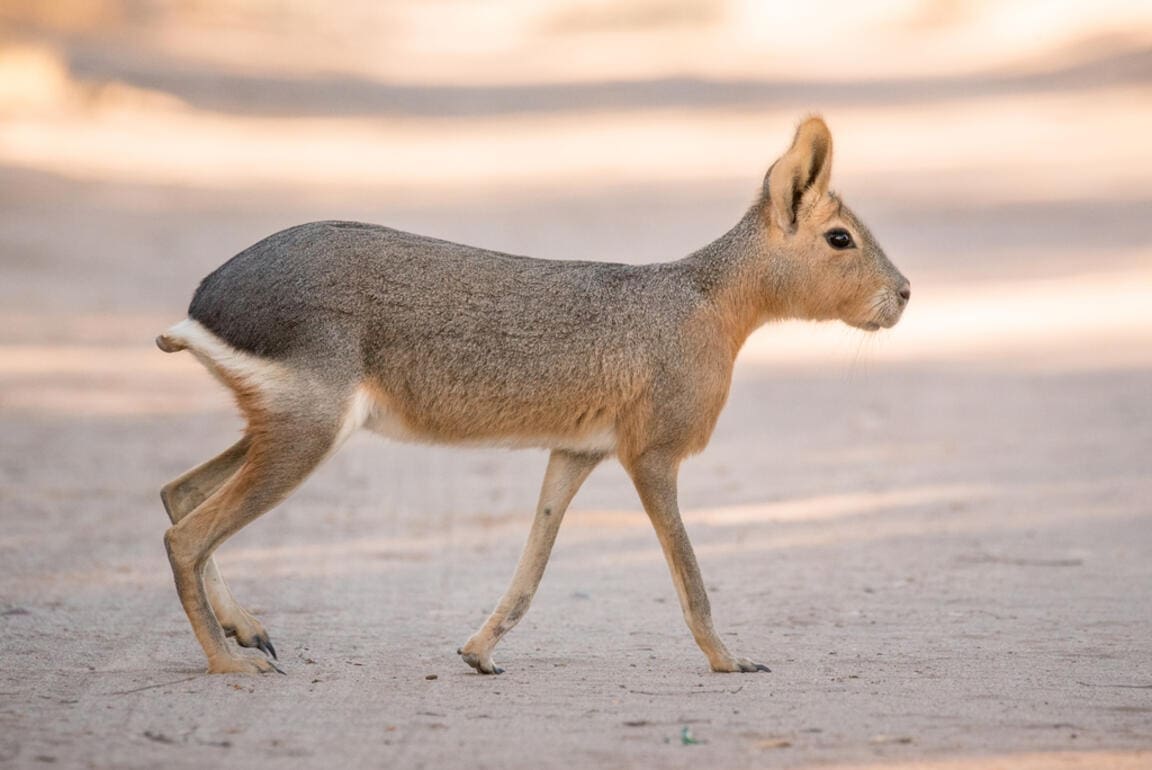
One of my favorite internships was doing photography and videography at the Smithsonian’s National Zoo in Washington, D.C. during the summer of 2018. I took tons of photos and recorded some videos of the zoo’s animals to use for social media posts and promotional e-mails for the Friends of the National Zoo (FONZ). One day, I found a species that piqued my curiosity: rabbit-like animals with long legs, compressed feet, and a short, hairless tail. I had never heard of maras before, and, eager to learn more, I took a collection of photographs of these easygoing mammals.
Looks Like a Rabbit, Runs Like an Antelope
The Patagonian mara is found in central and southern Argentina, ranging approximately from 28°–50°S latitude. They typically inhabit areas with plenty of shrub cover, such as scrublands and grasslands with a good deal of open space. They have also been found in areas of overgrazed and barren soils within the biome of the Monte Desert, forests in the species’ furthest reaches in northwestern Argentina, and in the sandy, low-shrub habitat within the Valdes Peninsula of southeastern Argentina.
Adapted for a life of running along open plains and steppes, Patagonian maras have long legs, reduced clavicles, and well-developed sensory organs, all of which make them capable of running and communicating across these vast, open habitats. They have smaller collarbones that increase their flexibility and stride lengths, making them efficient and fast runners. Mara are the fastest rodents on the planet, reaching speeds up to 45 miles per hour (72 km/hr).
The Need for Speed? Efficiency and Survival
The Patagonian mara is primarily diurnal, or most active during daylight hours, especially in the cooler hours of the mornings and late afternoon. They will spend nearly half of the day feeding on green vegetation and fruit. Patagonian maras’ daily rhythms shift and relate to environmental conditions such as precipitation, light, relative humidity, and temperature to balance energy use, water loss, and risk of predation in their dry, open habitats. Mara become especially active after periods of rain, as precipitation promotes fresh vegetation and lowers the temperature of the area.
The risk of predation is 24/7, but daytime activities increase their survivability. Mara possess keen vision during the day but not at night. They are hunted by cougars, culpeo foxes, birds of prey, Geoffroy’s cats, and lesser grisons (a type of mustelid). Mara predators are fast, but the mara is faster.
Communication and Breeding: A Complex, Communal Affair
The social organization of the Patagonian mara is a unique combination of monogamy (one male-one female breeding pairs) and communal breeding. Mated pairs breed together either on their own or alongside other pairs in warrens shared by up to 29 breeding pairs. Maras breed, at least in southern Argentina, from August to January, with most births occurring in September and October after a gestation period of 100 days. The birthing period comes before the summer dry season and after the plentiful rains of winter, ensuring there is plenty of green growth to feed upon when the next generation arrives.
Communal living provides protection from predators, with larger groups having higher infant survival rates compared to smaller groups or single pairs. Litters from one to up to 29 pairs are grouped together, and breeding pairs visit the den in cycles as other parents circle the den. Females don’t typically cooperate in raising young, although some pups may try to steal milk from a nursing mother other than their own. Young mara remain near the den for the first three weeks of life, grooming one another, playing, and huddling.
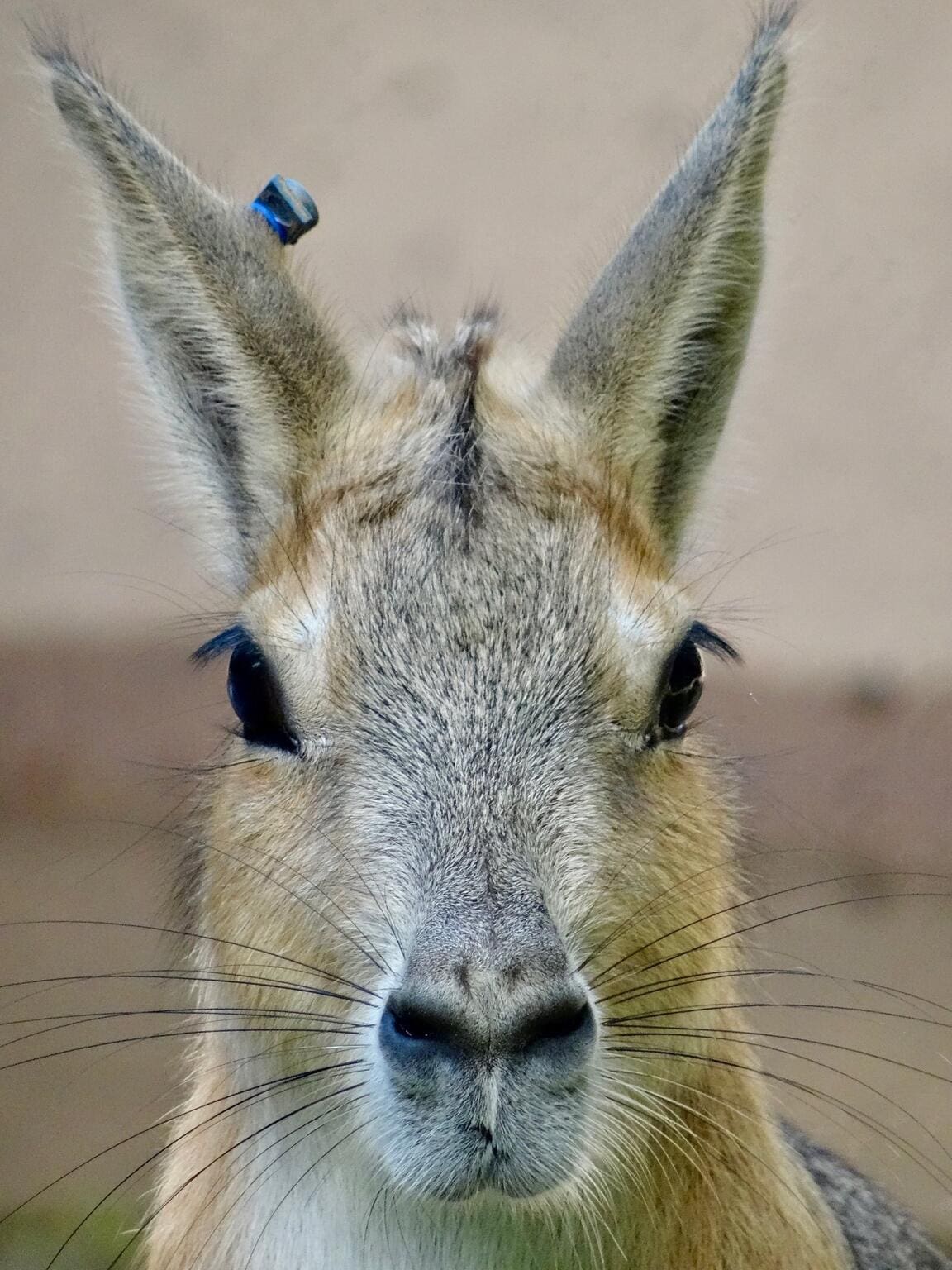
Mara communication is complex and varied. While grazing or slowly moving about, maras make numerous vocalizations. If a mara is seeking contact, s/he emits an inflected “wheet”. When following another individual, a mara will make a low, repetitive grunt. When feeling threatened, maras will again emit low grunts, but also chatter their teeth. Even grooming is a noisy affair, with a series of short grunts being emitted. Scent marking is used by maras for complex and intense social interactions, especially during the breeding season. These involve spraying urine on one another, and rubbing the anogenital region on the ground.
A Race Against Change and Extinction
Mara contribute to healthy vegetation by distributing seeds across their grazing areas in their droppings, cycling a steady recolonization of native plants. Concentrated urine and feces near their burrows also return nutrients to the soil in a landscape where organic input is scarce. Patagonian maras also face competition from large, non-indigenous introduced mammals, such as European hares and sheep. Unfortunately, overgrazing by sheep has put Patagonian steppes at risk, with roughly one third of the land now converted to desert-like conditions. Sheep graze to bare ground, and researchers estimate that more than 90% of Patagonian soil has some degree of degradation.
The Patagonian mara is listed as Near Threatened on the International Union for the Conservation of Nature (IUCN) Red List, and Vulnerable in the Red Book of Mammals of Argentina. Historically, they ranged from north-central Argentina south almost to Tierra del Fuego. Localized extinctions, such as in Buenos Aires Province, have occurred due to hunting for their skins that are sold in local and international markets, as well as habitat destruction.
Luckily, the Patagonian mara can be found in at least 12 protected Argentinian national parks and reserves, including Patagonia National Park, which secure critical grassland and shrubland habitat. Conservationists, such as the Tompkins Conservation team, closely monitor mara dens to study their breeding, behavior, and habitat needs. This is particularly the case in regions like Patagonia Azul, a conservation initiative which spans over 124 miles (200 km) of coastal habitat. Hopefully, such actions combined with those to mitigate human pressures and competition from introduced mammalian species will help the Patagonian mara withstand the looming threat of endangerment and extinction.

Sienna Weinstein is a wildlife photographer, zoologist, and lifelong advocate for the conservation of wildlife across the globe. She earned her B.S. in Zoology from the University of Vermont, followed by a M.S. degree in Environmental Studies with a concentration in Conservation Biology from Antioch University New England. While earning her Bachelor’s degree, Sienna participated in a study abroad program in South Africa and Eswatini (formerly Swaziland), taking part in fieldwork involving species abundance and diversity in the southern African ecosystem. She is also an official member of the Upsilon Tau chapter of the Beta Beta Beta National Biological Honor Society.
Deciding at the end of her academic career that she wanted to grow her natural creativity and hobby of photography into something more, Sienna dedicated herself to the field of wildlife conservation communication as a means to promote the conservation of wildlife. Her photography has been credited by organizations including The Nature Conservancy, Zoo New England, and the Smithsonian’s National Zoo and Conservation Biology Institute. She was also an invited reviewer of an elephant ethology lesson plan for Picture Perfect STEM Lessons (May 2017) by NSTA Press. Along with writing for Bio4Climate, she is also a volunteer writer for the New England Primate Conservancy. In her free time, she enjoys playing video games, watching wildlife documentaries, photographing nature and wildlife, and posting her work on her LinkedIn profile. She hopes to create a more professional portfolio in the near future.
Sources
- De Gruyter: Dolichotis patagonum – Mammalia (1997)
- Discover Wildlife: The Fastest Rodent – Patagonian Mara
- Wikipedia: Patagonian Mara
- IUCN: Patagonian Steppe
- Tompkins Conservation: Meet the Patagonian Mara (video)
- IUCN Red List: Patagonian Mara
- Smithsonian’s National Zoo: Patagonian Mara
- Oxford University Research Archive: Patagonian Mara Thesis (PDF)
- CONICET Digital: Patagonian Mara Behavioral Research (PDF)
- Tompkins Conservation: Patagonia Azul
- Zoo Atlanta: Patagonian Mara