

What plant floats its seeds to new grounds, can bear fruit for 300 years and has been feeding people for at least 5,000 years?
The Pecan! (Carya illinoinensis)
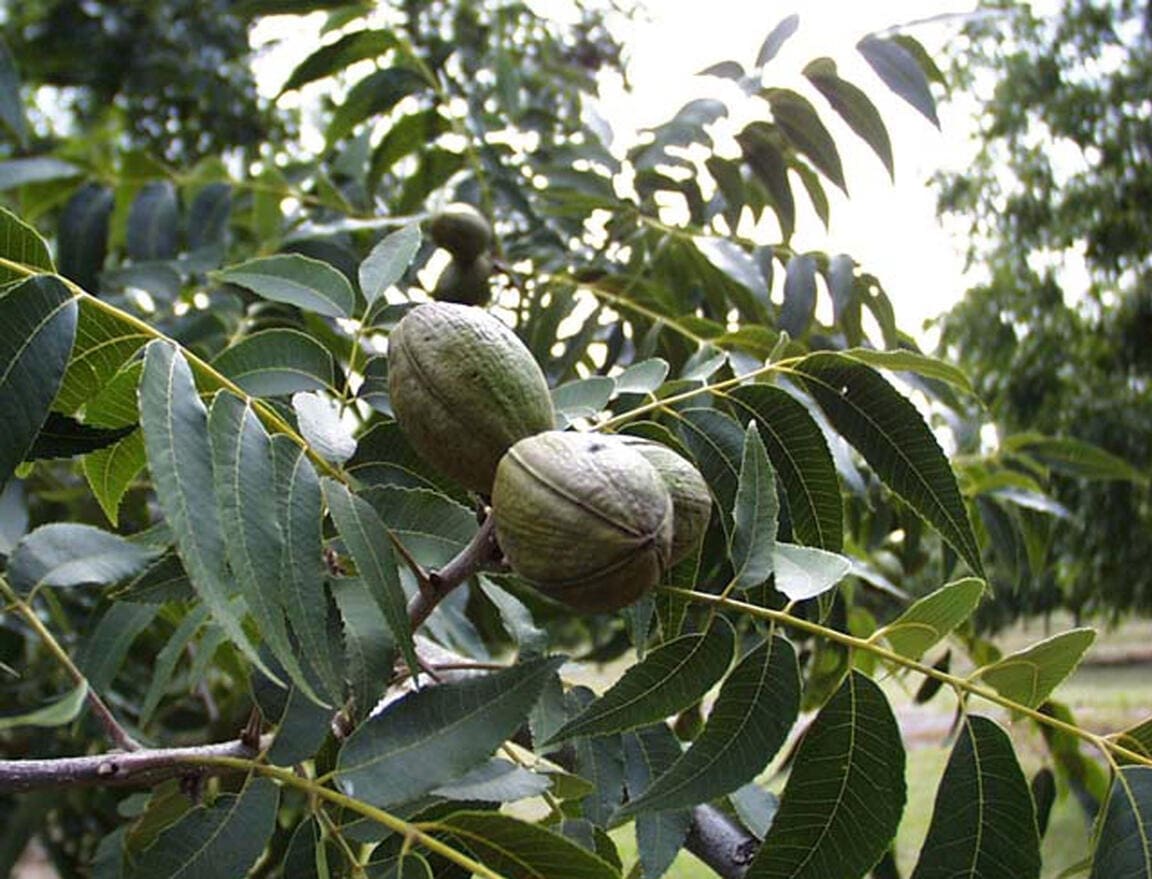
My mother grew up in North Carolina with a pecan tree in her backyard. She and her sister loved to gather fresh pecans and crack them open for a snack. I never saw that tree, but when I was growing up, we always had a bag of fresh nuts in their shells at Thanksgiving. We’d sit around with family and friends, picking out the nutmeat as we talked. It was just part of the holiday.
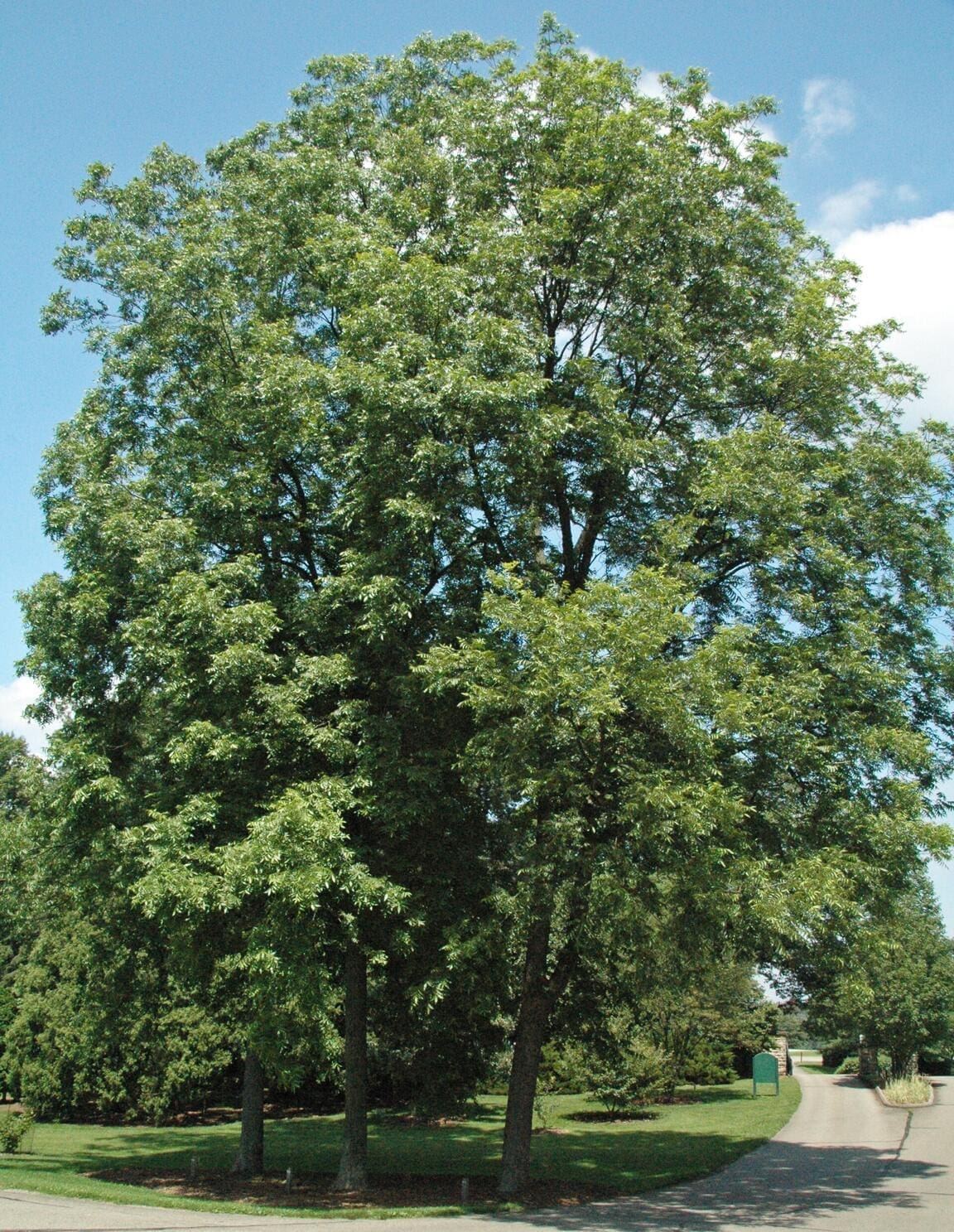
These days I live near Mount Vernon, where a pecan tree once stood about 145 feet tall beside George Washington’s home until it had to be removed in 2014. Though that tree was planted around 1860, Washington had planted pecans on the estate much earlier. On March 11, 1775, he wrote in his diary that he planted “25 Mississippi Nuts” comparing them to pignuts, another kind of hickory nut, and noting that the pecans had thinner shells and more meat. But that was not even the biggest pecan tree in the US.
Even larger than the one at Mount Vernon, in Assumption Parish, Louisiana, the 1945 national big-tree register recorded a pecan about the same height as the one at Mount Vernon but with a trunk nearly seven feet across. Some pecan trees have been reported to bear nuts when they are about 300 years old.

From Flower to Fall Harvest
The name “pecan” comes to us through French interpretations of an Algonquian word for a nut. Related words in Algonquian languages can also refer to other nuts, including walnuts. There is still no official pronunciation, with some saying PEE-can and others Puh-KAHN. In Bio4Climate staff meetings we hear both versions!
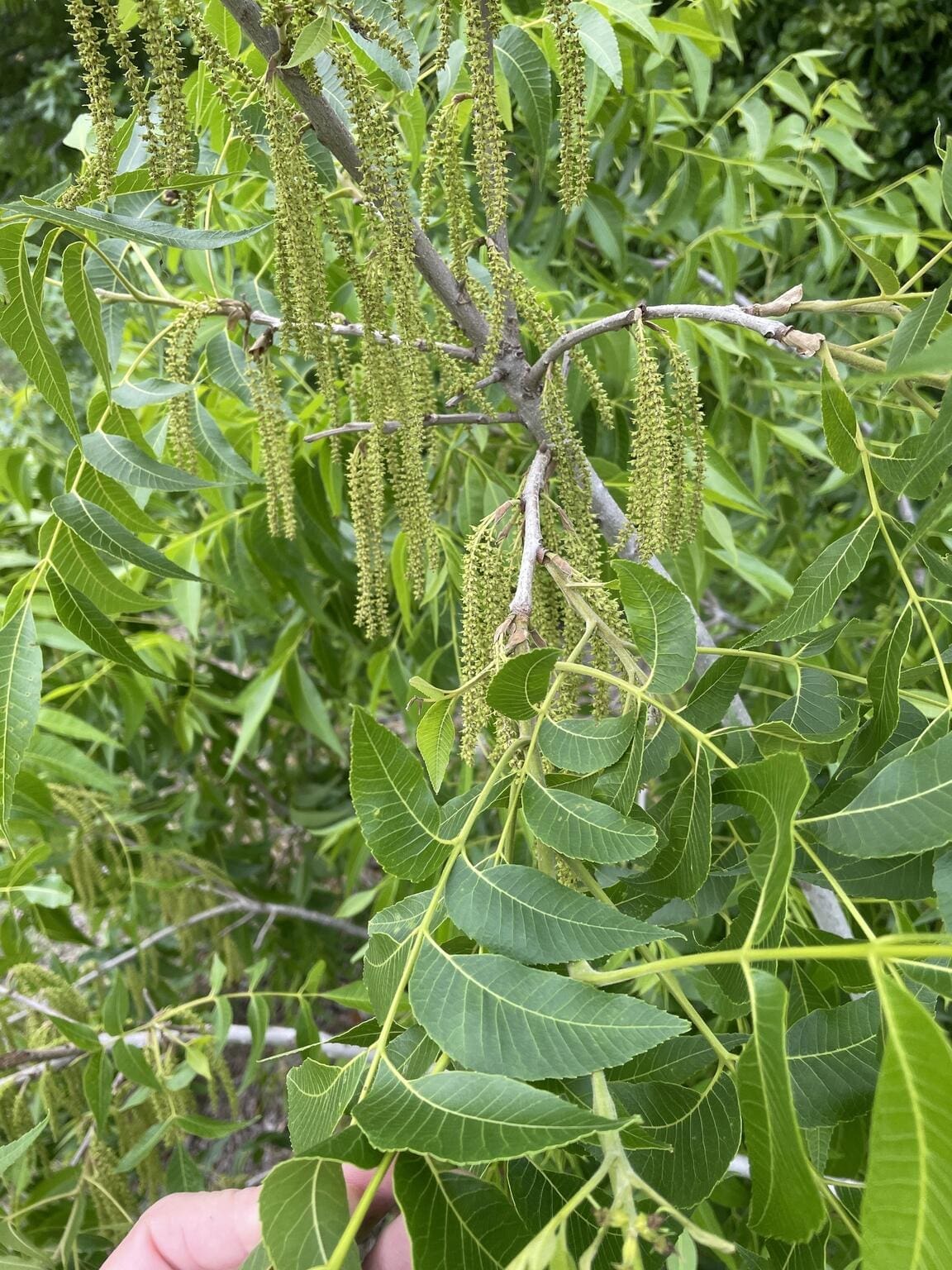
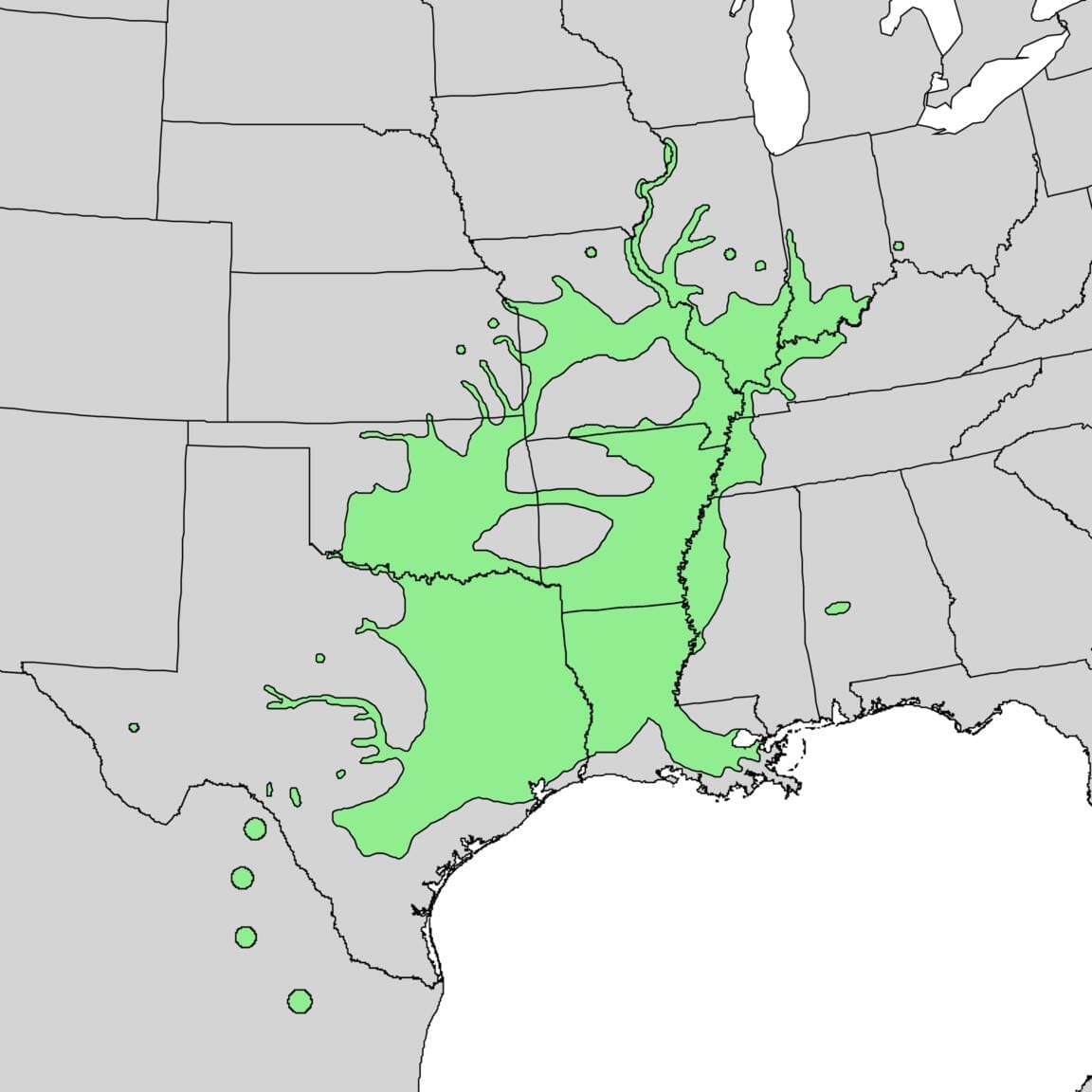
The pecan (Carya illinoinensis) is a hickory native to parts of the central and southern United States and Mexico. In spring, pollen drifts from long, dangling clusters of male flowers to tiny female flowers. Both grow on the same tree, though they often mature at different times. A nearby pecan shedding pollen at the right moment can make a difference to the fall harvest.
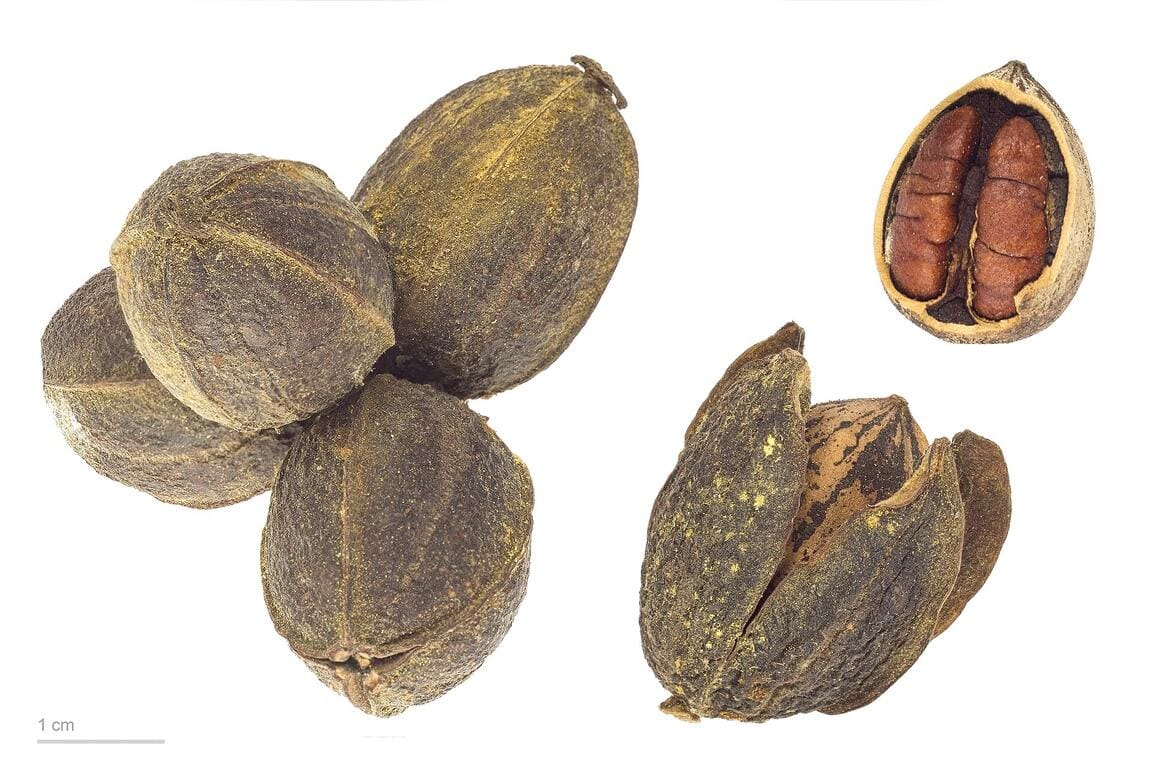
As the fruit grows, the shell hardens around the developing seed. The husk around it is a brassy green, a color also called aeneous. By fall the husk has turned brown. It splits into four sections and releases the pecan, still in its shell. The piece we pick out and eat is the seed. Botanists call the whole fruit a tryma, a type of fruit with a husk around a hard shell.
Wild pecans grown from seed can vary a great deal in the quality and amount of nuts. To grow a variety with qualities they want, such as a thinner shell, orchard growers graft a bud or shoot from a tree of that variety onto a seedling. A pecan growing in the wild can take up to 20 years to bear its first nuts.
Once a pecan tree begins bearing, its harvest can swing dramatically from year to year—a boom-and-bust pattern known as mast fruiting. A heavy crop that leaves more nuts than you can gather may be followed the next year by a sparse harvest, with the U.S. Forest Service noting intervals of roughly one to three years between good crops.
In her essay “Council of the Pecans,” botanist and Indigenous writer Robin Wall Kimmerer explores how pecans coordinate these massive synchronized harvests—and what that shared abundance means for survival. As Kimmerer explains, a tree produces so many nuts in a mast year that it overwhelms seed-eating animals like squirrels and weevils, allowing enough nuts to escape and sprout rather than get eaten all at once. She also points to underground mycorrhizal fungal networks that can link tree roots together and redistribute carbohydrates and resources across individuals, raising the question of how deeply subterranean fungal and microbial webs help trees share signals and synchronize life across a grove.

Once the outer shuck splits, a pecan can travel by land or water. Squirrels cache nuts away from the parent tree, while floodwaters carry floating pecans far downstream—depositing them along fertile alluvial terraces. When a nut washes onto a well-drained rise above standing water, it finds the deep, moist, well-aerated soil where pecans thrive.

How Trees Fed People
Long before commercial orchards, pecans were a staple wild harvest across river valleys and plains. At Baker Cave near the Rio Grande, archaeologists uncovered layers of pecan shells more than 5,000 years old. In what is now Texas, the Payaya gathered large harvests and buried them in caches for later use, while the Comanche ate pecans fresh and stored them for winter. Because pecan harvests swing from year to year, storing surplus harvests was essential. Indigenous trade networks also moved pecans well beyond local groves, and archaeological and paleobotanical evidence in the upper Mississippi Valley indicates people likely helped disperse the tree itself.
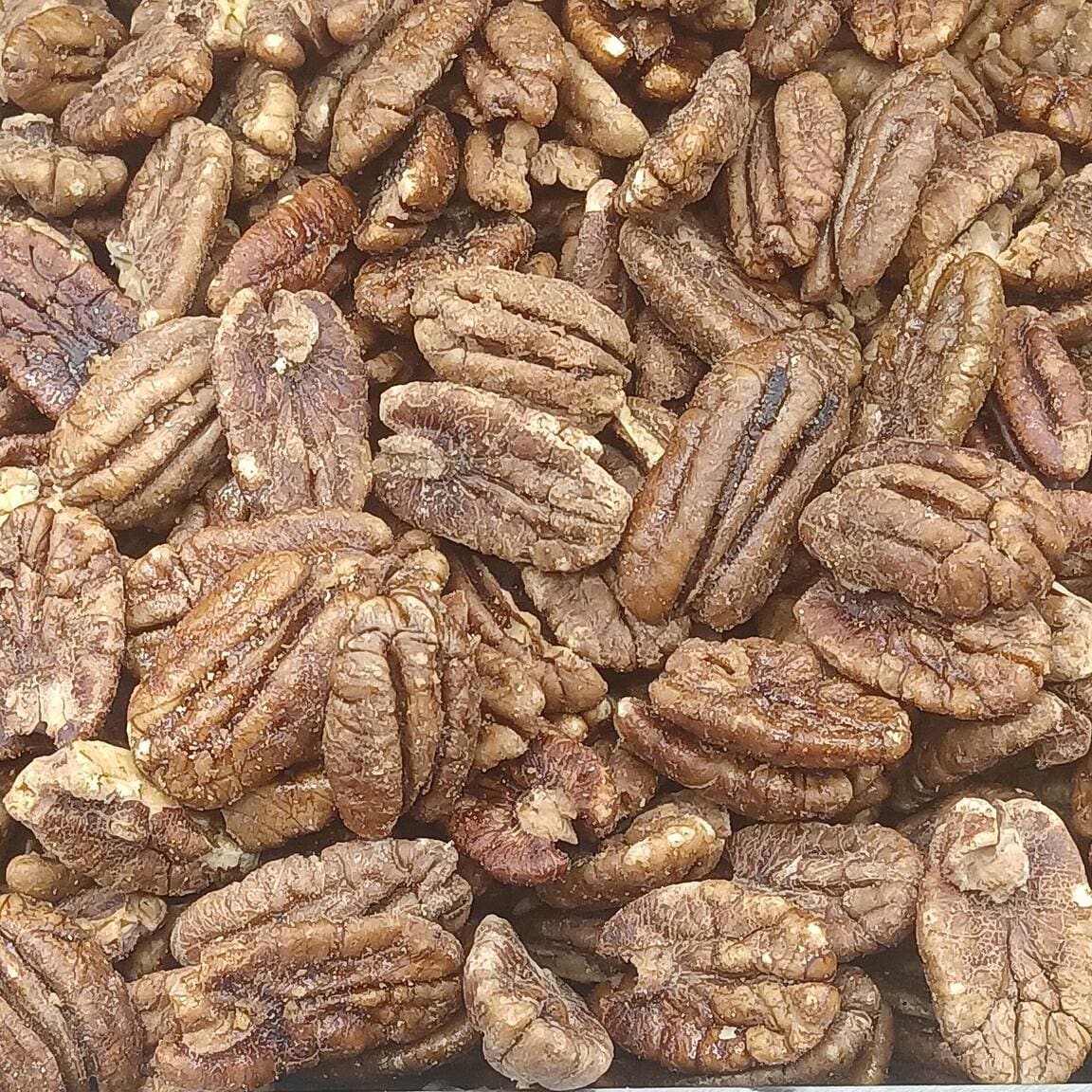

Here in Virginia, Indigenous cooks made a milky liquid from hickory nuts. They cracked the nuts between stones and pounded them in a wooden mortar. When they stirred in water, the pieces of shell sank to the bottom. The milky liquid was called pawcohiccora. I had no idea nutmilks were part of the Indigenous diet long before they became popular dairy substitutes.
In Feed Us with Trees, Elspeth Hay writes about a time when people could build whole meals around foods they gathered from trees. Oak savannahs were actually created by and managed by Indigenous peoples to harvest acorns. In a Bio4Climate discussion group we explored how this method of food production was nearly invisible to settlers, but fortunately we can learn from traditional practices to help us balance food production with the need to preserve our living climate systems.
Pecans as a Crop
The rich moist bottom land where pecans naturally grow has been disappearing as development in the US has increased. The need for rural electricity in 1937 led to the building of Buchanan Dam, whose lake flooded the town of Bluffton, Texas, and its pecan orchards. Timber and agriculture led to the clearing of 20 million acres of Lower Mississippi Alluvial Valley, another native habitat for pecans.
The pecan is now a crop in places far from its native rivers. Mexico and the United States grew 87 percent of the reported world crop in the 2023–24 season. South Africa ranked third. Most of its pecan exports went to China. In 2025, Georgia and New Mexico grew about two-thirds of the U.S. pecan crop. Texas came in third.
In the arid Southwest, pecan orchards require more irrigation water to maximize yield than almost any other regional crop, though growers apply that water efficiently, and pecans earn a high return for each unit of water compared with other crops. At a mature, flood-irrigated orchard in New Mexico’s Mesilla Valley, researchers tracked the orchard’s energy budget—measuring incoming solar radiation alongside heat moving into the air and soil—to calculate how much water returned to the atmosphere through evapotranspiration. Over a year, the orchard transpired nearly five feet of water across its footprint.
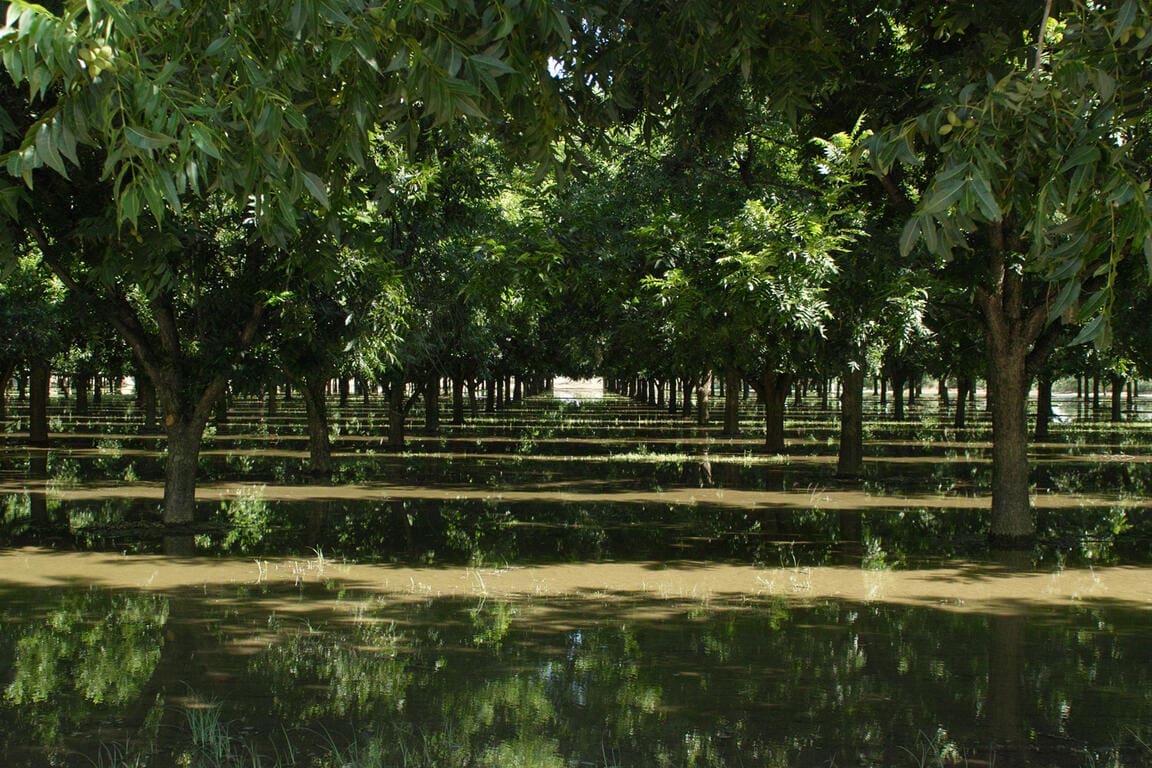

Because water is scarce, growers are increasingly turning to regenerative practices to keep more of that moisture in the ground while boosting biodiversity. In that same Mesilla Valley, one orchard stopped annual deep-tilling, planted diverse cover crops between the tree rows, and introduced grazing animals—resulting in higher nut quality within just a couple of years. A separate USDA-summarized study confirmed why this works: soil beneath pecan cover crops retains more moisture and supports richer microbial life than bare orchard floors. While orchard-wide water savings are still being quantified, similar principles are already proven further east in Oklahoma, where growers practice traditional agroforestry by harvesting nuts from native pecan groves while grazing cattle on the forage underneath.
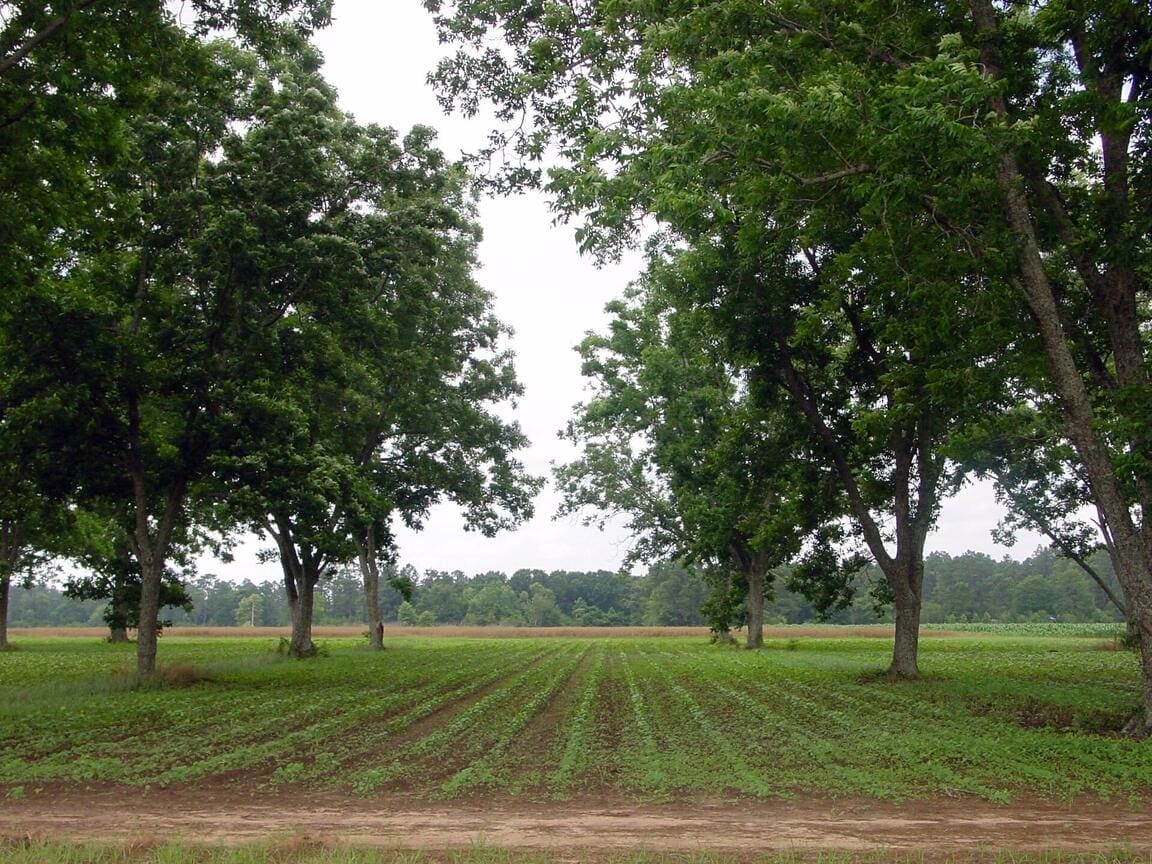

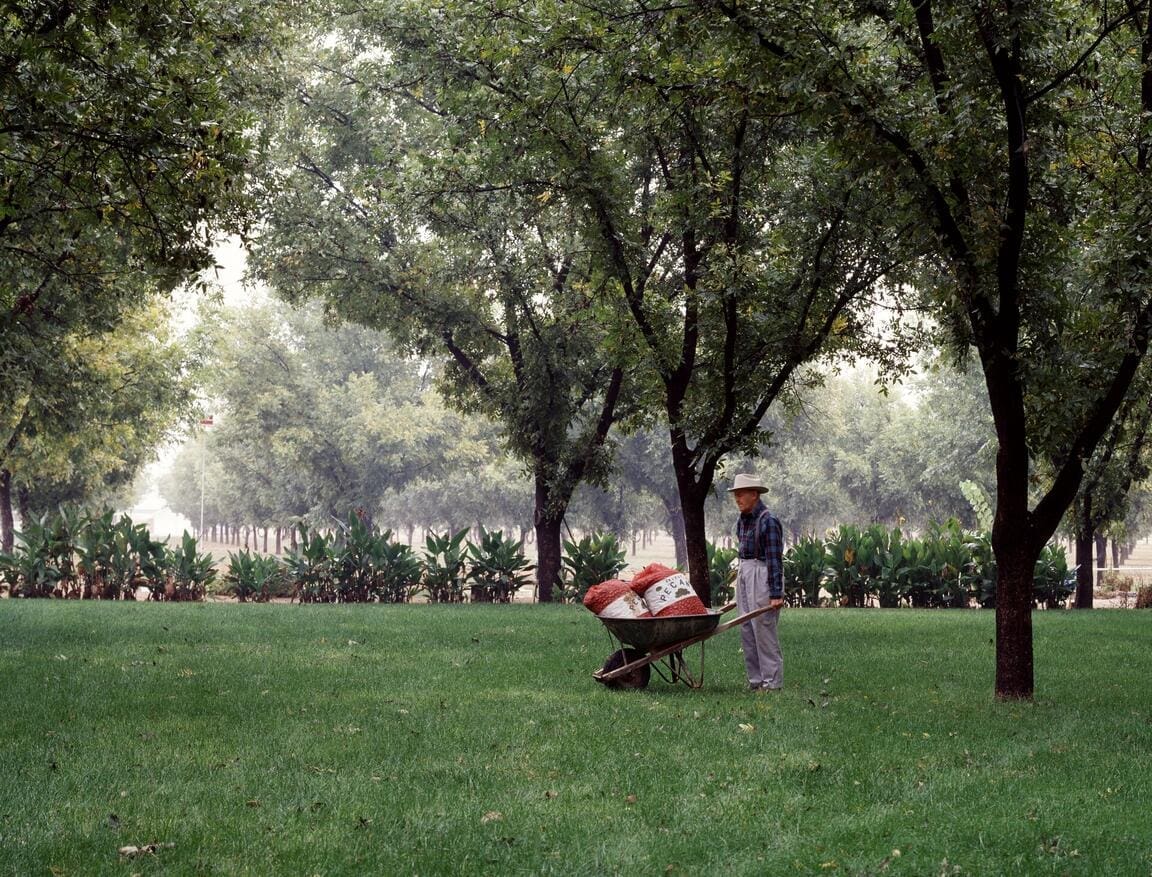
The story of the pecan takes us back in time to Indigenous practices and also hints at solutions for the future that could help us preserve our forests and wetlands, while growing food. At Thanksgiving I think about my mother and her sister gathering pecans in their backyard. It reminds me that ecorestoration is not just a policy issue, but something as personal as planting a nut tree for our children so that one day they can collect snacks as they play outside.

Beck Mordini, JD, Executive Director
Beck brings 20 years of nonprofit experience including protecting the biodiversity of native plants at the Santa Barbara Botanic Garden and protecting undocumented workers from exploitation in Washington state. Her studies of International Environmental Law in Nairobi, Kenya were her first exposure to the issues of desertification and the challenges to global action. While practicing law in Colorado, she and friends founded Climbing for Life, a technical rock-climbing program for at-risk youth. Her career shifted to nonprofit management as a grant writer, development director, marketing and communications manager, community liaison, and executive director. Beck has been a Pachamama Project Drawdown workshop leader, worked on the County Community Climate Action Plan, and testified on behalf of solar reforms to the Board of Supervisors. She has degrees from the University of Virginia and the College of William & Mary with coursework in Sustainable Agriculture and Sustainable business from local colleges.
Sources
- Mount Vernon’s account of the tree
- Washington’s diary, printed page 319
- Etymology and related words
- On the pronunciation of pecan
- Royal Botanic Gardens, Kew. Carya illinoinensis (Plants of the World Online)
- U.S. Forest Service. Pecan (Silvics of North America)
- American Heritage Dictionary
- University of Georgia’s pecan development guide
- Arnold Arboretum’s pecan profile
- 1945 National Register of Big Trees
- Texas Historical Commission on Indigenous foodways
- Oklahoma State University on pecan history
- Texas A&M on alternate bearing
- Early Holocene pecan in the Mississippi River Valley near Muscatine, Iowa
- John Smith’s account, printed page 54
- Historical identification of the hickory
- Elspeth Hay. Feed Us with Trees: Nuts and the Future of Food
- The story of Bluffton
- U.S. Fish and Wildlife Service. Lower Mississippi Alluvial Valley Landscape Conservation, map sheet 1
- International Nut and Dried Fruit Council production data
- South African export data
- T.W. Sammis, J.G. Mexal and D. Miller, “Evapotranspiration of Flood-Irrigated Pecans,” Agricultural Water Management (2004)
- Mesilla Valley orchard case study
- USDA summary of the orchard soil study
- Oklahoma State University on pecan groves and grazing
- Jessie Biele, “A Pecan Tree Grows at Mount Vernon,” Patch (2011)
- University of Georgia Extension, “Pecan Propagation”
- USDA National Agricultural Statistics Service, “Leading States for Pecans,” 2025 figures
- Robin Wall Kimmerer, “Council of the Pecans: Lessons on Native Resilience from a Venerable Tree,” Orion Magazine (2013)