
What bird has an eagle-like body on crane-like legs, long and luxurious eyelashes, and is well-known for its lightning-fast stomping kicks that kill venomous snakes?
The Secretarybird! (Sagittarius serpentarius)
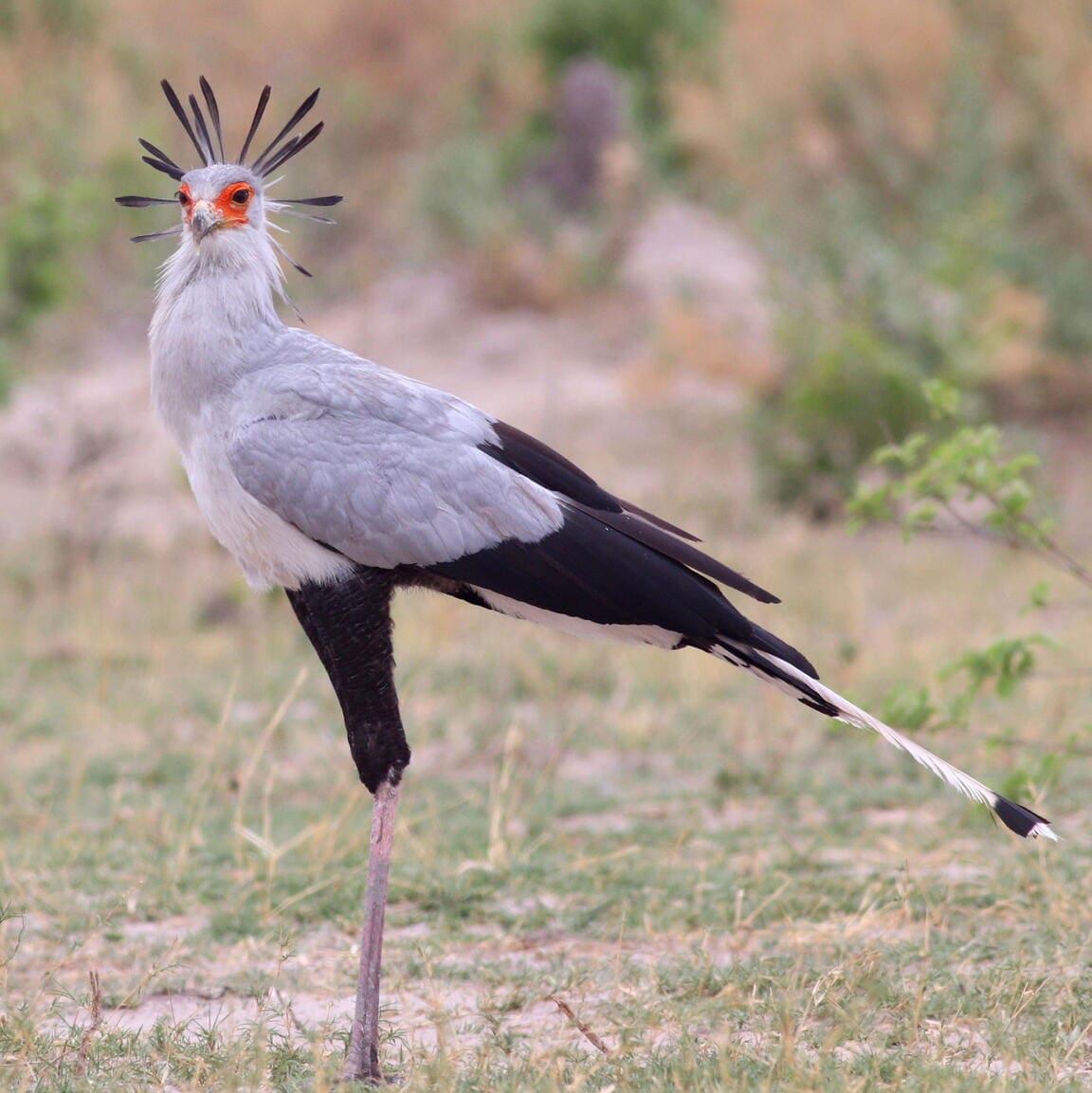
With its elegant crest, striking black-and-gray plumage, and ridiculously long legs, the secretarybird is one of those creatures that seems almost too unusual to be real. But its beauty is only part of what makes this African grassland raptor so fascinating. I chose the secretarybird as this week’s Featured Creature because, quite frankly, I think it is gorgeous—and because few birds can claim to dispatch their prey by literally stomping it into submission!
Despite spending most of its time walking rather than flying, the secretarybird is a formidable predator, capable of delivering lightning-fast, skull-crushing kicks to dangerous prey, including venomous cobras and puff adders. Add in its nomadic lifestyle, impressive soaring abilities, and fascinating adaptations for life on the ground, and you have one truly remarkable bird.
But why is it called the secretarybird?
The name is generally believed to come from its distinctive crest of long, quill-like feathers, which resemble the pens 18th-century secretaries tucked behind their ears. French naturalist Georges-Louis Leclerc, Comte de Buffon, proposed this explanation in 1780, although the name’s exact origins remain debated.
A Raptor Like No Other
The secretarybird is native to sub-Saharan Africa, from Senegal to Somalia, and south to the Western Cape province of the Republic of South Africa. They can be found at various elevations, from coastal plains to highlands, but prefer open grasslands, savannas, and shrubland with scattered small thorn trees. The secretarybird prefers areas with grass under 1 foot 8 inches (0.5 m) high, and avoids those with grass over 3 feet 3 inches (1 m) high. Why? It all has to do with visibility regarding their hunting strategy, which will be discussed further.
A gorgeous bird (in my humble opinion), the secretarybird is immediately recognizable—a large terrestrial bird with an eagle-like head and body atop crane-like legs. They are distantly related to buzzards, harriers, kites, and vultures, and stand at 4.1–4.9 feet (1.2–1.5 m) tall, with a wingspan reaching 6.9 feet (2.1 m). In fact, secretarybirds have the longest legs of any bird of prey, and have to bend them in a crouch when feeding or drinking. The secretarybird sports a robust body covered in gray, white and black feathers, a feathered black crest and a red-orange and yellow patch of skin around the eyes and in front of the strong, curved beak.
Although in flight it looks more like a stork than a raptor, it is distinguishable from any other bird by the two long tail feathers that extend beyond its feet when in the air. Finally, to protect their eyes from blowing dust and debris, as well as from prickly grass while traversing at ground level, the secretarybird is a bit of a fashionista, sporting a lovely pair of modified feathers which serve as eyelashes.

A Life of Stomping and Soaring
Largely nomadic, the secretarybird spends much of the day walking up to 12.43 miles (20 km) searching for prey, typically in pairs or family groups spaced some distance apart and hunting independently. Insects comprise the majority of their diet, but this opportunistic bird is also content with small rodents, shrews, hedgehogs, mongooses, squirrels, hares, meerkats, small birds (and their eggs), amphibians, freshwater crabs, scorpions, millipedes, tortoises, lizards, and snakes, including venomous species such as cobras and puff adders.
Speaking of snakes, the secretarybird has one cool scientific name: Sagittarius serpentarius, which translates to “archer of snakes.” Not only is this because snakes make up a portion of their diet, but secretarybirds are famous for stomping and kicking snakes to death, especially venomous ones. These rapid, skull-crushing kicks can exert a force up to five times their own body weight, delivering around 195 newtons of force in as little as 15 milliseconds. This beatdown behavior isn’t limited to snakes, however, as they will also smack down large lizards and other dangerous prey targets. Smaller prey are simply caught using the sharp beak and swallowed whole.
While secretarybirds stay on the ground while hunting, they otherwise will use rising thermal air currents during the hottest part of the day to soar as high as 2.4 miles (3,800 m) in order to cool off, or move to another area within their territory, which can range from 7.7–27 mi2 (20–70 km2) in size, depending on the habitat. In the late afternoon, pairs return to their roost site in the canopy of a tree or an old nest.
Secretarybirds are monogamous, breeding for life with a single partner. Breeding can occur throughout the year, although it is typically timed so chicks fledge during the wet season, when food is most plentiful. Courtship includes undulating aerial displays high above the nest area, stalling and swooping down with closed wings before opening them again to regain height. Pair members build a large flattened stick nest, 3.3–8.2 feet (1–2.5 m) across and 11.8–19.7 inches (30–50 cm) deep, lined with grass, small sticks, wool, animal dung and leaves, situated 9.8–24.6 feet (3–7.5 m) high in the trampled canopy of a thorny tree, like an acacia.
Both parents incubate the one to three eggs in the clutch, starting when the first egg is laid and lasting 42–46 days. The chicks are fed by both parents, fledging at 65–106 days, after which they remain dependent on their parents for as long as several months. Fledglings are able to catch small prey on their own at around two weeks after leaving the nest, and join their parents on foraging trips at around 4–8 weeks.
Keeping the Secretarybird Soaring
The secretarybird is listed as Endangered on the International Union for the Conservation of Nature (IUCN) Red List. Threats are numerous and include habitat loss and degradation due to afforestation of grasslands, land conversion for agriculture and human settlements, overgrazing by livestock, and encroaching woody vegetation onto grasslands. Other threats include increasing droughts due to climate change, reduced prey availability from excessive (human) burning of grasslands, hunting for traditional medicine markets, increased nest-raiding by humans, capture for the illegal wildlife trade, poisoning from pesticides, and finally, collisions with fence lines and power cables.
Secretarybirds occur in numerous national parks and other protected areas throughout their range. However, continued conservation efforts are needed to better understand and protect their populations. The IUCN recommends establishing a coordinated monitoring program across Africa to obtain updated population estimates and track population trends. Researchers also hope to deploy more tracking devices to better understand the birds’ movements and identify important habitats across the continent.
Protecting the secretarybird also means working with people. Engaging landowners in biodiversity stewardship initiatives can encourage sustainable land management, while raising awareness among local communities—particularly livestock herders in areas where secretarybird populations are declining—can help address threats. Additionally, monitoring and combating the capture and trade of secretarybirds remains important to their long-term survival.
Finally, identifying and mapping suitable habitat across the species’ range would help conservationists prioritize key areas for protection and management, giving these remarkable birds a better chance of thriving in the wild.
The secretarybird is a reminder that nature’s most extraordinary hunters don’t always take to the skies to catch their prey. Sometimes, the action unfolds on the ground, where a pair of powerful legs can be just as impressive as a set of talons. By preying on snakes, rodents, and other small animals, secretarybirds help shape the food web and contribute to the ecological balance of Africa’s grasslands. By protecting the grasslands these birds call home and supporting the people working to conserve them, we can help ensure that the secretarybird’s remarkable hunting displays remain part of Africa’s natural heritage. Here’s hoping these feathered kickboxers keep their footing—and their place in the wild—for generations to come!

Sienna Weinstein is a wildlife photographer, zoologist, and lifelong advocate for the conservation of wildlife across the globe. She earned her B.S. in Zoology from the University of Vermont, followed by a M.S. degree in Environmental Studies with a concentration in Conservation Biology from Antioch University New England. While earning her Bachelor’s degree, Sienna participated in a study abroad program in South Africa and Eswatini (formerly Swaziland), taking part in fieldwork involving species abundance and diversity in the southern African ecosystem. She is also an official member of the Upsilon Tau chapter of the Beta Beta Beta National Biological Honor Society.
Deciding at the end of her academic career that she wanted to grow her natural creativity and hobby of photography into something more, Sienna dedicated herself to the field of wildlife conservation communication as a means to promote the conservation of wildlife. Her photography has been credited by organizations including The Nature Conservancy, Zoo New England, and the Smithsonian’s National Zoo and Conservation Biology Institute. She was also an invited reviewer of an elephant ethology lesson plan for Picture Perfect STEM Lessons (May 2017) by NSTA Press. Along with writing for Bio4Climate, she is also a volunteer writer for the New England Primate Conservancy. In her free time, she enjoys playing video games, watching wildlife documentaries, photographing nature and wildlife, and posting her work on her LinkedIn profile. She hopes to create a more professional portfolio in the near future.
Sources
- San Diego Zoo Animals & Plants: Secretary Bird
- Biology Dictionary: Secretary Bird
- BirdLife South Africa: Secretarybird – Bird of the Year 2019
- Wikipedia: Secretarybird
- IUCN Red List: Secretarybird (Sagittarius serpentarius)
- The Peregrine Fund: Secretarybird
- SANBI (South African National Biodiversity Institute): Secretarybird
- Current Biology: The Fast and Forceful Kicking Strike of the Secretary Bird
- Ostrich: Shoot the Messager? How the Secretarybird Sagittarius serpentarius Got Its Names (Mostly Wrong)
- World Land Trust: Secretarybird