
What large bird has an intimidating appearance, but is actually very docile, bows to show respect, and makes bill clattering sounds reminiscent of a machine gun?
The Shoebill! (Balaeniceps rex)
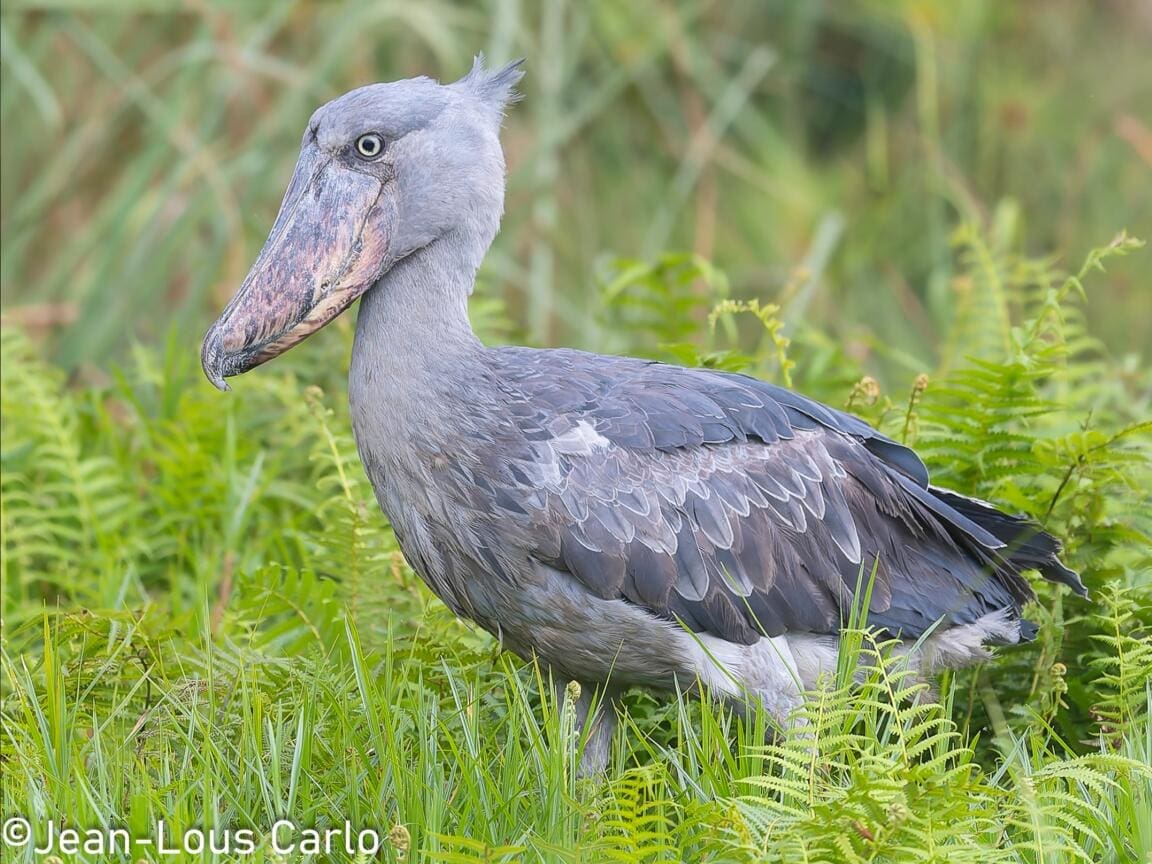
I didn’t pay much attention to shoebills until the internet made their “death stare” and bill-clattering sounds famous. But what started as an appreciation for a wonderfully strange “meme bird” soon turned into genuine fascination with one of the world’s most unusual birds.
The Whale-Headed Wonder
Also known as the whale-headed stork, whalebill, and shoe-billed stork, the shoebill is a large wading bird more closely related to pelicans and herons than to storks. It is native to the freshwater swamps of central tropical Africa, from southern Sudan and South Sudan, through parts of eastern Democratic Republic of the Congo, Rwanda, Uganda, western Tanzania, and northern Zambia. More isolated sightings have been reported of shoebills in Kenya, the Central African Republic, northern Cameroon, southwestern Ethiopia, and Malawi. Vagrant strays to the Okavango Basin in Botswana and the upper Congo River have also been observed.
The shoebill is tall, with a typical height range of 43–55 inches (110–140 cm), with some individuals reaching as tall as 60 inches (152 cm). Standing nearly 5 feet (1.52 m) tall, a shoebill can look almost eye-to-eye with a small child. When it spreads its wings, however, its wingspan can exceed 8 feet (2.44 m)—wider than most people are tall. Adults typically weigh around 11–12 pounds (5–5.6 kg).
The shoebill’s most obvious feature is, of course, its enormous bill. While it doesn’t look much like any of my shoes, a European explorer apparently thought it resembled a wooden clog, giving the bird its memorable name. That comically oversized bill can grow nearly 10 inches (25.4 cm) long, but the shoebill has another oversized feature hiding down below: its feet! Its middle toe can stretch more than 7 inches (17.8 cm), with those huge feet likely helping it balance on aquatic vegetation while hunting. Add a thick neck and broad wings, and you have a bird that looks unlike almost anything else flying—or wading—through an African wetland.
Adult plumage is blue-grey with darker slate grey flight feathers. The breast includes some elongated feathers, which have dark shafts. Juveniles have a similar plumage color, but it is darker grey with a brown tinge. When they are first hatched, shoebills have a more modestly sized bill, which is initially silvery-grey. The bill becomes more noticeably large when the chicks are 23 days old and becomes well-developed by 43 days of age.
Shoebills spend the majority of their day fishing, and are predominantly piscivorous, or fish-eating. They have also been documented eating water snakes, frogs, young monitor lizards, rodents, small turtles and even crocodiles!
They ambush their prey by striding slowly or remaining completely motionless in shallow water, holding their head vertically downward against the breast in order to create binocular vision. Once their prey is in range, they swiftly and violently “collapse” their entire body weight on their victim, with the bill taking the brunt of the force. The shoebill’s bill and skull are reinforced and act as shock absorbers during these intense strikes. The fish, along with a large amount of water and vegetation, are engulfed in the bill, and the water and vegetation are removed by manipulating the mandible side to side. The fish is decapitated by the sharp edges of the bill, before the contents are swallowed.
Shoebills are typically a silent species, but perform bill-clattering displays at the nest to woo mates, intimidate predators, signal dominance, and warn intruders away from their personal swamp domains. These clatters are loud, hollow, rattling noises that echo across the swamp, and strongly resemble automatic gunfire! YIKES! You can watch a sample of this, along with other facts, in the video below. Both nestlings and adults engage in bill-clattering during the nesting season as a means of communication, and each gender has different tones to their clattering. Besides this famous auditory exclamation, adults have been noted to utter cattle-like “moos” and high-pitched whines. When young are begging for food, they call out with a sound uncannily like human hiccups.
The World’s Most Intimidating Babysitter
Shoebills are generally solitary birds, with breeding pairs defending their own territories in the swamp. Their breeding season is closely tied to local water conditions, although the timing varies across their range. When a pair settles down to raise a family, both parents help build a large nest from aquatic vegetation. The nest sits on a floating or partially submerged platform, sometimes surrounded by several meters of cleared vegetation. Then comes one of my favorite shoebill parenting facts.
On very hot days, adults can bring water to the nest and use it to help cool their eggs. They may also add wet vegetation to the nest and turn the eggs with their feet or bill.
After roughly a month of incubation, one to three chicks may hatch. Both parents participate in brooding, shading, guarding, and feeding the young. Food is regurgitated directly into the chick’s bill.
But shoebill families have a harsh survival strategy, too. Although multiple eggs may be laid, shoebills rarely raise more than one chick. Oftentimes, first-to-hatch chicks will bully and potentially kill their younger sibling(s). The surviving chick eventually takes its first steps toward independence, fledging at around three and a half months and becoming capable of strong flight shortly afterward. Parents may continue feeding it for another month or more.
For a bird whose harsh stare makes it appear as though it prefers to be left alone, shoebills can be remarkably attentive parents.
No Swamp, No Shoebill
The majority of threats against shoebills are human-based. Shoebills are listed as Vulnerable on the International Union for Conservation of Nature (IUCN) Red List, and throughout most of their range, they are threatened by habitat destruction and degradation, hunting of eggs and birds for food, and capture for the bird trade. Many local communities also perceive them as bad omens, which gives people another reason to hunt them. Ideal habitats are being polluted, converted for agriculture and aquaculture, and used as cattle pastures. Habitats are further reduced as a result of energy production (including dams) and mining.
Conservation actions currently underway include a Single Species Conservation Action Plan (SSAP) developed in 2012, which includes stakeholder workshops with representatives throughout the shoebill’s range. In addition, a conservation management plan has been implemented by the Bangweulu Wetlands Management Board. Steps are being taken in South Sudan to understand the shoebill population more thoroughly, and improve the status of protected areas. Several key shoebill sites are designated Ramsar sites (wetlands designated as internationally important under the Ramsar Convention, an international environmental treaty) in South Sudan, Uganda, Tanzania and Zambia. In Zambia’s Bangweulu Wetlands, local fishermen are employed as guards to protect shoebill nests in order to increase breeding success as well as local awareness.
The shoebill may look as if it wandered out of a prehistoric swamp, but it’s very much a bird of the modern world. Its survival is tied to the wetlands beneath its feet, the fish moving through those waters, the people living alongside them, and the conservation decisions we make about these ecosystems. Wetland protection is beneficial for all species—plant and animal—that depend on it. Not only that, but wetlands throughout the world are also key to cooling the climate—a win for all species, including ours.
And somewhere out there, in the middle of an African swamp, a shoebill is probably standing perfectly still, waiting for a fish to make one very unfortunate mistake.

Sienna Weinstein is a wildlife photographer, zoologist, and lifelong advocate for the conservation of wildlife across the globe. She earned her B.S. in Zoology from the University of Vermont, followed by a M.S. degree in Environmental Studies with a concentration in Conservation Biology from Antioch University New England. While earning her Bachelor’s degree, Sienna participated in a study abroad program in South Africa and Eswatini (formerly Swaziland), taking part in fieldwork involving species abundance and diversity in the southern African ecosystem. She is also an official member of the Upsilon Tau chapter of the Beta Beta Beta National Biological Honor Society.
Deciding at the end of her academic career that she wanted to grow her natural creativity and hobby of photography into something more, Sienna dedicated herself to the field of wildlife conservation communication as a means to promote the conservation of wildlife. Her photography has been credited by organizations including The Nature Conservancy, Zoo New England, and the Smithsonian’s National Zoo and Conservation Biology Institute. She was also an invited reviewer of an elephant ethology lesson plan for Picture Perfect STEM Lessons (May 2017) by NSTA Press. Along with writing for Bio4Climate, she is also a volunteer writer for the New England Primate Conservancy. In her free time, she enjoys playing video games, watching wildlife documentaries, photographing nature and wildlife, and posting her work on her LinkedIn profile. She hopes to create a more professional portfolio in the near future.
Sources
- San Diego Zoo Wildlife Alliance: Shoebill
- The Dallas World Aquarium: Shoebill Stork
- Wikipedia: Ramsar Site
- Wikipedia: Shoebill
- IUCN Red List: Shoebill