
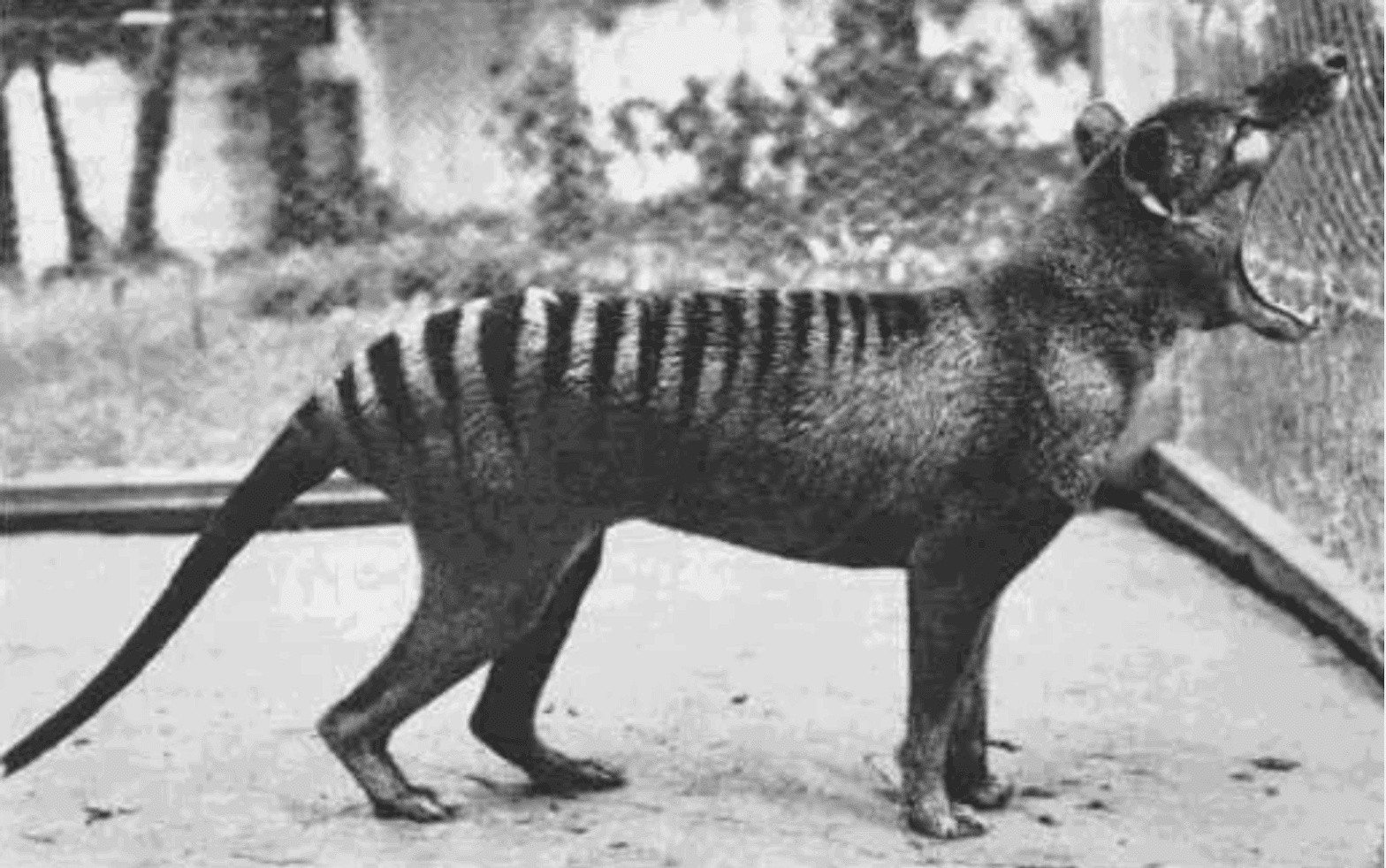
What stands like a kangaroo, has stripes like a tiger, and is found everywhere in art but nowhere in nature?
Meet the Thylacine! (Thylacinus cynocephalus)
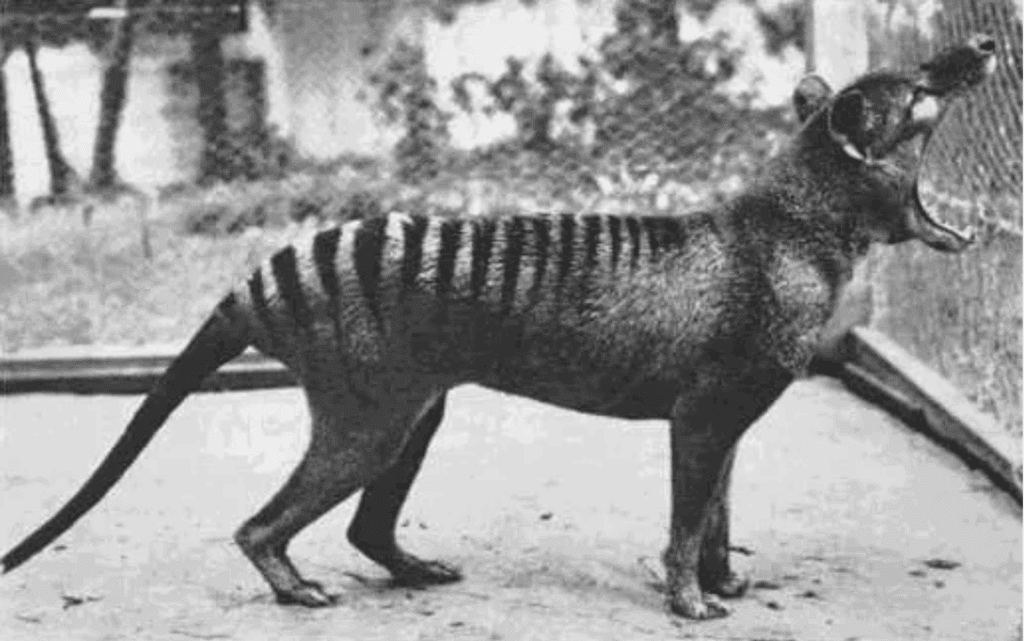
(Image credit: Unknown original photographer; Public Domain)
A Unique Creature with a Truly Unique Biology
I was first introduced to the thylacine at a young age while watching a wildlife documentary. This one, focused on the wildlife of Australia, featured a few seconds of black-and-white footage of a wolf-like creature with distinctive tiger-like stripes, pacing around its enclosure at the now-closed Hobart Zoo (also known as the Beaumaris Zoo) in Tasmania’s capital of Hobart. I was captivated by this animal’s unique appearance, and was shocked beyond belief when at one moment, the animal opened its jaws at an alarmingly wide gape. Instantly, it became my favorite extinct animal of modern times, and remains so to this day.
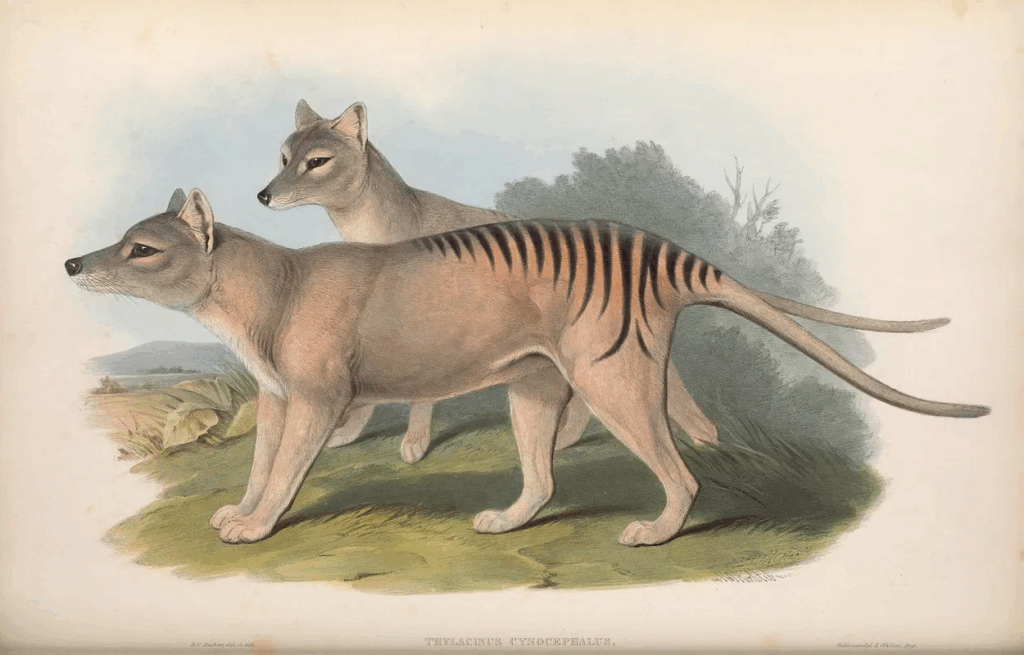
Though it is also known as the Tasmanian tiger and Tasmanian wolf, the thylacine was neither. Rather, it was a marsupial, a group of mammals in which the female carries her young in a pouch. Much like those of tigers, the stripes across the back and down to the base of the tail were used for camouflage. The thylacine was the apex predator in its woodland ecosystem, and relied on ambush to attack its prey. It was also the largest carnivorous marsupial of its time, with a size comparable to that of a medium or large dog.
Despite having raised heels like canids, and typically walking with a stiff, shuffling gait on all fours, the thylacine was able to rest its heels on the ground and use its rigid tail for balance, adopting a kangaroo-like stance. This stance was primarily used to gain better observation of the surroundings. Thylacines were one of only two marsupials in which the male had a pouch (the other was the water opossum).
The most noteworthy (and intimidating) feature of the thylacine was its ability to open its jaw to a near 80º angle—the widest of any mammal! This may have been beneficial in taking down fast-moving prey, like wallabies. In theory, the greater the gape, the greater the clench onto the prey, which in turn, heightened the chance of a hunt well done. The gape yawn was also documented as a threat warning. It has been theorized that the gape may have been used by males as a display to win the attention of females and intimidate rival males.
Out-Competed, Wrongly Persecuted, and Hunted Until the End
Native to the islands of Tasmania, New Guinea, and mainland Australia, the thylacine died out in the latter two locations over 3,000 years before the arrival of Europeans. This has been theorized to be the result of the introduction of another Australian icon: the dingo, who won the competitive war for prey in those areas, but never reached our striped hero’s last stronghold in Tasmania.
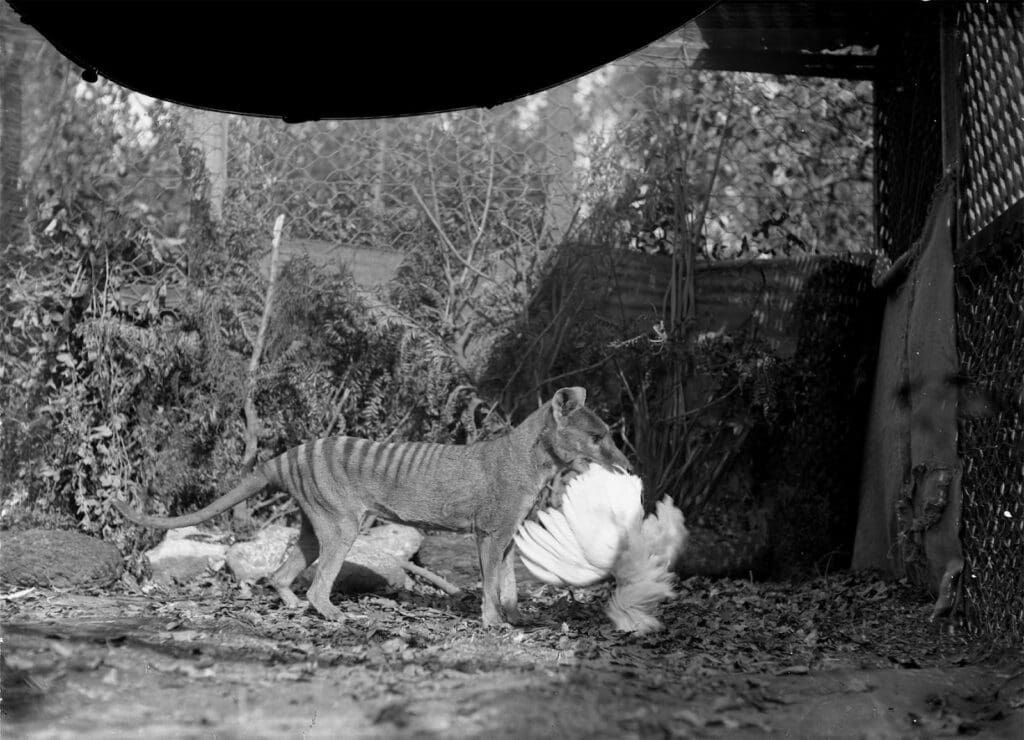
Once Europeans formally established settlements on Tasmania in the nineteenth century, the thylacine was perceived as a sheep thief and a bounty placed on their innocent heads. A series of photos taken by Harry Burrell depicted a thylacine with a chicken in its mouth. Over recent years, these photos have been the subject of heavy debate and discussion among researchers as to whether the individual shown is captive, or even a living specimen. Speculation exists that editing was performed prior to the a photo’s publication in The Australian Museum Magazine (shown below).[1] [2] [3]
Based on observations, the thylacine was in fact a shy and reclusive animal. Their depiction as a sheep-killer was greatly exaggerated, yet persisted. A 2011 study exploring thylacine skull biomechanics conducted by Marie Attard, PhD of the University of New South Wales advanced our understanding of their hunting behavior. Her research suggested that the thylacine’s bite force and jaw mechanics restricted it to smaller prey. As stated by Attard, “… our findings suggest that [the thylacine’s] reputation was, at best, overblown.”
Cultural Icon
The last wild thylacine was shot and killed by farmer Wilf Batty on his property in Mawbanna, Tasmania, in 1930. In 1936, the last captive thylacine, named Benjamin, died at the Hobart Zoo on September 7. The day is now known as National Threatened Species Day in Australia, and not only serves to remember Benjamin, but to raise awareness for all threatened native plant and animal species throughout the continent.
Today, the thylacine is a cultural icon of Australia, and imagery of this unique marsupial is found all over Tasmania, including in artwork, the Tasmanian cricket team mascot, license plates, and even the state’s coat of arms.
A Candidate for a Real Life Jurassic Park
The thylacine is just one of several subjects currently undergoing intensive research and experimentation by the American biotechnology and genetic engineering company Colossal Laboratories & Biosciences De-extinction Project. The company has already made headlines for planning to bring back the wooly mammoth; the thylacine is another animal they hope to bring back from extinction.
As the apex predator of Tasmania, the thylacine controlled populations of various native and invasive herbivore species, ensuring they did not cause chaos in their native ecosystem. This included preventing overgrazing, culling weaker and sick animals, suppressing disease among other species, and promoting biodiversity. Since the loss of the thylacine, trophic downgrading has occurred, which is a significant ecological disruption that cascades throughout the food chain.
Think about the classic example of Yellowstone’s wolves: when they were hunted to near extinction, herds of elk began overgrazing across the landscape, damaging the health of the ecosystem. With the return of wolves to Yellowstone, elk numbers are kept in check, and the number of plant and animal species have since diversified and thrived.
While genetic engineering may create hope of restoring thylacines as the wolf of Tasmania, it is more important to address threats to living species and their habitats. As we restore the water cycles and vegetation of degraded land, biodiversity begins to recover, creating a positive feedback loop of regeneration.

Sienna Weinstein is a wildlife photographer, zoologist, and lifelong advocate for the conservation of wildlife across the globe. She earned her B.S. in Zoology from the University of Vermont, followed by a M.S. degree in Environmental Studies with a concentration in Conservation Biology from Antioch University New England. While earning her Bachelor’s degree, Sienna participated in a study abroad program in South Africa and Eswatini (formerly Swaziland), taking part in fieldwork involving species abundance and diversity in the southern African ecosystem. She is also an official member of the Upsilon Tau chapter of the Beta Beta Beta National Biological Honor Society.
Deciding at the end of her academic career that she wanted to grow her natural creativity and hobby of photography into something more, Sienna dedicated herself to the field of wildlife conservation communication as a means to promote the conservation of wildlife. Her photography has been credited by organizations including The Nature Conservancy, Zoo New England, and the Smithsonian’s National Zoo and Conservation Biology Institute. She was also an invited reviewer of an elephant ethology lesson plan for Picture Perfect STEM Lessons (May 2017) by NSTA Press. Along with writing for Bio4Climate, she is also a volunteer writer for the New England Primate Conservancy. In her free time, she enjoys playing video games, watching wildlife documentaries, photographing nature and wildlife, and posting her work on her LinkedIn profile. She hopes to create a more professional portfolio in the near future.
Dig Deeper
https://colossal.com/de-extincting-tassie/
https://colossal.com/thylacine/
https://en.wikipedia.org/wiki/Thylacine
https://en.wikipedia.org/wiki/Water_opossum
https://www.instagram.com/p/DICL8ALsbGA/
https://www.livescience.com/15862-tasmanian-tiger-jaw-sheep.html
http://www.naturalworlds.org/thylacine/index.htm
https://www.nma.gov.au/defining-moments/resources/extinction-of-thylacine
https://zslpublications.onlinelibrary.wiley.com/doi/abs/10.1111/j.1469-7998.2011.00844.x
Images: