
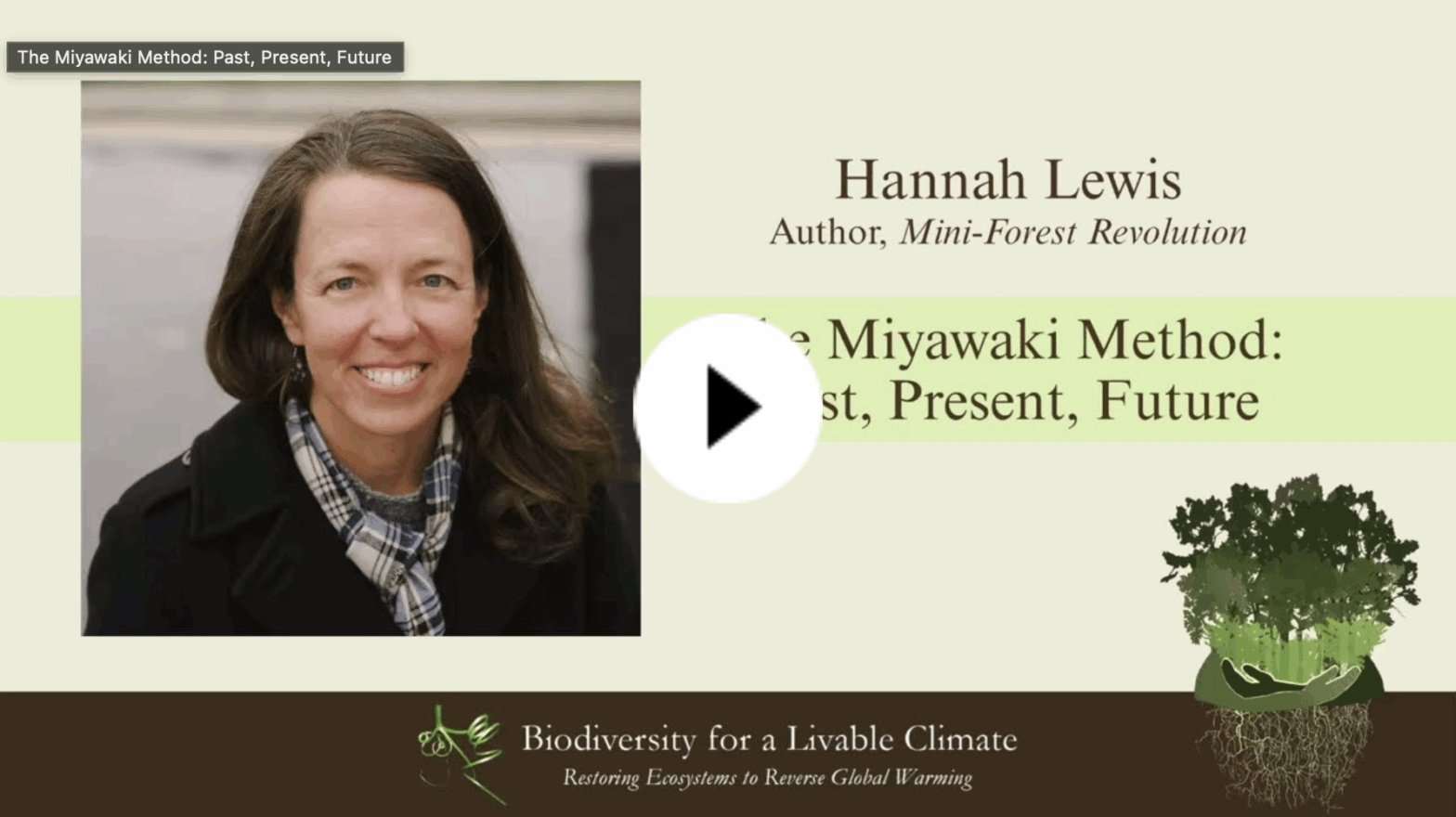
Today, we’re excited to share the introductory keynote of the 2025 Northeast Miniforest Summit. Hannah is the author of Mini-Forest Revolution: Using the Miyawaki Method to Rapidly Rewild the World—a book many of you may already know well.
Hannah’s presentation brought us back to the heart of the Miyawaki method and what it really asks of us. She drew a clear line between planting trees and planting an actual forest community. She emphasized the method’s goal of skipping ecological succession by planting climax species from the start—supported by soil preparation, multi-layered planting, and early canopy formation. She walked us through Dr. Akira Miyawaki’s original work and how the approach has expanded globally through hands-on experimentation and a growing network of practitioners.
In the Q&A, Hannah underscored the importance of stable, shade-tolerant climax species and shared examples of how colder climates face added pressures from non-native plants. She also noted a key distinction: Dr. Miyawaki worked largely within evergreen forest communities, which function differently from the deciduous systems we are working with in the Northeast U.S.
Hannah’s presentation left us with two questions to reflect on:
If Dr. Miyawaki developed his method largely within evergreen systems—where shade persists year-round—how should we think about applying the method in our deciduous Northeastern forests, where light and shade shift so dramatically across the seasons? What seasonal dynamics deserve closer attention in the early years?
As ecological roles shift across contexts, how do we determine which species are truly “climax species” for the forest community we’re emulating—and what the right ratios across canopy, sub-canopy, understory, and shrub layers should be?
We hope these questions deepen your own thinking as well.
Posted: November 28, 2025