
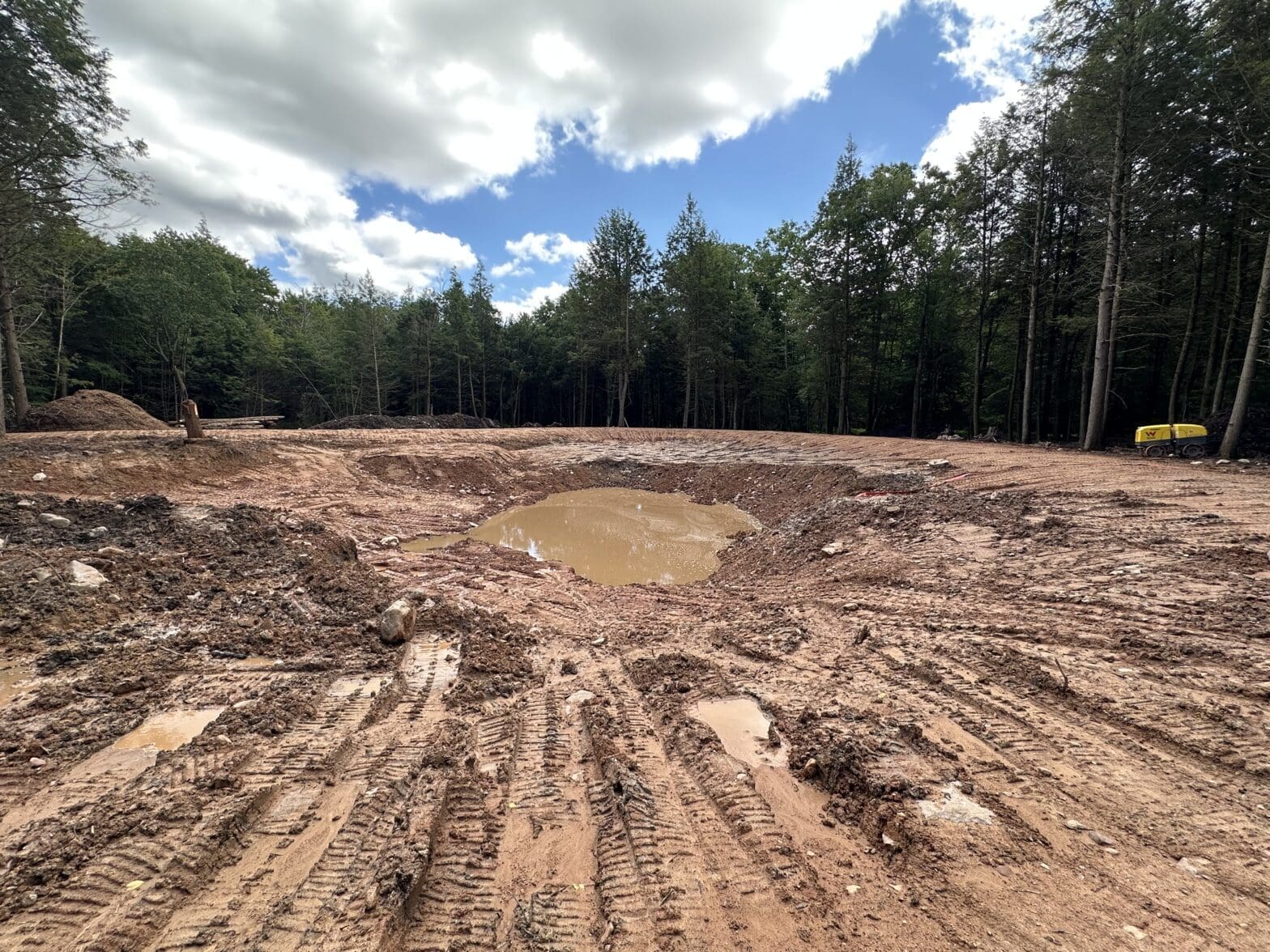
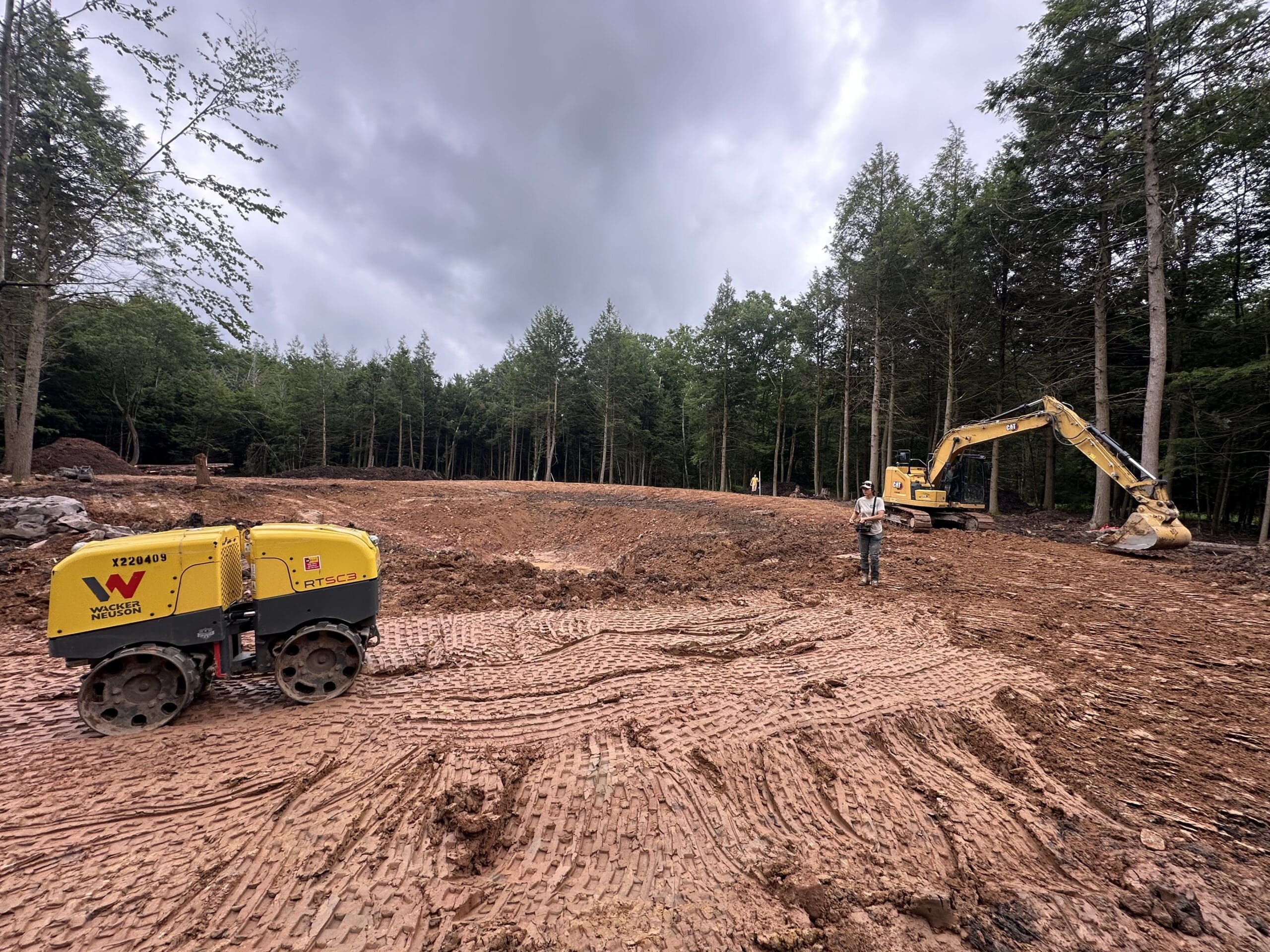
compacting the dam of one of the two ponds being built.
Following a Chance Encounter
After taking the Water Stories Core Course in 2025, this month I joined a wonderful group of volunteers for a week of camping to support their team with whatever they needed as they built two earthen ponds and connected them to a third.
To understand why I became so interested in earthen ponds, I have to go back a few years.
Sometime during graduate school, around 2020, I came across a lifeless dragonfly in downtown Providence as I was walking home from class. It was lying there surrounded by concrete, with hardly any vegetation or water in sight, and I remember wondering: where is its habitat?
Until then, I had been somewhat obsessed with the form of things—with patterns, shapes, and structures. I might normally have been drawn to the dragonfly itself, to the hexagons in its compound eyes or the geometry of the tessellations found on its wings. Instead of looking only at the dragonfly, I began looking around it. The environment seemed almost agnostic to its needs; it was so human-centric. I began obsessively researching and talking about ponds.
I have no logical explanation for why that particular encounter stayed with me. Over time, I’ve learned to follow that kind of attention without necessarily knowing where it will lead. Sometimes it takes on a life of its own, becoming a whole universe of questions, pathways, and signs to explore.
Somehow, following it led me to earthen ponds—and to thinking about how ponds are constructed. While researching, I came across YouTube videos of what seemed like forty people dragging these massive pond liners across the ground, this enormous sheet suddenly separating the pond from the soil beneath it. Something about that image stayed with me too. At the time, it felt intuitively wrong to me, and I became fascinated by the possibility of constructing ponds without that separation. I understand now that there are circumstances in which a liner is necessary.
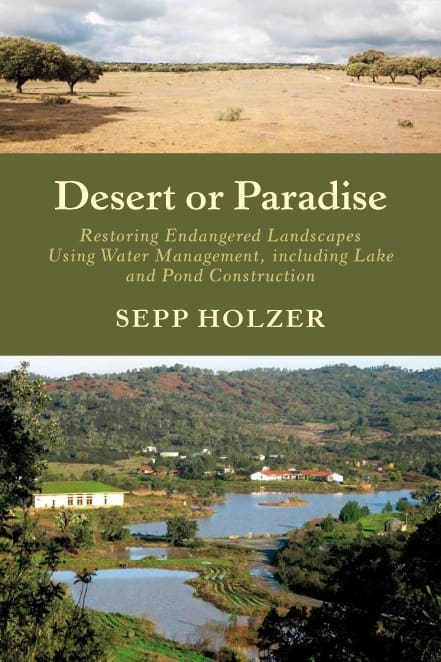
After talking about ponds to seemingly anyone who would listen, someone asked me, “Do you know Sepp Holzer’s book Desert or Paradise?”—the full title being Desert or Paradise: Restoring Endangered Landscapes Using Water Management, Including Lake and Pond Construction. I didn’t. So I started researching.
Sepp Holzer is an Austrian mountain farmer and author known for an approach to land management centered on observing and working with natural processes rather than trying to overcome them. At the Krameterhof, his family’s farm high in the Austrian Alps, water became fundamental to how he shaped the landscape. Over decades, he developed terraces, ponds, wetlands, and water gardens designed to harvest water, hold it in the landscape for as long as possible, and redistribute it across the land. These interconnected water systems help retain water, reduce erosion, influence microclimates, and create habitat—all on steep mountain terrain stretching from roughly 1,100 to 1,500 meters in elevation.
As I was researching Sepp’s work, Zach Weiss and Water Stories kept emerging. Zach apprenticed with Sepp for several years, and at some point Sepp told him, essentially, “There can’t be just one of you.” That idea—that this knowledge needed to be shared and carried by many more people—helped lead to the creation of Water Stories, which Zach founded to teach and advance water-cycle restoration. Zach also went on to learn from people working with water in very different landscapes, including Dr. Rajendra Singh, the “Waterman of India,” whose work with communities in Rajasthan has helped restore watersheds and revive rivers.
A few years after first wondering how an earthen pond could be constructed without that separation between water and earth, I had somehow followed that curiosity all the way to standing beside one as it was coming into being.
Witnessing the Genesis of a Pond
It was nothing like I had imagined it.
Witnessing the work made me reconsider what I had assumed I understood from afar, through the virtual space—and how much ecological knowledge can only really be understood through direct experience.
Witnessing the genesis of a pond, I began to see its “anatomy” emerge in my mind’s eye—the key, dam, spillway, slopes, terraces, deep and shallow zones—some already in the process of being shaped, one layer at a time, others still days or weeks away from being built, but all beginning to emerge from what still looked like an oversized puddle.
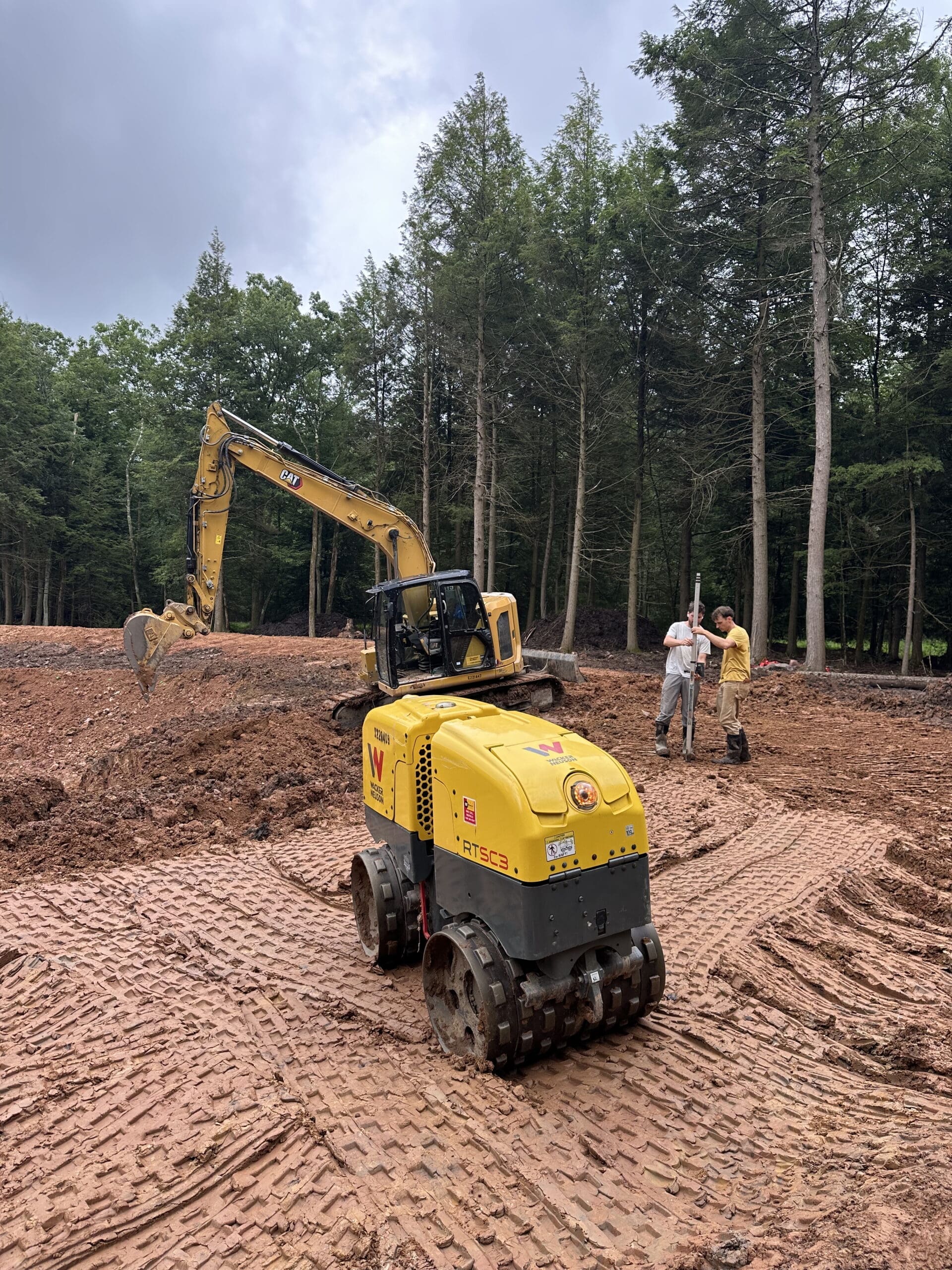
surveying with a rotary laser.
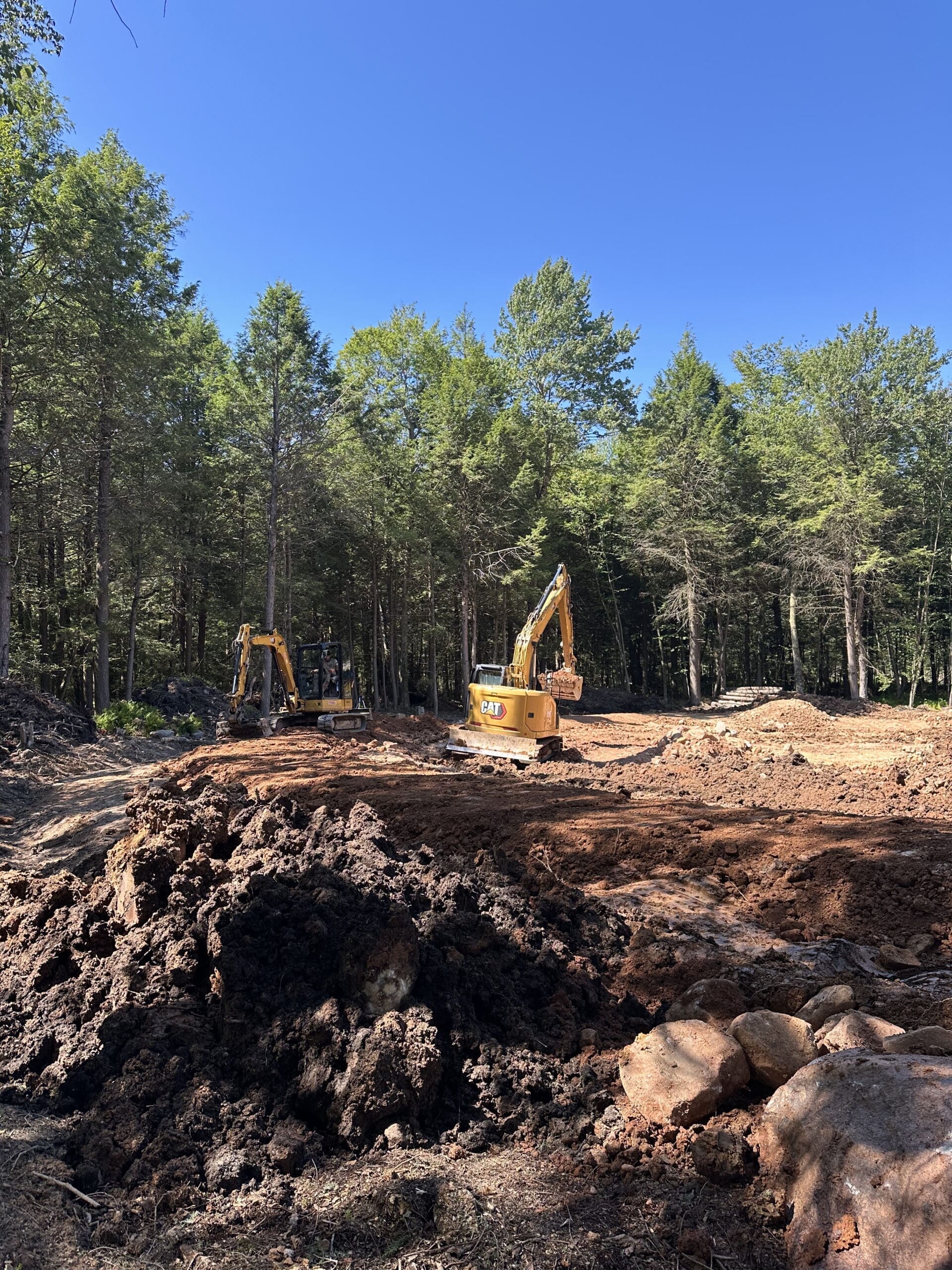
on top of the dam to be further compacted.
What struck me was seeing the whole scene of excavators coordinating with one another—one machine harvesting material and laying it down for the compactor, another shaping, someone else clearing—and how everyone moved between working independently and coming together at particular moments. There was this constant back and forth: individual, together, individual, together. The transitions were just as important.
I began to understand just how granular the work is, literally moving earth one layer at a time, while keeping track of where everything is coming from and where it needs to go: this is the pile I’m working on, this is where I can excavate, this material needs to go there.
There was also this mental map of all the materials and their strata: where the impermeable clay was, where the topsoil was, what material needed to be staged somewhere else, what could be shaped now, and what had to wait. And the pond seemed to have this organic unfolding. Something might be shaped and then extended; a shallow area might emerge; the key might need to continue farther than originally anticipated.
The Key
One thing that finally clicked for me was the key.
When I asked how to visualize it, Zach described it very simply: “Imagine this is like a wall, six to eight feet deep, four feet wide of compacted clay. It’s just like a wall.”
At this site, they had opened a trench through the different layers of soil until reaching the red/orange clay below—the layer they were keying into: the impermeable clay. The key itself was then built incredibly incrementally: a layer of clay, compacted; another layer, compacted; another, and another.
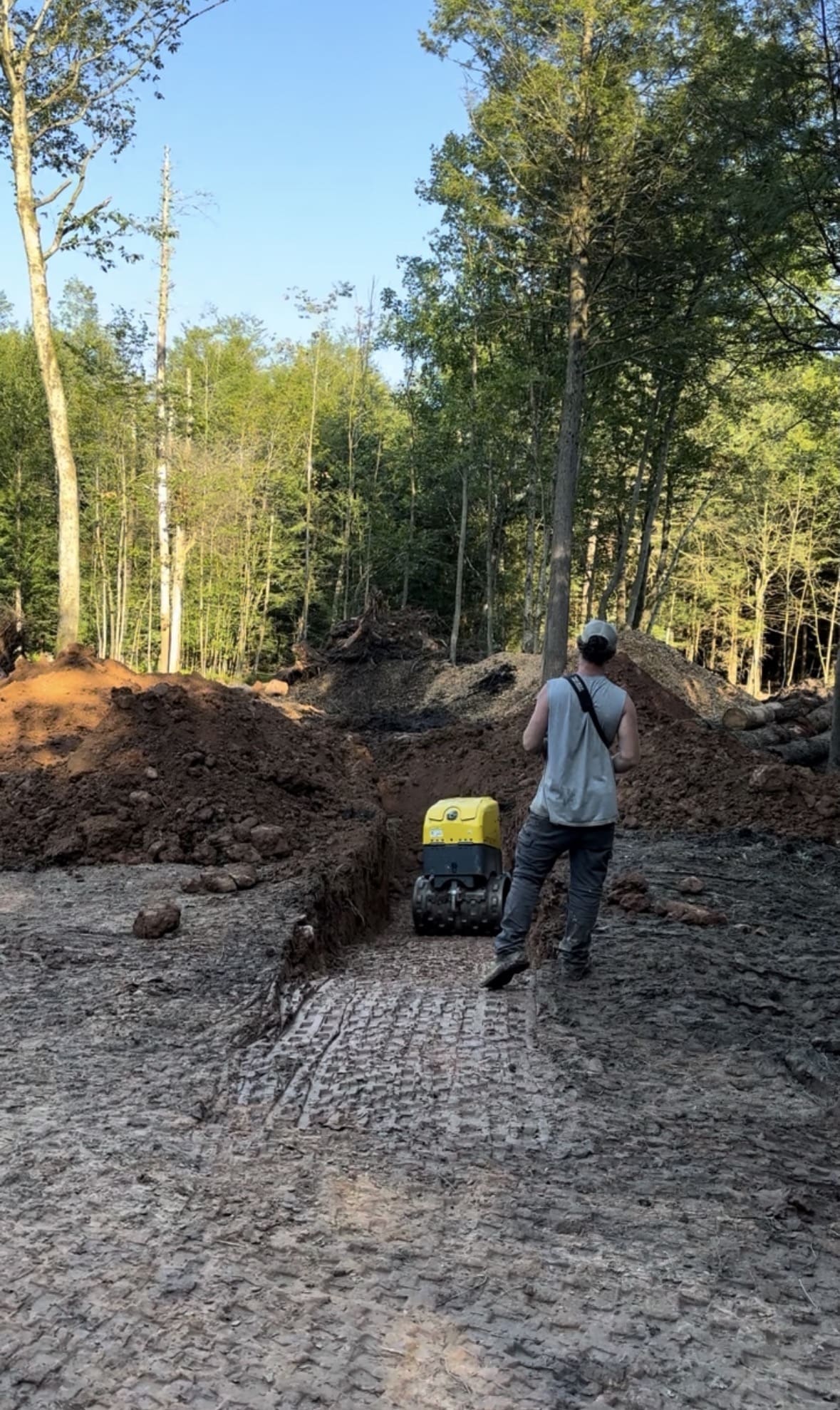
and compacted layer by layer.
The shape of the key also emerged from the shape of the land. This was an incredibly gentle landscape—almost perceptibly flat—so the key extended around much of the pond rather than forming a short barrier across a narrow pinch point.
I think before being there I had imagined pond building as something like digging a hole, finding clay, compacting it, and creating some shallow zones. But I began to understand a very different logic of an earthen, keyed-dam pond—not simply creating an impermeable hole that holds water, but building a key and dam that intercept water moving through the landscape and hold it laterally. The pond itself can remain permeable, allowing water to move into the surrounding soil and groundwater. Josh, from the Water Stories team, described the key as a kind of wick, sending water in the other direction, amplifying it.
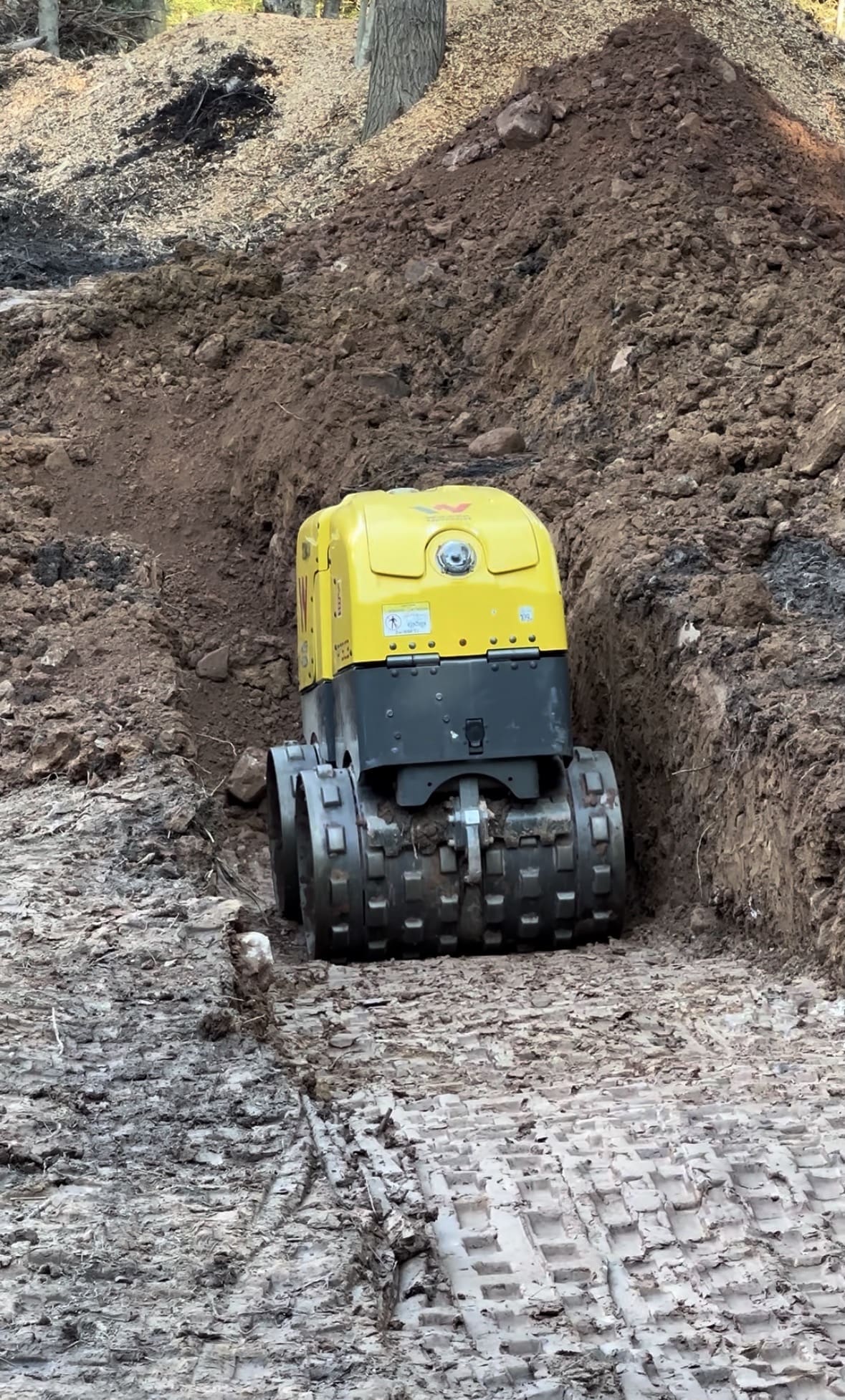
Clay is added and compacted one layer at a time with a trench roller.
Back and Forth, Back and Forth
What also stayed with me was the sheer repetition of constructing it: back and forth, back and forth, back and forth. Move some earth. Compact it. Move somewhere else. Shape something. Come back. How much earth do you take with the excavator at once? How much do you deposit? Where do you position yourself in space? How do you know where to move next?
The team was also constantly surveying using a rotary laser, checking elevations to know how much earth needed to be excavated or added in different places. I began to realize that what looked to me like simply digging and moving earth was actually being continually measured as the pond took shape.
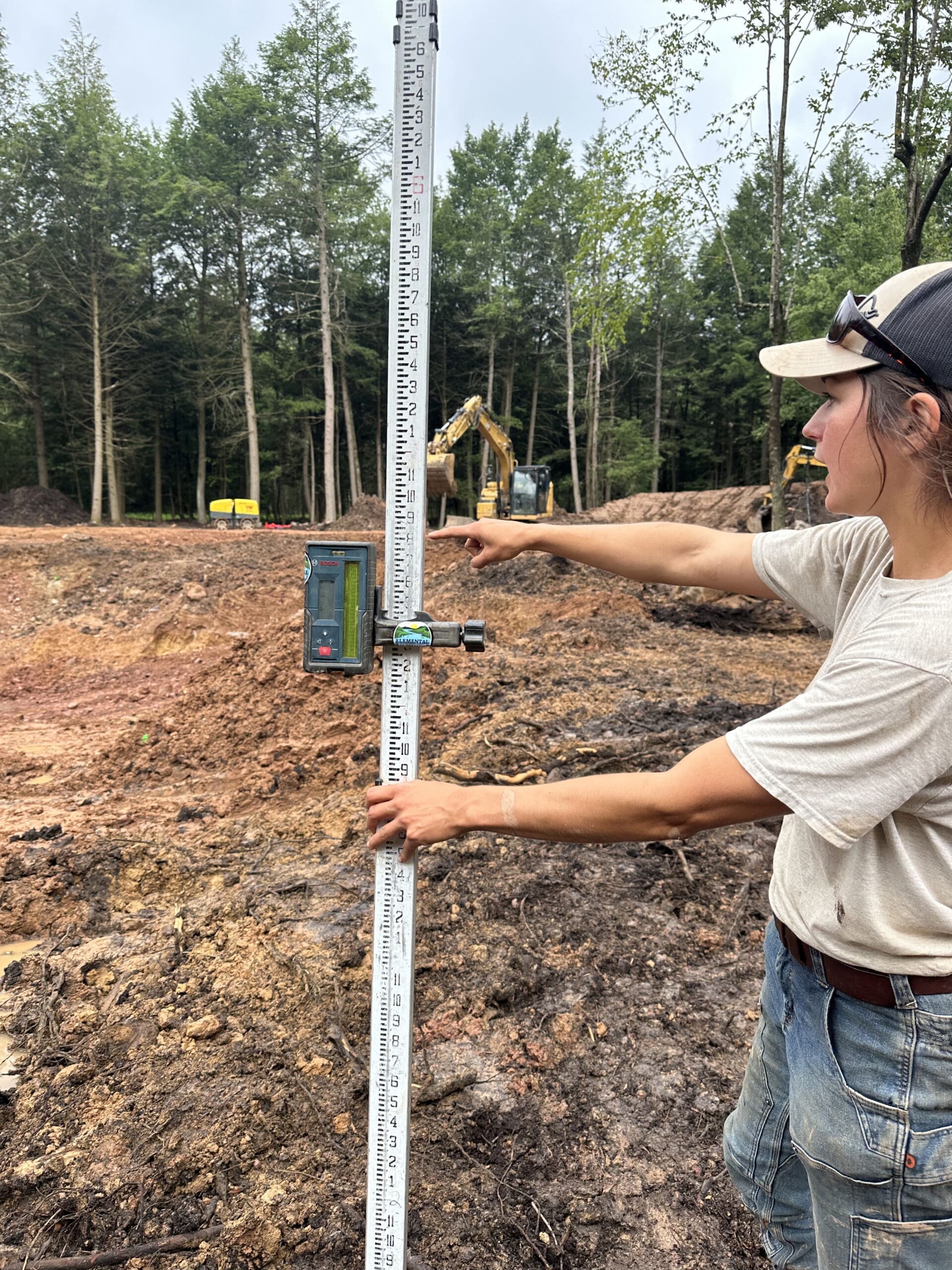
Watching the Water Stories team at work, I began to understand pond building as a constant interplay of harvesting, layering, compacting, shaping, surveying, moving materials, knowing where different soil layers lie, managing water, communicating across machines, and continually adapting to what is actually there—in very large machines, through hours and hours of continuous, repetitive work, while somehow remaining deeply attuned to all the conditions around them.
It takes an incredible amount of endurance to do this kind of work!
Maintaining the Conditions
And then there was the rain.
Because it rained almost every day, maintaining the conditions for the work became almost as present as the shaping itself. We spent considerable time guiding water out of the construction area so the ground could be worked and compacted—learning firsthand how one tiny channel can redirect water, connect drainage patterns, or obstruct its flow entirely.
Zach and Megan explained that the clay itself had to be within a particular range of moisture to work with—a kind of “Goldilocks” condition. It couldn’t be too wet or too dry. In New Mexico, they said, the challenge might be keeping the material wet enough. Here, after an unusually rainy month, they had exactly the opposite problem: everything needed to get drier.
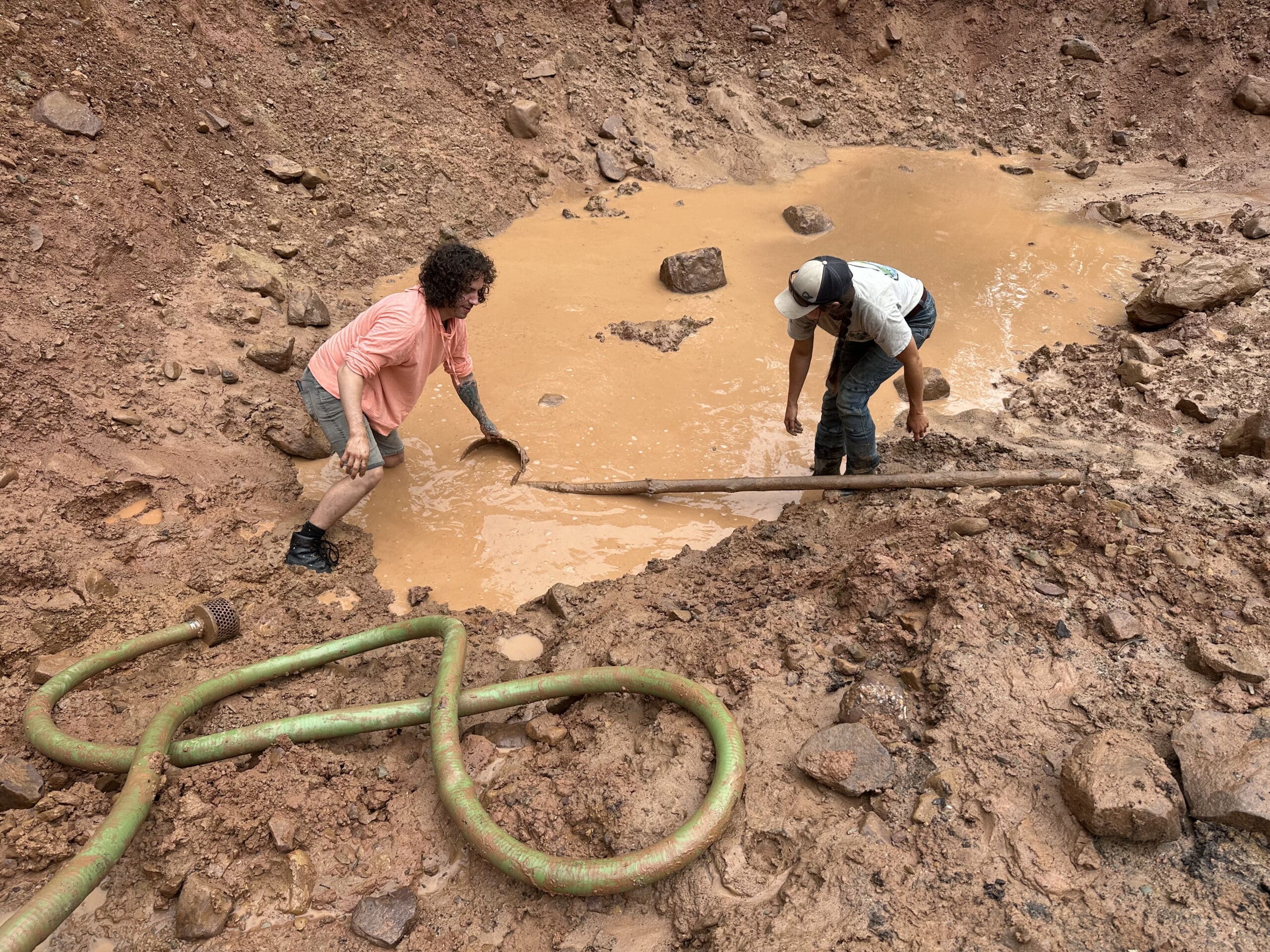
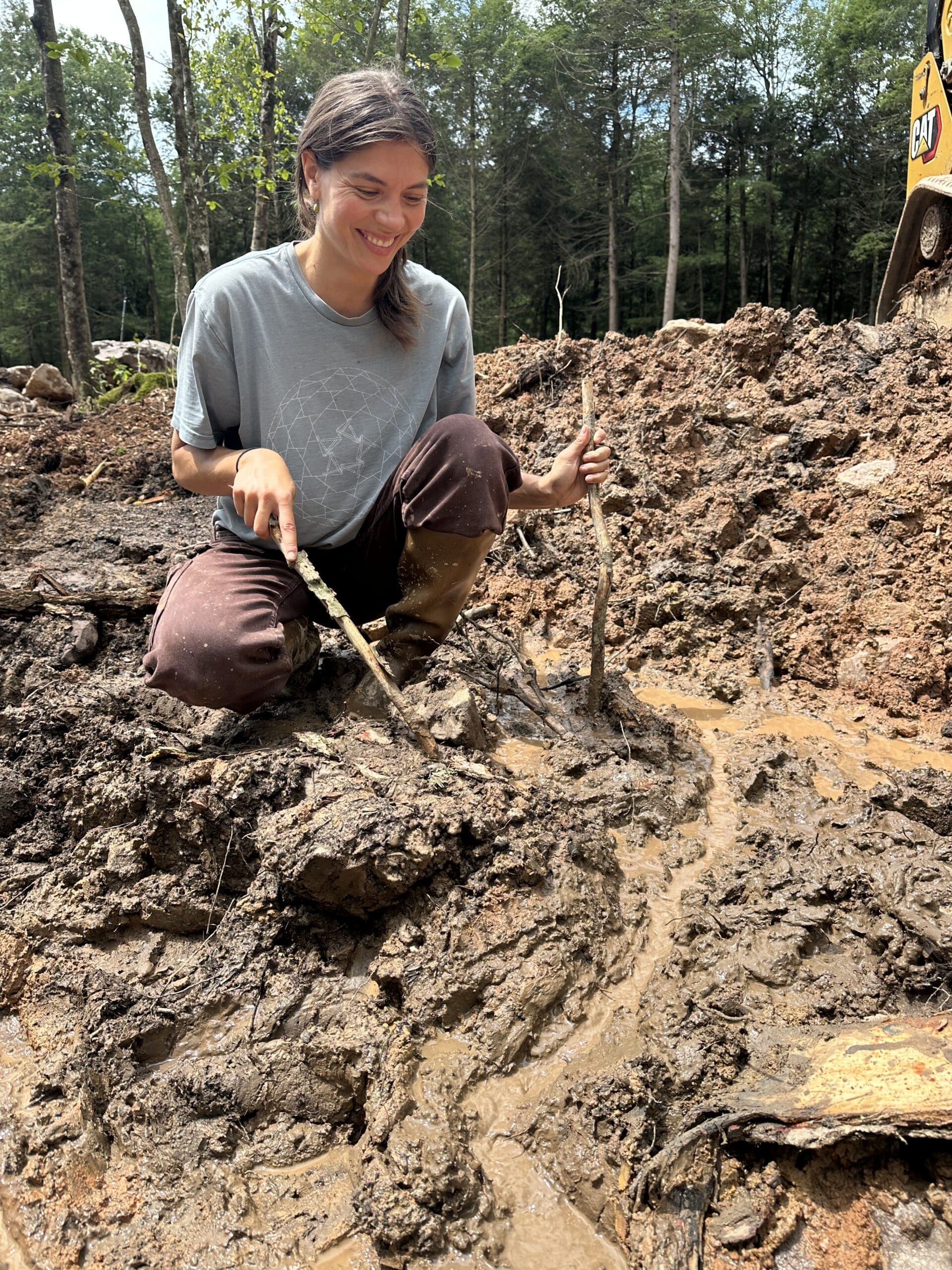
The team was constantly working to maintain the conditions that made shaping and compacting the earth possible. Exposed clay was rolled and packed to keep it from absorbing more water. If rain was coming, areas that might otherwise have been left open to dry had to be rolled and closed so that water would drain away instead of collecting there. After a rain, Zach said they could lose half a day simply getting the site ready to work again. We experienced that firsthand!
I began to realize how much of pond construction was this work of maintaining the conditions: draining water, managing moisture, staging materials, creating access, surveying elevations, opening sections and closing them again.
What I Couldn’t See From Afar
Maybe what I became most aware of was how much I still don’t understand, but also how important it is, with this kind of work, to simply start doing it—because there really is no better way to learn.
I think this is what I had been missing when I tried to understand pond construction through diagrams, courses, presentations, books, and videos. Those things gave me concepts and language—the key, dam, spillway, catchment, terraces—but being there gave those words dimension. I could begin to see the relationships between them: the geology under my feet, water appearing through a vein in the soil, the rotary laser constantly checking elevations, the excavators continually repositioning, piles of materials waiting for their next use, the tiny channels we made to move water away from the construction area.
I also began to understand the pond less as an isolated body of water and more as part of a much larger process of rehydrating a landscape: slowing water down, holding it there longer, and allowing it to move through the soil, groundwater, vegetation, and everything connected to it.
More than anything, I began to understand how much of this work depends on reading the landscape, as Water Stories teaches. Reading it to understand where the “acupuncture points” for intervention might be; continuing to read it throughout construction, as water, soil, weather, and the land itself continually shape the work; and continuing to read it afterward, as the pond fills and begins to interact with the larger landscape. Even the spillway—which we didn’t get to see constructed—is part of this ongoing process. It is one of the most important parts of the pond because it determines where and how water can safely leave once the pond is full, rather than allowing it to find its own path and potentially erode the dam. Its placement and shape therefore depend on reading the land: its elevations, existing drainage patterns, and where water naturally wants to move.
I feel like I understand a bit more about pond construction, even if so much of what I witnessed is still taking shape in my own understanding. For now, I see it as a dynamic movement—of earth, water, machines, people, observation, and response—but I hope that, with time, more complex questions can emerge for me.
With Gratitude
I’m very grateful to Bio4Climate for supporting me in having this experience; to Water Stories for allowing us to witness their meaningful work, for being so generous with our questions, and for trusting us to be there alongside them; and to Chase, Pack, and Robbie, the wonderful group of volunteers I got to learn, work, and spend the week with!
I’m also still making my way through the Water Stories Core Course assignments, continuing to learn more about the water cycle and how to read the landscape.
Learn more about Water Stories at waterstories.com and explore their incredible collection of educational resources on YouTube.

About the Author
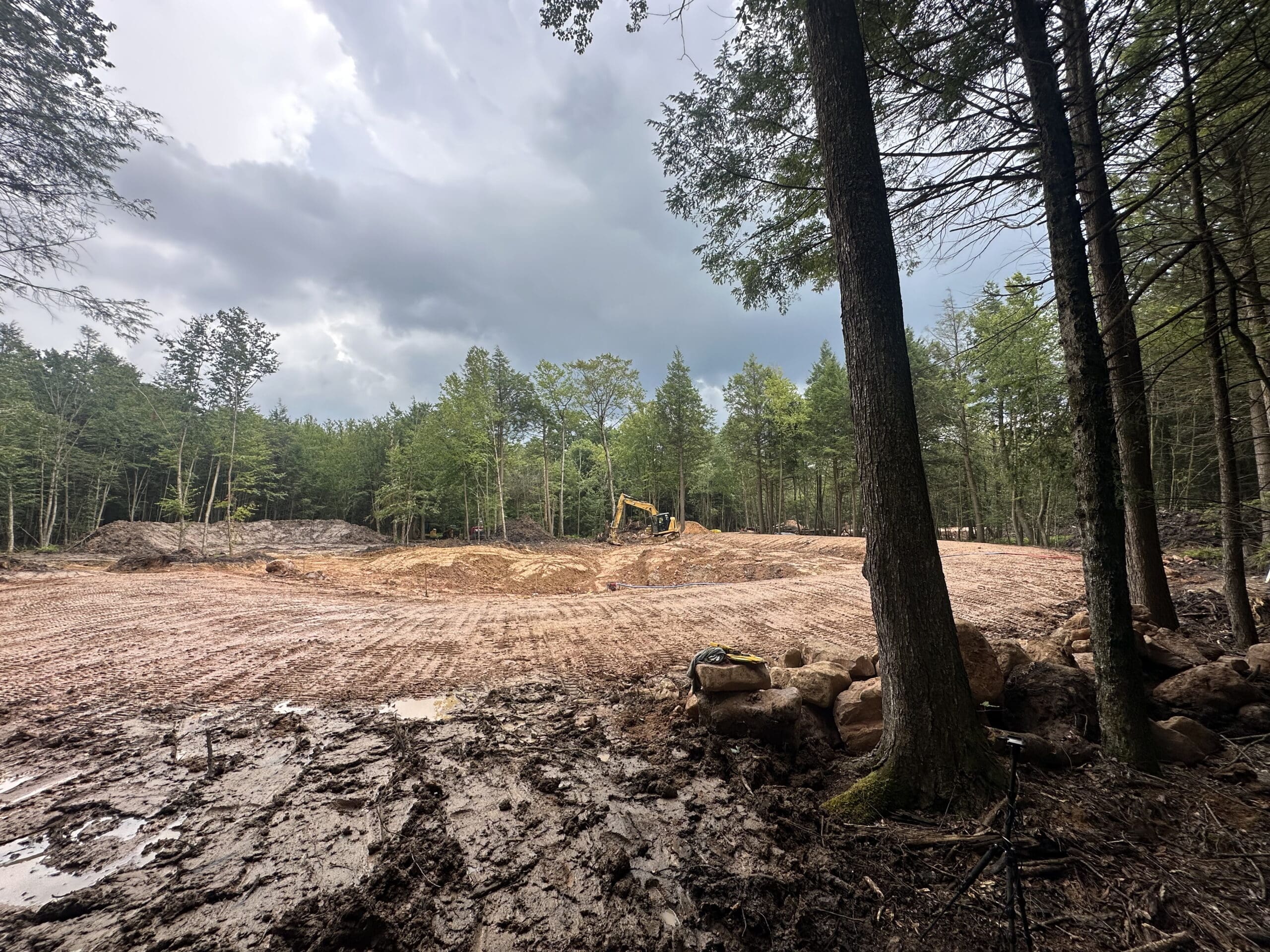
Alexandra Ionescu is the Associate Director of Regenerative Projects at Biodiversity for a Livable Climate, where she leads the Miyawaki Forest Program—supporting the planting of miniforests, cultivating partnerships, and guiding strategic planning—and recently curated the inaugural 2025 Northeast Miniforest Summit. Her work focuses on urban afforestation using the Miyawaki Method, education around beaver-engineered landscapes, and floating wetlands that combine art with ecological functionality. A lifelong student of how nature works, her mindset—shaped by graduate education in Biomimicry from Arizona State University and Nature–Culture–Sustainability Studies from the Rhode Island School of Design—is about cultivating propensities for the web of life to emerge. Her practice brings together the implementation of nature-based solutions, knowledge activation, curation, writing, photography, and strategic, as well as creative direction. She is a Certified Biomimicry Professional, and in 2025 she further deepened her ecological understanding through the Water Stories Core Course, a training focused on water-cycle restoration and decentralized water retention systems. Alexandra serves in an administrative role on the Board of Directors of the Beaver Institute and is a co-leader of the Beaver Network for East Coast/Rhode Island.