
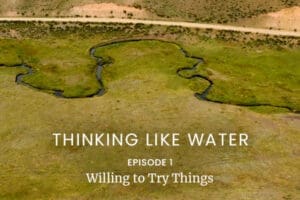
Episode 1: “Willing to Try Things” lays the foundation of Zeedyk’s pioneering contribution of the ‘induced meandering’ of water to the field of nature-based restoration and how it began to take off.
The Thinking Like Water Film Club kicked off this week! As we gathered to watch Episode 1: Willing to Try Things online, we learned a variety of techniques Bill developed in partnership with communities to slow the flow of water, or to induce the meandering of water.
For example, for rivers that had been straightened, Bill and his partners would build simple ‘baffle’ structures in the river. Baffles push water to the opposite side of the river bank and direct the energy of flooding waters to erode unnaturally steep banks. Eventually baffles help rivers reconnect with their old flood plains, refill perennial ponds, and allow forgotten fish to return.
Alternatively, Bill and his teams would use ‘post vanes’ to prevent water from eroding streambanks even more, and allow sediment to drop and seeds to eventually germinate. We also learned of techniques like Zuni bowls, one rock dams, worm ditches, cattle fences and cattle exclusionary zones to help water become in sync with the environment.
Decisions about which techniques to use are honed by walking the landscape many times, and trying to, as Bill says, live and observe from the perspective of the landscape.
In other words, what would water do if water was in sync with the land and life?
After screening Episode 1, we started our Film Club conversation with the question of how people in the Film Club have learned to live and observe from the perspective of their landscapes. One participant who works in this field kicked us off by sharing her process of taking time to sit, watch, walk barefoot on the land, to put her hands in the water, to connect sensorily, before engaging with the more analytical side of her role.
Not only was the theme of deep listening relevant to engaging with the landscape, but Renea also told stories of how important deep listening was for Bill when bringing together so many diverse stakeholders in landscape restoration projects – ranchers, fishers, conservationsists. Our conversation meandered across many topics from dam removal, to the relationships between beavers and trout, to the benefits of landscape rehydration for fire prevention.
As we wrapped up, participants shared what they’d be “Willing to Try”. Perhaps you might be inspired by some of their intentions this summer?:
- I am going to convert my lawn to a meadow.
- I’m going to reconsider/design my garden to slow water flow!
- I am going to get to know my local watersheds sensorially and begin mapping out local connections (social and issues the waterway is facing), as well as thinking about bringing awareness about the difficulties of lawns.
- I am going to go back to the first video to excerpt the sinuosity, channel width numbers that Bill cited (i.e. he had goals to increase XX sinuosity, yy channel width, based on some metrics he cited) and apply this to some goal setting I need to do for a project.
What are you willing to try? share your intentions in the comments below.
Dr. Katie Ross — Thinking Like Water Film Series Facilitator| Bio4Climate
Katie Ross is an independent writer and researcher with a background spanning ecology, renewable energy, regenerative agriculture, transdisciplinary research, and transformative sustainability learning. Her work connects restoration, water cycles, biodiversity, and climate resilience through story and practice. Read more about Katie.