

A History Written in Hoofprints
Few animals have traveled through human history quite like the donkey.
Domesticated in northeast Africa more than 7,000 years ago, donkeys descended from the Nubian wild ass and became essential partners in the growth of early civilizations and trade networks across Africa, Asia, and the Ancient Near East. They carried people, food, building materials, and goods across landscapes where wheeled transport was often impossible.
Centuries later, donkeys were taken to the Americas, Australia, the Caribbean, and Indian Ocean islands during European colonization. There, they became deeply tied to farming, mining, railroad construction, and resource extraction. But as machinery and motorized transportation replaced much of this work, many donkeys were abandoned or released. Unlike mules, donkeys can reproduce, allowing free-roaming populations to establish themselves far from their ancestral range.
Today, that history has produced a complicated ecological and ethical story.
Australia is believed to contain the world’s largest population of free-roaming donkeys, although estimates vary considerably. Brazil also supports a large population, while free-ranging burros remain part of the landscape of the western United States. In some places, these animals are now treated primarily as ecological problems and targeted for population control.
At the same time, elsewhere in the world, donkeys remain vital to rural livelihoods, while their wild relatives face an entirely different challenge: survival. Recent conservation stories from Mongolia, for example, document the return of khulan, or Mongolian wild asses, to landscapes from which they had been absent for decades.
A particularly urgent version of this tension is unfolding at Kachana Station in Western Australia’s Kimberley region. There, a managed population of wild donkeys has become part of an experiment in restoring a dry, fire-prone landscape.
Judith D. Schwartz describes how the donkeys graze vegetation in places cattle rarely reach, interrupt potential fire pathways, create small bare patches that may function as firebreaks, dig wells used by other animals, and help move seeds and nutrients through the landscape.
Yet approximately 70 of these donkeys now face a government-ordered cull. Their story raises a difficult conservation question: when landscapes have already been profoundly altered by extinction, colonization, climate change, and human intervention, should an animal be understood only by where it came from or also by what it is doing within the living system it now inhabits?
The donkey therefore occupies an unusual place in our relationship with nature: worker, companion, abandoned animal, introduced species, wild relative, and conservation concern.
Perhaps its story asks us to look beyond simple labels such as useful, feral, or invasive and instead ask a deeper question: How did these animals arrive in a landscape, what role are they playing there now, and what responsibilities do we carry because of the history that brought them there?
What do you think of wild donkeys? Leave a comment below.
Kachana Research Interest Register
This Register is open to anyone interested in seeing the research continue and its future potential properly assessed. It will help demonstrate the scientific, professional, and community interest in the opportunity and identify people interested in following, supporting or contributing to the research.
Resources
- Lundgren, E. J., et al. Research on the history, ecology, and management of introduced equids, including free-roaming donkeys. The Journal of Wildlife Management.
https://wildlife.onlinelibrary.wiley.com/doi/full/10.1002/jwmg.22090 - Video report on the legalization of donkey slaughter in Kenya and the effects of donkey theft on small farmers. YouTube.
https://www.youtube.com/watch?v=GypGiOuvT4c - Mongabay. “Hundreds of khulan return to eastern Mongolia after 65-year absence.” May 2026.
https://news.mongabay.com/short-article/2026/05/hundreds-of-khulan-return-to-eastern-mongolia-after-65-year-absence/ - Henggeler, C. (2026, January 7). The managed wild donkeys of Kachana. Kachana Station. https://www.kachana-station.com/the-managed-wild-donkeys-of-kachana/
- Schwartz, J. D. (2026, August 16). Donkeys on death row: Last chance for the winsome land-healers at Kachana Station. Substack.
- Roa, T. (2021, October 23). Kachana Station: A home for donkey-led restoration. Biodiversity for a Livable Climate. https://bio4climate.org/2021/10/23/kachana-station-a-home-for-donkey-led-restoration/
- Hurford-Jones, I. (2023, May 5). The “mysterious” connection between humans and donkeys. Brooke. https://www.thebrooke.org/what-we-do/news-case-studies/mysterious-connection-between-humans-and-donkeys
- Ross, M., & Cheshire, B. (2024, November 4). Meet the defiant grazier using feral donkeys to regenerate his land at Kachana Station in an ‘illegal’ experiment. ABC News. https://www.abc.net.au/news/2024-11-04/grazier-using-wild-donkeys-to-regenerate-land-in-legal-battle/104445766
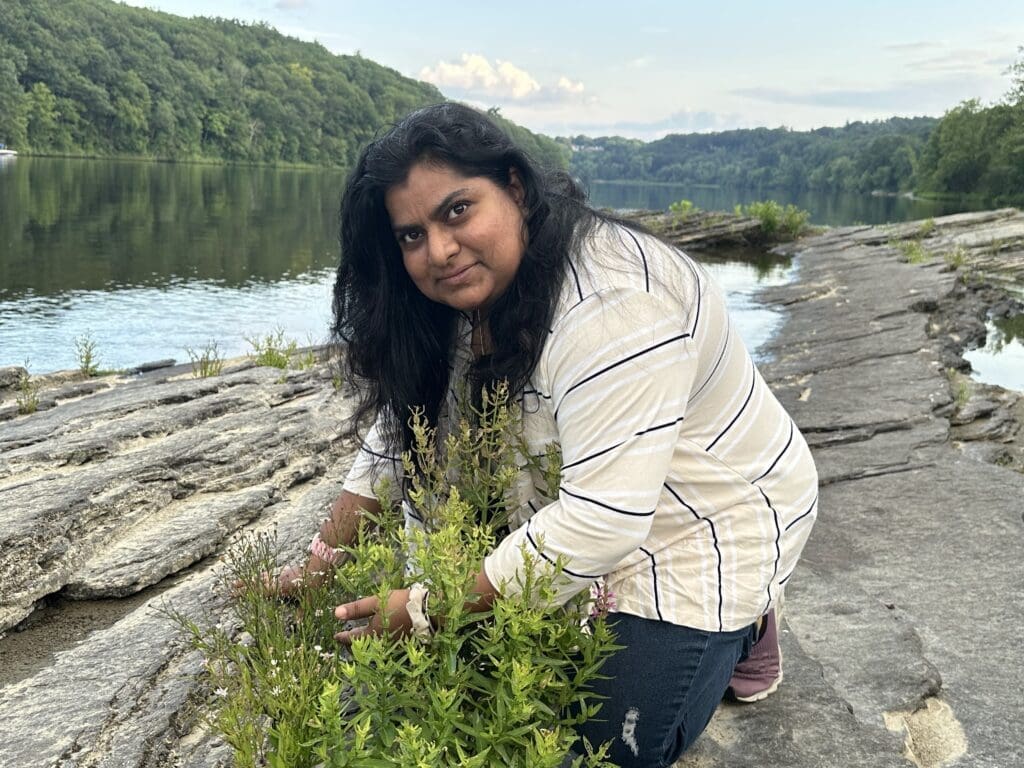
Poulomi Chakravarty, PhD is an environmental scientist, educator, and science communicator with expertise in micrometeorology, ecology, biodiversity, phytoremediation, climate extremes, remote sensing, and climate education. She serves as Scientific Advisor, India Program Director, and Education Lead at Biodiversity for a Livable Climate, where her work advances climate literacy, environmental education, ecosystem restoration, and nature-based climate solutions. Her work also focuses on integrating natural systems, Indigenous Knowledge, and AI-enabled approaches for climate resilience. As a facilitator of climate action programs, she designs curricula and leads community-based initiatives that help diverse learners engage with climate science, biodiversity, soil, water, and sustainability. Beyond her professional work, she is passionate about environmental protection, animal rescue, painting, music, and life as a devoted dog mom.
Failing to protect donkeys as a key species in arid ecosystems is like burning books in the library of life.